
Investigations
The Deal Behind Nairobi Animal Orphanage: Is This Really About Animals Or Billions In Prime Park Land
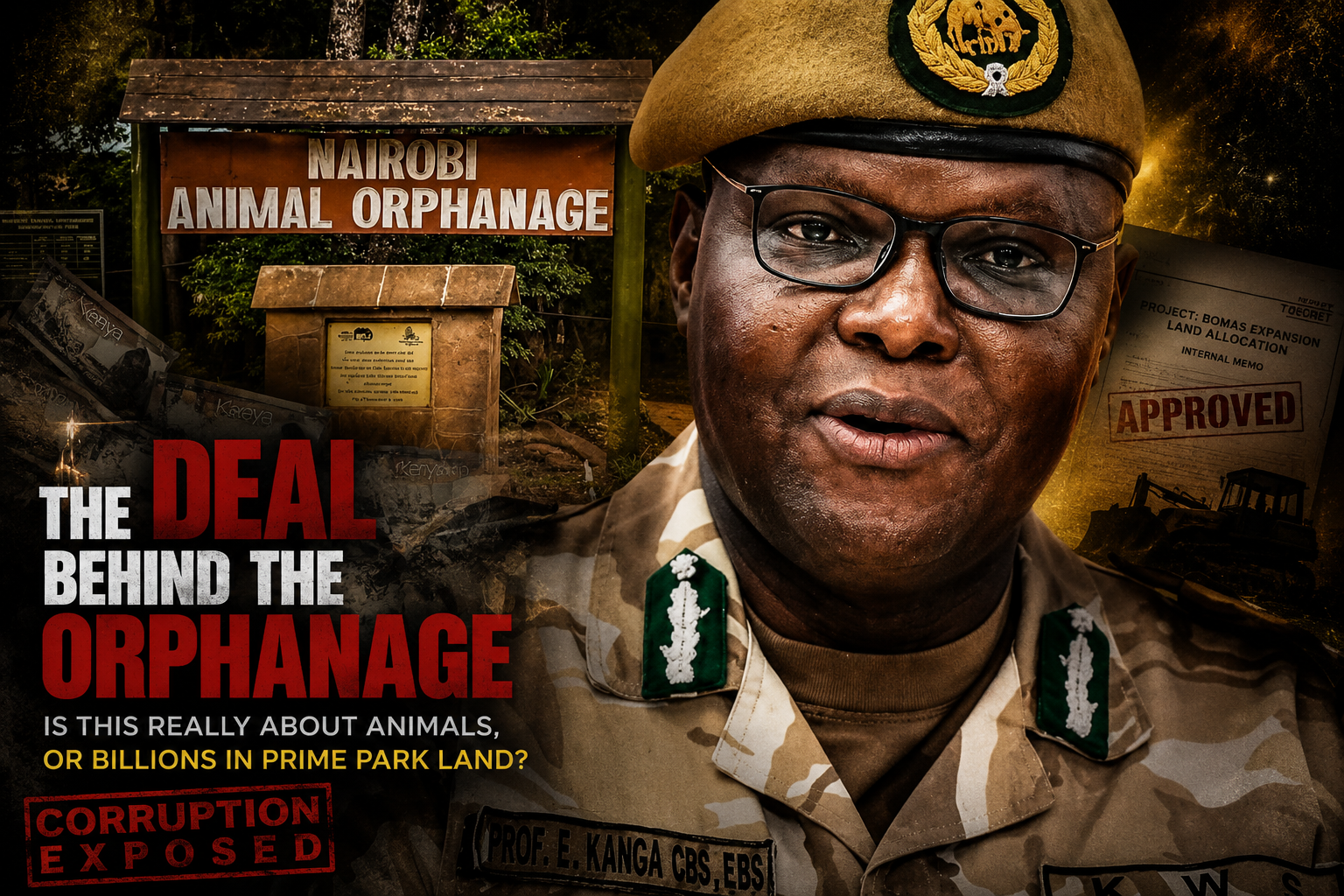
KWS Director General Erustus Kanga frames the gutting of Nairobi National Park’s upland forest as a welfare upgrade for rescued wildlife. The paper trail tells a very different story about who really benefits and why the most corrupt government agency in Kenya is now also its most aggressive land authority.

The Animals Were Always Cover
On the morning of Friday, June 5, 2026, Prof. Erustus Kanga stood before a carefully curated press corps at Kenya Wildlife Service headquarters on Langata Road and did what he does best. He performed conservation.
He spoke of orphaned lions, of injured Maasai giraffes, of rising human-wildlife conflict across a nation whose population is pressing against sixty million people. He spoke of metallic cages that were internationally unacceptable and of a new facility with natural enclosures, a world-class wildlife hospital, and the capacity to receive twenty thousand visitors at peak.
He spoke of an eighteen-month construction timeline, a Sh3 to Sh4 billion budget, and a solemn guarantee that the new orphanage would not be privatised. He spoke, above all, about the animals.
What he did not speak about was the December 2025 NEMA licence NEMA/ENVIS/CPR/LIC-0940, which authorised the conversion of 76 acres of indigenous forest inside Nairobi National Park three months before this press conference was convened.
He did not speak about the October 2025 public participation meeting at which the Environmental Impact Assessment was never tabled, never distributed and never posted online for review. He did not speak about the fact that conservationists at Friends of Nairobi National Park only learned of the licence in February 2026, after trees were already falling.
He did not speak about the pedestrian bridge being designed to physically connect the new wildlife facility to the Sh41.9 billion Bomas International Convention Centre across Langata Road, a bridge that transforms what he calls an animal sanctuary into a commercial tourism annex for the state’s most audaciously procured mega-project in recent memory.
He gave the press the animals. He kept the architecture for himself.
The orphanage relocation is the most expertly constructed fig leaf in Kenyan conservation history. The real project was never about the animals. It was always about the parking.
WHAT THE ANNOUNCEMENT WAS DESIGNED TO OBSCURE
When KWS says the new facility occupies 89 acres opposite Bomas of Kenya, it is technically accurate in the same way that saying a heist took place at a bank is technically accurate.
The precision stops there.
The NEMA licence issued on December 3, 2025, authorises the conversion of 76 acres, or 31 hectares, of land currently covered by indigenous forest inside the Low Use Zone of Nairobi National Park.
That zone exists specifically to protect ecological corridors and the wildlife species, including black and white rhinos, lions, leopards and critically endangered birds, that depend on undisturbed upland habitat. The park’s own 2020-2030 Management Plan designates this zone precisely because it is not meant to be touched.
Friends of Nairobi National Park and the conservation lobby PILAE have obtained photographic and video evidence showing that tree-felling and bush clearing inside the park began on March 21, 2026. By the time KWS held its June press conference, conservationists estimated that nearly 100 acres of upland forest had been disturbed, a figure KWS contests but has refused to independently verify by releasing the full Environmental Impact Assessment for public scrutiny.
The Greenbelt Movement, which grew from Wangari Maathai’s legacy and commands considerable moral authority in Kenyan conservation circles, has described the destruction as an existential threat, not a renovation.
The details buried inside the project design reveal the actual ambition. The convention complex component includes a parking facility for approximately 1,300 vehicles. The current Nairobi Animal Orphanage, a facility whose visitor numbers average fewer than 1,700 people per day, has no conceivable operational need for a 1,300-vehicle car park.
That capacity is designed for one audience and one audience only: the delegates, diplomats, heads of state and high-end tourism traffic generated by the Bomas International Convention Centre next door.
The orphanage is not the destination.
It is the attraction, the greenwash layer that converts a commercial parking lot and convention annex inside a national park into a conservation achievement. And the man standing before the cameras selling that story is the Director General of the very institution constitutionally mandated to prevent exactly this kind of conversion.
THE SH41.9 BILLION SCANDAL NEXT DOOR
Understanding what is happening inside Nairobi National Park requires understanding the Bomas International Convention Centre project, because they are not separate stories.
They are the same story with different spokespeople.
The BICC, intended to position Nairobi as the dominant conference hub in East and Central Africa and initially scoped at Sh31.5 billion before growing to Sh41.9 billion, has been dogged by procurement controversy since before ground was broken.
Auditor-General Nancy Gathungu’s findings, tabled in Parliament in February 2026, are unambiguous: Defence Principal Secretary Patrick Mariru approved the request for direct procurement authority on February 17, 2025, four days after tender invitation documents and site visit certificates had already been issued on February 13 and 14, 2025.
Under Section 69(2) of the Public Procurement and Asset Disposal Act, 2015, procurement proceedings cannot lawfully commence without prior authorisation. The PS signed after the fact. The entire contracting process is legally compromised.
Parliamentary committees have demanded answers. The National Assembly’s Environment, Forestry and Mining Committee has flagged the project.
Lawmakers including Wajir Woman Representative Fatuma Jehow and Ndhiwa MP Martin Owino demanded explanations about whether the facility had been mortgaged to foreign interests.
MPs questioned the Ministry of Defence’s role in a project that should have been managed by tourism authorities. The government’s response has been to accelerate construction, frame every objection as politically motivated obstruction, and use the animal orphanage announcement to give the project a conservation halo it has never earned.
The BICC was rushed for a reason. President Ruto committed to hosting the Africa-France Summit at Bomas in May 2026. That diplomatic deadline drove construction timelines, procurement shortcuts and the urgency of resolving the land question inside the adjacent national park.
When the state needed 76 acres of protected forest cleared to provide parking, access and visual integration between the convention centre and a planned pedestrian bridge into the park, the animal orphanage was retroactively identified as the justification.
The welfare of injured animals became the political cover for a commercial land grab from one of the world’s most unique protected areas. This is not speculative. It is sequential. The licence came in December. The clearing began in March. The press conference came in June. The animals were always the ending, not the beginning.
KWS received 35.73 percent of all national bribery in Kenya according to the EACC’s own data. The institution entrusted to guard the park is the same one carving it up.
THE MAN AT THE CENTRE: A RECORD OF OPACITY
To understand why this particular project could advance with such speed and so little transparency, one must understand who is running Kenya Wildlife Service and how he runs it. Prof. Erustus Kanga arrived at KWS in August 2023 with an impressive academic record, two decades of field experience and the kind of conservation credentials that should have made him the safest possible appointment.
What followed has been, by almost every independent account, a systematic dismantling of the institutional culture that once made KWS one of Africa’s most respected wildlife agencies.
The Ethics and Anti-Corruption Commission’s National Ethics and Corruption Survey of 2024, published in August 2025, crowned KWS as the single most corrupt institution in Kenya, capturing 35.73 percent of all national bribery across every public institution in the country.
The next-highest, the National Social Security Fund, accounted for 8.42 percent. Job seekers at KWS were found to be paying an average bribe of Sh200,000, compared to a national average of Sh4,878. This is not a peripheral finding.
This is the EACC’s own data, based on a nationwide household survey of 5,960 respondents, describing an institution under Kanga’s watch as the dominant bribery engine in Kenyan public life. He has not resigned over it. He has not publicly addressed it. He has continued to chair press conferences about animal welfare.
The internal picture is darker still. A 28-point whistleblower dossier circulated among KWS officers in April 2026 and subsequently reviewed by this publication accused Kanga and a tight circle of personal aides of systematically centralising power, dismantling professional structures, making politically motivated appointments without due process, suppressing internal dissent, and transforming what the dossier’s authors called a once-proud national institution into a private empire operating beyond accountability.
Scientists described recommendations dismissed for political convenience. Rangers described fear and intimidation. Several officers were moved without explanation. Rangers reported inadequate support during dangerous missions. Anonymous petitioners took complaints directly to the Ethics and Anti-Corruption Commission.
The Senate has not been silent.
Senators summoned Kanga to account for escalating scandals and questioned his legitimacy during committee hearings, giving him one week to produce documents, a deadline that generated acute tension inside the agency.
Parliamentary committees on environment and wildlife have expressed sustained frustration at repeated failures to appear or provide adequate answers.
In April 2026, the Commission on Administrative Justice, Kenya’s ombudsman, ordered Kanga to release data on snakebite-related deaths within twenty-one days or face criminal prosecution under the Access to Information Act. He had withheld the data. The ombudsman had to intervene.
Then there is the case of Francis Awino Onyango.
On January 14, 2026, activist Awino filed a constitutional petition alleging Chapter Six violations against Kanga. He then allegedly approached Kanga seeking Sh1.7 million to withdraw the petition. Kanga reported him to police.
On April 22, DCI officers arrested Awino without a warrant and charged him with attempted extortion. Awino’s lawyer told the court his client’s petition was a legitimate exercise of constitutional rights and that the criminal charges were a mechanism to silence a public interest complainant who had become an embarrassment to the KWS Director General.
The extortion case may be exactly as the prosecution describes it. But it generated no curiosity whatsoever about the underlying Chapter Six petition, which simply dissolved the moment its author was in handcuffs.
An institution genuinely committed to transparency would have welcomed an opportunity to publicly rebut a constitutional petition. Kanga’s institution reached for the DCI.
A NATIONAL PATTERN BEING REPEATED
The Nairobi Animal Orphanage move does not happen in isolation. It is the latest episode in a multi-year pattern of protected forest encroachment that Kenyan conservation bodies have been documenting, challenging and losing with grim regularity. Each episode follows the same script. A development project emerges with a welfare or public benefit framing.
An Environmental Impact Assessment process is conducted in a way that minimises meaningful public input. An agency issues a licence with limited visibility. Construction begins. Objections follow. Statements calling the objections misleading and inflammatory are issued. Momentum is maintained until reversal becomes politically implausible.
Karura Forest, which became a global model of urban conservation under the joint management partnership between Friends of Karura Forest and the Kenya Forest Service, provided the most instructive recent precedent.
After more than fifteen years of a successful arrangement that generated between Sh225 million and Sh245 million annually, employed 135 salaried workers and over 300 casual workers, and turned a degraded landscape into one of Africa’s most celebrated urban green spaces, KFS issued a directive on August 28, 2025, ordering all gate entry, parking and service payments to shift exclusively to the eCitizen platform, effectively severing the community trust from revenue it used to fund operations.
The directive violated a legally binding joint management agreement under the Karura Forest Management Plan 2021 to 2041. Friends of Karura went to court. The Environment and Land Court certified the case as urgent.
The eCitizen petition simultaneously flagged in an Auditor-General report for Sh1.8 billion in unlawful convenience fees, Sh6.3 billion in unreconciled receipts, and Sh127 million in unauthorised transfers to private entities was the vehicle chosen to restructure control of a successful community conservation model.
That is not a coincidence. It is a template.
Ngong Forest provided a parallel lesson in institutional confidence. In November 2024, the Kenya Forest Service granted Konyon Company Ltd a Special User Licence to construct what was described as a glamping eco-lodge inside the Ngong Road Forest Sanctuary. Construction began without the required NEMA Environmental Impact Assessment.
By May 2025 when the Green Belt Movement sounded the alarm on social media, significant infrastructure was already in place.
KFS defended the project. Parliamentary committees summoned officials who repeatedly failed to appear.
The National Assembly’s Environment committee chair ultimately declared the construction not illegal, citing the precedent of other gazetted forest developments including, in a moment of unintended candour, noting that Bomas of Kenya itself sits on a gazetted forest area. The identity of Konyon Company’s beneficial owners was never fully established on the public record.
The Mau Forest complex, whose political excision history over decades has been one of Kenya’s most documented environmental tragedies, shows where this trajectory ends.
Each generation of encroachment was accompanied by assurances about economic benefit, job creation and responsible management. Each cycle left behind irreversible biodiversity loss, disrupted water towers, downstream flooding and a new baseline from which the next excision was measured.
There is no recovery in these forests. There is only a shrinking line of what remains to protect.
Every forest encroachment in Kenya comes dressed in the language of jobs, tourism revenue or necessary infrastructure. Every one leaves behind a question: who really benefited, and where is the money?
THE QUESTIONS THAT MUST BE ANSWERED
The June 5 press conference created far more questions than it answered, and those questions have specific addresses. The first and most fundamental is the discrepancy in acreage. Kanga announced the new facility will sit on 89 acres. The NEMA licence issued in December 2025 authorises conversion of 76 acres, or 31 hectares. Conservationists estimate 100 acres have been disturbed.
Three different numbers for what should be a single, documented, legally bounded land parcel. The public is entitled to a single definitive number supported by survey documentation, and to an explanation for why the number changed between the licence and the announcement.
The EIA must be publicly released in full. KWS claims that a comprehensive Environmental Impact Assessment was conducted under the Environmental Management and Coordination Act and that a stakeholder workshop was held on October 2, 2025. Friends of Nairobi National Park state categorically that no EIA document was distributed or even mentioned at that October meeting and that the completed report was never posted online for public review.
The licence was issued on December 3, 2025. Under Kenya’s environmental law, public participation is not optional. If the process was genuine, releasing the full EIA costs KWS nothing and restores significant credibility. If the process was a sham, releasing the full EIA will confirm what conservationists already believe. The document must be tabled.
The commercial relationship between the orphanage and the Bomas International Convention Centre must be disclosed in complete detail. KWS says the new facility will generate up to Sh4 billion annually. The current orphanage, averaging under 1,700 daily visitors, generates no such figure. Those revenues will come from the traffic generated by the convention centre.
The pedestrian bridge connecting the two facilities is not incidental infrastructure. It is the revenue mechanism. Kenyans are entitled to know the full revenue-sharing arrangement, the build-operate-transfer terms for any commercial components, and whether any KWS official, contractor or connected individual has a financial interest in those arrangements.
The broader Bomas procurement scandal must not be allowed to disappear behind the animal welfare narrative. The Auditor-General has made specific findings about retrospective procurement authorisation and the exposure of the contracting officer to criminal liability. Those findings do not become less valid because a new orphanage has been announced next door. They become more urgent. If the land allocation process for the orphanage component was shaped by the same urgency, the same disregard for due process and the same disregard for parliamentary budget authority that characterised the convention centre procurement, then KWS, NEMA, the Ministry of Tourism and the Ministry of Defence all face accountability questions that deserve simultaneous parliamentary scrutiny.
WHAT MUST HAPPEN NOW
The Ethics and Anti-Corruption Commission, which has already received anonymous petitions from KWS officers about leadership practices under Kanga, should examine whether any procurement or land allocation processes linked to the Bomas expansion and the orphanage component violated the Public Finance Management Act, the Public Procurement and Asset Disposal Act or Chapter Six of the Constitution.
The EACC already knows KWS is the most corrupt institution it monitors. It has the data. It has the mandate. It now has a specific project to examine.
Parliamentary committees on environment, lands and wildlife must summon the Director General and require production of the complete Environmental Impact Assessment, the full survey documentation establishing the exact acreage involved, the tender documentation for construction contracts, the justification for the 1,300-vehicle parking facility, the full revenue projection methodology and evidence of genuine public participation meeting the constitutional threshold under Article 69. The Senate committee that already questioned Kanga’s legitimacy has standing and urgency to act.
NEMA must account for its own conduct. An environmental regulator that issues a licence touching a national park’s core indigenous habitat zone, a licence that only becomes publicly known two months after issuance, and then watches tree-felling begin before any court challenge can be mounted, is not discharging its statutory function. It is providing regulatory cover for a predetermined outcome. The NEMA board must appear before Parliament and explain the October 2025 public meeting, the December licence and the gap between the two.
The Environment and Land Court petition filed challenging the excision must be allowed to proceed without political interference, administrative attrition or the kind of intimidation that transformed Francis Awino’s constitutional petition into a criminal extortion charge. Courts exist precisely for moments when executive agencies and their institutional guardians align against public interest. This is that moment.
And Prof. Erustus Kanga must make a choice. He can continue issuing press conferences about natural cages and visitor capacity while the legal and institutional architecture of the broader project remains hidden from the people who own the park. Or he can release every document, explain every discrepancy, disclose every commercial arrangement and demonstrate that KWS under his leadership serves Kenya’s wildlife and Kenya’s citizens rather than the development ambitions of whichever connected entities are positioned to capture the value of a convention centre with a national park as its garden.
THE VERDICT BEFORE THE TRIAL
Nairobi National Park is not replaceable. It is the only national park on earth located inside a capital city. Its lions move through corridors that have existed since before Nairobi was a colonial settlement. Its rhinos are among the last viable populations in the region. The upland forest being cleared was not degraded scrubland. It was functioning habitat, classified as a Low Use Zone precisely because its ecological function depends on not being converted into a parking facility for state events.
Kenya’s conservation reputation has already been strained by what happened at Karura, by what happened at Ngong, by what continues to happen in fragments of the Mau. Each episode eroded a portion of international trust that took decades of genuine conservation achievement to build.
That trust is worth billions in tourism revenue, in climate financing, in the soft power that comes from being one of the handful of nations on earth where wildlife and humanity have maintained something close to coexistence. Destroying it to build a convention centre with better footfall cannot be the calculation. Yet it increasingly appears to be exactly that.
The animals in the Nairobi Animal Orphanage deserve better care. Nobody who has argued against this project disputes that. What they dispute is whether destroying irreplaceable indigenous forest inside a protected national park, under the cover of regulatory processes that excluded meaningful public input, driven by the timeline of a diplomatic summit, managed by an agency that its own anti-corruption watchdog has identified as the most corrupt institution in Kenya, and overseen by a Director General who responds to constitutional petitions with criminal charges against their authors, is an acceptable way to provide it.
The answer, for any Kenyan who understands what a national park is and what it is worth, is no. The Director General knows what was agreed in the rooms where this deal took shape. He knows who will capture the Sh4 billion he promises annually. He knows why the EIA was not circulated before the licence was issued. He knows why the acreage in the announcement differs from the acreage in the licence.
He knows how a 1,300-vehicle car park serves an animal sanctuary that sees 1,700 visitors on its busiest days. Kenyans are waiting for him to say all of it out loud. Every day he does not, the trees fall a little faster, and the question of what exactly is being built inside Kenya’s most precious urban wilderness becomes a little harder to ask.
Kenya Insights allows guest blogging, if you want to be published on Kenya’s most authoritative and accurate blog, have an expose, news TIPS, story angles, human interest stories, drop us an email on [email protected] or via Telegram










Why All Eyes Are On Gambling Authority CEO Peter Karimi As Kenya’s Betting Firms Race To Beat The June Licence Renewal Deadline

The Deal Behind Nairobi Animal Orphanage: Is This Really About Animals Or Billions In Prime Park Land

The Great Mogo Extraction: How a Latvian Fintech Built a Debt Trap for Kenya’s Most Vulnerable Borrowers and Got Away With It

Iran Launches Missiles At Israel For First Time Since Mideast Truce

MozzartBet Faces Licence Cancellation For Operations in Kenya Amid Tax Evasion, Money Laundering Scandals As Rumours Swirl Of Sh100M Bribery To Evade Trap

Rogue Developers, Engineers, Architects and City Hall Officials Charged Over Deadly Manzil Towers Collapse

Kalonzo Unveils His 2027 Presidential Campaign Platform

Artur Margaryan of Kenya’s Infamous Artur Brothers Seeks Prime Minister’s Office in Armenia

Sonko Re-Elected Head of Party

US Denied Visas to Team Officials for World Cup – Iran

Cement, Cash and Courts: How the Hashu Dynasty Crushed the Ramji Brothers for Fourteen Years and Why the Walls Are Now Closing In

Why Ruto’s Favourite Candidate Adan Mohammed Could Be Locked Out of the KRA Top Job

Inside The Urban Planning Cartel That Owns Nairobi

LifeCare on the Brink: SHA Fraud, Stolen Wages, and the Rotten Empire Jayesh Saini Built

Este Medical Kenya Fights American’s Explosive Complaints

Safaricom’s Sh1.4 Billion Reckoning: How Kenya’s Most Profitable Company Stole a Man’s Idea and Got Caught

The Rot Inside Absa: How Bank Insiders Are Looting Nairobi’s Customers

Inside FAFSA Fraud: How Kenyan Cybercriminals Siphoned Millions from America’s Sh12 Billion Student Loan System

THE INSURER THAT TOOK YOUR PREMIUM AND FORGOT YOUR NAME: How ICEA Lion Left a Client Begging for Sh7.8 Million Across Four Months

Denial Under Duress: The Untold Collapse Threatening David Lagat’s DL Group’s Empire
-
 Investigations3 days ago
Cement, Cash and Courts: How the Hashu Dynasty Crushed the Ramji Brothers for Fourteen Years and Why the Walls Are Now Closing In
-
 Investigations2 days ago
Inside The Urban Planning Cartel That Owns Nairobi
-
 Investigations2 weeks ago
LifeCare on the Brink: SHA Fraud, Stolen Wages, and the Rotten Empire Jayesh Saini Built
-
 News2 weeks ago
Este Medical Kenya Fights American’s Explosive Complaints
-
 Americas2 weeks ago
Inside FAFSA Fraud: How Kenyan Cybercriminals Siphoned Millions from America’s Sh12 Billion Student Loan System
-

 Investigations7 days ago
Betika Faces DCI Probe, Directors Arrest and License Revocation Over Massive 29.5 Million Safaricom Customers’ Data Breach
-

 News1 week ago
Eight Students Arrested In Kenya After Suspected Deadly School Arson Attack
-
 Investigations3 days ago
Fresh Move Launched to Remove Kenya Railways MD Mainga From Office After Awarding Sh817 Million Consultancy Contract