
Politics
Maraga’s 2027 Bid Hit by Explosive Sexual Harassment Claims as Former Insider Alleges Cover-Up and Victim Intimidation
Shakira Wanjira Wafula, who served as Secretary of the Political Committee in former Chief Justice David Maraga’s presidential campaign, has broken her silence with a bombshell account of sexual harassment and assault by two senior officials, a six-week institutional delay, deliberate sidelining of victims, and a party process she describes as rigged against survivors from the start. The scandal now threatens to demolish the UGM’s entire moral platform ahead of 2027 and raises a question no reformist candidate can afford to leave unanswered.

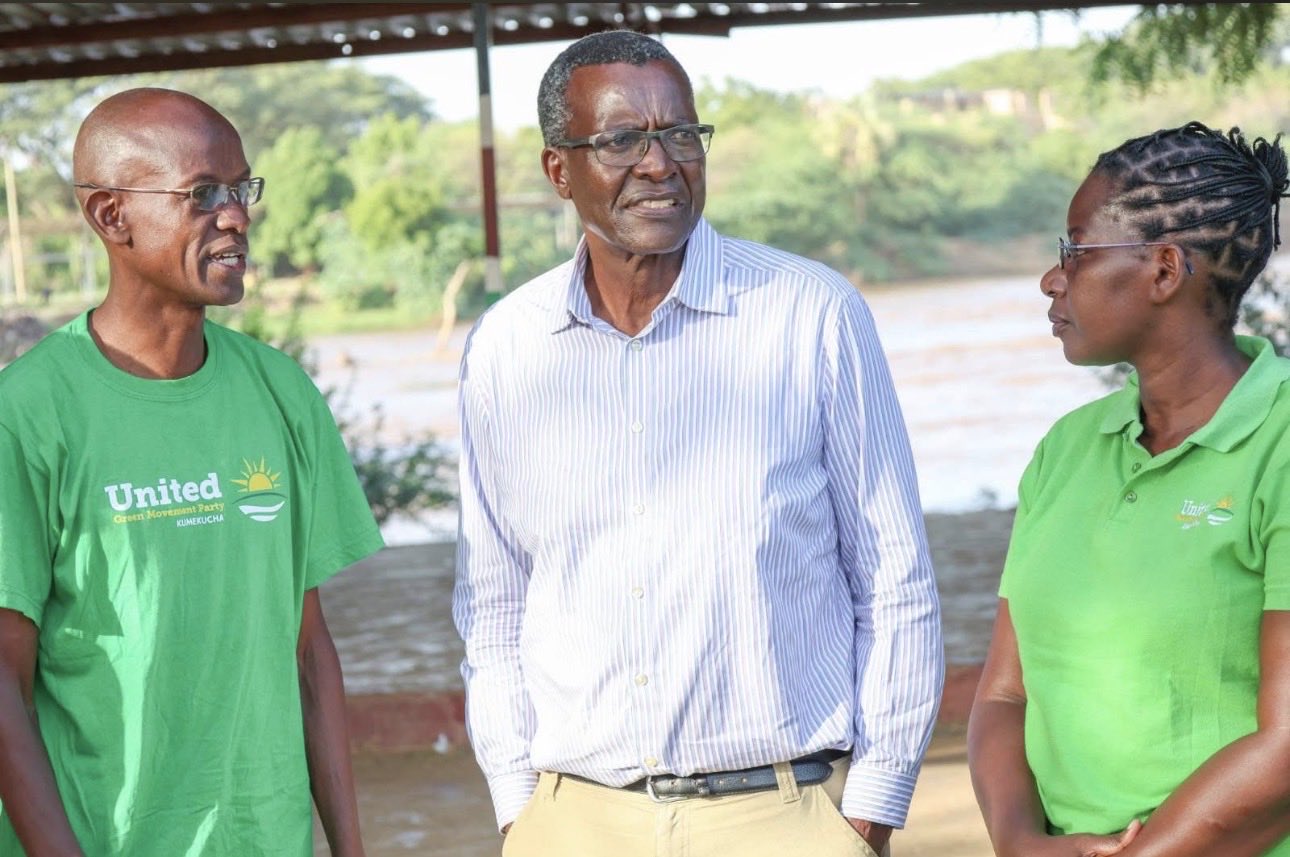
It was supposed to be a moment of solemn solidarity. On June 1, 2026, former Chief Justice David Maraga arrived at the anti-femicide sit-in on Kenyatta Avenue in Nairobi carrying what witnesses described as an exceptionally large bouquet of red flowers.
He worked his way through the crowd to the front of the demonstration, waved at protesters, and reportedly requested to address the gathering a request that was declined.
Thousands had gathered that morning to mourn women killed at the rate of at least one per day in Kenya, to demand that President William Ruto declare femicide a national crisis, and to carry symbolic coffins through the city’s central business district in memory of victims like gospel singer Rachel Wandeto, doused in petrol and set alight in May.
For Shakira Wanjira Wafula, watching that scene unfold on her screen broke something open that months of careful silence had held in place.
“Someone who was not seeking attention would not have come to a gathering where people were seated on the ground, made his way up to the front, carrying an exceptionally big and beautiful bouquet of flowers, and waved to the crowd, even requesting to speak.” — Shakira Wanjira Wafula
Within hours, Wafula who had resigned from Maraga’s presidential campaign in November 2025 citing what she described diplomatically as differences in foundational values posted an account on social media that has since detonated inside Kenya’s political and feminist conversations.
In meticulous chronological detail, she disclosed that the real reason she left was the campaign’s handling of sexual harassment and assault allegations involving two senior officials close to the campaign leadership, and what she called a systematic effort to gaslight complainants, sideline them from campaign activities, and engineer a party process from which the accused emerged practically untouched.
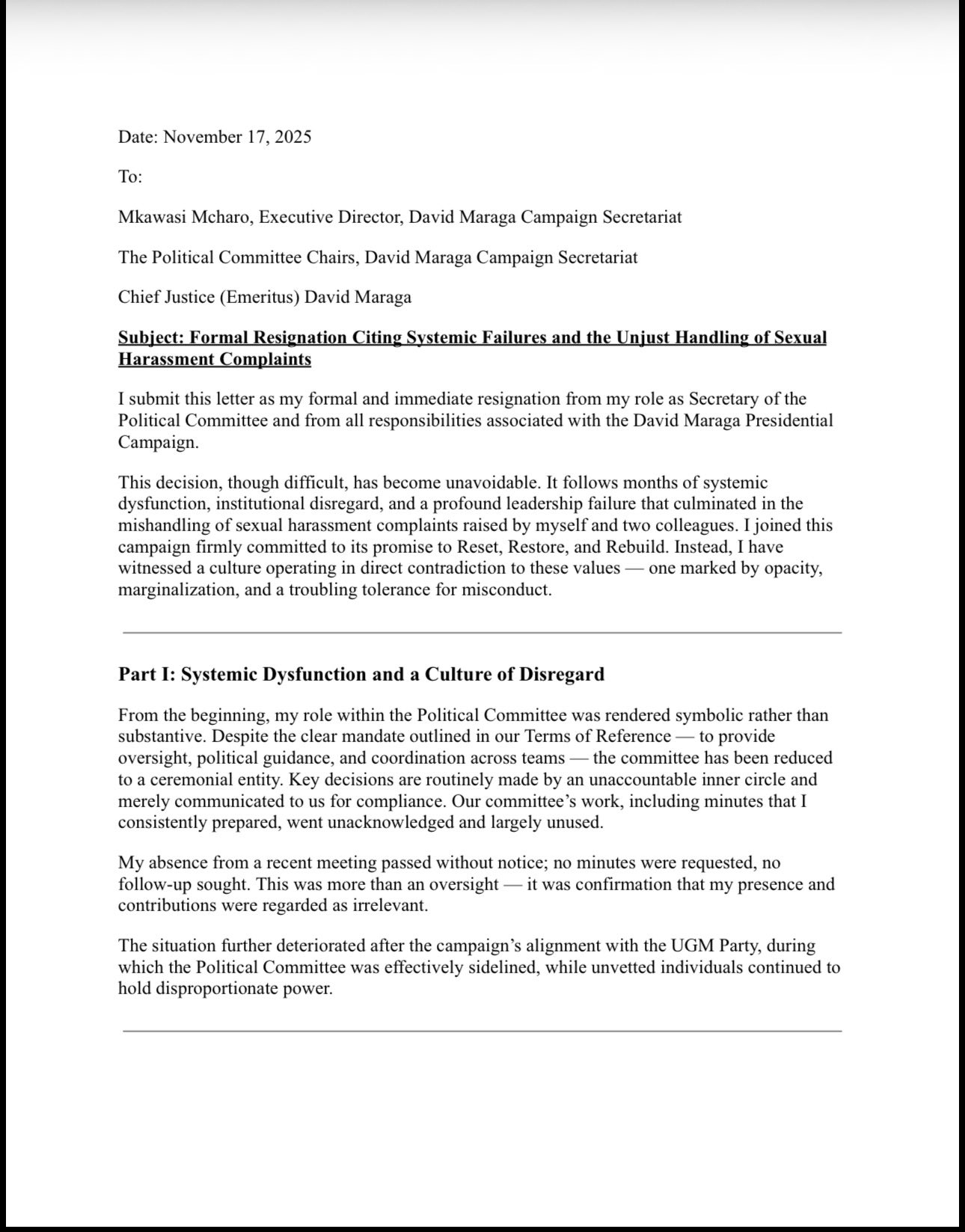
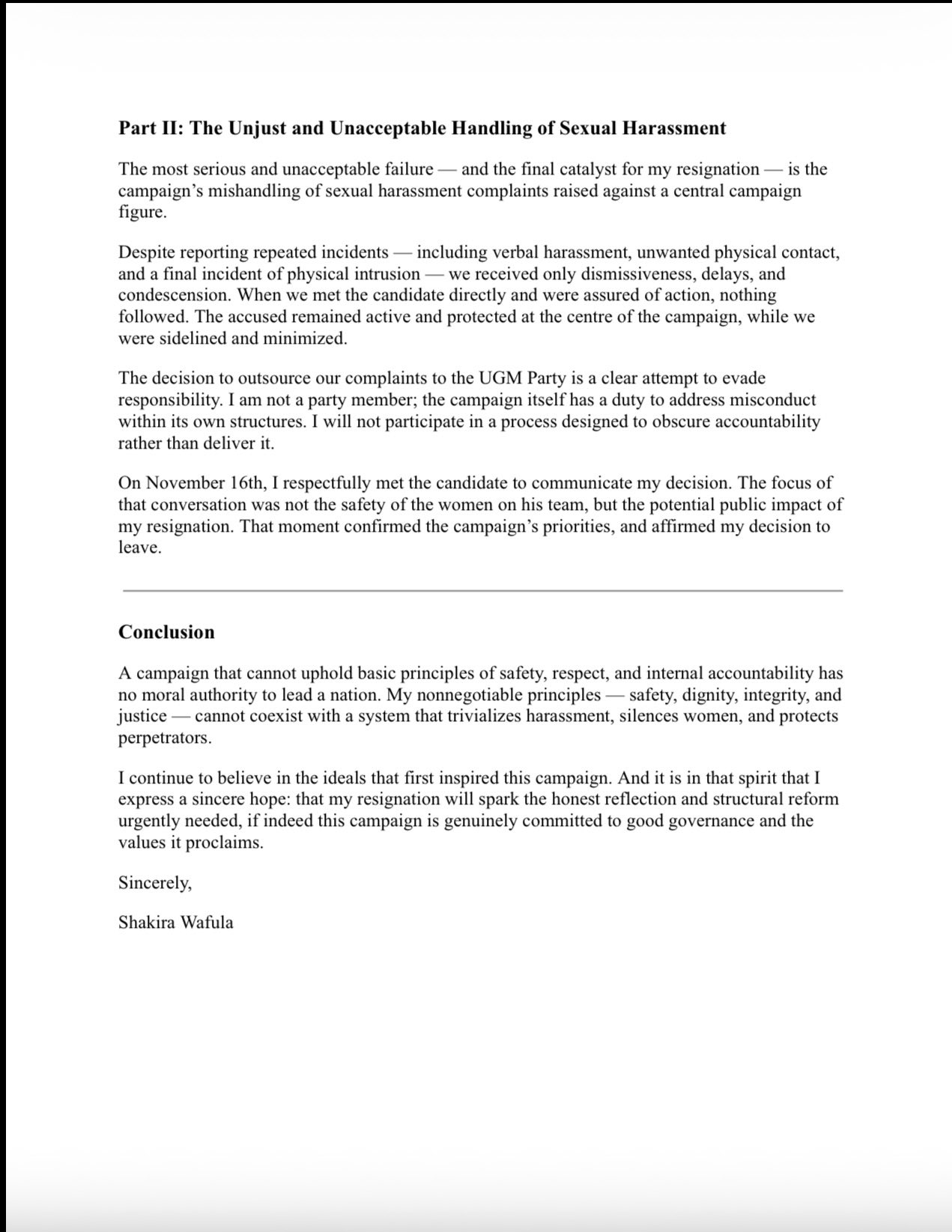
The United Green Movement has not issued any detailed public statement responding to Wafula’s specific allegations. David Maraga has not addressed the substance of the claims.
What is not in dispute is the timeline Wafula has reconstructed in extraordinary detail a timeline that maps the distance between a reform candidate’s stated values and the actual experience of women inside his machine.
THE WOMEN AT THE DINNER TABLE
The crisis traces its origins to October 7, 2025. Wafula met with two other women from the campaign for dinner in Nairobi. She had gone to share frustrations about the campaign’s direction. What emerged, she says, was far more alarming: a recognition across the table that sexual harassment within the campaign was not an isolated incident. Multiple women had been affected. The pattern had gone unreported and unaddressed.
The group brought in a fourth woman a lawyer also embedded in the campaign and formed a private chat group to agree on a path forward. Almost immediately, they discovered that the campaign had no safety policy of any kind.
There was no formal mechanism for women to report misconduct, no designated safe contact, and no written protocol for handling complaints.
A presidential campaign premised on institutional reform and ethical governance had not even written down what to do when a woman said she had been harassed.
“We realized there was no safety policy for the campaign.” — Wafula
On the lawyer’s advice, the group approached a senior figure in the campaign someone they trusted, though Wafula is careful to note he did not hold a formal position.
They convened a virtual call on October 11 and laid out what had happened.
The man listened, she says, and promised to organize a follow-up meeting with officials who held defined roles inside the secretariat. That meeting was delayed by the death of Raila Odinga’s elder brother, a period of national mourning that disrupted the campaign’s schedule.
THE MEETING THAT MADE THINGS WORSE
When the group finally convened a wider call on October 16, the allegations that surfaced went beyond harassment. Wafula describes what she heard that day as even more serious allegations of predatory behavior that she believed eclipsed the original complaints. The response they received from the officials on the call would become the sentence she has not been able to forget.
“Women have been through worse, and we would be taught how to fight.”
Having listened to accounts of sexual misconduct by members of their own team, the men in the room told the complainants that women had endured worse, and that the women would be equipped to defend themselves.
Then, in a move Wafula describes as staggering, the officials gave the complainants themselves the responsibility for drafting the policy guidelines that should have existed before any of them set foot in the secretariat.
From that moment, she says, the gaslighting began in earnest. The complainants found themselves progressively sidelined from campaign activities. Attempts were made to approach and manage them individually rather than as a group a divide-and-rule dynamic that Wafula recognized and rejected. The accused, she says, remained front and center in the campaign’s public-facing operations throughout.
THE CHIEF JUSTICE IS TOLD — AND HIS FIRST CONCERN IS NOT THE WOMEN
The women requested a direct meeting with Maraga. They got it on October 22. Wafula could not stay for the full meeting, but she communicated her account directly to the former Chief Justice. She says he appeared genuinely surprised by some of what she shared, and that he promised personally to handle the matter.
The following day October 23 Wafula drafted a proposed code of conduct for the campaign and circulated it within a WhatsApp group that had by then grown to include seven young members of the secretariat.
On October 28, a message arrived from the official they had originally reported to, suggesting the campaign had been waiting to hear from the complainants about how they wanted the situation resolved a framing Wafula found deeply troubling given that the situation had been in the campaign’s hands for nearly three weeks.
On October 29, Maraga called several of the complainants individually.
He asked them to put their concerns in writing as a formal complaint. They did so on November 3, submitting both the complaint and a code of conduct proposal.
The response arrived on November 5: the matter would be handed to the UGM Party itself — the party of which the accused officials were members and which Maraga leads.
On November 13, the complainants received an email from a UGM committee informing them that the legal process had officially begun thirty-three days after the October 11 call when the campaign was first formally notified.
Three days later, on November 16, Wafula attended a scheduled campaign meeting and made a decision.
She would tell Maraga directly that she was resigning, and she would tell him exactly why. His response, she says, was not what she expected from a man campaigning on protecting the vulnerable.
“His biggest concern from that conversation was not the safety of the women around him, but rather the public scrutiny that would come after my resignation.”
Wafula sent her resignation letter that evening.
The public statement she posted the next day, November 17, said nothing about what had happened. It cited differences in foundational values. Several media outlets and political commentators noted at the time that her letter appeared to have been stripped of something.
Reports circulated that an earlier draft had explicitly referenced the sexual assault allegations. She confirmed this week that the more detailed version existed but did not specify who redacted it.
On the same day she posted her resignation publicly November 17 Wafula received a formal invitation to participate in a hearing before the UGM’s ad-hoc committee. She declined.
Her reasoning is direct: she had already resigned, she had never been a member of the UGM Party, and she saw no evidence of good faith in referring the matter to a party structure effectively controlled by the accused’s political home. ‘Extracting the resolution to the party, where the accused is termed as the owner or party leader — at that point, I was convinced there was obviously no goodwill in the process,’ she wrote.
The other official complainants did participate in the hearing. On January 13, 2026, Wafula received a copy of the NEC report along with her response to it. She says she never received a reply to her email. None of the parties involved were satisfied with the process, the findings, or the final outcome.
Since her exit in November, she says at least five additional women she knows personally have also left the campaign.
The June 1 demonstration on Kenyatta Avenue was among the largest anti-femicide protests Nairobi had seen in months.
It was organized by the End Femicide movement alongside women’s rights groups, human rights organizations, and child protection advocates who had issued the government a 40-day ultimatum in May.
Participants carried symbolic coffins, wore white, and held red roses. The Federation of Women Lawyers in Kenya has reported handling roughly seventy gender-based violence cases per week across its offices in Nairobi, Mombasa, and Kisumu. According to government data, at least 10,500 child protection cases were recorded between January 2025 and March 2026 alone.
Former Chief Justice Maraga, one of the more prominent men present, joined the march in a show of solidarity. His presence was noted and reported widely as evidence of cross-political commitment to the cause.
What those reports did not know because Wafula had not yet spoken was what had been happening inside his campaign for the preceding seven months.
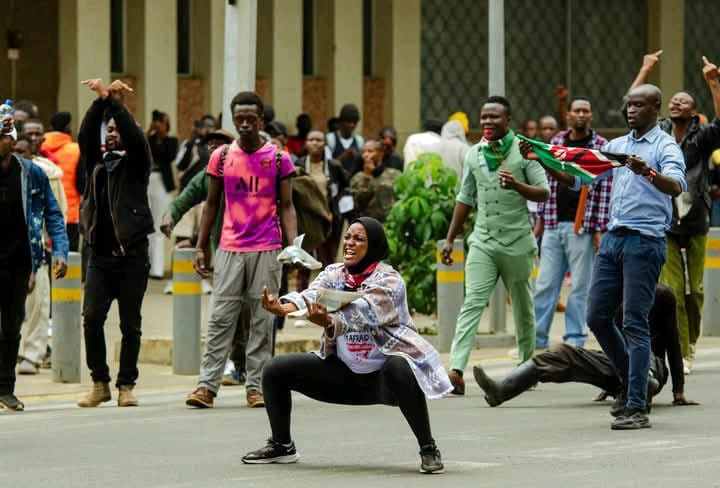
Shakira Wafula on the streets during 2025 protests.
Wafula’s reaction to seeing him there was what finally moved her to publish her account publicly. ‘On a day meant for us to grieve and send a message to the world to protect women and children, the sight of someone who should have protected women, and had failed to do so, broke something in me,’ she wrote.
“A presidency that protects potential sex offenders is not the type of presidency I would have any confidence in. Not in an age where we are screaming and crying every day about the safety of women.”
THE CREDIBILITY CATASTROPHE
The political damage this scandal inflicts on Maraga’s candidacy is proportional to the pillar it strikes. His entire presidential proposition rests on the claim that he is different from Kenya’s political establishment: more principled, more accountable, more serious about institutional reform.
His party, the UGM, promotes social justice, equality, and a vision of ethical governance that Kenya’s mainstream political culture has consistently failed to deliver.
That proposition was already being tested by the realities of building a national political machine from scratch funding pressures, coalition tensions, and the brutal arithmetic of Kenyan presidential politics.
But a scandal about how the party handled sexual misconduct complaints internally is a different kind of test. It does not ask whether Maraga can build a winning coalition. It asks whether he means what he says. And the answer emerging from Wafula’s account, and from the silence of the UGM in response, is deeply uncomfortable.
Political analysts who follow the 2027 field note that Maraga’s appeal has been strongest among women, young Kenyans, and civil society constituencies precisely the people most attuned to questions about how organizations treat survivors of sexual misconduct.
These are also the people most familiar with the enduring pattern in Kenyan politics where accountability rhetoric dissolves the moment it becomes inconvenient for those in power.
Supporters of Maraga argue, with some validity, that he is not personally accused of misconduct and that holding a leader responsible for every action by team members sets an unworkable standard. Critics counter that leadership accountability is not merely about personal conduct.
It is about what happens under your authority when serious complaints are raised. Did the accused remain front-facing in the campaign while complainants were sidelined? Did the formal process take over a month to begin? Was the matter handed to a party structure controlled by the accused’s political home? Wafula says the answer to all three questions is yes. The UGM has not disputed her account.
FIVE MORE WOMEN GONE
Perhaps the detail in Wafula’s account that carries the heaviest weight is the one that follows the formal process. She did not invent a dramatic conclusion. She offered a quiet statistic: since she left in November, at least five more women she knows have also departed the campaign.
That figure, if accurate, points to something more systemic than one complaint that was badly handled. It suggests an environment in which women calculated, rationally, that the campaign was not a safe or rewarding place to work and left.
Women like Wafula, who gave months of her life to a political project she believed in, who drafted a code of conduct at her own initiative, who asked to meet with the leader directly, who stayed longer than she wanted to because people reminded her of the big picture.
‘Leaving his campaign was honestly a painful and not easy decision,’ she wrote. ‘But tolerance to the indignification and harassment of women, even in the slightest, is not something I could comfortably sit with.’
She has made clear that she holds Maraga in personal high regard. She is not calling for his campaign to collapse. She is calling for what the campaign promised in its own slogan a reset, a restoration, a rebuilding this time applied to the protection of its own people.
“Silence is what creates room for these matters to continue rising. It is what emboldens this kind of behavior and normalizes abuse of women.”
As of press time, neither Maraga nor the United Green Movement had issued any public statement directly addressing Wafula’s detailed allegations. The party faces a decision that will reveal more about its character than any policy launch or press conference. It can acknowledge the failures she has described, publish the findings of the NEC process, and commit to an independent review. Or it can stay silent and hope the news cycle moves on.
The second option carries the greater risk. Wafula has shown over months that she is not a person given to impulsive disclosure. She stayed quiet when it was painful. She offered the campaign every opportunity to resolve the matter internally. She only spoke after watching Maraga stand at the front of Kenya’s most prominent anti-femicide protest, holding flowers, seeking a microphone.
Kenya’s EndFemicide movement is not going away. The FIDA-Kenya figures, the child protection statistics, the murder of Rachel Wandeto, the government’s failure to implement a single recommendation from the femicide task force it commissioned in January all of these ensure that gender-based violence will remain at the center of Kenyan political discourse through 2027. Every major candidate will be forced to answer for their record on women’s safety. David Maraga’s record inside his own campaign is now part of that conversation.
Whether the UGM can recover from this moment depends not on political strategy, but on whether it does what it has always claimed distinguishes it from the parties it seeks to replace: tells the truth, protects the vulnerable, and holds power accountable beginning with itself.
Kenya Insights allows guest blogging, if you want to be published on Kenya’s most authoritative and accurate blog, have an expose, news TIPS, story angles, human interest stories, drop us an email on [email protected] or via Telegram









‘The Polygamist’ Pirated Book Go On Sale in Nairobi Following Show Popularity

Justice Mong’are, the Machakos Injunction and the EABL-Asahi Questions Kenya Cannot Ignore

The EABL–Asahi Deal and the Growing Demand for Judicial Transparency

Samburu Governor Lati Lelelit Exposed For Paying Sh60 Million To Ghost Workers

THE GHOST AT ELYSEE PLAZA: How Ghanaian Businessman Erick Agbeko Built a Two-Decade Empire of Land Fraud in Kenya

Njuca Consolidated, Three Firms Faces Auction of 65 Properties Over Crippled Cash Flow

Why Absa Bank Is On The Spot For Enabling Sh150 Million Alleged Insider Fraud In Vetlab Club

Somalia’s Disputed President Allegedly Siphons Up to $6 Million Monthly from Kenyan Miraa Trade, Sharing the Spoils with Nairobi’s Shadow Cartels

Ahmed Adan Hefow: Governor Otuoma’s Trusted Right-Hand Man at the Centre of Busia’s Deepening Finance Scandal

Karua Detained at Entebbe as Uganda Blocks Besigye Lawyer From Entering Country

Businessman Philip Waithaka Kinuthia’s Minor Son Allegedly Drove Drunk, Killed Two Peponi Students in Ngong Road Horror Crash as Claims of Cover-Up Intensify

Inside NCBA’s Decline: How a Banking Giant Lost Its Strategic Edge

South Sudan: Adut Salva Kiir’s Shadow Treasury Exposed

Cement, Cash and Courts: How the Hashu Dynasty Crushed the Ramji Brothers for Fourteen Years and Why the Walls Are Now Closing In

Standard Chartered Ghosts Haunt Joshua Oigara At Stanbic As Whistleblower Spills Beans

Inside The Urban Planning Cartel That Owns Nairobi

THE VULTURE AND THE SCHEME How Nairobi West Hospital Became the Most Dangerous Institution in Kenya’s SHA Ecosystem and Why the Books Must Be Audited Now

The President’s Daughter and The Missing Witness: How Adut Salva Kiir’s Shadow Treasury Silenced Its Most Dangerous Critic

How Adil Popat Saved His Empire On The Eve Of Imperial Bank Collapse and Why Kenya’s Mainstream Media Buried The Story

Why John Ngumi Is Running From the EACC and Why the Sh415 Million Payday May Be the Least of His Worries
-
 News1 week ago
Businessman Philip Waithaka Kinuthia’s Minor Son Allegedly Drove Drunk, Killed Two Peponi Students in Ngong Road Horror Crash as Claims of Cover-Up Intensify
-
 Business2 weeks ago
Inside NCBA’s Decline: How a Banking Giant Lost Its Strategic Edge
-
 Africa2 weeks ago
South Sudan: Adut Salva Kiir’s Shadow Treasury Exposed
-
 Business2 weeks ago
Standard Chartered Ghosts Haunt Joshua Oigara At Stanbic As Whistleblower Spills Beans
-
 Investigations5 days ago
THE VULTURE AND THE SCHEME How Nairobi West Hospital Became the Most Dangerous Institution in Kenya’s SHA Ecosystem and Why the Books Must Be Audited Now
-
 Africa2 weeks ago
The President’s Daughter and The Missing Witness: How Adut Salva Kiir’s Shadow Treasury Silenced Its Most Dangerous Critic
-
 Business2 weeks ago
How Adil Popat Saved His Empire On The Eve Of Imperial Bank Collapse and Why Kenya’s Mainstream Media Buried The Story
-
 Business2 weeks ago
Why John Ngumi Is Running From the EACC and Why the Sh415 Million Payday May Be the Least of His Worries