
Africa
Somalia’s Disputed President Allegedly Siphons Up to $6 Million Monthly from Kenyan Miraa Trade, Sharing the Spoils with Nairobi’s Shadow Cartels
Explosive claims by Senior Counsel Ahmednasir Abdullahi surface as Hassan Sheikh Mohamud makes an unannounced visit to Kenya amid a fierce legitimacy crisis back home.

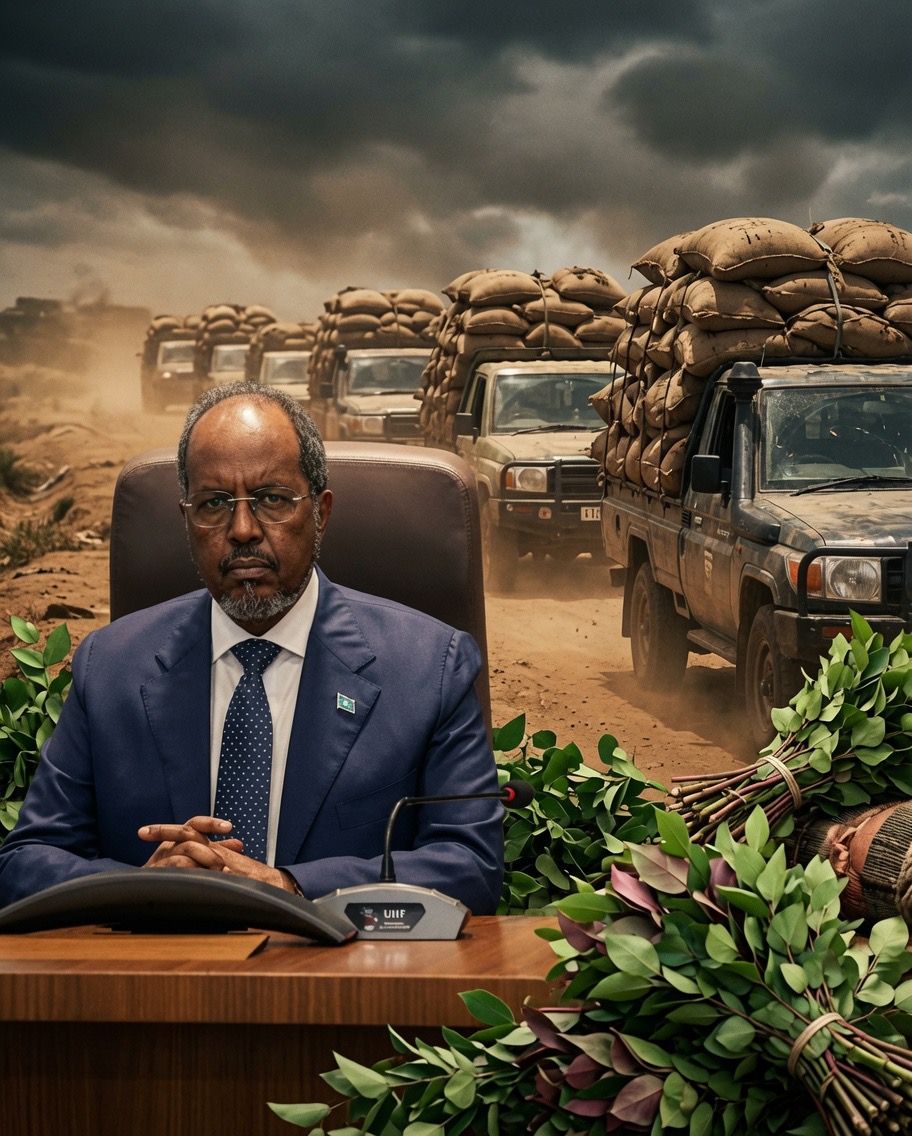
Explosive claims by Senior Counsel Ahmednasir Abdullahi surface as Hassan Sheikh Mohamud makes an unannounced visit to Kenya amid a fierce legitimacy crisis back home.
In the high-stakes world of Horn of Africa power politics and cross-border commodity flows, few rackets match the miraa (khat) pipeline for sheer scale, opacity, and elite capture.
Now, a prominent Kenyan lawyer with deep roots in the Somali community has leveled a direct and explosive accusation.
Somalia’s President Hassan Sheikh Mohamud, whose four-year term expired on or around May 15, 2026, and whose claim to an extended mandate is fiercely rejected by opposition forces, has turned the trade in Kenyan-grown stimulant leaves into a personal revenue machine generating a net US$6 million per month.
According to Ahmednasir Abdullahi SC, posting on X on June 21, 2026, this money comes from taxes and levies on miraa imported from Kenya. The president allegedly shares the proceeds with a tight circle of Somali-Kenyan brokers in Nairobi.
The lawyer, a Senior Counsel and publisher of Nairobi Law Monthly, described the president’s appetite for money as having few parallels in history.
He linked the current Nairobi visit, an unannounced working trip that included a private meeting and farm tour with President William Ruto in Narok, partly to renegotiating commissions with those same brokers, even as HSM pursues war efforts in Mogadishu.
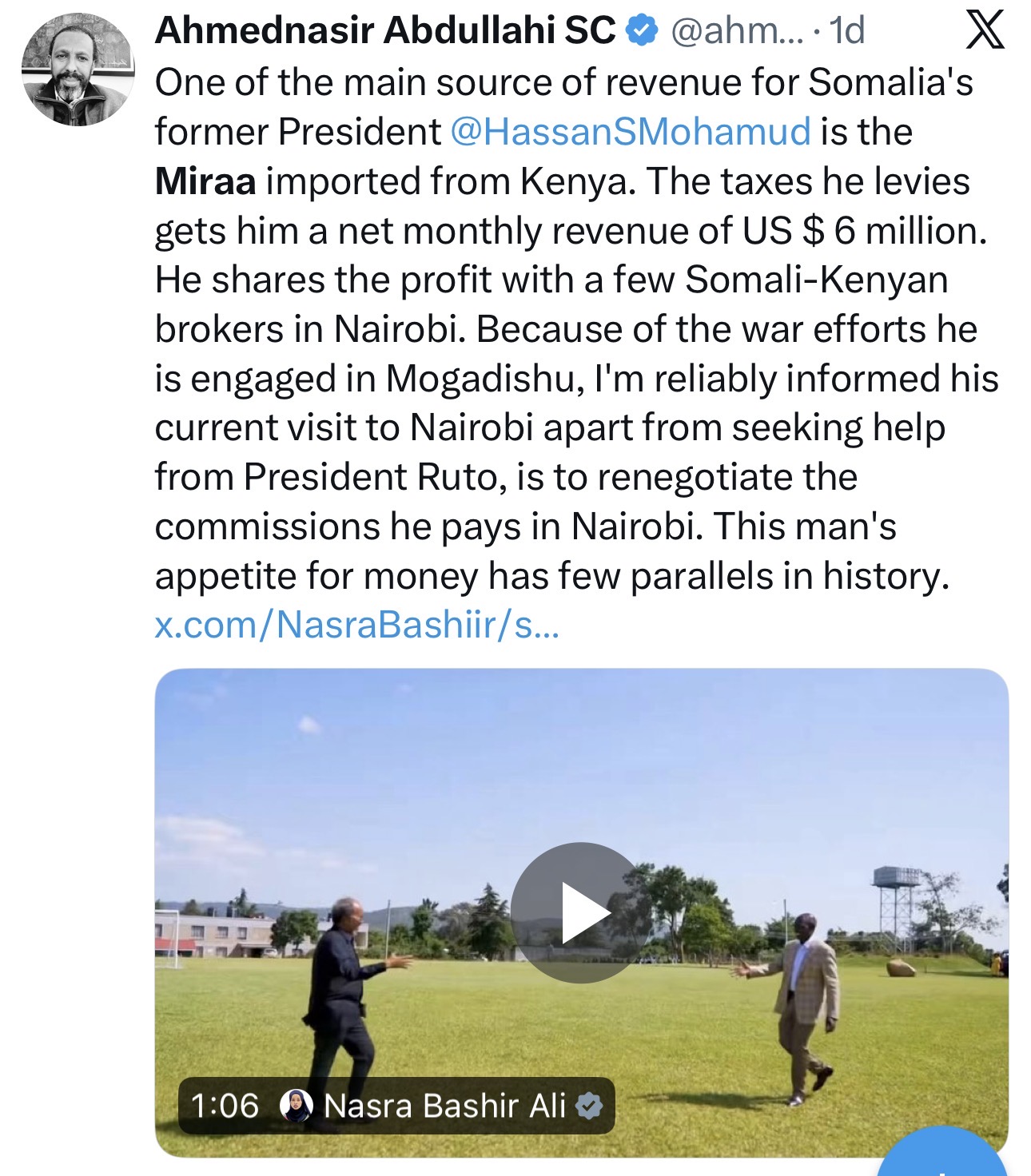
Screenshot
The timing is incendiary. HSM’s presidency is in limbo. Opposition groups, including the Somali Salvation Forum, declared on May 15 that his constitutional mandate had ended. They no longer recognize his authority.
Protests and gunfire have rocked Mogadishu over the disputed extension of his term via parliamentary amendments pushing toward direct elections later.
Kenya hosting the disputed leader, even for talks on security cooperation and AUSSOM funding, has drawn sharp criticism, including from Ahmednasir himself, who urged Ruto to treat him as a former president and push for a legitimate transition.
The Miraa Trade: A Multi-Hundred-Million-Dollar Cross-Border Lifeline (and Drain)
Miraa, the fresh, leafy stimulant chewed across Somalia and parts of the Horn, is overwhelmingly a Kenyan export success story with Somali consumers as its lifeblood.
Somalia accounts for 95 to 99 percent of Kenya’s miraa exports. Official volumes have fluctuated with diplomatic winds, bans, and reopenings.
Daily shipments of 13 to 17 metric tonnes (13,000 to 17,000-plus kg) flown to Mogadishu and other points in recent years, plus land-border trade resumed in early 2026 after a 15-year hiatus.
Cumulative exports since the 2022 reopening of air shipments ran into the tens of millions of kilograms, representing hundreds of millions of dollars in value flowing from Somali pockets to Kenyan farmers, packers, transporters, and exporters.
For Kenya’s Meru and surrounding regions, miraa is a vital cash crop supporting thousands of smallholders and ancillary jobs.
For Somalia, it is a double-edged sword.
It is a culturally entrenched habit that generates substantial tax revenue for the Federal Government of Somalia (FGS) and federal member states, yet drains scarce foreign exchange and fuels documented social and health costs including addiction, lost productivity, mental health strain, and oral health issues.
Taxes have long been a battleground. Historical data shows khat imports through Mogadishu airport alone delivered US$16.6 million to the FGS in 2019, about 15 percent of customs and import duties and 5 percent of total federal revenue at the time.
Puntland has reported even larger contributions from the trade in certain periods.
Official per-kilo import duties have varied, historically in the $3 to $4-plus per kg range, with periodic hikes during tensions. The trade has survived temporary bans, including a COVID-era air-shipment ban lifted after high-level Kenya-Somalia deals in 2022, and diplomatic spats that were sometimes used to squeeze more revenue.
The Alleged Personal Slush Fund and Nairobi’s Broker Networks
Ahmednasir’s claim goes far beyond official state taxes. He and supporting commentary on X describe a system in which traders and brokers in Nairobi are allegedly forced to pay significant sums, framed around $6 per kg in advance on substantial daily volumes shipped to all Somali regions, with the net proceeds after any official remittances flowing to HSM personally or his inner circle.
One detailed reply pegged it at over $6 million monthly for years, collected on roughly 40,000 kg shipments, far exceeding declared official volumes and rates tied only to Mogadishu-bound cargo.
Whether the exact $6 million figure holds under scrutiny, the underlying mechanics are plausible in Somalia’s personalized, clan-influenced governance. Control over import chokepoints such as airports, borders, and clearance has historically allowed powerful networks to extract rents.
A parallel or supplementary collection system operating upstream in Nairobi, enforced through trade access or disruption threats, would represent a sophisticated cross-border arrangement. The few Somali-Kenyan brokers in Nairobi are not faceless.
They form tight-knit commercial networks handling aggregation from Meru farms, specialized packaging (miraa is perishable and time-sensitive), air cargo logistics (often via Wilson or JKIA), and onward distribution in Somalia. These operators rely on relationships, hawala finance, and political protection on both sides of the border.
The money does not vanish. In similar commodity trades involving Somali networks, profits are routinely recycled into prime real estate in Nairobi’s Eastleigh and other Somali business hubs, hospitality, transport, and import-export companies, political patronage and influence operations in Kenya’s North Eastern counties and beyond, and properties and businesses back in Mogadishu or other Somali cities.
This creates a self-reinforcing ecosystem where economic actors have strong incentives to maintain favorable political arrangements in both capitals.
Intrigues, Clan Dynamics, and the Visit’s Real Agenda
The miraa trade sits at the intersection of clan business networks, state revenue, and political survival. Certain communities historically dominant in the sector have reportedly seen influence shift. Diplomatic ruptures between Nairobi and Mogadishu have repeatedly been leveraged to adjust taxes or access.
Al-Shabaab has imposed its own rules or taxes in controlled areas. With HSM’s domestic position weakened by the term dispute and ongoing security operations, securing reliable revenue streams and adjusting the shares paid to facilitators becomes existential.
Ahmednasir explicitly tied the Nairobi visit to renegotiating those commissions. Public reporting confirms the trip happened. HSM arrived unannounced around June 21, met Ruto privately (including at the Kenyan president’s Narok farm area), and discussed bilateral ties, security, and trade. A video circulating with Ahmednasir’s posts shows the two leaders in relaxed, high-security settings, with Ruto hosting, even driving a specialized off-road vehicle.
Can a President Rightfully Pocket These Proceeds?
Even setting aside the disputed legitimacy, the answer is a resounding no. Official taxes belong to the Somali state and its long-suffering people, resources desperately needed for security, basic services, and reconstruction in one of the world’s most fragile contexts.
Extra-legal or personally directed levies collected through brokers in a neighboring country represent a particularly brazen form of elite capture. It fuels precisely the grievances that undermine state legitimacy and perpetuate instability.
Somalia’s political class has long struggled with accountability over resource rents. When a leader allegedly treats a major import stream as a personal or inner-circle franchise while the country grapples with contested power transitions, insurgency, and economic fragility, it is not statesmanship. It is plunder dressed in the language of necessity.
The Story Behind the Story
This is bigger than one man’s alleged greed. It is a textbook case of how weak institutions and personalized power turn legitimate trade into a rent-extraction machine. Kenyan miraa farmers depend on Somali demand and smooth logistics. Somali consumers and distributors pay the price. A narrow set of brokers and power brokers in both countries capture the upside. The political crisis in Mogadishu has turned the trade into both a lifeline and a battleground.
Kenya is not a passive observer. Its farmers’ livelihoods, its security interests in Somalia (including deployed forces), and its own Somali-Kenyan commercial community are entangled. Hosting a disputed leader while explosive allegations swirl about that leader monetizing a Kenya-origin trade raises uncomfortable questions about due diligence and long-term interests.
Ahmednasir’s intervention, coming from a figure of legal stature and community standing rather than a partisan operative, cannot be waved away as mere noise. It demands forensic scrutiny including independent verification of collection mechanisms, beneficial ownership of key trading entities, money flows, and any Nairobi-based facilitation.
Until transparent, rules-based systems replace personalized control over chokepoints, the miraa trade will continue to enrich the few while burdening the many on both sides of the border.
The allegations paint a portrait of a leader whose political survival appears intertwined with locking in favorable terms for one of the region’s most lucrative and least transparent commodity flows. In a region where commodity rents have repeatedly distorted governance, this is a story that deserves daylight, not because it is convenient, but because the stakes for ordinary Kenyans and Somalis are too high to ignore.
Kenya Insights allows guest blogging, if you want to be published on Kenya’s most authoritative and accurate blog, have an expose, news TIPS, story angles, human interest stories, drop us an email on [email protected] or via Telegram







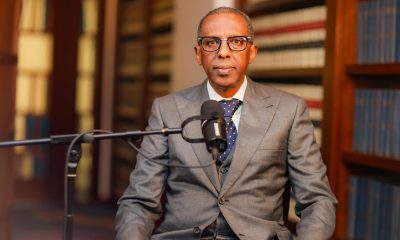




Somalia’s Disputed President Allegedly Siphons Up to $6 Million Monthly from Kenyan Miraa Trade, Sharing the Spoils with Nairobi’s Shadow Cartels

Ahmed Adan Hefow: Governor Otuoma’s Trusted Right-Hand Man at the Centre of Busia’s Deepening Finance Scandal

Karua Detained at Entebbe as Uganda Blocks Besigye Lawyer From Entering Country

How KCB and Airtel Turned Kenya’s Unbanked Into a Data Goldmine Behind a ‘Financial Inclusion’ Deal

The Chivayo Network: How a Convicted Fraudster Won Access to Presidents, Passports and Billion-Dollar Deals Across Africa

BURRIED TWICE: The Victoria Bank CEO Yogesh Pattni Files

Court Stops Transfer Of EABL Shares To Asahi By Diageo In A Fresh Snag

Death Before Justice: Stephen Ngei, Victim of Sh180 Million Laptop Tender Scam Linked to Allan Chesang, Killed in Highway Crash

Court Brands Sh1.1 Billion Fee Demand by Lawyer Victor Swanya “Excessive and Exorbitant,” Exposes How City Hall Lets Public Money Bleed Through Legal Bills

Trump Unveils New Air Force One

Businessman Philip Waithaka Kinuthia’s Minor Son Allegedly Drove Drunk, Killed Two Peponi Students in Ngong Road Horror Crash as Claims of Cover-Up Intensify

Inside NCBA’s Decline: How a Banking Giant Lost Its Strategic Edge

Cement, Cash and Courts: How the Hashu Dynasty Crushed the Ramji Brothers for Fourteen Years and Why the Walls Are Now Closing In

Standard Chartered Ghosts Haunt Joshua Oigara At Stanbic As Whistleblower Spills Beans

South Sudan: Adut Salva Kiir’s Shadow Treasury Exposed

Inside The Urban Planning Cartel That Owns Nairobi

THE VULTURE AND THE SCHEME How Nairobi West Hospital Became the Most Dangerous Institution in Kenya’s SHA Ecosystem and Why the Books Must Be Audited Now

The President’s Daughter and The Missing Witness: How Adut Salva Kiir’s Shadow Treasury Silenced Its Most Dangerous Critic

How Adil Popat Saved His Empire On The Eve Of Imperial Bank Collapse and Why Kenya’s Mainstream Media Buried The Story

Why John Ngumi Is Running From the EACC and Why the Sh415 Million Payday May Be the Least of His Worries
-
 News1 week ago
Businessman Philip Waithaka Kinuthia’s Minor Son Allegedly Drove Drunk, Killed Two Peponi Students in Ngong Road Horror Crash as Claims of Cover-Up Intensify
-
 Business2 weeks ago
Inside NCBA’s Decline: How a Banking Giant Lost Its Strategic Edge
-
 Business2 weeks ago
Standard Chartered Ghosts Haunt Joshua Oigara At Stanbic As Whistleblower Spills Beans
-
 Africa2 weeks ago
South Sudan: Adut Salva Kiir’s Shadow Treasury Exposed
-
 Investigations4 days ago
THE VULTURE AND THE SCHEME How Nairobi West Hospital Became the Most Dangerous Institution in Kenya’s SHA Ecosystem and Why the Books Must Be Audited Now
-
 Africa2 weeks ago
The President’s Daughter and The Missing Witness: How Adut Salva Kiir’s Shadow Treasury Silenced Its Most Dangerous Critic
-
 Business2 weeks ago
How Adil Popat Saved His Empire On The Eve Of Imperial Bank Collapse and Why Kenya’s Mainstream Media Buried The Story
-
 Business2 weeks ago
Why John Ngumi Is Running From the EACC and Why the Sh415 Million Payday May Be the Least of His Worries