
Business
THE GRAND MULLAH AND THE PIPELINE : How Ahmednasir Turned a Lebanese Contractor’s Legal Battle into a Multi-Billion-Shilling Machine Against a State Corporation
It is a story about a lawyer who has built a business empire partly on the proceeds of parastatal litigation.

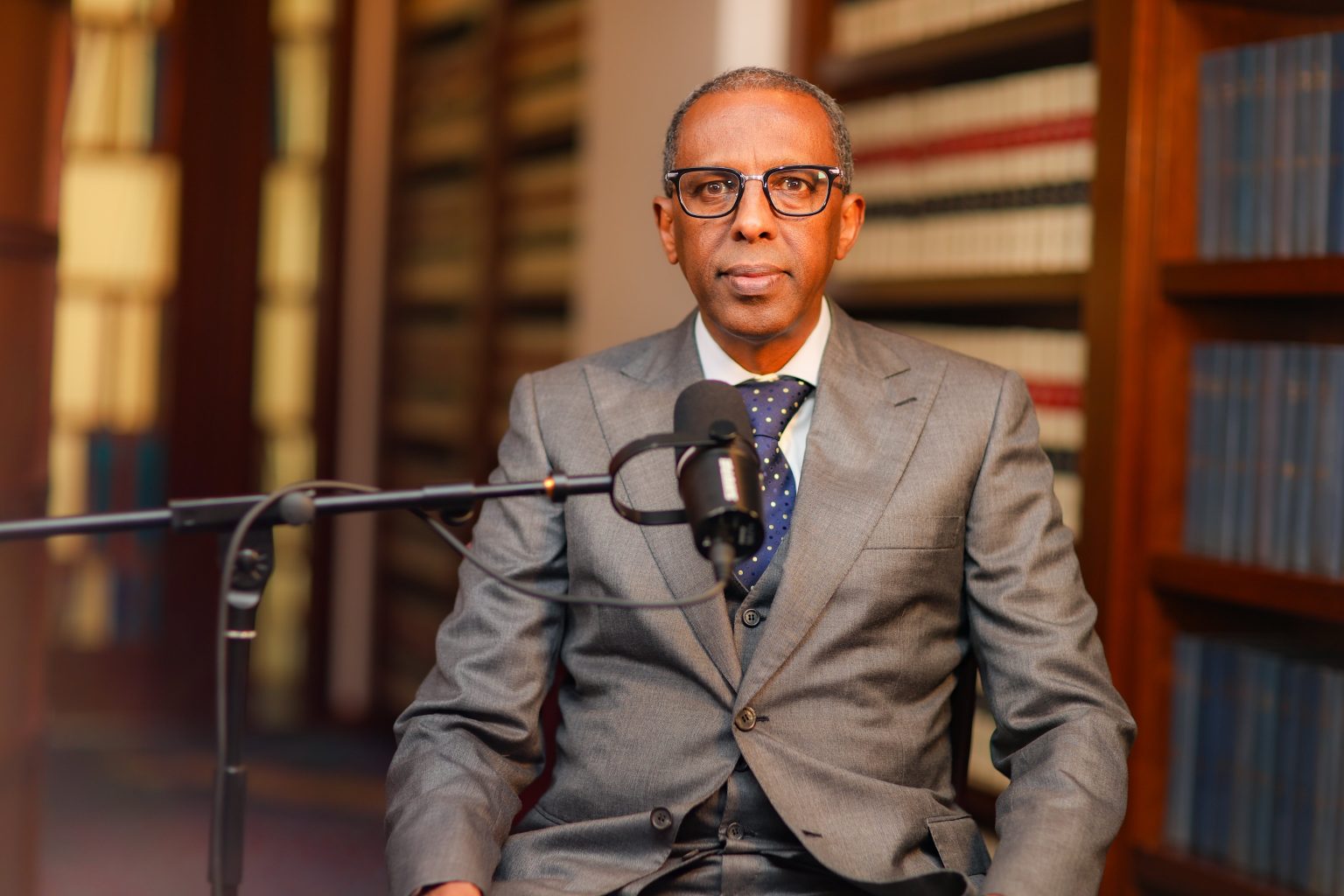
On a warm morning in July 2023, a demand letter landed on the desk of Kenya Pipeline Company’s management. It bore the letterhead of Ahmednasir Abdullahi Advocates LLP, the firm of Kenya’s most famous lawyer, a man the legal fraternity calls the Grand Mullah.
The letter sought payment of USD 29,308,349.80 from the state-owned fuel transporter, on behalf of a Lebanese construction company called Zakhem International Construction Limited.
At the prevailing exchange rate, that figure translated to approximately Ksh 3.8 billion. It was not the first such letter, and it was not the last. By the time a fresh lawsuit was filed before the Milimani Commercial Court on June 15, 2026, the total claim against Kenya Pipeline Company had swelled to USD 84.12 million, equivalent to Ksh 10.89 billion, and Ahmednasir’s firm was at the centre of every move.
Now Robert Alai, the Kileleshwa Member of County Assembly and one of Kenya’s most provocative online commentators, has detonated what he describes as an explosive expose.
In a post shared widely across X and Facebook, Alai accused Ahmednasir of orchestrating the defrauding of Kenya Pipeline Company and of secretly withdrawing what he characterised as ‘illegal consents’ designed to unlock USD 72 million from the state corporation.
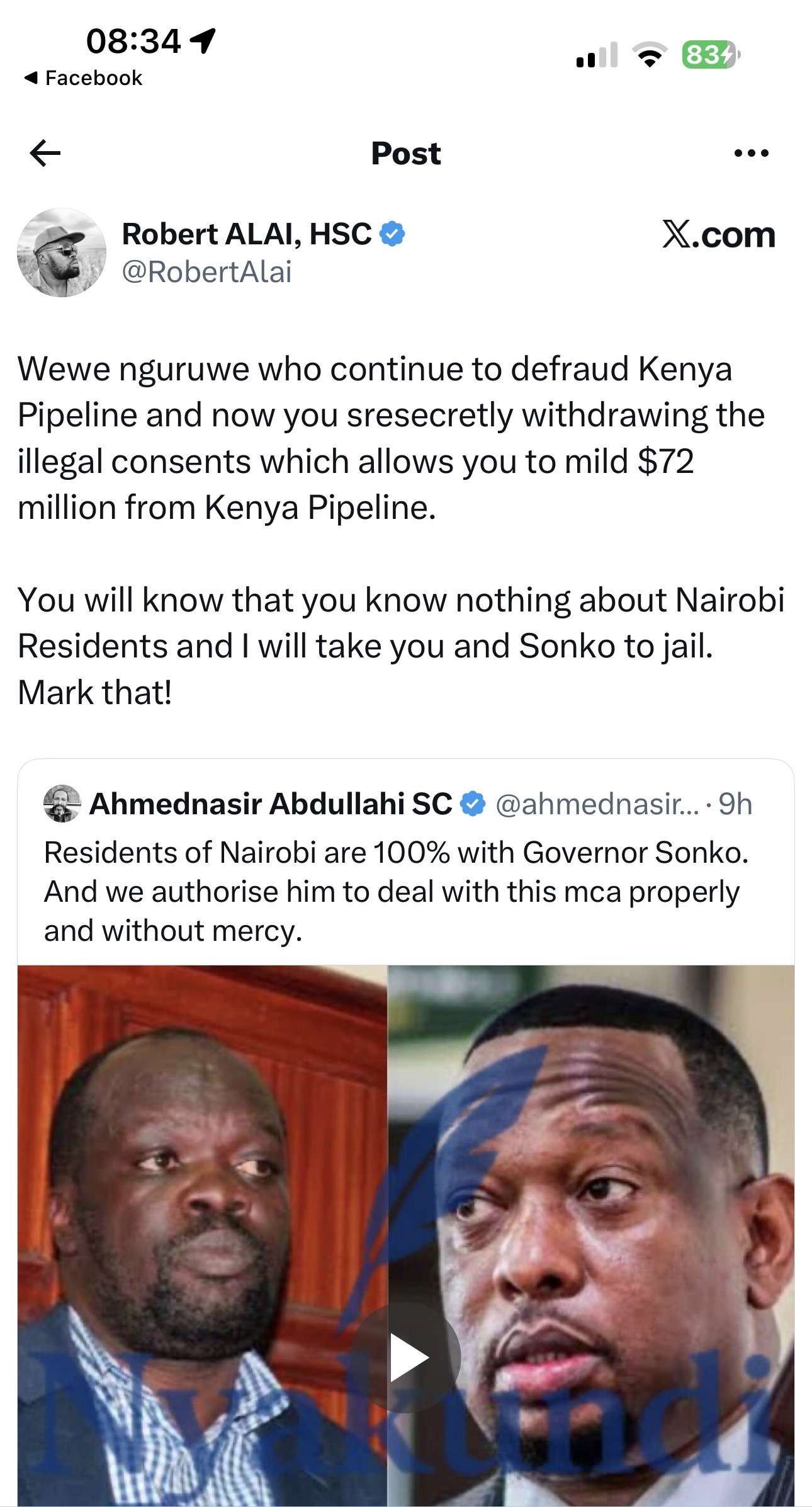
Screenshot
The accusation is sensational, and the language is that of street-level outrage. But the underlying facts, drawn from court records, published company filings, and documented parliamentary proceedings, tell a story more layered and more disturbing than Alai’s furious posts can fully capture.
This is that story.
It is a story about a lawyer who has built a business empire partly on the proceeds of parastatal litigation. It is a story about a single infrastructure contract that has become a legal perpetual motion machine, generating claims, decrees, consents, consent reversals, garnishee orders, and fresh suits for over a decade.
It is a story about public money flowing through a private law firm’s trust account. And it is a story about a newly privatised state corporation whose shares ordinary Kenyans now hold on the Nairobi Securities Exchange, discovering that billions in contingent liabilities were quietly baked into the balance sheet before the listing.
THE MAN THEY CALL GRAND MULLAH
Ahmednasir Abdullahi is not a figure who operates in the shadows. He is perhaps Kenya’s most visible lawyer, a man who spent decades cultivating a public persona as a crusading voice against judicial corruption, a disruptor willing to take on the most powerful institutions in the land.
He was president of the Law Society of Kenya from 2003 to 2005.
He chaired the advisory board of the Kenya Anti-Corruption Commission during that same period. He represented the LSK on the Judicial Service Commission until 2013. He has defended presidents. He has pilloried judges. He drives a Bentley Bentayga. He owns Al-Nur Media Group, publisher of the Nairobi Law Monthly and the Nairobi Business Monthly. He operates RTN TV, one of Kenya’s first Somali television stations.
In a country where reputation is currency, the Grand Mullah has spent decades accumulating both.
He has also spent those decades accumulating legal fees at a rate that has repeatedly alarmed parliamentary oversight committees.
In the 2013 presidential election petition, Ahmednasir was paid Ksh 40 million by the Independent Electoral and Boundaries Commission to represent former chairman Issack Hassan, a figure that translated to Ksh 2.9 million per day for the fourteen days of the hearing. He was paid more than the lead counsel for the commission itself, a fact that drew pointed questioning from Parliament’s Public Accounts Committee.
Ahmednasir’s response was characteristically unabashed. He told the Daily Nation that by senior counsel standards, the amount was actually modest. ‘They could not afford the original fee,’ he said. When asked by MPs to justify the payment, the IEBC’s chief executive said that Ahmednasir ‘had asked for much more money.’ Auditor General Edward Ouko had questioned the total legal fees paid across the petition, which ran to Ksh 1.06 billion.
“The more you charge the client, the more he or she loves you.” Ahmednasir has described this philosophy as a lesson learnt from the late Mutula Kilonzo. The question Kenya Pipeline Company’s shareholders should now ask is whether they were the ones paying for his client’s love.
In a 2020 interview on The Hot Seat YouTube show, Ahmednasir explained his fee philosophy with characteristic candour. He said he had learnt from the late Senator Mutula Kilonzo that higher fees command greater client loyalty and respect. ‘The more you charge the client, the more he or she loves you,’ he told the interviewer. ‘When a client pays a lawyer Ksh 10 million, he or she walks around proud. My lawyer is an expensive lawyer; he charges me Ksh 10 million.’ It is a revealing admission from a man whose clients have included state corporations, parastatal agencies, and foreign contractors pursuing billions from Kenya’s public purse.
THE PIPELINE: A CONTRACT THAT BECAME A MACHINE
On July 1, 2014, Kenya Pipeline Company signed a contract with Zakhem International Construction Limited for the Line 1 Replacement Project, a 450-kilometre pipeline linking the port of Mombasa to Nairobi.
The contract was valued at USD 484.5 million, equivalent to approximately Ksh 62.65 billion at the time. The completion timeline was set at eighteen months. What actually followed was four years of construction, a cascade of extension of time claims from Zakhem, and a financial dispute that has not been resolved to this day.
The complications began with how Zakhem financed its operations. The Lebanese contractor obtained a credit facility from Ecobank Nigeria and pledged its receivables under the KPC contract as collateral.
When Zakhem later defaulted on that loan, Ecobank moved to recover its funds by filing a lawsuit in 2018 against both the contractor and Kenya Pipeline Company, seeking over USD 52 million. This development transformed the pipeline project into something far more dangerous for KPC. A Kenyan state corporation that had simply contracted a construction company now found itself dragged into litigation over a foreign bank loan it had never taken out. The case opened multiple fronts simultaneously, drawing in subcontractors, financiers, law firms, and the full apparatus of Kenya’s commercial courts.
Court records confirm that KPC’s accounts at Standard Chartered Bank, Equity Bank, and Stanbic Bank were all targeted by Zakhem at various points through garnishee applications.
Billions of shillings sat frozen in contested escrow arrangements while lawyers argued over currency conversion rates, interest calculations, and the legal effect of consent judgments.
The Directorate of Criminal Investigations was at one stage directed by the Court of Appeal to submit a report on bribery allegations swirling around one of the judges handling the matter. In the middle of this legal battlefield, one firm’s name appeared with consistent frequency: Ahmednasir Abdullahi Advocates LLP.
THE TRUST ACCOUNT AT THE CENTRE OF EVERYTHING
The detail in the court record that demands the most serious attention is this: when Justice Patrick Otieno of the High Court issued a critical order in the KPC-Zakhem-Ecobank dispute, he directed that Ksh 4.1 billion paid by Kenya Pipeline Company be wired to an account jointly held by Ahmednasir Abdullahi Advocates LLP and another firm, Majanja Luseno and Company, with strict instructions that the money not be transmitted to Zakhem or to Ecobank Nigeria.
The Court of Appeal was immediately invoked. A three-judge bench comprising Justices Daniel Musinga, Kathurima M’inoti, and Mwaniki Gachoka froze the case and directed that the DCI first submit its findings on allegations that a judge had been approached to seek a favourable ruling.
To be precise: billions of shillings of public money, paid by a state corporation, were being held in a private law firm’s trust account. Ahmednasir’s trust account.
The question of who controls the release of such funds, on what terms, and following what internal authorisation processes inside the firm, is not one that Kenya Pipeline Company’s now-public shareholders have ever been given a satisfactory answer to. KPC’s management, through its acting chief legal officer Nelson Nyaduwa, has consistently maintained that all outstanding sums were settled through the September 2023 consent.
What Nyaduwa did not say publicly was that in February 2024, the High Court ruled that the September 2023 consent had no legal effect at all, having been filed after Zakhem had already withdrawn the underlying suit. The consent, in other words, was legally void from the moment it was recorded.
Billions of shillings of public money, paid by a state corporation, were held in a private law firm’s trust account. The question of who controls the release of such funds has never been answered.
This is the context in which Robert Alai’s accusation about ‘illegal consents’ and their secret withdrawal must be read.
Whether or not Alai’s characterisation of the mechanics is legally precise, the documented court history confirms that consents in this matter have been contested, voided, countered, and exploited by multiple parties as tools to manoeuvre around existing court orders rather than to resolve the dispute.
In one particularly stark episode in the litigation, it was argued before the court that Zakhem and KPC had gone before Justice Alfred Mabeya and filed a consent specifically to circumvent existing injunctive orders issued by another judge.
‘They are doing this because they want to go about your pending rulings,’ argued one counsel.
‘They want to countermand them. They are looking for an easy way and that is why they recorded consent before Justice Mabeya even though he told them this does not affect other obligations. They have been actively involved in getting the subject matter that has been reserved out of this court.’ The judge agreed with enough of this analysis to block the release of the funds.
THE ESCALATING DEMANDS: FROM $44 MILLION TO $84 MILLION
The financial chronology of the Zakhem-KPC dispute, with Ahmednasir at the helm of the legal offensive on Zakhem’s behalf, is worth setting out in precise terms because the numbers themselves constitute an indictment of the scale of exposure Kenya Pipeline Company’s public shareholders have inherited.
In June 2020, the High Court issued a partial decree ordering KPC to pay Zakhem approximately USD 44 million, a sum that at current exchange rates represents around Ksh 5.72 billion.
KPC made payments totalling Ksh 3.099 billion to the Kenya Revenue Authority in October 2020 and a further Ksh 915 million in January 2021, arguing that these tax payments discharged part of the decretal obligation.
Zakhem, through Ahmednasir, disputed the currency conversion methodology and maintained that a residual balance remained owing. In June 2025, Zakhem successfully executed a garnishee order seizing Ksh 485 million from KPC’s account at Equity Bank.
In September 2023, the parties recorded what KPC described in its annual report as a full and final consent judgment of USD 69.68 million, a settlement linked to a Ksh 2.85 billion decline in KPC’s cash reserves in that financial year.
Five months later, in February 2024, the High Court nullified that settlement, ruling it had no legal effect. On February 25, 2026, with KPC having listed on the Nairobi Securities Exchange only two weeks earlier, Ahmednasir Abdullahi Advocates LLP issued a fresh demand letter to then Managing Director Joe Sang seeking USD 6.03 million, calculated as the residual balance of the 2020 partial decree plus interest accruing at fourteen percent per annum.
The letter noted that other claims arising from the same contract would follow separately. On June 15, 2026, those further claims arrived: a lawsuit before the Commercial Court seeking USD 84.12 million, comprising USD 19.04 million in extension of time claims and USD 65.08 million in interest on delayed payments.
To appreciate the full dimension of this financial exposure, one must also recall that a July 2023 demand letter from Ahmednasir Abdullahi Advocates LLP sought payment of USD 29,308,349.80 from KPC, a figure that has received little mainstream media scrutiny.
Added to the various garnishee orders, the tax payments, the Ksh 485 million seizure from Equity Bank, the legal fees across multiple proceedings, and the latest USD 84 million claim, the total sums connected to this single infrastructure contract now dwarf the original project value and represent one of the most costly contractor disputes in Kenya’s parastatal history.
THE ARBITRATOR WHO BECAME THE ADVOCATE
The pattern of Ahmednasir’s involvement with Kenya Pipeline Company stretches back further than the Zakhem dispute. In 2006, oil marketer KenolKobil sued KPC for breach of a petroleum storage agreement, and Ahmednasir was appointed as the arbitrator in the dispute.
In December 2009, he delivered an award in KenolKobil’s favour, ordering KPC to pay approximately Ksh 5.8 billion in damages. KPC successfully challenged the award before the High Court, which referred the matter back to Ahmednasir for reconsideration.
It was during this revisitation process that things took a significant turn.
On June 11, 2014, Ahmednasir gave a live television interview in which he publicly criticised KPC’s decision to award the pipeline replacement tender to Zakhem International Construction. KPC moved immediately, filing an urgent application to have him removed as arbitrator on grounds of apparent bias.
The corporation argued that his public commentary demonstrated that he could not be impartial. Justice Francis Gikonyo dismissed the application, ruling that a reasonable person would not infer bias from the interview.
Ahmednasir remained the arbitrator in a multi-billion-shilling case against the same corporation whose procurement decisions he had publicly condemned on national television.
Within months of that controversy, KPC awarded Zakhem the very contract that Ahmednasir had criticised, and within years, Ahmednasir Abdullahi Advocates LLP became Zakhem’s primary legal representative in disputes arising from that same contract.
In 2014, Ahmednasir publicly criticised KPC’s award of the pipeline tender to Zakhem on live television. He was simultaneously arbitrating a Ksh 5.8 billion case against KPC. He later became Zakhem’s own lawyer in disputes arising from that contract.
This sequence of positions deserves to be stated plainly.
Ahmednasir first sat in judgment over Kenya Pipeline Company as an arbitrator, awarding billions against it. He then publicly expressed views about KPC’s governance and procurement on national television while still serving as its arbitrator in an unresolved matter.
He then took on as a client the very contractor whose tender award he had publicly questioned, and proceeded to pursue that contractor’s claims against KPC with characteristic aggression. No court has found that any of these transitions constituted a breach of professional ethics.
But the architecture of the relationships, viewed in totality, represents a financial ecosystem in which the same senior counsel occupied multiple roles touching the same state corporation and the same contested contract, each role generating fees and each position creating informational and strategic advantages that are not available to ordinary Kenyan litigants.
THE SUPREME COURT, THE BAN, AND THE PROTECTION OF POWER
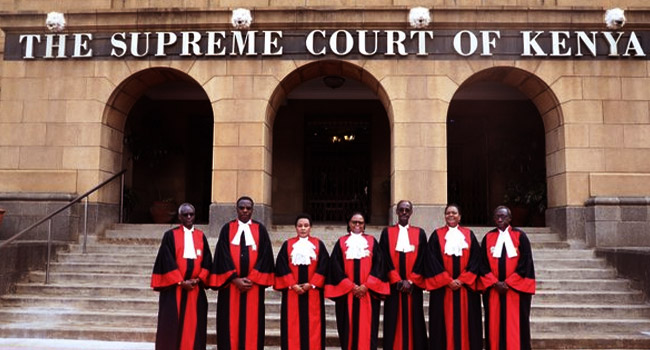
The Supreme Court of Kenya judges.
To understand how Ahmednasir operates in the Kenyan legal landscape, it is essential to understand his relationship with the institution that is supposed to hold lawyers accountable: the judiciary itself.
In January 2024, the Supreme Court of Kenya took the extraordinary step of permanently banning Ahmednasir and any lawyer from his firm from appearing before the apex court.
The ban followed years of escalating social media attacks in which Ahmednasir had publicly accused Supreme Court judges of corruption, incompetence, and outright bribery, in one instance claiming without producing evidence that a named judge had accepted a Ksh 4 million bribe to influence a Court of Appeal case.
The Supreme Court’s statement was unsparing.
It accused the senior counsel of having ‘relentlessly and unabashedly conducted a campaign in the broadcast, print and social media aimed at scandalizing, ridiculing and outrightly denigrating this Court.’
It noted that this conduct had continued despite a 2018 warning and despite years of institutional restraint. The seven-judge bench voted unanimously to bar him. In May 2025, the judiciary escalated further, writing to Director of Public Prosecutions Renson Ingonga to request investigations and possible criminal charges against Ahmednasir over the same conduct.
What the mainstream narrative about Ahmednasir’s judicial war rarely examines critically is the political architecture that protected him throughout this period.
Two weeks before the Supreme Court issued its ban, President William Ruto posted publicly on X to praise Ahmednasir for having warned him about ‘sabotage by corrupt judicial officers’ before he took office.
The spectacle of a sitting president publicly endorsing, in real time, a lawyer whose firm was simultaneously holding billions of shillings from a state corporation in a trust account, and who was simultaneously pursuing escalating claims against that state corporation, is a portrait of elite political proximity that should alarm any accountability journalist.
In January 2026, the Supreme Court lifted the ban entirely and allowed Ahmednasir to resume full practice before the apex court.
In a country where the consequences of legal controversy fall most heavily on those without connections, Ahmednasir’s ability to operate with full access to all courts, to serve as arbitrator, advocate, and media commentator on the same set of issues simultaneously, and to hold public funds in his firm’s trust account while pursuing further claims from the same public institution, represents an accumulation of leverage that deserves sustained public scrutiny.
THE IPO, THE HIDDEN LIABILITIES, AND THE PUBLIC SHAREHOLDERS
On March 10, 2026, Kenya Pipeline Company made its debut on the Nairobi Securities Exchange in what was described as the bourse’s first privatisation listing in nearly two decades.
Ordinary Kenyans who subscribed to the IPO were investing in a company the government had valued at approximately Ksh 120 billion.
What the Information Memorandum accompanying the listing disclosed about the Zakhem litigation was, according to analysts who reviewed it, significantly less detailed than the scale of the contingent liability warranted.
KPC’s annual report for the year ended June 2025 had already reported revenue of Ksh 38.6 billion and net profit of Ksh 7.49 billion, figures that individual investors cited with confidence when making their subscription decisions.
Just ninety-seven days after the listing, on June 15, 2026, Zakhem filed a USD 84.12 million lawsuit before the Commercial Court. The amount, at current exchange rates, represents more than Ksh 10.89 billion.
KPC’s board immediately issued a cautionary notice to shareholders, advising them to exercise caution when dealing in KPC securities and noting that preliminary legal advice suggested credible grounds to contest the claim.
This notice is itself a disclosure concession that the company had not previously made with equivalent clarity. The Zakhem litigation was not a new development. The relationship between KPC, Zakhem, Ahmednasir, and the courts had been generating public record for over a decade.
The question that KPC’s new public shareholders are entitled to demand an answer to is why the full scope of that exposure was not disclosed with the specificity that investors deserved before their money changed hands.
Ninety-seven days after Kenya Pipeline Company listed on the NSE, Zakhem filed a Ksh 10.89 billion lawsuit. The litigation was not new. Ordinary Kenyans who bought shares deserved to know its full scope before the IPO closed.
The managing director at the time of both the IPO and the filing of that latest lawsuit was Joe Sang, who was arrested in April 2026 over allegations of fuel data manipulation in a separate investigation.
Sang’s tenure at KPC began in 2015, during the execution phase of the Zakhem contract. He later resigned amid the Kisumu Oil Jetty controversy, was acquitted, and returned to the managing director role in 2023, precisely the period during which the September 2023 consent judgment was negotiated, subsequently challenged, and ultimately nullified by the High Court in February 2024.
The overlapping timelines of the procurement, the dispute, the aborted settlement, the IPO, and the arrests place the question of institutional governance at KPC in a context that no serious investigation can avoid.
WHAT ALAI’S ACCUSATIONS ACTUALLY POINT TO
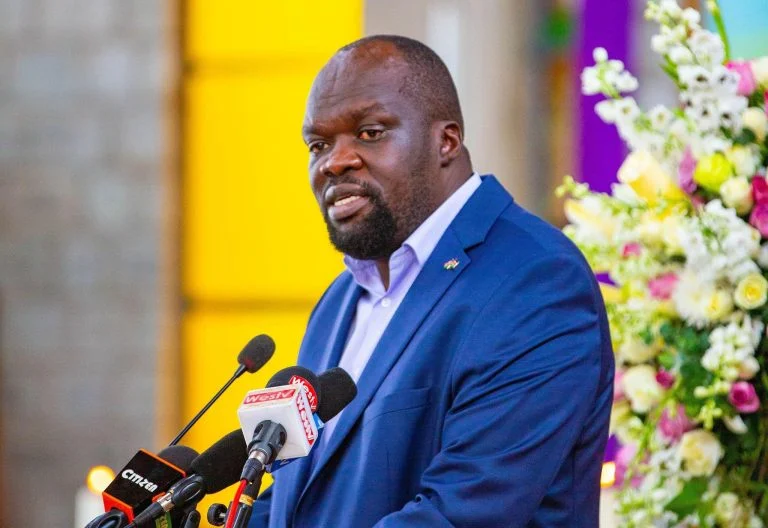
Robert Alai.
Robert Alai is not a disinterested observer. He is a politician who carries his own legal baggage, including defamation suits that have resulted in court orders against him.
His methods are those of the social media agitator, not the forensic investigator.
His accusation that Ahmednasir is ‘secretly withdrawing illegal consents to milk $72 million from Kenya Pipeline’ conflates several distinct legal processes, overstates the secrecy of proceedings that are on public record, and attributes to Ahmednasir personally conduct that is more accurately attributable to his role as an advocate executing his client’s instructions.
But the core of what Alai is pointing at is real.
The documented record confirms that consents in the Zakhem matter have been contested, exploited, circumvented, and voided. The documented record confirms that funds have flowed through Ahmednasir’s firm’s trust accounts. The documented record confirms that demand letters bearing his firm’s name have sought sums running into the hundreds of millions of dollars from a public institution.
And the documented record confirms that this litigation architecture has continued to expand, not contract, even after repeated settlement attempts, even after a consent judgment that KPC itself described as ‘full and final,’ and even after the company listed on a public exchange and invited ordinary Kenyans to become its shareholders.
Whether Ahmednasir is doing anything improper in a strict legal sense is a question for investigative authorities and ultimately for the courts. He is a lawyer representing a client who has legitimate contractual claims against a state corporation that signed a binding agreement and is obligated to honour its terms.
The fact that those claims have grown and multiplied over a decade does not, by itself, prove wrongdoing. What it does prove, definitively, is that the architecture of how Kenya’s parastatal institutions negotiate and execute major infrastructure contracts creates structural vulnerabilities that sophisticated legal operators know how to exploit.
Ahmednasir Abdullahi, whatever else one says about him, is among the most sophisticated legal operators in the country.
THE QUESTIONS THAT MUST BE ANSWERED
This investigation does not accuse Ahmednasir Abdullahi of a crime. What it does is place on public record a series of questions that no one in mainstream Kenyan media has yet pressed with sufficient force, and which the relevant investigative authorities, including the Ethics and Anti-Corruption Commission, the Directorate of Criminal Investigations, and the Capital Markets Authority as the regulator of a newly listed public company, are obligated to pursue.
What is the total sum that has passed through Ahmednasir Abdullahi Advocates LLP’s trust account in connection with the KPC-Zakhem litigation? What percentage of those sums has been disbursed to Zakhem, what percentage has been retained as fees, and what are the specific terms of the fee arrangement between Zakhem and the firm? How was the September 2023 consent judgment negotiated, who authorised KPC’s participation in it, and who within KPC’s management approved a settlement that described itself as ‘full and final’ but that a court subsequently found to have no legal effect?
How were the Zakhem contingent liabilities disclosed in KPC’s Information Memorandum ahead of the NSE listing, and did that disclosure meet the standards required by the Capital Markets Authority’s listing rules? Who within KPC’s governance structure, including its board, its external auditors, and its transaction advisers, bears responsibility for ensuring that investors understood the full scope of the litigation exposure before the IPO closed? And why, given that Ahmednasir served as arbitrator in a previous dispute against KPC and made public comments criticising KPC’s governance before becoming Zakhem’s lawyer, has no formal professional conduct inquiry ever been initiated against him before Kenya’s Advocates Complaints Commission?
These are not rhetorical questions.
They have specific, documentable answers that investigators with subpoena power and access to the relevant court files, bank records, and internal KPC communications could obtain. The public interest in obtaining those answers is acute, because the money at stake is public money, the institution at stake is now owned in part by public shareholders, and the legal mechanism being deployed against it has been operating continuously, producing escalating claims, for over a decade.
A RECKONING THAT CANNOT WAIT
Kenya Pipeline Company is not a marginal institution. It moves millions of litres of fuel every day across the country.
Every delay, every disruption, every diversion of its revenues into litigation settlements and legal fees is a cost borne by ordinary Kenyans who pay for petrol at the pump and who have now also invested their savings in the company’s shares.
The Zakhem litigation, with Ahmednasir Abdullahi Advocates LLP as its engine, has extracted hundreds of millions of shillings from that institution and is currently seeking to extract billions more.
The total financial exposure connected to a single infrastructure contract now exceeds, in cumulative form, the value of several years of the company’s net profit.
Ahmednasir Abdullahi is, by any measure, one of the most powerful lawyers in East Africa. He has represented presidents and electoral commissions. He has won multi-billion-shilling arbitration awards against state corporations. He has stared down the Supreme Court and walked away, eventually, with his audience rights restored. He drives a Bentley and owns a television station. He has built his brand on the proposition that he is one of the few people in Kenya willing to name and shame the corrupt. The Grand Mullah’s admirers are many and his critics are afraid.
But power is not innocence, and prominence is not a substitute for accountability.
The question that Robert Alai’s crude but pointed intervention raises, and that this investigation attempts to situate within the documented facts, is whether the same infrastructure of legal sophistication, political proximity, and judicial access that has made Ahmednasir Abdullahi the figure he is has also made him the indispensable mechanism through which a foreign contractor continues to drain a Kenyan state institution of public funds accumulated over a decade of compounding claims.
That question deserves an answer. It deserves an answer from the EACC, from the DCI, from the CMA, and from the DPP. And it deserves an answer before the next demand letter arrives on KPC’s desk, as one surely will.
Kenya Insights allows guest blogging, if you want to be published on Kenya’s most authoritative and accurate blog, have an expose, news TIPS, story angles, human interest stories, drop us an email on [email protected] or via Telegram









Generation Hooked: How BAT Kenya Built a Profit Machine on Teenage Addiction

The Enemy Within: How Old Mutual’s Own Staff and Rotten Systems Are Draining Kenya’s Insurance Giant

THE GRAND MULLAH AND THE PIPELINE : How Ahmednasir Turned a Lebanese Contractor’s Legal Battle into a Multi-Billion-Shilling Machine Against a State Corporation

Finance Bill 2026 ‘Rushed’ Through Second Reading Without Our Input – Opposition MPs

Sh2 Billion Victims Pay Threatens to Split UDA-ODM Pact

Sifuna Removed From Lucrative Senate Energy Committee Chaired By Oburu

‘I’m The Boss’, Trump Tells G7 Counterparts

Equatorial Guinea Govt Resigns After Failing To Meet Targets

Media Council Puts Kameme FM On Notice Over Offensive Content and Ethnic Incitement

Gladys Wanga Defends Sh500,000 Cost of Two-Door Pit Latrine

Businessman Philip Waithaka Kinuthia’s Minor Son Allegedly Drove Drunk, Killed Two Peponi Students in Ngong Road Horror Crash as Claims of Cover-Up Intensify

Inside NCBA’s Decline: How a Banking Giant Lost Its Strategic Edge

Cement, Cash and Courts: How the Hashu Dynasty Crushed the Ramji Brothers for Fourteen Years and Why the Walls Are Now Closing In

Standard Chartered Ghosts Haunt Joshua Oigara At Stanbic As Whistleblower Spills Beans

Inside The Urban Planning Cartel That Owns Nairobi

South Sudan: Adut Salva Kiir’s Shadow Treasury Exposed

Why John Ngumi Is Running From the EACC and Why the Sh415 Million Payday May Be the Least of His Worries

The President’s Daughter and The Missing Witness: How Adut Salva Kiir’s Shadow Treasury Silenced Its Most Dangerous Critic

How Adil Popat Saved His Empire On The Eve Of Imperial Bank Collapse and Why Kenya’s Mainstream Media Buried The Story

Betika Faces DCI Probe, Directors Arrest and License Revocation Over Massive 29.5 Million Safaricom Customers’ Data Breach
-
 News3 days ago
Businessman Philip Waithaka Kinuthia’s Minor Son Allegedly Drove Drunk, Killed Two Peponi Students in Ngong Road Horror Crash as Claims of Cover-Up Intensify
-
 Business1 week ago
Inside NCBA’s Decline: How a Banking Giant Lost Its Strategic Edge
-
 Investigations2 weeks ago
Cement, Cash and Courts: How the Hashu Dynasty Crushed the Ramji Brothers for Fourteen Years and Why the Walls Are Now Closing In
-
 Business7 days ago
Standard Chartered Ghosts Haunt Joshua Oigara At Stanbic As Whistleblower Spills Beans
-
 Investigations2 weeks ago
Inside The Urban Planning Cartel That Owns Nairobi
-
 Africa6 days ago
South Sudan: Adut Salva Kiir’s Shadow Treasury Exposed
-
 Business6 days ago
Why John Ngumi Is Running From the EACC and Why the Sh415 Million Payday May Be the Least of His Worries
-
 Africa7 days ago
The President’s Daughter and The Missing Witness: How Adut Salva Kiir’s Shadow Treasury Silenced Its Most Dangerous Critic