
Business
Generation Hooked: How BAT Kenya Built a Profit Machine on Teenage Addiction
Inside the lobbying campaigns, bribery attempts, regulatory blackmail, and cynical youth marketing strategy behind the KSh 7 billion dividend that BAT Kenya’s shareholders will never read about in the company’s glossy annual report.


On a warm Tuesday morning in June 2026, British American Tobacco Kenya’s shareholders gathered for their Annual General Meeting to receive the most generous dividend payout in the company’s 119-year history in East Africa.
A total of KSh 70 per share KSh 7 billion in aggregate was signed over against a backdrop of polished corporate presentations, talk of a ‘Smokeless World,’ and the language of responsible stakeholder engagement. The smiles in that boardroom told only half the story.
The other half was being lived by a sixteen-year-old girl in Kibra who, according to community health workers who have tracked the explosion of nicotine pouch use among secondary school students, had already been using Velo BAT’s flavored, tobacco-free nicotine pouch daily for several months.
She discovered the product on TikTok, where videos of young Kenyans using Velo have accumulated millions of views, and purchased her first tin from a boda boda rider who had become an informal distributor for the product. She is not an anomaly. She is, in the cold commercial arithmetic of BAT Kenya’s turnaround strategy, a customer.
This investigation, drawing on leaked internal letters, financial filings, peer-reviewed scientific research, parliamentary records, documented bribery allegations, and interviews with public health experts and regulatory insiders, reveals what BAT Kenya does not say to its shareholders: that the profit recovery which funded that record dividend was powered in meaningful part by a product deliberately made irresistible to a demographic that was never supposed to exist in its customer base Kenya’s teenagers.
THE PROFIT RECOVERY STORY BAT KENYA TELLS
On paper, BAT Kenya’s 2025 results are a turnaround narrative that investment analysts have been quick to celebrate. Net revenue fell ten percent to KSh 23.2 billion, hammered by the surge in illicit cigarettes that now command an estimated 45 percent of the domestic market a criminal ecosystem that the company loudly blames for KSh 12 billion in annual tax leakage.
Yet profit before tax jumped 18 percent to KSh 7.7 billion, net profit rose to approximately KSh 5.25 billion, and earnings per share climbed to KSh 52.46. Operating costs were slashed by nearly 16 percent.
The company points to three rescue mechanisms: export market stability (exports now representing roughly 50 percent of revenue), favorable currency movements that converted what had been an exchange loss of KSh 0.8 billion in 2024 into finance income of KSh 0.2 billion in 2025, and, critically, the relaunch of Velo nicotine pouches in the second half of the year.
Finance Director Philemon Kipkemboi told investors with barely concealed excitement that Velo contributed approximately KSh 232 million in just six months a single percent of total turnover but projected the category could grow to represent between 15 and 25 percent of total revenue within three to five years.
So seductive was this story that the board elected to pay a dividend exceeding the year’s net profit by KSh 1.75 billion, dipping into retained earnings accumulated during years of Velo-adjacent capital planning.
That payout, of which BAT Plc the London-listed parent holding 60 percent of the Kenyan subsidiary received approximately KSh 4.2 billion, was funded in part by the decision in 2024 to offload the nicotine pouch manufacturing machinery the company had previously held idle for five years.
The machinery sale, combined with accumulated reserves, freed the cash. The Velo relaunch provided the growth narrative. And Kenya’s teenagers, largely unbeknownst to them, helped provide the commercial momentum.
“The only rationale for BAT to spend big money marketing this new product is a clever way of recruiting a new generation of nicotine addicts.” — Public health investigative report, 2021
VELO: THE PRODUCT DESIGNED TO DISAPPEAR INTO A CLASSROOM
Understanding why Velo matters to BAT Kenya requires understanding what the product actually is and what makes it uniquely dangerous in the hands of a sixteen-year-old. Each Velo pouch is a small, white sachet, roughly the size of a sugar cube, placed between the lip and gum. It contains no tobacco leaf and produces no smoke or smell. Flavors Polar Mint, X-Freeze, Tropic Breeze deliver a nicotine hit comparable to a standard cigarette, absorbed through the oral mucosa in minutes. A single tin holds 20 pouches and costs approximately KSh 1,250 in Nairobi.

Velo comes in different flavors.
The product’s physical format is not incidental to its appeal in schools. It produces no visible smoke. It leaves no smell on breath or clothing. It fits in a school trouser pocket or can be slipped beneath a desk. A student can use Velo during a lesson, during an exam, or at home without detection by a teacher, invigilator, or parent.
This is not an accidental design feature.
It is the product’s core proposition and in the hands of a company that understands addiction, it is a feature that dramatically expands the potential customer pool beyond those who would ever risk a cigarette.
BAT markets Velo under its ‘A Better Tomorrow’ sustainability banner as a ‘reduced-risk’ product aimed exclusively at adult smokers seeking a smoke-free alternative. The company insists it neither targets minors nor considers young Kenyans to be its customers. The evidence on the ground makes this claim untenable.
Preliminary research by Cyprian Mostert, Assistant Professor of Global Health Economics at Aga Khan University’s Brain and Mind Institute in Nairobi, found that nicotine pouches in Kenya are used predominantly by young people in particular, urban girls belonging to Generation Z.
Teachers across multiple schools have described the product as having ‘infiltrated the schooling system, especially secondary schools,’ with a ‘very drastic upswing’ in use they attribute directly to marketing that positions Velo as cool, aspirational, and identity-affirming. Mostert has warned publicly that ‘a lot of youth that use these pouches are very addicted to these products.’
An estimated 70 percent of Velo trade happens online, according to researchers tracking the product.
The rest moves through informal community networks the boda boda rider who also carries pouches for delivery, the petrol station attendant who does not ask for identification, and in documented cases, school security guards who have been found selling to students on school premises. Some teachers have faced disciplinary processes for involvement in the trade. The product has found its way into exam halls. It has been found in dormitories. It is, for a generation of Kenyan teenagers who were told cigarettes were dangerous and dirty, the respectable face of nicotine.
THE TIKTOK PIPELINE: YOUTH MARKETING BY ANOTHER NAME
The question of how Velo came to be so embedded in Kenya’s youth culture is not a mystery.
TikTok videos of young Kenyans using Velo pouches tucking them under their lips at parties, during university lectures, in public transport have accumulated millions of views.
The content portrays Velo use as casual, social, and low-stakes: just another lifestyle accessory for the connected, urban Kenyan young person. The company insists it does not pay for such content. The question is whether the distinction matters when the organic spread produces the same commercial outcome.
BAT has historically bet on influencer marketing globally: the company’s parent has pledged billions to shift its brand identity toward ‘smoke-free’ products, and influencer campaigns have been central to that strategy in markets across Europe, Asia, and Africa.
In Kenya, the Lyft product that preceded Velo was actively promoted on social media and sold on Jumia, the e-commerce platform, before government scrutiny forced a market withdrawal in 2020.
A 2021 investigative report noted that the registration and marketing of the nicotine pouch ‘was shrouded by controversies,’ with suspicion that licensing officials were compromised to allow the product into the market.
Marketing research published in the journal Tobacco Control analyzing Velo’s US marketing strategy found that Velo’s messaging consistently encourages use in environments where smoking is not permitted workplaces, transport, social gatherings rather than positioning the product as a tool for existing smokers to quit.
The researchers concluded that such marketing messages may encourage dual use of cigarettes and pouches rather than complete switching, and specifically noted that the strategies were likely to attract non-smokers, including young people. That research focused on the United States. The dynamics it describes translate directly to Kenya.
In 2024, ahead of a public participation forum on new graphic health warnings, BAT-backed advocates organized a closed-door briefing for Kenyan journalists promoting ‘harm reduction’ narratives.
A coordinated social media campaign deployed the hashtag #HarmReductionKE, pushing the message that nicotine pouches are safer alternatives to cigarettes and that graphic warnings would be counterproductive. The campaign positioned BAT’s commercial interests as aligned with public health progress. Critics in the Kenya Tobacco Control Alliance described it as a textbook tobacco industry interference operation.
“Kenya is being misused. We are making BAT feel that its home in Africa is Kenya subjecting an entire generation to this kind of addiction.” — Joel Gitali, Kenya Tobacco Control Alliance
THE LOBBYING MACHINE: HOW BAT BLACKMAILED A GOVERNMENT

Bat Kenya officials.
The most damning chapter in Velo’s Kenyan history is not what happened on TikTok or in school corridors. It is what happened in the corridors of Afya House, the headquarters of Kenya’s Ministry of Health.
When Lyft was first suspended in 2020 following Health CS Mutahi Kagwe’s declaration that the product was illegal, BAT did not quietly accept the regulatory verdict. It launched an aggressive lobbying campaign that would unfold over four years, involve at least ten documented written communications with the Ministry of Health, and ultimately force the Kenyan government to breach its own tobacco control law.
The critical moment came in September 2021, when BAT Kenya Managing Director Crispin Achola wrote directly to then-Health CS Mutahi Kagwe.
The letter, obtained by The Examination, Africa Uncensored, and The Guardian in a joint investigation published in January 2024, contained a barely disguised ultimatum. Achola told Kagwe that ‘our resumption of factory operations and the sale of Lyft in Kenya hinges on the provision of appropriate text health warnings.’
The company was holding a claimed KSh 2.4 billion investment in a Nairobi nicotine pouch manufacturing facility described in public communications as worth KSh 2.5 billion as economic leverage over a sovereign government’s health policy.
The threat worked. A government public health official, speaking to The Examination on condition of anonymity, described the aftermath: ‘This is when heavy lobbying now started, letters were written and many meetings held in Afya House.’ The result was a regulatory carve-out that had no basis in Kenya’s 2007 Tobacco Control Act: the Ministry agreed that Velo could be sold with a warning covering just 15 percent of the front of the pack, bearing only the text ‘This product contains nicotine and is addictive.’ No mention of other toxicants. No graphic images. No reference to cancer risk.
Kenya’s own Tobacco Control Act requires health warnings to cover one-third of the front of the packaging and include detailed hazard information.
The United Kingdom, where BAT is headquartered, requires nicotine pouch labels to state that the products are ‘not risk-free’ because they contain traces of tobacco-specific nitrosamines known carcinogens.
Kenyan teenagers buying Velo were given none of that information.
BAT Kenya’s management had ensured, through investment threats and sustained ministerial lobbying, that the warnings protecting Kenyan youth were weaker than those protecting consumers in any developed market where the company operates.
Investigators later identified at least ten letters exchanged between BAT and the Ministry of Health that contributed to delaying the implementation of graphic health warnings on nicotine pouches for five years.
The Ministry of Health may, in creating this regulatory carve-out, have placed Kenya in technical breach of the Framework Convention on Tobacco Control the international tobacco treaty to which Kenya is a signatory.
When a new Health CS moved to introduce graphic health warnings in 2024 warnings that would include images of tumors, coffins, and children exposed to smoke BAT escalated again.
The company announced it would sell its Nairobi nicotine pouch machinery rather than operate under such conditions, a move public health advocates interpreted as a further act of economic intimidation.
Tobacco control activists were skeptical that the announcement was genuine, and their skepticism proved prescient: once Kenya gazetted pictorial health warnings in February 2025, and what the company described as a ‘more suitable regulatory environment’ emerged, Velo returned to the market by July 2025.
The machinery sale had been real. The regulatory ‘clarity’ had been negotiated. The product came back.
THE JOURNALIST THEY TRIED TO BUY
When a company’s lobbying strategy inside government ministries is matched by its strategy outside them, it tells you everything about the lengths to which it will go to protect a story.
BAT Kenya’s approach to investigative journalism covering its Velo activities offers a case study that no public relations handbook would endorse in print.
In early 2021, Kenyan investigative journalist Edwin Okoth was working on behalf of the Bureau of Investigative Journalism, examining how BAT was targeting young non-smokers with its Lyft nicotine pouch product.
An employee of Engage BCW — a PR agency affiliated with the global advertising giant WPP, which was working on behalf of BAT contacted Okoth.
In text messages, the employee asked Okoth: ‘What is your price?’ for leaking details of his investigation. The employee confirmed the offer was ‘serious’ and described it as part of a ‘media intelligence’ gathering operation to ‘manage the client,’ meaning BAT.
The attempt was brazen even by the standards of Kenyan corporate PR. Okoth, who has spent close to a decade reporting for the Daily Nation and has documented Big Tobacco’s activities extensively, told the Bureau: ‘It is normally expected that an agency representing a multinational will be more professional… I was shocked that this person was actually acting on behalf of this respectable multinational from Britain.’ He added a line that cuts to the heart of the corporate culture at play: ‘My shock was how bold they were. BAT being cleared by the SFO that was the point of them becoming bold.’
The reference was to the UK’s Serious Fraud Office, which had announced in January 2021 that its investigation into BAT bribery allegations across Africa including in Kenya had found insufficient evidence for prosecution.
A BBC Panorama investigation in 2015 had previously exposed BAT’s bribery of public officials in Rwanda, Burundi, and the Comoros Islands to influence tobacco legislation. BAT’s own documents, obtained through an employment tribunal, described some of those payments as ‘unlawful bribes.’
The SFO investigation closed without charges.
Emboldened, BAT’s ecosystem of influence the lobbyists, the PR agencies, the informal intermediaries apparently concluded that boldness had been vindicated.
BAT terminated its relationship with Engage BCW ‘with immediate effect’ and launched an internal investigation. The agency suspended the employee. Both issued statements condemning bribery.
The story, nonetheless, was the story: a tobacco multinational operating in Kenya through a PR agency that believed buying a journalist was a legitimate ‘media intelligence’ strategy.
Rory Donaldson of Transparency International noted that ‘offering a bribe to a journalist isn’t just an attempt to undermine honest reporting and journalistic integrity the very offer of a bribe is a crime in most jurisdictions.’
“What is your price?” — Text message sent by an Engage BCW employee to Bureau of Investigative Journalism reporter Edwin Okoth, in exchange for leaking details of a BAT investigation
PARLIAMENT FIGHTS BACK AND LOSES
The story of Velo’s political battle in Kenya is the story of institutional resistance that was ultimately outmaneuvered by corporate persistence. The resistance was real, and some of it was loud.
On October 4, 2023, Nominated Member of Parliament Sabina Chege walked into the National Assembly chamber carrying two tins of Velo nicotine pouches and held them up for the Speaker and her colleagues to see. ‘Our school-going children are buying Velo when they’re going back to school,’ she declared, demanding that the then Health CS Susan Nakhumicha explain how an addictive substance she described the rebranded product as a disguised revival of Lyft, which had been recalled in 2020 had returned to Kenyan shelves. She called for a ban until proper investigation could be conducted: ‘This way we can save our generation and our children.’
Nakhumicha acknowledged the product’s chemical profile noting that Velo’s contents include nicotine derived from tobacco leaves, bulking agents, sodium chloride, flavoring, and sodium bicarbonate and that users could potentially absorb 90 percent of the tobacco compounds orally. She proposed a technical team to examine the Tobacco Control Act.
Fellow Nominated MP Nyakerario Mayaka pointed out that the formulation sold in Kenya carried higher addiction potential than versions sold in markets like Australia. The parliamentary moment generated significant media coverage. It did not generate a ban.
The Kenya Tobacco Control Alliance and its secretary Joel Gitali had been tracking Velo’s spread with growing alarm. Gitali warned publicly that Kenya was becoming a testing ground for BAT’s nicotine strategy, telling journalists: ‘We are making BAT feel that its home in Africa is Kenya something that is so bad to us and the region and to the entire generation that we are subjecting to this kind of addiction.’
The shipments continued.
In October and November 2023, almost twenty tonnes of nicotine pouches were impounded at Jomo Kenyatta International Airport. The reasons for the seizure were never officially confirmed. By the time Kenya gazetted new pictorial health warnings in February 2025 a genuine regulatory victory for public health advocates BAT had already successfully positioned itself to re-enter the market on terms that it found commercially viable.
The warnings, including images of tumors and coffins now covering 30 percent of the front and 50 percent of the back of packaging, were stronger than what BAT had fought for.
But the company had had five years to build brand recognition and distribution networks. The damage, for an entire cohort of Kenyan teenagers, had already been done.
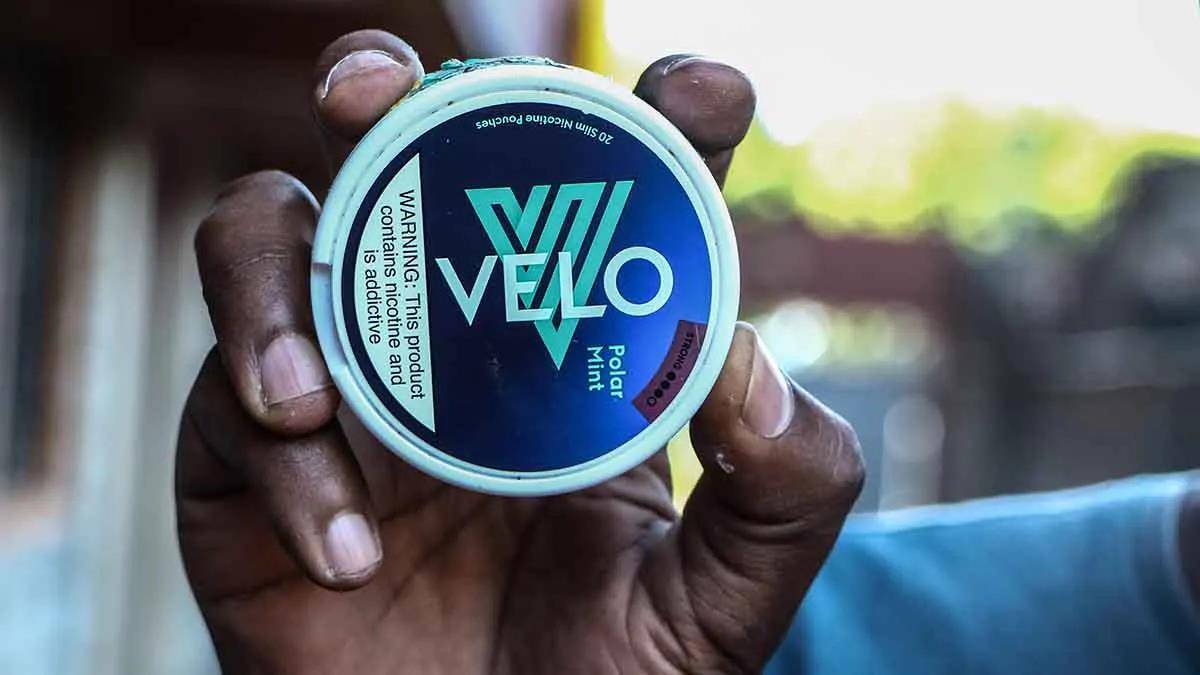
A young Nairobian Velo user shows off his pouch on social media
THE SCIENCE THEY DON’T WANT PARENTS TO READ
BAT’s position on Velo’s health profile is carefully constructed. The company describes nicotine pouches as containing ‘around 99 percent fewer toxicants than cigarettes,’ a claim based on a comparison between pouch contents and cigarette smoke, and positions the products as part of its commitment to ‘tobacco harm reduction.’ The framing is sophisticated, technically defensible in narrow comparative terms, and profoundly misleading when applied to a product being used by teenagers who have never smoked.
The scientific reality is more complicated and considerably more alarming, particularly for young users. BAT’s own internal research has found that Velo nicotine pouches contain the two most dangerous tobacco-specific nitrosamines TSNAs which are known carcinogenic compounds formed when nicotine is extracted from tobacco during manufacturing.
The company asserts these are not found in ‘quantifiable’ levels.
Scientists from Germany’s Federal Institute for Risk Assessment have pushed back directly on that framing, stating that TSNAs pose a potential health risk even at very low, non-quantifiable amounts and that manufacturers should improve their processes to eliminate carcinogenic substances entirely.
The American Cancer Society has noted that nicotine pouches are likely to contain other chemicals that may be cancer-causing, and that research on their long-term effects remains limited.
The cardiovascular evidence is unambiguous.
A November 2025 peer-reviewed study published in Frontiers in Public Health found that nicotine pouches introduce nicotine directly into the bloodstream via oral absorption, bypassing pulmonary routes and potentially intensifying systemic effects.
The nicotine content in many pouches meets or exceeds levels found in traditional cigarettes, significantly increasing addictive potential and associated cardiovascular risks. Each pouch carries as much or more nicotine than a standard cigarette, absorbed efficiently into developing teenage physiology.
The consequences for the adolescent brain are where the science becomes most devastating. The human brain continues developing until approximately the mid-twenties. Nicotine exposure during this period affects attention, learning, memory, impulse control, and mood regulation.
It alters the architecture of neural pathways in ways that increase susceptibility to addiction broadly not just to nicotine and raises the probability of progression to stronger stimulants.
The US CDC Foundation reported in November 2025 that nicotine pouch use among youth had become a serious public health risk, noting that ‘as brain development continues up to age 25, nicotine use during adolescence can harm the parts of the brain that control attention, learning, mood and impulse control.’ Stanford researchers confirmed in August 2025 that nicotine pouches ‘affect the developing brain as much as smoking or vaping.’
The World Health Organization has warned that novel nicotine pouches can double the risk for non-smokers to start smoking a finding that directly undermines the ‘harm reduction’ narrative when applied to markets like Kenya, where only 3.2 percent of 18-to-24-year-olds had smoked in the preceding month at the time the most recent national survey was conducted.
In Kenya, Velo is not reaching young people who were already smokers. It is reaching young people who were not.
A 2024 study by the National Taxpayers Association found that 7.3 percent of Kenyans now use new-generation nicotine products, up from 5.6 percent in 2022.
The highest usage rates are concentrated in wealthier urban areas Nairobi and Mombasa which are precisely the markets where Velo has been most aggressively distributed. Tobacco use already contributes to approximately 12,000 deaths annually in Kenya according to the Tobacco Control Data Initiative.
THE BUSINESS MODEL OF IRREVERSIBLE ADDICTION
To understand why BAT Kenya is betting so heavily on Velo, it is necessary to understand what the company’s financial situation would look like without it. Cigarette volumes are under siege: illicit trade has grown from 37 percent of the domestic market in 2024 to 45 percent in 2025, a trajectory that management describes as ‘unsustainable.’
The domestic cigarette business is structurally impaired. Export markets provide stability but not growth.
Operating cost cuts down nearly 16 percent in 2025 — have already delivered much of the efficiency available. Without a new revenue stream, BAT Kenya’s earnings trajectory is constrained.
Velo changes that arithmetic in a way that the cigarette business never could. Nicotine pouches historically carry gross margins of approximately 70 percent substantially higher than combustible tobacco.
They require no tobacco farming, no complex manufacturing infrastructure (BAT Kenya now imports from Pakistan), and no paper, filtration, or combustion chemistry. They are small, lightweight, and cheap to ship. The marginal cost of adding a new customer is low. The lifetime value of an addicted customer, particularly one who starts at 15 or 16, is enormous.
Finance Director Kipkemboi’s projection that Velo could represent 15 to 25 percent of total revenue within three to five years implies a business generating between KSh 3.5 billion and KSh 5.8 billion annually from oral nicotine alone, at a margin structure that would transform the company’s profitability.
That growth requires volume. Volume requires customers. And the most efficient way to acquire new customers in a market where adult smokers are an established and declining pool is to reach people who have not yet formed their nicotine preferences which means, in practice, teenagers.
The product’s discreet format, its fruity flavors, its social media virality, its informal distribution through community networks that do not check identification, and its strategic absence of warnings that might deter a young person: all of these work together as a customer acquisition system. It is not accidental. It is structural.
BAT Group’s stated ambition is to reach 50 million non-combustible product users globally by 2030. The company had reached 34 million by the end of 2025. Each new user represents, in the company’s investor presentations, a transition from a higher-risk to a lower-risk product a harm reduction success story.
What the investor presentations do not surface is the proportion of those new users who were non-smokers before they encountered Velo, or how many are Kenyan teenagers whose introduction to nicotine dependency will be measured not in months but in decades.
BAT pays shareholders KSh 7 billion. Kenya’s teenagers pay with their developing brains.
FRANCE BANNED IT. KENYA WELCOMED IT BACK.
The global regulatory picture around nicotine pouches provides a sharp contrast to BAT Kenya’s experience.
In 2025, France explicitly banned the sale of Velo, Zyn, On!, and other nicotine pouch brands by name, citing public health concerns. Several other European governments have moved to impose restrictions.
The products are regulated under pharmaceutical frameworks in a number of markets, requiring proof of efficacy as smoking cessation aids a standard that Velo does not meet, as no robust evidence supports its effectiveness as a cessation tool.
BAT is advertised on McLaren Formula One cars through its ‘A Better Tomorrow’ sponsorship deal under the Velo brand global sporting exposure for a product banned in parts of the very continent where that sponsorship is most watched.
In the UK, consumer protection requires disclosures about TSNA content that Kenyan consumers were specifically denied through five years of ministerial lobbying. In Kenya, regulatory clarity arrived not because the health evidence improved but because the political environment shifted in a direction that made commercial operation viable again.
The question for Kenyans for parents, teachers, the Ministry of Health, the Kenya Revenue Authority, and the parliamentary committees that will receive petitions about this product in the months ahead is a simple one.
If the product warranted prohibition in France, pharmaceutical regulation in several European markets, and the level of explicit advocacy from public health institutions including WHO, what has changed about the science or the ethics that makes Kenya’s teenagers an appropriate test population for its commercial scalability?
THE DIVIDEND AND THE DEBT IT DOESN’T MENTION
The record KSh 70 per share dividend that BAT Kenya shareholders approved in June 2026 is real money, flowing to real investors. BAT Plc in London received approximately KSh 4.2 billion of that total distribution, repatriating capital from a Kenyan subsidiary that serves its parent’s obligations to global investors.
The dividend was funded by a combination of 2025 net profit, retained earnings built over years of Velo-adjacent capital planning, and cash freed by the machinery sale. It is, in the language of corporate finance, a rational deployment of available capital.
What the dividend does not account for what no line in BAT Kenya’s financial statements will ever reflect is the parallel ledger being accumulated by the healthcare system, the families, the schools, and the young Kenyans themselves who are meeting the real cost of this profit recovery.
The cost of treating nicotine dependency and the cognitive impairment it causes in adolescent development.
The cost of cardiovascular conditions emerging in young adults who used nicotine pouches through their secondary school years. The cost of a generation normalized into nicotine use at precisely the age when the brain is most vulnerable to its effects.
Kenya’s tobacco mortality already stands at approximately 12,000 deaths per year.
BAT Kenya is not responsible for those deaths alone, and the causal relationship between nicotine pouches and specific health outcomes remains the subject of ongoing research.
But when a company lobbies to remove health warnings that might slow youth uptake, attempts to purchase the silence of investigating journalists, coordinates social media campaigns to neutralize public health advocacy, and then projects a growth trajectory that implicitly assumes continued expansion into a non-smoking youth population the claim that it bears no responsibility for what follows cannot be sustained.
BAT Kenya Managing Director Crispin Achola said in a February 2026 investor briefing that the resumption of Velo sales ‘represents a new revenue stream’ that will give ‘more momentum’ to company revenue. He is right. The question the shareholders enjoying their KSh 70 per share have not publicly been asked to answer is: momentum built on what, exactly, and at whose expense?
WHAT COMES NEXT
In the months since Velo returned to Kenyan shelves in July 2025, the product has moved from a novelty to an embedded feature of youth social life across Nairobi and other urban centers. Community health workers report it is now found in estates and campuses where cigarettes were rarely seen.
Teachers describe confiscating Velo tins the way a previous generation confiscated cigarettes except that the tin fits in a pencil case and produces no visible evidence of its use.
BAT Kenya is currently importing its pouches from Pakistan. It has said it may reconsider local production depending on commercial performance. The company’s global parent has reached 34 million non-combustible users and wants 50 million by 2030.
Kenya with its young, urban, social-media-connected demographic and its regulatorily permissive environment is a logical growth market for that ambition.
The question is whether the Kenyan state, having spent five years being outmaneuvered by one of the world’s most sophisticated corporate lobbying operations, has the institutional will to hold the line.
The Kenya Tobacco Control Alliance, public health advocates, and researchers at institutions including Aga Khan University have called consistently for stronger enforcement of existing laws, higher taxes on nicotine products, closure of the online sales loopholes that allowed Velo to be sold directly to teenagers, and mandatory age verification across all distribution channels.
None of these measures would require new legislation. All of them would require a Ministry of Health willing to resist the economic pressure that BAT has demonstrated, in writing, it is prepared to apply.
For now, the product is back. The profits are rising. The dividend has been paid. And in a secondary school somewhere in Nairobi, Mombasa, or Kisumu, a student who will never appear in any of BAT Kenya’s financial disclosures is developing a nicotine dependency that the company’s own science buried in its internal research, never shared with Kenyan regulators in full tells it will last for decades.
This is what the record dividend is built on. It should make everyone uncomfortable.
Kenya Insights allows guest blogging, if you want to be published on Kenya’s most authoritative and accurate blog, have an expose, news TIPS, story angles, human interest stories, drop us an email on [email protected] or via Telegram




US-Iran Agreement: Key Details Revealed

Generation Hooked: How BAT Kenya Built a Profit Machine on Teenage Addiction

The Enemy Within: How Old Mutual’s Own Staff and Rotten Systems Are Draining Kenya’s Insurance Giant

THE GRAND MULLAH AND THE PIPELINE : How Ahmednasir Turned a Lebanese Contractor’s Legal Battle into a Multi-Billion-Shilling Machine Against a State Corporation

Finance Bill 2026 ‘Rushed’ Through Second Reading Without Our Input – Opposition MPs

Sh2 Billion Victims Pay Threatens to Split UDA-ODM Pact

Sifuna Removed From Lucrative Senate Energy Committee Chaired By Oburu

‘I’m The Boss’, Trump Tells G7 Counterparts

Equatorial Guinea Govt Resigns After Failing To Meet Targets

Media Council Puts Kameme FM On Notice Over Offensive Content and Ethnic Incitement

Businessman Philip Waithaka Kinuthia’s Minor Son Allegedly Drove Drunk, Killed Two Peponi Students in Ngong Road Horror Crash as Claims of Cover-Up Intensify

Inside NCBA’s Decline: How a Banking Giant Lost Its Strategic Edge

Cement, Cash and Courts: How the Hashu Dynasty Crushed the Ramji Brothers for Fourteen Years and Why the Walls Are Now Closing In

Standard Chartered Ghosts Haunt Joshua Oigara At Stanbic As Whistleblower Spills Beans

Inside The Urban Planning Cartel That Owns Nairobi

South Sudan: Adut Salva Kiir’s Shadow Treasury Exposed

Why John Ngumi Is Running From the EACC and Why the Sh415 Million Payday May Be the Least of His Worries

The President’s Daughter and The Missing Witness: How Adut Salva Kiir’s Shadow Treasury Silenced Its Most Dangerous Critic

How Adil Popat Saved His Empire On The Eve Of Imperial Bank Collapse and Why Kenya’s Mainstream Media Buried The Story

Betika Faces DCI Probe, Directors Arrest and License Revocation Over Massive 29.5 Million Safaricom Customers’ Data Breach
-
 News3 days ago
Businessman Philip Waithaka Kinuthia’s Minor Son Allegedly Drove Drunk, Killed Two Peponi Students in Ngong Road Horror Crash as Claims of Cover-Up Intensify
-
 Business1 week ago
Inside NCBA’s Decline: How a Banking Giant Lost Its Strategic Edge
-
 Investigations2 weeks ago
Cement, Cash and Courts: How the Hashu Dynasty Crushed the Ramji Brothers for Fourteen Years and Why the Walls Are Now Closing In
-
 Business7 days ago
Standard Chartered Ghosts Haunt Joshua Oigara At Stanbic As Whistleblower Spills Beans
-
 Investigations2 weeks ago
Inside The Urban Planning Cartel That Owns Nairobi
-
 Africa6 days ago
South Sudan: Adut Salva Kiir’s Shadow Treasury Exposed
-
 Business6 days ago
Why John Ngumi Is Running From the EACC and Why the Sh415 Million Payday May Be the Least of His Worries
-
 Africa7 days ago
The President’s Daughter and The Missing Witness: How Adut Salva Kiir’s Shadow Treasury Silenced Its Most Dangerous Critic