
Business
The Great Mogo Extraction: How a Latvian Fintech Built a Debt Trap for Kenya’s Most Vulnerable Borrowers and Got Away With It
A Thika courtroom just tore open the numbers. A class action represents thousands. A regulator has fined and been ignored. The Central Bank of Kenya has stayed silent. And a Latvian parent company celebrated record profits while its Kenyan borrowers lost their motorcycles, their cars, and their livelihoods.

Court: Thika Small Claims Court, ruling delivered 2 June 2026
Judge: Honourable Jamlick Muriithi Mwenda
Interest rate found exploitative: 86.4% effective annual rate, exclusive of additional charges
Mogo’s claim: Ksh677,381 on a Ksh400,000 loan after borrower paid Ksh299,369
Judgement entered: Ksh100,631 only, capped by the in duplum rule
CAK penalty (October 2024): Ksh10,851,473.20 for false and misleading representation
Class action pending: High Court Nairobi, filed October 2025, Nderitu, Gikonyo & Wangari v Mogo Auto
Parent company: Eleving Group S.A., Latvia/Luxembourg
Eleving Group net profit 2024: EUR 29.6 million, historically best performance
A Reckoning Four Years in the Making
On the morning of 2 June 2026, Honourable Jamlick Muriithi Mwenda, presiding at the Thika Small Claims Court, put into precise and public language what thousands of Kenyans have been saying in Facebook groups, WhatsApp chains and consumer complaint portals for the better part of four years.
Mogo Auto Limited, the Kenya arm of Latvia-headquartered Eleving Group, did not merely charge high interest rates. It charged a rate that the court declared, in plain English on the record, was exploitative. The word is important. Courts are not given to hyperbole. When a Kenyan judge calls a lending rate exploitative, it is because the numbers have spoken and there is no other word available.
The case of Aziz Daniel Odoyo seems simple. In June 2022, Mogo advanced him Ksh400,000 under an asset financing agreement. He paid Ksh299,369 before defaulting. The security went missing. Mogo then walked into court demanding Ksh677,381 together with interest and costs.
The court, applying the in duplum rule, a principle of law that caps recoverable interest at the amount of the original principal, entered judgement for only Ksh100,631. Mogo’s demand had collapsed under scrutiny. But the implications of that collapse extend far beyond one borrower and one court.
“An effective interest rate of 86.4 per cent, exclusive of additional charges, is nothing short of exploitative.” — Hon. Jamlick Muriithi Mwenda, Thika Small Claims Court, 2 June 2026
What the Thika ruling has done, with clinical brevity, is to give every other Kenyan trapped in a Mogo contract a legal weapon, a living precedent, and a roadmap. It has also handed regulators, including the Central Bank of Kenya which Mogo itself cites as its overseer, grounds for a targeted intervention that can no longer be avoided.
The Architecture of a Debt Trap
Mogo Auto Limited is a subsidiary of Eleving Group, a fintech company founded in Latvia in 2012, domiciled in Luxembourg, and listed on multiple bond markets where it raises capital from European institutional investors on the promise of responsible financial inclusion. In Kenya, where the company has issued its 150,000th loan and injected what it claims is Ksh25 billion into the economy, the operating model is straightforward in marketing and opaque in execution.
The company targets what it calls underserved communities: boda boda riders, tuk-tuk operators, small traders, gig workers and individuals who need car financing but lack access to conventional bank credit. The pitch is speed. Loans in 12 hours. No complex requirements. A vehicle as security. The target market is people who cannot afford to read the fine print slowly and who have no independent legal advice when they sign.
What the contracts deliver, as documented across regulatory findings, court records and witness testimony, is a lending structure designed to maximise extraction while maintaining sufficient legal complexity to confuse borrowers and intimidate courts. The Competition Authority of Kenya, after investigating complaints from four borrowers between May 2023 and April 2024, identified the following practices as proven and found them to constitute false and misleading representation and unconscionable conduct under the Competition Act Cap 504.
Dollar Indexing of Shilling Loans
Loans are disbursed in Kenya shillings. But the underlying calculations, balances and effective repayment obligations are tabulated with reference to the US dollar. When the shilling weakens, as it has done dramatically and repeatedly over the past four years, borrowers who paid every instalment on time find their outstanding balance rising in shilling terms. The Competition Authority found this practice applied to multiple complainants. One borrower took a Ksh300,000 facility in July 2021 and repaid for 20 months. When he asked for a statement, the balance shown was Ksh392,000, computed in US dollars despite the loan having been disbursed in shillings.
A second complainant discovered that the loan agreement, which was withheld during initial negotiations, captured two currencies simultaneously. When challenged, Mogo described the dollar tabulation as being for record-keeping purposes only. It was not. When the shilling fell, the dollar tabulation became the operative figure. The Competition Authority found that Mogo had gone ahead to calculate amounts payable in US dollars in defiance of what any reasonable borrower would have understood the agreement to mean.
Flat Rate to Reducing Balance Switches
Interest calculation methods were shifted without proper disclosure. Borrowers who agreed to a flat rate found their accounts recalculated on a reducing balance basis, or the reverse, depending on which method generated a higher recoverable sum. The Competition Authority’s investigation documented this practice directly. No clear borrower consent was obtained. The result, predictably, was that outstanding balances grew in ways that borrowers could not understand or challenge because the methodology had changed beneath them.
Compulsory Insurance Premium Bundling
All borrowers are required to maintain insurance. In itself this is not unusual for secured lending. What is unusual is the mechanism. Mogo arranges and pays bulk insurance premiums for its entire portfolio and then charges individual borrowers for this bundled arrangement in ways that inflate the effective cost of the loan without that cost being transparently disclosed as part of the interest calculation. The Competition Authority found that borrowers were charged for insurance cover in a manner that concealed the true cost of borrowing. Court records in the Wanjiku case at the High Court confirm Mogo made bulk insurance payments covering motorcycles, tuk-tuks and vehicles simultaneously, with individual borrowers effectively subsidising a group arrangement they never agreed to individually.
Post-Signing General Provisions
Borrowers have reported receiving additional contract documents after signing the principal loan agreement. These General Provisions documents impose further obligations and modify the terms under which Mogo can enforce its security. Because borrowers have already signed the primary agreement and received their funds, the leverage to negotiate or refuse is gone. The presentation of material contractual terms after disbursement is a practice that no court applying principles of fairness can easily defend.
Mogo’s own witness at the High Court failed to produce evidence that the company was licensed to issue loans and charge interest at the rates applied. The court found the interest rate unconscionable.
The Bodies Are Already Piling Up in Court
The Odoyo ruling at Thika is not the first time Mogo has lost in a Kenyan court on the question of its conduct. What is remarkable, given the volume of litigation the company generates, is how consistent the adverse findings have been across different courts, different judges and different borrowers.
Mogo Auto Limited v Ochola (Civil Appeal E071 of 2023)
In a ruling delivered on 4 May 2023, the High Court held that Mogo had repossessed a vehicle without giving the borrower notice. The court found that the absence of notice made the repossession illegal regardless of whether the interest rate was exorbitant or not. The court went further: repossessing without notice and without proper valuation was in breach of the agreement between the parties. The case established a principle that Mogo’s repossession teams, operating on the ground across Kenya, were not following legally required procedures.
Mogo Auto Limited v Otianga (Civil Appeal E036 of 2024)
On 22 October 2024, the High Court heard an appeal in which the borrower had paid Ksh1,400,000 toward her loan only to face a demand for a further Ksh979,985 from Mogo. When she asked for clarification on how the interest had been calculated, the company withheld the information and instructed auctioneers to repossess her vehicle.
The High Court found no proof of service of notice prior to repossession, set aside the repossession order, and directed Mogo to follow legal procedures before any future enforcement. The auctioneer was found to have failed to satisfy himself that notice had been properly issued.
Costs of the repossession, found to be illegal, were borne by each party individually.
In this same case, the court found that the respondent’s witness from Mogo failed to produce evidence that the company was licensed to issue loans and charge interest at the rates it had applied. This is a detail that should concern the Central Bank of Kenya directly.
Wanjiku v Mogo Auto Limited (Civil Appeal E816 of 2023)
This case, decided at the High Court on 31 October 2024, involved a borrower whose motorcycle had been robbed. The dispute centred on insurance obligations and repossession.
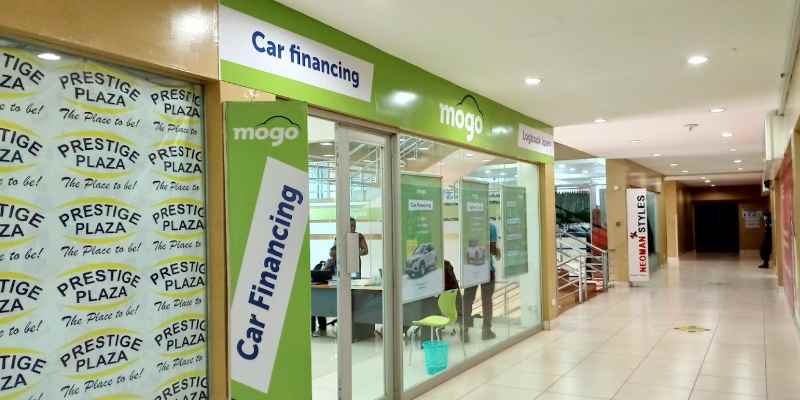
Mogo office.
Court records confirmed that Mogo was making bulk insurance payments covering large numbers of its vehicles simultaneously while individual borrowers believed they held separate, individually arranged policies. The registered owner of the motorcycle in the log book was Mogo Auto Limited, not the borrower who was paying for it.
Beyond these documented cases, Kenya Law records show Mogo involved in appeals and rulings across courts in Nairobi, Siaya, Kisumu, Nakuru and Nyeri, with dates ranging across 2023 and 2024.
This is not a company with a handful of difficult customers. This is a company generating a volume of litigation that speaks to a systemic problem with its lending model.
The Competition Authority Acted. Mogo Carried On.
In October 2024, following an investigation into four customer complaints received between May 2023 and April 2024, the Competition Authority of Kenya issued a formal determination against Mogo Auto Limited. The findings were unambiguous. Mogo had violated sections 55(b)(i), 56(1) and 56(3) of the Competition Act by engaging in false and misleading representation and unconscionable conduct against its customers.
The penalty imposed was Ksh10,851,473.20. Mogo was also ordered to refund Ksh344,939 to three specific complainants for excess amounts charged due to currency manipulation and incorrect interest calculations. The company was directed to refrain from misrepresenting facts to clients, to amicably resolve all pending complaints, and to ensure that all staff completed consumer compliance training by 30 August 2025.
The CAK settlement was presented to the public as evidence of regulatory vigilance. What it was, in practice, was a cost of doing business. The fine of Ksh10.8 million represents, at today’s exchange rates, approximately EUR 83,000.
For a company that recorded a net profit of EUR 29.6 million in 2024 alone, described by its own management as historically the best performance ever, the penalty was a rounding error. No borrower received more than a token refund. No systemic change to the lending model was imposed. No audit of the entire loan portfolio was ordered. No compensation mechanism was established for the thousands of borrowers who were not among the four who complained to the Authority.
Eleving Group recorded EUR 29.6 million in net profit in 2024, its strongest ever performance. The CAK fine against its Kenyan subsidiary was EUR 83,000. The maths of impunity is not complicated.
By October 2025, barely a year after the CAK determination was issued and with the compliance training deadline of August 2025 having just passed, three borrowers filed a class action at the High Court in Nairobi alleging that precisely the same practices continued unchanged.
Caroline Nderitu, Wilson Mbogo Gikonyo and Joseph Muraya Wangari, represented by lawyer Simon Mburu, petitioned the court to represent thousands of similarly affected customers and sought a declaration that Mogo’s lending model was unlawful.
Their pleadings read like a list of the very practices the CAK had already penalised. Dollar indexing of shilling loans. Bundling of compulsory insurance premiums. Concealment of true interest rates.
Repossession of vehicles and motorcycles without due process, applied indiscriminately and systematically to all borrowers.
The class action is before Justice Freda Mugambi. It had not concluded at the time of writing.
Mogo’s response to the class action was to brand it a sensationalist attack designed to destroy its reputation. The company argued that each borrower’s situation involves individualised contractual and factual issues that cannot be resolved through a single proceeding.
This argument is notable for its candour. What it amounts to is an argument that the only way to challenge Mogo’s practices is for each of its tens of thousands of Kenyan borrowers to individually litigate against a company with a legal team and a European corporate structure. This is precisely the argument that class action suits exist to defeat.
The Borrowers Whose Stories Will Not Make the Mainstream
James Omondi borrowed Ksh100,000 from Mogo in 2023 to grow his boda boda business in Nakuru. After paying Ksh75,000, his motorcycle was repossessed. He had no prior notice. His sole source of income disappeared overnight. He was subsequently listed as a defaulter on the Credit Reference Bureau despite, by his account, having paid over three-quarters of his principal. His credit profile is now damaged in ways that will affect his access to any formal financial product for years.
A female borrower in Nairobi took a Ksh425,000 loan from Mogo in 2022. Over two years she paid over Ksh700,000. When she asked for a statement, the balance shown was Ksh495,385. She had paid more than the original principal in interest alone and her debt had grown. Her attempts to get clarification from Mogo’s staff were met, by her account, with rudeness and stonewalling. She described herself as exhausted from an endless debt trap.
Another client reported paying Ksh400,000 in interest over eight months on a Ksh750,000 loan, crippled by a combination of an already high rate and the invisible compounding effect of dollar indexing during a period when the shilling was weakening sharply. He had not been told, when he signed, that his shilling loan was effectively a dollar obligation.
Caroline Nderitu, one of the three named plaintiffs in the High Court class action, described her vehicle being seized in a public place by men who did not properly identify themselves as Mogo agents while she was on a work errand. No prior notice of repossession was produced. No independent valuation of the vehicle was conducted before it was taken and later sold. The proceeds of sale were applied to a debt calculation she had never been able to verify or challenge.
These are not isolated incidents or the complaints of borrowers who misunderstood their contracts. They are the predictable, documented output of a system that the Competition Authority found to be false and misleading, that multiple courts have found to involve illegal repossessions, and that a Thika magistrate has now formally characterised as exploitative.
What the Eleving Group Tells Investors About Kenya
While its Kenyan borrowers were losing motorcycles and watching their balances grow despite making payments, Eleving Group was issuing investor communications that painted a rather different picture of its African operations.
In May 2024, Eleving Group signed a letter of intent with the United States International Development Finance Corporation for a USD10 million loan to finance Mogo Kenya’s electric motorcycle programme.
The DFC, a US government agency, lends to companies that demonstrate commitment to development impact and responsible business practices. The application described Mogo’s e-boda programme as aligned with sustainability goals and financial inclusion in underserved Kenyan communities.
In its 2024 Integrated Annual Report, published in April 2025, Eleving Group announced that it was deploying an Environmental Social Management System across its Kenyan branch network in collaboration with Ibis Consulting ESG advisors and Verdant Capital.
The report described the group as operating in 16 markets on three continents, encouraging financial inclusion and upward social mobility in underserved communities around the globe.
The same report disclosed that 34 percent of the group’s total loan portfolio is located in Africa. Africa, for Eleving Group, is not a sideshow. It is more than a third of the entire business. And within Africa, Kenya, where Mogo has issued 150,000 loans, is the flagship market.
A US government development finance agency lent Mogo USD10 million in 2024 for financial inclusion. At the same time, Kenyan courts were finding Mogo’s repossessions illegal and its interest rates exploitative.
The gap between what Eleving Group says to European and American institutional investors about its African operations and what Kenyan courts and regulators have documented about those same operations is not a minor discrepancy. It is a material gap that anyone providing development capital or holding Eleving Group bonds listed on European exchanges should consider carefully.
Eleving Group’s senior secured bonds trade on the European market.
The company raises debt capital partly on the strength of its African portfolio. If that portfolio is being built on lending practices found by courts and regulators to be exploitative, misleading and unconscionable, then the risk profile of that portfolio is materially different from what the investor-facing narrative suggests.
The Central Bank of Kenya: A Regulator Collecting Rent
Mogo Auto Limited is licensed by the Central Bank of Kenya.
The company cites this licence prominently in its marketing and in its court pleadings as evidence of regulatory compliance and legitimacy. The CBK’s Digital Credit Providers Regulations 2022 were specifically introduced to bring non-bank digital and asset lenders under tighter oversight.
What the CBK has done with that oversight, in Mogo’s case, is difficult to determine because the regulator has said almost nothing publicly.
The CAK’s October 2024 determination, delivered against a CBK-licensed entity for false and misleading lending practices, does not appear to have triggered any formal CBK response.
The Thika court’s June 2026 ruling, explicitly finding the interest rate charged by a CBK-licensed lender to be exploitative, has not, at the time of writing, generated any statement from the CBK.
This is a regulatory failure of the first order. The CBK’s mandate is not merely to process licence applications. It includes ensuring that licensed lenders comply with fair lending standards, that interest rates are transparently disclosed, and that borrowers in the markets CBK oversees are protected.
A licence granted and then effectively abandoned is not regulation. It is the appearance of regulation deployed to give a predatory lender a veneer of official approval.
The Competition Authority’s finding that a CBK-licensed entity engaged in unconscionable conduct should have triggered a joint review. The court finding of an 86.4 percent effective interest rate on a loan issued by a CBK-licensed entity should trigger an immediate licence review. The failure to act is not a technical matter. It is a policy choice with direct consequences for thousands of Kenyan borrowers.
What Borrowers Already Inside These Contracts Must Do
The Odoyo ruling is a practical tool, not merely a news story. For any borrower currently holding a Mogo loan and facing a growing balance that appears disconnected from the amount they originally borrowed, the following steps are urgent.
First, gather every document in your possession. This means the original loan agreement, every statement ever received, every payment receipt, every SMS or email from Mogo, and any additional documents signed after the initial agreement. If you signed General Provisions documents after your loan was already disbursed, preserve those separately.
Second, calculate what you have actually paid against the original principal. Add up every payment. Subtract from the original loan amount. If the balance Mogo shows you is higher than what remains after this simple calculation, there is a problem that a court will listen to.
Third, look for any reference to US dollars in your statements or correspondence. If your shilling loan is being tracked in dollars, that is the precise practice the Competition Authority has already found to be false and misleading. It is also directly analogous to what the Thika court found exploitative.
Fourth, file a complaint simultaneously with the Competition Authority of Kenya and the Central Bank of Kenya. The CAK has already demonstrated willingness to investigate and penalise Mogo. More complaints with more documentation strengthen the case for a comprehensive audit of the entire loan portfolio rather than individual settlements.
Fifth, if Mogo has already repossessed your vehicle, review whether proper notice was given and whether an independent valuation was conducted before sale.
The High Court rulings in Ochola and Otianga have already established that repossession without notice is illegal. If no notice was served, the repossession may be challengeable.
Sixth, if you are a boda boda rider, trader or gig worker with a Mogo loan and you are in contact with others in the same situation, consider joining the class action already before the High Court.
The petition filed by Nderitu, Gikonyo and Wangari seeks to represent all similarly situated borrowers. Joinder in a class action is significantly cheaper and more powerful than individual litigation.
What Regulators Must Do Before Another Lender Follows This Playbook
The CBK must conduct a targeted review of Mogo Auto Limited’s entire Kenyan loan portfolio. This review should examine whether all loans are denominated and calculated entirely in Kenya shillings, whether effective interest rates including all compulsory add-ons have been disclosed in writing before disbursement, whether repossession procedures have followed the legal requirements for notice and independent valuation, and whether the insurance bundling arrangements meet the standards required for transparent consumer disclosure.
The CAK should treat the continuing pattern of complaints following its October 2024 determination as evidence that the penalty imposed was insufficient to change conduct. The authority has power to investigate repeat offenders and escalate sanctions. A fine calculated as a fraction of one year’s profit is not a deterrent. It is a licence fee.
Parliament, which has already debated predatory lending targeting boda boda operators, should note that the Thika ruling provides a factual record, not anecdote. A court, applying law, found an effective rate of 86.4 percent on a shilling loan issued by a licensed lender. The Digital Credit Providers Regulations 2022 were meant to prevent precisely this. If those regulations have been insufficient, the legislative response is obvious.
Development finance institutions, including the US DFC which signed a letter of intent with Eleving Group in 2024, and any European bondholder providing capital to the Mogo brand, should require that their investment be conditioned on independent verification of lending practices in Kenya. Development capital provided to fund exploitation of boda boda riders in Nakuru is not financial inclusion. It is subsidised extraction.
A regulator that licenses, fines, trains and then says nothing while courts find the same conduct ongoing has not regulated anyone. It has charged a processing fee.
The Scoreboard
Mogo has been found by the Competition Authority of Kenya to have engaged in false and misleading representation and unconscionable conduct. It has been fined Ksh10.85 million. It has been ordered to refund borrowers and reform its practices. Its staff were ordered to complete consumer compliance training by August 2025.
A class action representing potentially thousands of borrowers is pending before the High Court. Courts across at least five jurisdictions in Kenya have found Mogo’s repossessions to be illegal, its interest calculations to be unconscionable and its accounting to be incapable of explanation. A Thika magistrate has called the interest rate exploitative in a published ruling.
Meanwhile Eleving Group, Mogo’s Latvian parent, recorded its strongest ever annual financial performance in 2024, with a net profit of EUR 29.6 million. The group’s African loan portfolio, of which Kenya is the centrepiece, represents 34 percent of the total business. The group is listed on European bond markets and has received development finance commitments from US government institutions. It describes itself, in investor documents, as a company encouraging financial inclusion and upward social mobility in underserved communities.
The people living in those underserved communities, the boda boda rider in Nakuru who paid Ksh75,000 and lost his motorcycle, the woman in Nairobi who paid more than Ksh700,000 and still has a growing balance, the man who watched Ksh400,000 in interest leave his account in eight months, have not seen the upward social mobility in the investor pitch deck. They have seen the inside of a court room, or they have not, because they could not afford it.
The Thika ruling is a crack in a carefully maintained dam. Every borrower with a Mogo contract, every regulator who has ignored a complaint, every development finance official who read the ESG report and signed the funding letter, and every bond investor who priced the Eleving paper should now go back to the primary sources: the court records, the CAK determination, and the words of Honourable Jamlick Muriithi Mwenda.
Nothing short of exploitative.
That is on the record. Everything else is noise.
Kenya Insights allows guest blogging, if you want to be published on Kenya’s most authoritative and accurate blog, have an expose, news TIPS, story angles, human interest stories, drop us an email on [email protected] or via Telegram










Why All Eyes Are On Gambling Authority CEO Peter Karimi As Kenya’s Betting Firms Race To Beat The June Licence Renewal Deadline

The Deal Behind Nairobi Animal Orphanage: Is This Really About Animals Or Billions In Prime Park Land

The Great Mogo Extraction: How a Latvian Fintech Built a Debt Trap for Kenya’s Most Vulnerable Borrowers and Got Away With It

Iran Launches Missiles At Israel For First Time Since Mideast Truce

MozzartBet Faces Licence Cancellation For Operations in Kenya Amid Tax Evasion, Money Laundering Scandals As Rumours Swirl Of Sh100M Bribery To Evade Trap

Rogue Developers, Engineers, Architects and City Hall Officials Charged Over Deadly Manzil Towers Collapse

Kalonzo Unveils His 2027 Presidential Campaign Platform

Artur Margaryan of Kenya’s Infamous Artur Brothers Seeks Prime Minister’s Office in Armenia

Sonko Re-Elected Head of Party

US Denied Visas to Team Officials for World Cup – Iran

Cement, Cash and Courts: How the Hashu Dynasty Crushed the Ramji Brothers for Fourteen Years and Why the Walls Are Now Closing In

Why Ruto’s Favourite Candidate Adan Mohammed Could Be Locked Out of the KRA Top Job

Inside The Urban Planning Cartel That Owns Nairobi

LifeCare on the Brink: SHA Fraud, Stolen Wages, and the Rotten Empire Jayesh Saini Built

Este Medical Kenya Fights American’s Explosive Complaints

Safaricom’s Sh1.4 Billion Reckoning: How Kenya’s Most Profitable Company Stole a Man’s Idea and Got Caught

The Rot Inside Absa: How Bank Insiders Are Looting Nairobi’s Customers

Inside FAFSA Fraud: How Kenyan Cybercriminals Siphoned Millions from America’s Sh12 Billion Student Loan System

THE INSURER THAT TOOK YOUR PREMIUM AND FORGOT YOUR NAME: How ICEA Lion Left a Client Begging for Sh7.8 Million Across Four Months

Denial Under Duress: The Untold Collapse Threatening David Lagat’s DL Group’s Empire
-
 Investigations3 days ago
Cement, Cash and Courts: How the Hashu Dynasty Crushed the Ramji Brothers for Fourteen Years and Why the Walls Are Now Closing In
-
 Investigations2 days ago
Inside The Urban Planning Cartel That Owns Nairobi
-
 Investigations2 weeks ago
LifeCare on the Brink: SHA Fraud, Stolen Wages, and the Rotten Empire Jayesh Saini Built
-
 News2 weeks ago
Este Medical Kenya Fights American’s Explosive Complaints
-
 Americas2 weeks ago
Inside FAFSA Fraud: How Kenyan Cybercriminals Siphoned Millions from America’s Sh12 Billion Student Loan System
-

 Investigations7 days ago
Betika Faces DCI Probe, Directors Arrest and License Revocation Over Massive 29.5 Million Safaricom Customers’ Data Breach
-

 News1 week ago
Eight Students Arrested In Kenya After Suspected Deadly School Arson Attack
-
 Investigations3 days ago
Fresh Move Launched to Remove Kenya Railways MD Mainga From Office After Awarding Sh817 Million Consultancy Contract