
Investigations
KETRACO CEO Advert Marred By Controversies As Fears Grow That Kipkemoi Kibias Is A Predetermined Candidate
KETRACO’s board cancelled the CEO advert after a Nairobi law firm threatened court action over illegal qualification requirements — and suspicions are hardening that the entire exercise was engineered to crown the incumbent acting head without real competition.

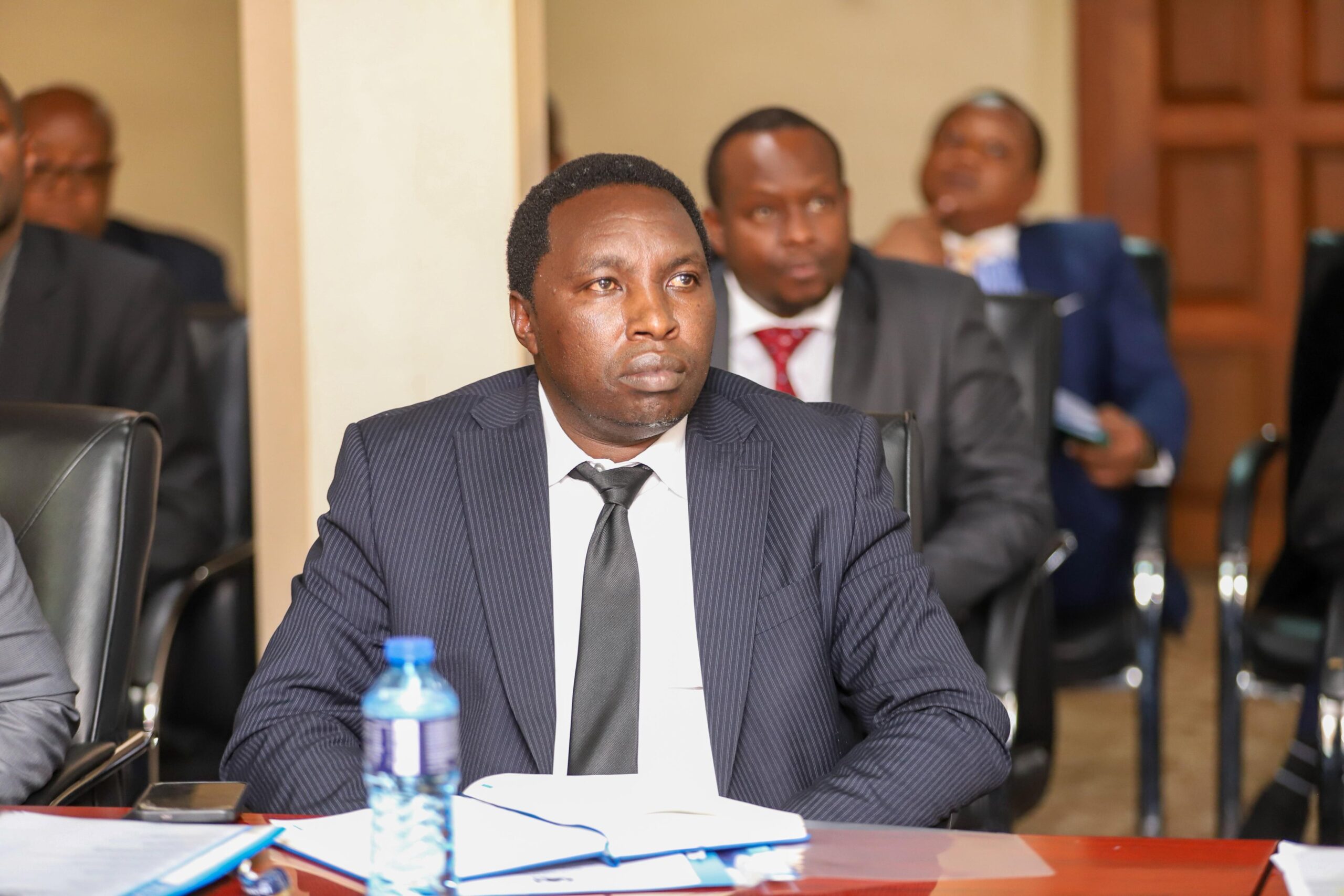
In what has rapidly crystallised into one of the most brazen governance scandals to hit Kenya’s energy sector in recent memory, the Kenya Electricity Transmission Company — KETRACO — has been forced to cancel its advertisement for a substantive Managing Director and Chief Executive Officer in circumstances that point, with disturbing clarity, to a recruitment process that was rigged before it began.
The cancellation, announced in a terse one-paragraph public notice on April 23, 2026, came barely seventy-two hours after a Nairobi law firm fired a blistering demand letter at the board, threatening immediate court action unless the illegal advert was withdrawn.
The board, rather than defending its position, capitulated without so much as an explanation. The silence is deafening — and for many Kenyans who have watched state corporations descend into patronage swamps, it speaks louder than any press statement ever could.
At the centre of this unfolding scandal is a single, explosive question: was the entire CEO recruitment exercise designed from the outset to deliver one predetermined outcome — the formal installation of Eng. Kipkemoi Kibias, who has held the acting CEO title since September 2025? The evidence accumulating around this recruitment attempt, from an illegally inflated qualifications bar to a truncated advertisement window, strongly suggests the answer is yes.
The board, rather than defending its position, capitulated without so much as an explanation. The silence is deafening.
THE ADVERT THAT SHOULD NEVER HAVE BEEN PUBLISHED
KETRACO published its advertisement for the Managing Director and Chief Executive Officer — Job Grade KET 1 — in the print media on April 7, 2026. On its face, it was a routine public sector job advert. Beneath the surface, it was a legal catastrophe waiting to happen.
Kenya Insights has reviewed the advertisement and the subsequent legal challenge in detail, and the problems are numerous, layered and, taken together, difficult to explain as anything other than deliberate manipulation.
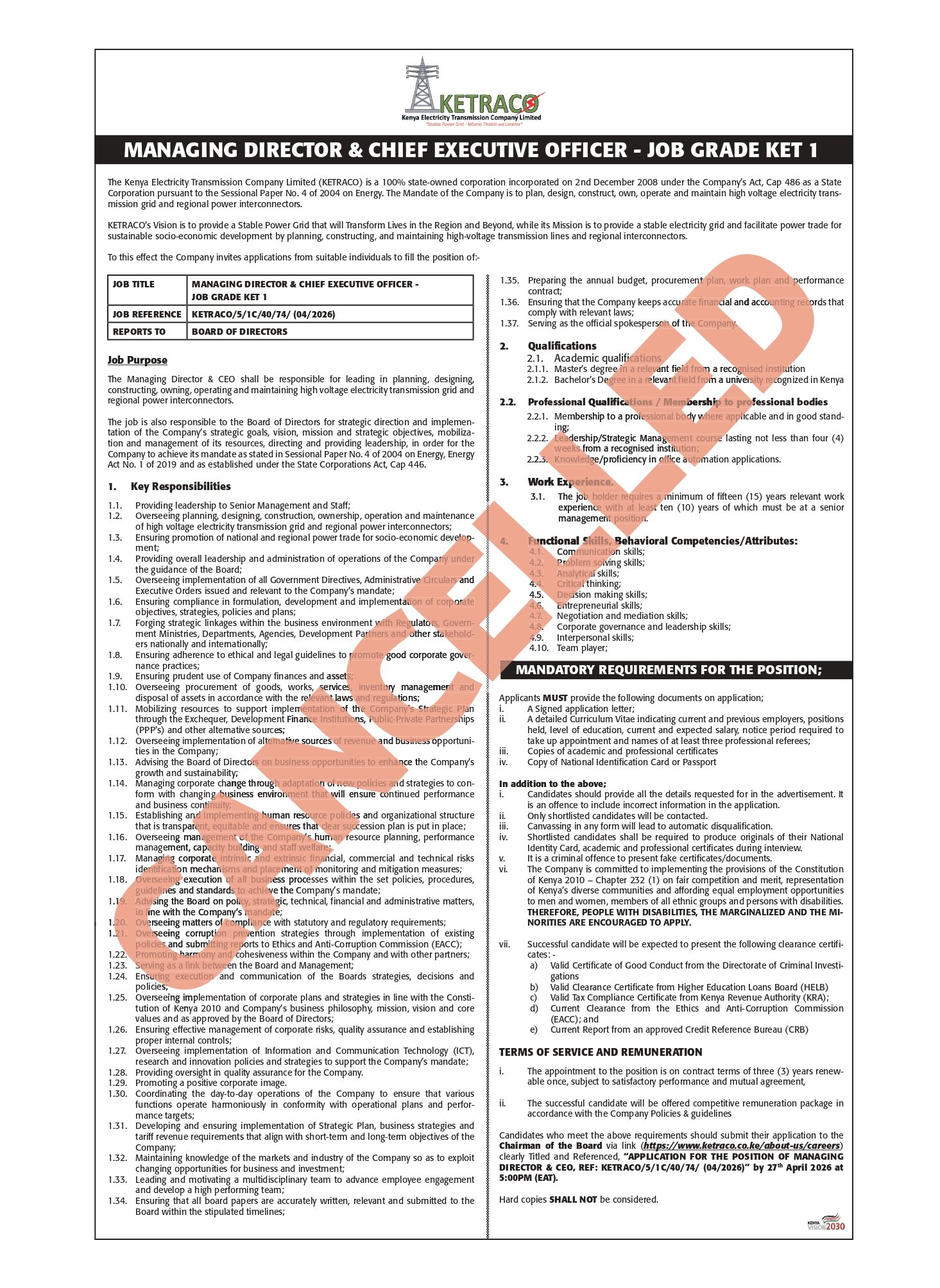
The most explosive allegation concerns the qualification requirements the board inserted into the advert.
The Government-Owned Enterprises Act, No. 25 of 2025 — the very law Parliament passed to clean up Kenya’s chronically abused parastatal appointment system — sets out the minimum statutory qualifications for CEO appointments at state corporations in unambiguous terms under Section 22(3).
Those requirements are a degree in a relevant field from a recognised Kenyan university, at least ten years of relevant work experience, a minimum of five years in a senior management role, and compliance with the integrity requirements of Chapter Six of the Constitution.
That is the complete list. Parliament did not add to it.
The Mwongozo Code of Governance for State Corporations, the long-standing ethical blueprint for parastatal conduct, is equally silent on anything beyond those parameters.
Yet the KETRACO board, in its wisdom, went further.
The advert reportedly demanded a Master’s degree as a mandatory baseline — an elevation above the statutory degree requirement — and set significantly higher thresholds for years of experience and management tenure.
And then there was the Credit Reference Bureau requirement.
The board demanded that any successful candidate present a current CRB clearance report from an approved bureau.
This requirement appears nowhere in the GOE Act, nowhere in Mwongozo, and nowhere in any public service regulation applicable to this class of appointment. It was inserted by the board on its own volition, without legal authority.
The CRB clause was not an oversight. It was architecture — a carefully constructed filter designed to thin the competitive field.
The CRB clause was not an oversight. It was architecture — a carefully constructed filter designed to thin the competitive field. In an economy where millions of ordinary Kenyans carry CRB listings for loans as modest as mobile phone credit facilities, demanding a clean bureau report as a gatekeeping instrument for a CEO appointment is a crude but effective way to disqualify candidates without appearing to target them by name.
The suspicion, now openly circulating among energy sector insiders and gaining traction in public discourse, is that Eng. Kibias — a career KETRACO insider who rose through the system as General Manager for System Operation and Power Management — could sail through such scrutiny in a way that some external competitors might not.
Beyond the qualifications issue, the demand letter received by the KETRACO board flagged a second, distinct procedural violation: the advertisement ran for only twenty days, from April 7 to April 27, 2026.
The Public Service Commission Human Resource Policies and Procedures Manual mandates that vacancies at this level be advertised for a minimum of twenty-one days.
The KETRACO advert fell one day short of that statutory floor.
One day short — and yet that single day is the difference between a lawful process and an illegal one. Coming on top of the illegal qualification additions, this shortfall can only be read as evidence of a board that was in a hurry, and was not particularly worried about getting the details right because it did not expect to be challenged.
THE LAW FIRM THAT PULLED THE PIN
The challenge came on April 22, 2026, when Kenya Electricity Transmission Company Ltd received a formal demand letter addressed to the Chairman, Capt. Mohamed M. Abdi, and copied to Cabinet Secretary for Energy Opiyo Wandayi.
The letter was from a Nairobi law firm writing on behalf of a client, and was signed by Francis Awino.
The firm’s identity and the identity of its client are significant: this was not a disgruntled applicant lodging a personal grievance, but a structured legal intervention with specific constitutional and statutory anchors.
The letter was systematic and forensic.
It identified the legal framework — the GOE Act 2025 — specified the precise statutory minimum thresholds under Section 22(3), enumerated the ways in which the KETRACO advert materially deviated from those thresholds, flagged the twenty-day advertising period as falling short of the twenty-one-day minimum, and declared the entire advertisement fundamentally defective, tainted with illegality and liable to challenge.
The letter invoked constitutional principles: fairness, transparency, competitiveness and the rule of law.
It then gave the board a seven-day ultimatum — running to April 29, 2026 — to withdraw the advert and re-advertise the position in full compliance with the law.
The letter left no room for negotiation.
It stated plainly that the board lacked the legal mandate to alter or dilute the statutory minimum requirements, and that any deviation from those requirements was unlawful, null and void. It warned that failure to comply would result in the immediate institution of appropriate legal proceedings, at the board’s sole risk as to costs and consequences.
The KETRACO board did not wait to be taken to court. It cancelled the advert within a day. That speed of compliance is itself an admission.
The KETRACO board did not wait to be taken to court. It cancelled the advert within a day. That speed of compliance is itself an admission — that the board knew, or was advised by counsel, that it could not defend the advert in court.
Any board that was confident in the lawfulness of its advertisement would have sought legal opinion, issued a public rebuttal, or at minimum waited out the deadline before making a decision. The board did none of those things. It folded.
THE MAN IN THE MIDDLE: KIPKEMOI KIBIAS

Eng. Kipkemoi Kibias
Who is Eng. Kipkemoi Kibias, and why does his name keep surfacing at the heart of this crisis? Kibias is a career KETRACO employee who worked his way up through the company’s technical ranks to the position of General Manager for System Operation and Power Management.
When Dr. John Mativo was unceremoniously dismissed from the substantive CEO role in September 2025 — after a tenure of approximately two and a half years that ended without public explanation, though credible reports pointed to an Sh6 billion audit cloud over his stewardship — Kibias was appointed acting head.
He has held that position for seven months, through a period of mounting pressure on the company’s leadership and escalating legal challenges to the board.
The acting CEO position is a temporary arrangement under any reading of the GOE Act, and the law imposes duties on boards to move with reasonable urgency to fill substantive vacancies.
That KETRACO took seven months to even publish an advert, and then published one so legally defective it had to be pulled within days, raises questions that go beyond administrative incompetence.
Those who believe the process was designed to produce a predetermined winner argue that the delay and the defective advert served a single purpose: to create the appearance of an open competition while engineering conditions that would leave Kibias as the only viable candidate.
The CRB filter is the most discussed mechanism in this regard, but it is not the only one.
The elevated academic requirements — a Master’s degree rather than the statutory degree — could also function as a filter, particularly if Kibias holds a Master’s that some potential competitors do not.
The shortened advertisement window reduced the number of qualified applicants who would have had time to prepare competitive applications.
And the insider status of the acting CEO gives him an inherent advantage in any process where the board controls the evaluation criteria and the interview structure.
Seven months of leadership limbo, and when the board finally acted, it produced a document so riddled with illegalities that it lasted less than three weeks.
A BOARD UNDER SIEGE
The KETRACO board under Capt. Abdi’s chairmanship has not had a quiet tenure.
The CEO advert debacle is the latest in a series of controversies that have drawn the company into repeated litigation and public scrutiny.
Earlier this year, the High Court struck out a petition by public interest activist Benjamin Okumu that had sought to block the reappointment of three KETRACO board directors.
The petition was dismissed on a technicality involving the petitioner’s counsel, leaving the underlying governance questions unanswered rather than adjudicated.
The company has also faced internal legal battles, including a successful court challenge by a senior KETRACO manager who obtained judicial relief against compulsory leave imposed under the Kibias administration.
That case raised questions about the management culture at KETRACO under the acting CEO and the board’s oversight of personnel decisions.
There have been separate allegations of ethnic imbalance in the composition of senior appointments — a charge that, if substantiated, would engage constitutional requirements on regional and ethnic inclusivity in public service hiring.
Layered on top of all this is the unresolved matter of John Mativo’s dismissal. Mativo served as KETRACO’s substantive CEO from roughly 2023 until his removal in September 2025.
The board has never publicly explained the grounds for his exit, despite the serious nature of the allegations reportedly underpinning it, including audit findings pointing to irregularities running into billions of shillings.
An organisation that cannot account for what happened under its previous substantive head — and that simultaneously struggles to fill that head’s position through a lawful process — is an organisation in deep institutional crisis.
WHAT THE LAW REQUIRES AND WHAT THE BOARD DELIVERED
Section 22(3) of the Government-Owned Enterprises Act, 2025 is clear and exhaustive.
The minimum qualifications for appointment as CEO of a state corporation are: a degree in a relevant field from a university recognised in Kenya; at least ten years of relevant work experience in a relevant field; service in a senior management position for a period of at least five years; and compliance with the requirements of Chapter Six of the Constitution on leadership and integrity.
The Mwongozo Code complements this framework with governance principles around transparency, merit and competitive recruitment, without adding to the substantive qualification bar.
What the KETRACO board delivered was a document that elevated the statutory degree requirement to a Master’s degree, significantly raised the years of experience requirements beyond the statutory floors, and inserted a mandatory CRB clearance — a requirement with no basis in law.
It ran the advertisement for twenty days rather than the legally required twenty-one.
It did all of this for the CEO position of a company that controls Kenya’s national electricity transmission backbone, that has billions of taxpayer shillings flowing through its capital projects, and that operates under intense scrutiny from donors, regulatory agencies and the public.
These are not the errors of a distracted administrator who misread a regulation.
These are the choices of a board that believed it could rewrite the rules and get away with it.
THE GOE ACT WAS MEANT TO END EXACTLY THIS
The Government-Owned Enterprises Act, 2025 did not emerge from nowhere. It was Parliament’s response to decades of documented abuse in parastatal appointments — ghost qualifications, politically connected appointees, ethnic balancing at the expense of merit, and boards that operated as extensions of executive patronage networks rather than independent governance bodies.
The Act was designed to codify minimum standards, remove discretion from individual boards, and create a legal framework enforceable by the courts.
It was supposed to make it impossible for a board to simply invent qualifications for a CEO position.
Within months of its passage, the KETRACO board appears to have treated the Act as an inconvenience to be worked around.
The insertion of the CRB requirement, the elevation of the academic threshold, the shortened advertising window — none of these were accidents of ignorance. Boards of state corporations have access to legal counsel.
They know, or are duty-bound to know, what the law requires.
The only conclusion consistent with the available evidence is that the board made a deliberate choice to exceed its mandate, gambled that no one would notice or challenge the advert in time, and lost that gamble.
Parliament passed a law to end this. Within months, KETRACO’s board treated it as an inconvenience to be worked around.
The April 27 deadline in the demand letter has now effectively been overtaken by events: the board cancelled the advert before the deadline expired, technically complying with the first of the two demands — withdrawal of the illegal advertisement.
The second demand — a fresh re-advertisement in strict compliance with the Constitution, the GOE Act 2025, and all applicable regulations and policies — remains outstanding.
That re-advertisement has not yet been published.
The coming weeks will test whether the KETRACO board has genuinely recalibrated its approach or whether it intends to attempt a second, more carefully disguised version of the same exercise.
The Energy Cabinet Secretary and the National Treasury, which serves as the principal shareholder in KETRACO under the GOE framework, have an urgent responsibility to intervene and ensure that the re-advertisement process is conducted in strict conformity with the law, with independent oversight, and with a timeline that gives qualified Kenyans a genuine opportunity to compete.
Whether the law firm that sent the demand letter and its unnamed client intend to monitor compliance — and return to court if the re-advertisement replicates the illegalities of the first — remains to be seen.
What is clear is that the legal architecture now exists to challenge any further attempt to manipulate this process, and that Kenya’s judiciary has shown, in case after case, a willingness to scrutinise parastatal appointments that do not meet constitutional and statutory standards.
Eng. Kibias, for his part, may well be a genuinely qualified candidate for the substantive CEO role.
That question cannot be answered here.
What can be said is that if he is appointed at the end of a process as tainted as the one just aborted, his tenure will be burdened from day one by the suspicion that the board engineered his ascent — and that suspicion will undermine not only his personal authority but the institutional credibility of a company whose work is essential to Kenya’s electricity future.
KETRACO deserves a CEO whose legitimacy is beyond question. Kenya’s grid cannot run on a mandate manufactured in a boardroom.
The KETRACO board has had its reckoning. What it does next will determine whether it has learned anything from it.
Kenya Insights allows guest blogging, if you want to be published on Kenya’s most authoritative and accurate blog, have an expose, news TIPS, story angles, human interest stories, drop us an email on [email protected] or via Telegram











Desperate Family Pleads For Ruto’s Help After Safaricom Defies Court Order in Son’s Murder, Exposing Deeper Data Privacy Crisis

Nyali MP Moha Jicho Pevu Caught Up In Alleged Sh44 Million KPA Debt Scam

Somalia Deputy PM Held at JKIA, Deported Over Questionable Acquisition of Kenyan Passport

The White-Coat Heist: How MP Shah Hospital Ran a Decade-Long Double-Extraction Racket While Hiding Behind Charity Status

The Patriarch, His Children, and a Buried Sh3.9 Billion Fraud: The Story of Titus Muya That Kenya Was Never Meant to Read

The Founder’s Ransom: How Titus Muya Had to Be Paid Sh231 Million to Let Go of Family Bank and Why That Bill Is Now Yours

Kenya’s gambling industry pushes back against a licensing bill

Kenya Airways Sinks Into Deeper Turbulence As American Supplier Sues In New York Court Over Sh129 Million Unpaid Debts

Kenyan player wins a Ksh3.2 million jackpot

IEBC Sets August 10 Date For 2027 General Election

Businessman Philip Waithaka Kinuthia’s Minor Son Allegedly Drove Drunk, Killed Two Peponi Students in Ngong Road Horror Crash as Claims of Cover-Up Intensify

Inside NCBA’s Decline: How a Banking Giant Lost Its Strategic Edge

South Sudan: Adut Salva Kiir’s Shadow Treasury Exposed

Cement, Cash and Courts: How the Hashu Dynasty Crushed the Ramji Brothers for Fourteen Years and Why the Walls Are Now Closing In

Standard Chartered Ghosts Haunt Joshua Oigara At Stanbic As Whistleblower Spills Beans

Inside The Urban Planning Cartel That Owns Nairobi

THE VULTURE AND THE SCHEME How Nairobi West Hospital Became the Most Dangerous Institution in Kenya’s SHA Ecosystem and Why the Books Must Be Audited Now
The Patriarch, His Children, and a Buried Sh3.9 Billion Fraud: The Story of Titus Muya That Kenya Was Never Meant to Read

The President’s Daughter and The Missing Witness: How Adut Salva Kiir’s Shadow Treasury Silenced Its Most Dangerous Critic

How Adil Popat Saved His Empire On The Eve Of Imperial Bank Collapse and Why Kenya’s Mainstream Media Buried The Story
-
 News2 weeks ago
Businessman Philip Waithaka Kinuthia’s Minor Son Allegedly Drove Drunk, Killed Two Peponi Students in Ngong Road Horror Crash as Claims of Cover-Up Intensify
-
 Investigations1 week ago
THE VULTURE AND THE SCHEME How Nairobi West Hospital Became the Most Dangerous Institution in Kenya’s SHA Ecosystem and Why the Books Must Be Audited Now
-
 Business1 day ago
The Patriarch, His Children, and a Buried Sh3.9 Billion Fraud: The Story of Titus Muya That Kenya Was Never Meant to Read
-
 Business5 days ago
BURRIED TWICE: The Victoria Bank CEO Yogesh Pattni Files
-
 Business1 week ago
Inside the Billion-Shilling Betrayal: How Senior Treasury Officials Plundered a UN Poverty Fund and Built a Real Estate Empire on the Backs of Kenya’s Rural Poor
-

 Business2 weeks ago
The Listing That Doesn’t Lie: What the Market Isn’t Saying About Family Bank’s NSE Debut
-

 Business1 week ago
The Banker Who Walked Away: How Yogesh Pattni Survived a Financial Crime Scandal That Shook Kenya
-

 News7 days ago
My Life Is In Danger: Investor Drops Bombshell Expose On Thomas Ogutu CEO VeGrid Ltd And Fugitive Nairobi CEC Charles Kerich – DCI Inaction And Corruption Network Exposed