
News
64-Year-Old KIM Faces Shutdown As Regulator Declares Its Certificates Worthless, Orders Employers To Shun Graduates
TVETA revokes Kenya Institute of Management’s accreditation with immediate effect, rendering 100,000 diplomas and certificates issued since 2018 legally invalid and unemployable


The Kenya Institute of Management, a business school that has trained generations of corporate Kenya’s finest minds since 1954, is staring at an existential crisis after the Technical and Vocational Education and Training Authority (TVETA) declared its certificates worthless, ordered all its campuses shut and directed employers across the country to reject its qualifications outright.
In a sweeping public notice dated April 20, 2026, TVETA Director-General Timothy Nyongesa announced the immediate revocation of KIM’s accreditation under Sections 36 and 37 of the TVET Act Cap 210A, declaring that any diplomas, certificates or professional qualifications the institution issued from 2018 onwards carry no legal weight and will not be recognised for purposes of employment, further education or professional advancement.
The directive puts 10,000 currently enrolled students in immediate jeopardy and leaves an estimated 100,000 former students who graduated from KIM’s diploma and certificate programmes since 2018 holding paper that their employers may now be legally obliged to disregard. KIM CEO Dr Muriithi Ndegwa confirmed both figures.
At the heart of the crisis is a regulatory reckoning that has been building for more than a decade. When the TVET Act came into force in 2013, it required all institutions operating under the repealed Education Act to seek fresh accreditation from TVETA within two years. The regulator extended that window to 2018 to accommodate students already mid-programme. KIM, which had been operating since 1954 under the authority of its founding charter, failed to transition its diploma and certificate offerings into the new framework by that deadline.
Instead, Nyongesa said, KIM continued issuing what TVETA characterised as internal qualifications with no approved legal basis. The regulator issued its first formal warning to the institution in 2021. Audits, follow-up meetings and engagements continued through 2025, including a session in August of that year at which KIM proposed forming a compliance partnership with accredited colleges. That plan, Nyongesa said, never materialised.
“The first notice we gave to KIM was in 2021, telling them that what they are offering was internal qualifications, which was not good,” Nyongesa told Business Daily. “So in August 2025, we called them for a meeting and our resolutions included that they should actually get to do programmes that are approved.” When no action followed, TVETA moved to enforcement.
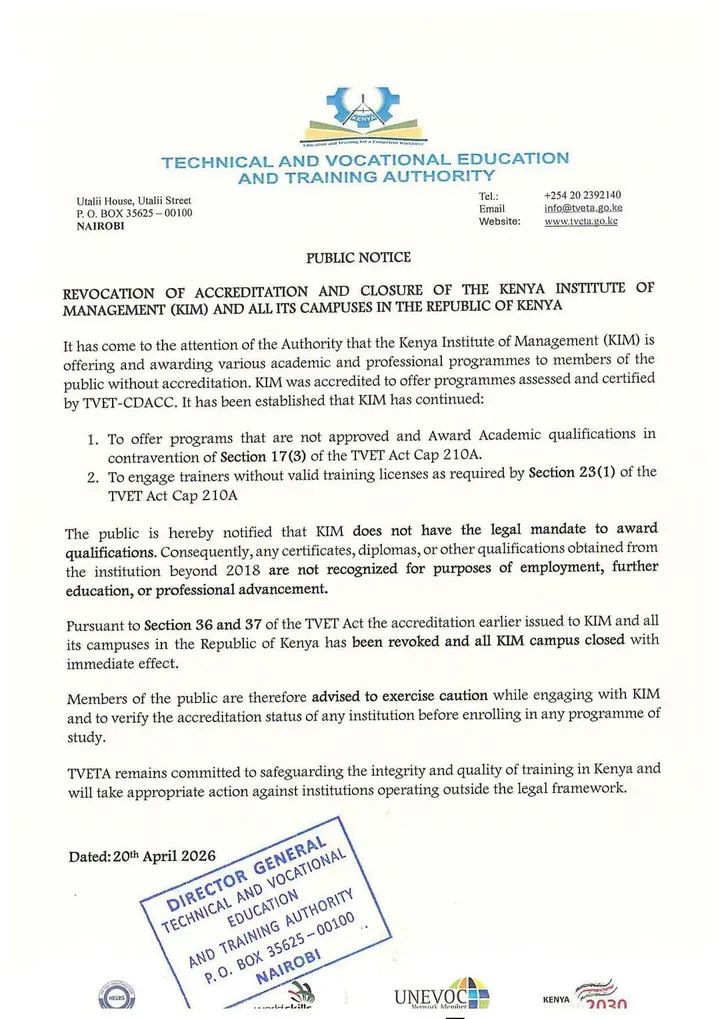
Beyond the compliance gap on its programmes, the regulator accused KIM of engaging trainers who lacked valid licensing from TVETA, a separate violation of Section 23(1) of the same law. The accusation means that not only were the courses unapproved, but the instructors delivering them were, in the regulator’s view, also operating outside the law.
KIM’s public response has been a study in controlled crisis management. In a statement signed by Dr Ndegwa on April 20, the institution described TVETA’s move as catching it off guard, with management sources in one interview characterising it to Nation as political propaganda. Officially, however, KIM struck a measured tone, saying it was reviewing the notice and engaging regulatory authorities to chart a way forward. Dr Ndegwa urged students and stakeholders to remain calm. The institution insists it remains operational in training and consultancy areas that fall outside TVETA’s jurisdiction.
The law, however, leaves KIM with a narrow escape route. Section 37.2 of the TVET Act provides a window of appeal to the Cabinet Secretary for Education. Nyongesa confirmed this avenue exists but was blunt about the current legal position. “As it stands, the law is clear. Certificates and diplomas issued from 2018 onwards should not have been awarded,” he said.
The fallout has been immediate and visible. At KIM’s Nairobi CBD campus, panic-stricken students arrived in large numbers seeking clarity on their status. Phones rang incessantly as graduates who had already secured employment called in to ask whether their jobs were at risk. One admin staff member attempted to contain the anxiety, telling callers that the institution had a government mandate and that management was addressing the situation. Neither assurance carried much legal weight against TVETA’s unambiguous notice.
On social media, the public reaction has been furious and largely directed at the regulator rather than the institution. “This is pure nonsense. This is 2026, what have you been doing since 2018? Revoking certificates from KIM offered since 2018 is an indication of laxity and failure from your side,” one commenter posted. Others questioned why an institution predating TVETA’s own existence by more than four decades was being subjected to a shutdown rather than a structured remediation process.
The Consumers Federation of Kenya (COFEK) has entered the fray, calling for an urgent review of TVETA’s implementation approach. While not defending KIM’s non-compliance, COFEK drew a sharp distinction between institutional failures and student culpability. “We are alarmed that TVETA’s notice makes zero provision for the protection of thousands of currently enrolled students who bear no responsibility for KIM’s institutional failures,” the consumer rights body said in a statement.
KIM students speaking in Kisumu on behalf of their peers echoed the same sentiment. Student representative Ojijo John called on TVETA to function as a partner rather than a punisher, demanding a grace period for compliance and a structured corrective action plan that would not disrupt the academic calendar. “Our education cannot be paused by a press release,” Ojijo said. “It must be protected through collaboration and partnership.”
The regulatory action sits against a broader backdrop of Kenya’s push to expand technical and vocational training as an economic development lever. That expansion has produced a proliferation of training centres, many of which have struggled to meet accreditation standards, raising systemic questions about the quality of certifications flooding the labour market. KIM was not the only institution caught in the regulatory gap created by the 2013 law, but it is, by far, the most prominent.
Critics of TVETA’s approach have noted the anomaly at the heart of its enforcement logic: several specialised government training institutions, including the Kenya Medical Training College, the Kenya Revenue Authority’s KESRA college, the Central Bank of Kenya’s Institute of Monetary Studies and the Kenya Institute of Mass Communication, operate under their own Acts of Parliament and are therefore outside TVETA’s regulatory reach. KIM, which lacks a standalone statute, has no such protection.
For the 100,000 Kenyans holding KIM qualifications issued since 2018 and the 10,000 currently enrolled, the coming days will depend on whether the Cabinet Secretary intervenes, whether KIM mounts a successful legal challenge, or whether TVETA’s enforcement stands exactly as issued. Until that clarity arrives, their paper hangs in a legal limbo that no employer’s HR department can safely ignore.
Kenya Insights allows guest blogging, if you want to be published on Kenya’s most authoritative and accurate blog, have an expose, news TIPS, story angles, human interest stories, drop us an email on [email protected] or via Telegram


Kenya Airways Sinks Into Deeper Turbulence As American Supplier Sues In New York Court Over Sh129 Million Unpaid Debts

Kenyan player wins a Ksh3.2 million jackpot

IEBC Sets August 10 Date For 2027 General Election

Furious Ruto Lashes Out at Gideon Moi Over Repeated ‘Blackmail, Extortionist’ Headlines on The Standard and KTN

Mombasa Gripped by ‘Male Organ Theft’ Panic as Social Media Fuels Mob Attacks and Fear

TOO MUCH PR, NOTHING TO SEE: How Gladys Wanga Built a Perfect Story of Transformation While Homa Bay Bled

Netanyahu Says Israel Must ‘Break Free from Dependence’ After Tensions With Trump Administration

Niger pulls Out Of International Criminal Court After Calling It Neo-Colonialist

Kenya Awards Sh154 Billion JKIA Upgrade Tender To Chinese Firm CRBC

The Untouchable: How KURA’s Silas Kinoti Has Survived A Decade Of Corruption Storms While Kenya’s Roads Bled

Businessman Philip Waithaka Kinuthia’s Minor Son Allegedly Drove Drunk, Killed Two Peponi Students in Ngong Road Horror Crash as Claims of Cover-Up Intensify

Inside NCBA’s Decline: How a Banking Giant Lost Its Strategic Edge

South Sudan: Adut Salva Kiir’s Shadow Treasury Exposed

Cement, Cash and Courts: How the Hashu Dynasty Crushed the Ramji Brothers for Fourteen Years and Why the Walls Are Now Closing In

Standard Chartered Ghosts Haunt Joshua Oigara At Stanbic As Whistleblower Spills Beans

Inside The Urban Planning Cartel That Owns Nairobi

THE VULTURE AND THE SCHEME How Nairobi West Hospital Became the Most Dangerous Institution in Kenya’s SHA Ecosystem and Why the Books Must Be Audited Now

The President’s Daughter and The Missing Witness: How Adut Salva Kiir’s Shadow Treasury Silenced Its Most Dangerous Critic

How Adil Popat Saved His Empire On The Eve Of Imperial Bank Collapse and Why Kenya’s Mainstream Media Buried The Story

Why John Ngumi Is Running From the EACC and Why the Sh415 Million Payday May Be the Least of His Worries
-
 News1 week ago
Businessman Philip Waithaka Kinuthia’s Minor Son Allegedly Drove Drunk, Killed Two Peponi Students in Ngong Road Horror Crash as Claims of Cover-Up Intensify
-
 Africa2 weeks ago
South Sudan: Adut Salva Kiir’s Shadow Treasury Exposed
-
 Investigations6 days ago
THE VULTURE AND THE SCHEME How Nairobi West Hospital Became the Most Dangerous Institution in Kenya’s SHA Ecosystem and Why the Books Must Be Audited Now
-
 Business2 weeks ago
How Adil Popat Saved His Empire On The Eve Of Imperial Bank Collapse and Why Kenya’s Mainstream Media Buried The Story
-
 Business2 weeks ago
Why John Ngumi Is Running From the EACC and Why the Sh415 Million Payday May Be the Least of His Worries
-

 Business3 days ago
BURRIED TWICE: The Victoria Bank CEO Yogesh Pattni Files
-

 Business1 week ago
The Listing That Doesn’t Lie: What the Market Isn’t Saying About Family Bank’s NSE Debut
-

 Business6 days ago
Inside the Billion-Shilling Betrayal: How Senior Treasury Officials Plundered a UN Poverty Fund and Built a Real Estate Empire on the Backs of Kenya’s Rural Poor