
Investigations
THE BRAZEN RETURN: Triton Thief Yagnesh Devani, Who Pillaged Kenya of Sh7.6 Billion and Fled, Now Asks the Same Courts He Escaped to Restore His Stolen Wealth
The architect of Kenya’s most spectacular oil heist, who perfected the art of disappearing with public wealth, has been granted an urgent hearing to account for company assets he alleges were mismanaged during a receivership his own fraud made inevitable. The audacity is breathtaking.

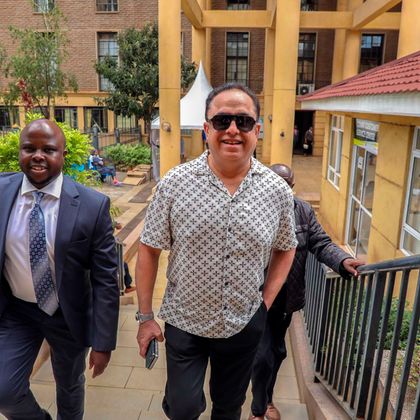
Yagnesh Mohanlal Devani has the nerve of a man who has never truly been made to pay. Last week, the principal shareholder of the long-collapsed Triton Petroleum Company Limited walked into the High Court’s Commercial and Tax Division, clutching an urgent petition demanding a full account of his company’s 17-year receivership.
The same receivership that followed, inexorably, from his own documented fraud.
The same courts whose processes he tied up for over a decade fighting extradition from Britain. The same Kenya whose fuel supply he plunged into chaos, whose banks he bankrupted of billions, and whose long-suffering taxpayers were left to absorb the systemic fallout of his spectacular greed.
The petition, filed through Echessa and Bwire Advocates LLP, names the appointed receiver managers, Kenya Commercial Bank, the Eastern and Southern African Trade and Development Bank, and the Central Bank of Kenya as respondents. In it, Devani argues with remarkable straightforwardness that the receivers have for 17 years failed to provide the company’s board of directors with updates on the status of the receivership, the disposal of assets, or the composition of outstanding loan balances.
He wants a forensic audit.
He wants an independent inquiry into potential misconduct. He wants compensation for losses he says were suffered during the receivership period.
The court has certified the matter as urgent and directed respondents to file their responses within seven days. A mention has been set for April 29 for further directions.
A man who stole 126 million litres of fuel worth Sh7.6 billion now returns to court complaining that his receivership has been insufficiently transparent.
THE ANATOMY OF A CAREFULLY PLANNED THEFT
Devani did not stumble into fraud. He engineered it, over years, with the precision of a man who understood exactly which institutions he could corrupt, which officials could be compromised, and which legal loopholes could be exploited to buy time when the scheme eventually collapsed.
Triton Petroleum Company Limited was registered in 2000, with Devani holding 4,999,500 of the company’s five million shares. The remaining 500 shares were held by a shell entity called Triton Business Solutions.
From the beginning, the corporate architecture was designed to concentrate control while obscuring accountability.
Forensic auditors who later picked through the wreckage noted that despite operating a multi-billion-shilling business with multiple subsidiaries, Triton rarely kept complete records. As one audit observation grimly noted, the company’s files revealed “a lot of information gaps.” Those gaps were not accidental.
The scandal’s foundations were laid through a system known as the Open Tender System, through which the Kenya Pipeline Company awarded monthly contracts to a single importer to supply petroleum products across Kenya, Uganda, Rwanda and Burundi.
The logic was straightforward: economies of scale would benefit the entire market.
Triton, despite being a relatively small player with an 11.5 per cent market share, managed to outmanoeuvre seasoned international giants including Shell and BP to secure a six-month national oil supply quota.
According to the African Centre for Open Governance, which produced one of the definitive analyses of the scandal in July 2009, there was considerable evidence to suggest that Triton enjoyed exceptional political connections that could have given it preferential treatment at KPC.
Those connections were not subtle. At the 2006 launch of Triton’s LPG depot in Nairobi, the guest list included then Vice President Moody Awori, Raila Odinga and Uhuru Kenyatta.
During President Daniel arap Moi’s administration, Triton had secured lucrative contracts to supply petroleum products to the Kenya Power and Lighting Company. Devani was, by his own carefully cultivated design, the kind of businessman Nairobi’s political establishment wanted at their tables.
The actual theft, as reconstructed by the PricewaterhouseCoopers forensic audit and subsequent investigations, was executed between November 2007 and November 2008.
Taking advantage of a new computerised stock-tracking system at KPC that had not yet been fully implemented and could not provide live data, Triton conspired with KPC officials to draw oil from the pipeline system for which it had not paid.
KPC staff then falsified records to show the stocks remained in the system. By the time financiers demanded accurate stock positions, 126.4 million litres of petroleum products worth Sh7.6 billion had been irregularly and illegally released to Triton without the authorisation of the financiers who held the cargo as collateral.
THE BANKS LEFT HOLDING PHANTOM COLLATERAL
The scale of the financial damage was staggering. When KCB wrote to KPC asking for the official stock position of Triton products held for the bank, it discovered to its horror that 25.9 million litres of fuel it believed was being held in storage was simply missing.
By the time the full picture emerged, Triton had accumulated an estimated Sh7.6 billion in obligations it could not meet: Sh1.85 billion owed to KCB, Sh2.3 billion to Glencore Energy UK Limited, Sh906 million to Fortis Bank of the Netherlands, and Sh2.5 billion to Emirates National Oil Company of Singapore.
The Kenya Revenue Authority separately demanded Sh4 billion in unpaid taxes and penalties, plus Sh2 billion in unpaid corporation taxes.
These were not abstract figures on a balance sheet. Banks that had issued letters of credit and financial guarantees on the strength of collateral that did not exist were facing catastrophic losses.
The Collateral Financing Agreement that governed such transactions required KPC to hold oil stocks and release them only upon written authorisation from the financiers.
That requirement was systematically ignored, with KPC issuing false acknowledgement letters while Devani’s company drew down inventory it had not paid for and sold it into the market.
The country’s entire petroleum supply system was thrown into crisis.
The illegal drawdown of stocks at the Kipevu Oil Storage Facility left insufficient storage space for other oil marketing companies to import their own products fast enough to fill the resulting shortfall. Fuel shortages spread across the country.
Total Kenya Limited, which had a supply contract with Triton to fuel KenGen’s thermal power plants, was forced to terminate the arrangement after Triton consistently failed to deliver.
With Kenya already experiencing a drought that had pushed power producers toward greater reliance on thermal generation, the prospect of fuel shortages compounding a power crisis was not theoretical. The country teetered on the edge of electricity rationing.
Televisions and radio stations broadcast the chaos. Ordinary Kenyans queued for fuel they could not find, and paid more for power they could barely afford.
THE SPIRITUAL CLEANSING AND THE LONG FLIGHT
In mid-December 2008, as the walls closed in, Devani and his right-hand man Mahendra Pathak boarded a flight to Prayagraj, India, ostensibly to attend the Magh Mela pilgrimage, a Hindu religious festival held at the confluence of the Ganga, Yamuna and Saraswati rivers, where pilgrims bathe to cleanse themselves of their sins.
Whether the spiritual symbolism was intentional or merely coincidental, both men knew exactly what was waiting for them in Nairobi.
Triton was placed under receivership on December 19, 2008, at the request of KCB and the Eastern and Southern African Trade and Development Bank, after the company’s catastrophic inability to service its debts became undeniable.
Pathak eventually returned to Kenya and faced charges. Devani did not. He surfaced in London, where he would spend the next 15 years deploying an extraordinary array of legal arguments to resist extradition, while Kenya’s banking sector absorbed his losses and ordinary Kenyans paid the price of disrupted fuel markets.
An arrest warrant was issued in June 2009. Interpol was activated. Kenya filed extradition proceedings with the British authorities in 2011.
What followed was a masterclass in how wealth, access to expensive legal representation, and the structural complexity of international extradition law can be weaponised to delay accountability indefinitely.
Devani argued variously that he would not receive a fair trial in Kenya, that Kenyan prisons were dangerous, that there was cholera at Kamiti Maximum Security Prison, and that his extradition would violate his human rights.
He appealed at every available level of the British judicial system. The UK Court of Appeal ultimately dismissed all his challenges in the judgment Secretary of State for Home Department v. Yagnesh Mohanlal Devani (2020) EWCA Civ 612, delivered on May 7, 2020 by Lord Justice Underhill.
The court found his claims about Kenyan prisons and trial conditions unsubstantiated. Even then, the actual extradition did not happen for nearly four more years.
He was finally returned to Kenya on January 23, 2024, after more than 15 years as a fugitive.
The country that had spent enormous diplomatic and legal capital extracting him from Britain expected, at minimum, a reckoning.
THE PROSECUTION COLLAPSE THAT BEGGARED BELIEF
What followed was not a reckoning. It was a farce that exposed the deep rot in Kenya’s accountability infrastructure with almost surgical precision.
On his return, Devani was charged with four counts over the irregular sale of petroleum products at Kipevu, relating to a Sh1.5 billion jet fuel case, and released on bail of Sh1 million.
In August 2024, the Ethics and Anti-Corruption Commission separately arrested him and charged him afresh with 11 counts in the Sh7.6 billion case, including two counts of fraudulent disposition of mortgaged goods, eight counts of conspiracy to defraud, and one count of obtaining by false pretences.
He pleaded not guilty to all charges and was eventually freed on a Sh5 million cash bail after spending 13 days in remand at Industrial Area Prison.
The charges were detailed and specific. Count one alleged that on September 5, 2008, as managing director of Triton Petroleum, he disposed of 13,054.85 cubic metres of diesel valued at US$10.2 million to Total Kenya Limited without the consent of Emirates National Oil Company, the mortgagee.
Count two alleged the disposal of aviation fuel worth US$550,020 to the same company without authorisation. Counts three through ten alleged conspiracies to defraud Kenya Shell Limited, Engen Kenya Limited, GAPCO Kenya Limited, Hashi Empex Limited, Muloil Kenya Limited, and Emirates National Oil Company of sums totalling hundreds of millions of shillings, by fraudulently representing that Triton held stocks at Kipevu that it no longer owned.
By October 2024, Anti-Corruption Magistrate Harrison Barasa had allowed Director of Public Prosecutions Renson Ingonga’s application to withdraw the entire case.
The stated reasons were: the death of certain witnesses; the unwillingness of former Energy Minister Kiraitu Murungi, once described as the man who ordered the original investigation, to testify; and the inability to locate the original complainant. The magistrate found that the DPP and EACC could not be compelled to proceed when key witnesses had become uncooperative.
The case that Kenya had spent 15 years and substantial diplomatic capital to prosecute collapsed in under a year of Devani’s return, without a single conviction, on the ground that witnesses who had been alive for the entire period of his fugitive existence were suddenly unavailable when the moment of reckoning actually arrived.
Fifteen years in hiding. Fifteen years of diplomatic effort. Fifteen years of waiting. Collapsed in ten months. Without explanation.
POLITICAL CONNECTIONS AND THE ARCHITECTURE OF IMPUNITY
The Devani story is impossible to understand outside the context of his extraordinary political network. The Africog analysis noted explicitly that Triton’s past transactions with government, its ability to secure lucrative state contracts from the Moi era onward, and the presence of senior political figures at its corporate events all pointed to connections that extended deep into the Kenyan state.
The company held the tender in partnership with Total Kenya to supply petroleum products to KenGen, the state power producer. It was considered a local champion in an industry historically dominated by multinationals.
Forensic auditors noted that despite his company’s multi-billion-shilling operations, Triton maintained minimal records.
The company’s cross-ownership structures, spreading assets across Triton Bulk Storage, Triton Gas Stations Limited, Triton Service Stations and Triton Network Solutions Limited, created a corporate maze that complicated any attempt to trace funds or hold a single entity accountable. This was not the structure of a businessman who expected to be investigated. It was the structure of a businessman who expected to be protected.
When the scandal broke, the then-managing director of KPC was fired immediately. The chairman of the KPC board was removed shortly thereafter.
Several KPC officials were charged with corruption.
The managing director, the chairman, the board, and multiple line staff all faced consequences. The man who had bribed and conspired with them to steal 126 million litres of fuel, and who had then run to London, faced nothing for 16 years.
THE PROPERTIES, THE ASSETS, AND THE RECEIVERSHIP GAMES
Triton was placed under receivership in December 2008. Abdul Zahir Sheikh and Peter Kahii were appointed receiver and manager by KCB. The receivership, now entering its 18th year, has become a legal battleground in its own right.
What is not disputed is the extraordinary breadth of assets that once existed in the Triton estate. Devani’s own petition before the High Court records that the receivers took full control of the company’s warehouses, vehicles, stocks, offices and even post office boxes.
Triton operated service stations in Nairobi, Kisumu, Eldoret and Nakuru, as well as in Kampala, Uganda. Separate litigation has established that the Triton estate once included Karen Cross Road Mall, Lang’ata Road Arcade, Westland Plaza along Waiyaki Way, 60 acres of land in Karen, and over 20 other properties, most of them petrol stations.
A deed of settlement signed between Triton, Devani and the receivers on March 16, 2009 referenced the Camelot property, to be sold for not less than Sh1.1 billion.
KCB sued Devani for Sh2.7 billion. The bank also sued Triton for Sh2 billion. Courts ordered the disposal of various Triton assets to service debts. Devani was separately stopped from offering for sale shares or assets held in 19 other companies until KCB’s case was heard and determined.
Now, in 2026, Devani argues that he has never been informed of how those assets were disposed of, what recoveries were made, what expenses were incurred during the receivership, or what remains of the company’s estate after 17 years.
He frames this as a transparency and accountability issue, invoking the equitable jurisdiction of the courts to compel a trustee who has remained in possession of trust assets to render account.
He wants a full forensic audit. He wants an independent inquiry into potential misconduct. He wants compensation.
THE OBSCENITY OF THE CURRENT PETITION
It is worth pausing to appreciate fully what Devani is asking for.
A man who engineered the theft of 126 million litres of petroleum products, who conspired with state officials to falsify inventory records, who defrauded international banks of the equivalent of US$100 million, who fled the country on the eve of his arrest, who spent 15 years in London exhausting the British legal system with arguments about Kenyan prisons, and who watched the case against him collapse through witness attrition he may well have had some hand in creating, is now petitioning the Kenyan High Court, on an urgent certificate, to protect assets he claims were mishandled during the receivership his own fraud necessitated.
He argues that shareholders have never been informed of the status of loan accounts, that assets have been disposed of without transparency, and that there has been no meaningful regulatory intervention despite repeated complaints.
The Central Bank of Kenya, he argues, failed in its oversight role.
The receivers failed in their statutory obligations.
The lenders failed to account for assets under their control. Having destroyed the company, stolen its inventory, bankrupted its creditors, and evaded justice for nearly two decades, he is now positioning himself as the wronged party in a badly managed insolvency.
The audacity of the argument would be almost admirable if it did not represent such a profound insult to every institution, every creditor, every worker, and every ordinary Kenyan citizen whose daily life was disrupted by fuel shortages that Devani’s greed directly caused.
He has the temerity to call himself a shareholder seeking accountability. The rest of Kenya calls him something rather different.
THE CITIZENS WHO PAID
The Triton scandal is often discussed in the financial press as a corporate governance failure and a banking sector crisis.
This framing, while accurate, systematically understates its human cost.
When 126 million litres of fuel disappears from the national supply chain in a market as dependent on petroleum imports as Kenya’s, the consequences do not stay inside boardrooms and balance sheets.
They spread into every sector of the economy, carried on every lorry that cannot refuel, every matatu that raises its fare, every generator that goes dry, every farmer whose produce cannot reach market.
By early January 2009, fuel shortages were visible and reported across the country.
Televisions and radio stations broadcast the queues. The termination of Triton’s supply contract with Total Kenya, and Total’s consequent inability to meet its obligations to KenGen, threatened to compound a fuel crisis with an electricity crisis at a moment when Kenya was already managing drought-related power pressures. The threat of a return to power rationing, with its cascading damage to manufacturing, services, and small businesses, was entirely real.
KRA’s demand for Sh4 billion in unpaid taxes meant revenue that would otherwise have supported public services simply did not exist.
The exposure of KPC, a wholly state-owned parastatal, to multi-billion-shilling lawsuits from defrauded international financiers meant that any damages awarded would ultimately be absorbed by the Kenyan public.
The systemic damage to the banking sector’s confidence in collateral financing arrangements for petroleum imports had long-term effects on how those arrangements were structured and priced, with costs ultimately passed on to consumers.
None of the ordinary Kenyans who queued at petrol stations in January 2009, who paid inflated transport costs, who sat in the dark during unscheduled power outages, who absorbed higher prices for goods whose supply chains ran on diesel, none of them have ever received any acknowledgement from Yagnesh Devani that his actions caused their hardship. Nor have they received compensation. Nor, it now appears, will they.
A WARNING TO INVESTORS AND HOST COUNTRIES
Devani spent his London years living in a house estimated to be worth Sh550 million. In 2007, at the peak of his fraudulent enterprise, he flew guests in first class from London and India to celebrate his wife’s 40th birthday in Nairobi.
He chartered a private jet for an Indian performer. He brought hairdressers from London and the UAE. He gave each guest a Rolex watch. The entire event was estimated to cost Sh300 million.
This was the lifestyle of a man whose business model depended on stealing from state infrastructure, corrupting public officials, and bankrupting international banks.
The United Kingdom, which hosted Devani for 15 years and became the venue for his prolonged legal resistance to extradition, deserves to know the character of the man it sheltered.
The elaborate proceedings in the British courts, the claims about prison conditions and fair trial rights, were not the principled stand of a man persecuted by an unjust state.
They were the tactical deployment of a wealthy fugitive’s legal resources against the legitimate accountability claims of a country he had robbed.
Any investor, business partner, or financial institution that is currently dealing with Devani, in whatever jurisdiction, should understand that they are dealing with a man whose fundamental business method, as documented in thousands of pages of forensic audit findings, criminal charge sheets, and court judgments, has been the systematic falsification of records, the corruption of public officials, the exploitation of regulatory gaps, and the strategic use of legal delay to avoid accountability.
The receivership petition now before the Kenyan High Court is entirely consistent with that method. Its purpose is not justice. Its purpose is asset recovery.
WHAT THE COURTS MUST DECIDE
The High Court’s Commercial and Tax Division will on April 29 give further directions in Devani’s receivership petition.
The respondents, KCB, the Eastern and Southern African Trade and Development Bank, the receiver managers, and the Central Bank of Kenya, have been directed to file their responses within seven days.
There is a legitimate question embedded within Devani’s petition, entirely separate from the question of whether he deserves to benefit from the answer. Receiverships that run for 17 years without formal reporting to shareholders are a governance problem.
The accountability obligations of receiver managers under Kenyan law are real, and a court is entitled to examine whether those obligations were met. These are questions the commercial courts have the capacity and the authority to address.
But the Kenyan judiciary must be clear-eyed about the context in which these questions are being asked, by whom, and for what purpose.
This petition is not a good-faith inquiry by a wronged shareholder.
It is the latest manoeuvre in a 17-year campaign by the principal architect of one of Kenya’s largest corporate frauds to recover, preserve, or otherwise access assets that were pledged as collateral for debts his own fraud created.
Every order it secures, every disclosure it compels, every forensic audit it initiates, will be scrutinised not merely for its compliance with receivership law but for what it ultimately delivers into Devani’s hands.
There is also a broader accountability question that neither this petition nor the criminal case collapse has answered.
What happened to the assets? Where did the Sh7.6 billion worth of stolen petroleum products ultimately go? Who, beyond Devani and his immediate co-conspirators, benefited from the scheme? These questions have never been fully answered in a court of competent jurisdiction, because the man who held the answers spent 16 years in Britain and his prosecution collapsed in under a year of his return.
Kenya deserves those answers.
The institutions that lost billions deserve them. The workers who lost their jobs when Triton collapsed deserve them.
The ordinary citizens who paid through their fuel bills and their electricity tariffs and their transport costs for a scandal that enriched one man and his associates deserve them.
Yagnesh Devani has returned to Kenya’s courts. He will not find the sympathy or the silence he found in London. Not this time.
Kenya Insights allows guest blogging, if you want to be published on Kenya’s most authoritative and accurate blog, have an expose, news TIPS, story angles, human interest stories, drop us an email on [email protected] or via Telegram


Kenyan player wins a Ksh3.2 million jackpot

IEBC Sets August 10 Date For 2027 General Election

Furious Ruto Lashes Out at Gideon Moi Over Repeated ‘Blackmail, Extortionist’ Headlines on The Standard and KTN

Mombasa Gripped by ‘Male Organ Theft’ Panic as Social Media Fuels Mob Attacks and Fear

TOO MUCH PR, NOTHING TO SEE: How Gladys Wanga Built a Perfect Story of Transformation While Homa Bay Bled

Netanyahu Says Israel Must ‘Break Free from Dependence’ After Tensions With Trump Administration

Niger pulls Out Of International Criminal Court After Calling It Neo-Colonialist

Kenya Awards Sh154 Billion JKIA Upgrade Tender To Chinese Firm CRBC

The Untouchable: How KURA’s Silas Kinoti Has Survived A Decade Of Corruption Storms While Kenya’s Roads Bled

Fake Papers, Dirty Millions And The Analo Connect: How Kitisuru MCA Alvin Palapala Built a Shadow Empire Inside Nairobi’s Planning Machine

Businessman Philip Waithaka Kinuthia’s Minor Son Allegedly Drove Drunk, Killed Two Peponi Students in Ngong Road Horror Crash as Claims of Cover-Up Intensify

Inside NCBA’s Decline: How a Banking Giant Lost Its Strategic Edge

South Sudan: Adut Salva Kiir’s Shadow Treasury Exposed

Cement, Cash and Courts: How the Hashu Dynasty Crushed the Ramji Brothers for Fourteen Years and Why the Walls Are Now Closing In

Standard Chartered Ghosts Haunt Joshua Oigara At Stanbic As Whistleblower Spills Beans

Inside The Urban Planning Cartel That Owns Nairobi

THE VULTURE AND THE SCHEME How Nairobi West Hospital Became the Most Dangerous Institution in Kenya’s SHA Ecosystem and Why the Books Must Be Audited Now

The President’s Daughter and The Missing Witness: How Adut Salva Kiir’s Shadow Treasury Silenced Its Most Dangerous Critic

How Adil Popat Saved His Empire On The Eve Of Imperial Bank Collapse and Why Kenya’s Mainstream Media Buried The Story

Why John Ngumi Is Running From the EACC and Why the Sh415 Million Payday May Be the Least of His Worries
-
 News1 week ago
Businessman Philip Waithaka Kinuthia’s Minor Son Allegedly Drove Drunk, Killed Two Peponi Students in Ngong Road Horror Crash as Claims of Cover-Up Intensify
-
 Africa2 weeks ago
South Sudan: Adut Salva Kiir’s Shadow Treasury Exposed
-
 Business2 weeks ago
Standard Chartered Ghosts Haunt Joshua Oigara At Stanbic As Whistleblower Spills Beans
-
 Investigations6 days ago
THE VULTURE AND THE SCHEME How Nairobi West Hospital Became the Most Dangerous Institution in Kenya’s SHA Ecosystem and Why the Books Must Be Audited Now
-
 Africa2 weeks ago
The President’s Daughter and The Missing Witness: How Adut Salva Kiir’s Shadow Treasury Silenced Its Most Dangerous Critic
-
 Business2 weeks ago
How Adil Popat Saved His Empire On The Eve Of Imperial Bank Collapse and Why Kenya’s Mainstream Media Buried The Story
-
 Business2 weeks ago
Why John Ngumi Is Running From the EACC and Why the Sh415 Million Payday May Be the Least of His Worries
-
 Business6 days ago
Inside the Billion-Shilling Betrayal: How Senior Treasury Officials Plundered a UN Poverty Fund and Built a Real Estate Empire on the Backs of Kenya’s Rural Poor