
Investigations
THE UNTOUCHABLE CLERK: How Fatuma Mwalupa Allegedly Turned Kwale Assembly Into a Personal Treasury and Outsmarted Scrutiny
‘Whenever any scandal emerges, she normally silences it. To her, money is everything. She uses proxy companies because they give huge figures and kickback percentages without asking questions.’

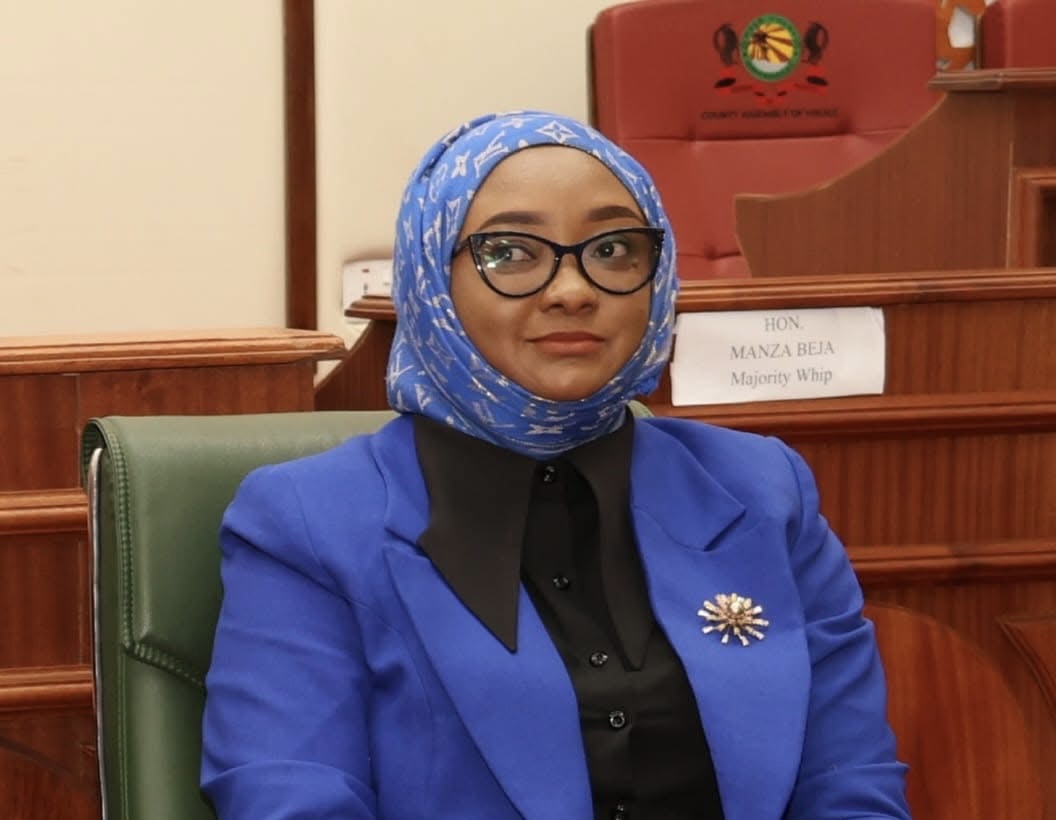
She walks into the Kwale County Assembly’s gleaming new headquarters in Matuga with the unhurried authority of someone who has seen rivals come and go. Fatuma Hassan Mwalupa, the Clerk of the County Assembly of Kwale, has outlasted at least one predecessor who was dragged through the courts, survived reported interrogation by the Ethics and Anti-Corruption Commission, navigated the minefields of successive political transitions, and still, according to whistleblowers who have spoken to Kenya Insights, controls the flow of billions of shillings in public procurement with an iron hand that leaves almost no fingerprints.
The question that civil society groups, MCAs, and increasingly, investigators are asking is not whether corruption has infected the Kwale assembly. The Auditor-General’s reports have answered that already, in excruciating and repeated detail. The question is who, at the centre of the machine, is driving it, and who has made it their business to ensure the machine keeps running without accountability.
Multiple sources, speaking to Kenya Insights on condition of anonymity, point their answers firmly at Mwalupa.
‘Whenever any scandal emerges, she normally silences it. To her, money is everything. She uses proxy companies because they give huge figures and kickback percentages without asking questions.’
THE ARCHITECTURE OF ALLEGED IMPUNITY
In the past three weeks, explosive allegations have emerged from whistleblowers within the county assembly ecosystem that Mwalupa has accumulated funds spread across at least 20 different bank accounts, with the total figure alleged to be in the region of KSh 20 million at any given time.
The use of multiple accounts, sources say, is a deliberate fragmentation strategy designed to frustrate detection by the Financial Reporting Centre and to confuse any asset declaration analysis.
A contractor who dealt with the assembly, and who has asked not to be identified for personal security reasons, described Mwalupa as an figure of such institutional dominance that approaching assembly business without her blessing is not merely difficult, it is professionally fatal.
According to this source, the Clerk has a preference for working through proxy companies, particularly those drawn from business networks in the Somali community, whose members, the source claims, are selected precisely because they are willing to issue inflated invoices and return kickbacks without seeking explanations.
Kenya Insights could not independently verify the specific bank account figures at the time of publication. Mwalupa was approached for comment; she had not responded by press time.
A BUILDING THAT KEPT GETTING MORE EXPENSIVE
Perhaps no single piece of evidence captures the culture of impunity at the Kwale County Assembly more starkly than the story of the assembly’s own headquarters. What began as a project budgeted at KSh 508 million swelled to KSh 624 million following contractor changes, an unexplained increase of KSh 116 million that the Auditor-General’s office has flagged but which has attracted no prosecutorial consequence.
The construction saga stretched across nearly eight years before the building was partially occupied. When it was finally inaugurated in late 2024, Speaker Seth Mwatela Kamanza crowed about its architectural magnificence, describing it as a testament to devolution.
What he did not address was the KSh 155 million that had been paid out by 2022, when the project was terminated, with, in the Auditor-General’s words, no meaningful progress visible on the ground. The contractor at that point had simply walked. The money, however, had not.
The original acting clerk who presided over early phases of the building project was Fatuma Hassan Mwalupa, who in 2023 was still describing the structure to The Star newspaper as a transformative facility that would revolutionise service delivery in Kwale. She did not address the ballooned costs or the contractor termination.
THE AUDITOR-GENERAL’S DAMNING PAPER TRAIL
The Auditor-General’s reports, which Mwalupa and Speaker Kamanza have appeared before the Senate County Public Accounts Committee to answer, detail a series of institutional failures that go far beyond administrative sloppiness.
The Assembly has been consistently employing staff in excess of legally permitted ceilings. The Commission on Revenue Allocation caps county assembly staffing at 100 regular employees.
The Kwale assembly employed 126, and layered on top of that an additional 159 temporary workers irregularly attached to Members of the County Assembly and the Speaker’s office.
That is a combined workforce of 285 people being paid from the public purse through an institution legally mandated to sustain fewer than half that number. The Clerk, as the accounting officer of the assembly, bears institutional responsibility for that excess.
The auditors further established that nine assembly employees had committed more than two-thirds of their gross salaries to deductions, a direct violation of the Employment Act, which caps such deductions to protect workers from debt bondage through payroll manipulation. Other staff members went for months without being paid at all, a paradox in an institution simultaneously over-staffed and, apparently, selectively cashless.
Conference expenditure of KSh 15.9 million was flagged as entirely unsupported, meaning no procurement documentation existed and no price justification was offered to explain how nearly KSh 16 million in public funds was disbursed to facilitate meetings.
In any functional accountability ecosystem, unsupported expenditure of that magnitude would constitute grounds for criminal referral. At the Kwale assembly, it appears on audit reports and then, apparently, disappears.
Of the six vehicles assigned to the assembly, only two were operational during the audit period.
The remaining four were grounded with no credible explanation for their mechanical failures, while the assembly continued to spend additional public funds on vehicle rentals to compensate for the very fleet that was already owned and budgeted for.
At the Kwale County Assembly, KSh 15.9 million in conference expenses was flagged as entirely unsupported. No procurement documentation. No price justification. No consequence.
EACC IN THE ROOM, AND THE CULTURE OF SILENCE
Kenya Insights has established that Mwalupa has reportedly been called in for questioning by the Ethics and Anti-Corruption Commission over allegations of financial misconduct and violations of financial regulations.
The EACC’s Mombasa regional office, which covers Coast operations, has historically been active in Kwale County, a county that the Commission’s own 2024 National Ethics and Corruption Survey ranked among the most bribery-prone counties in Kenya, alongside Kilifi and Wajir.
That survey, conducted across all 47 counties between November and December 2024, found that bribery remains the dominant form of unethical conduct in Kenyan public institutions, and specifically identified county executive employment as the sector commanding the highest average bribe nationwide, at KSh 243,651.
The county assembly space, with its extensive patronage networks for temporary staff recruitment, sits within precisely this corruption ecosystem.
What sources find extraordinary is not the interrogation itself but the outcome, or rather the absence of one. Mwalupa continued in her role, continued to issue tenders through the assembly’s procurement office, and continued to be received as a senior official at national forums even as questions mounted.
THE WIDER WEB: A COUNTY THAT CANNOT STOP LOOTING ITSELF
To understand Mwalupa’s alleged position, it is necessary to understand the county she operates in. Kwale is not simply a county with a corruption problem. It is a county where corruption has, over the decade-plus of devolution, become structurally embedded across departments, families, and procurement networks in ways that have defeated repeated interventions.
In the county executive, a scandal of breathtaking scale has also been unfolding involving the family of Francisca Kilonzo, the county’s CECM for Social Services and Talent Management. Whistleblower documents obtained by Kenya Insights indicate that three companies with direct or indirect connections to the Kilonzo family secured contracts from the county government that together amount to more than KSh 390 million.
Diani Occasions, owned by Kilonzo’s late nephew Muema Christopher Kilonzo, received KSh 33,670,500. Mutanga Investments, registered under the name of the CECM’s late mother and listing multiple directors including Peter Njagi, Catherine Sonia Wairimu Mahan, and Abraham Vinner among others, was awarded contracts worth KSh 266,644,200. R Flink, owned by Kilonzo’s sister Fatuma Kilonzo and described by sources as a briefcase company with no visible operational footprint, received KSh 90,296,011.
The total alleged siphoning through these three entities alone approaches KSh 391 million of public money flowing into a single politically connected family network through a procurement system that was supposed to be competitive and transparent.
Chief Officer of Finance Alex Thomas Onduko has also been drawn into the web of allegations. Sources allege that Onduko, whose contact details appear on official county tender documents as the designated accounting officer, used his office to facilitate and shelter fraudulent dealings. He is further alleged to have links to Cloemart Company, which reportedly won a KSh 16 million tender to construct an oxygen plant at Msambweni Hospital during the 2021/2022 financial year, as well as the Kilolapwa Laboratory project, which consumed additional millions in circumstances sources describe as deeply irregular. Within three years of holding his position, Onduko is alleged to have amassed properties worth more than KSh 200 million.
Alex Thomas Onduko, listed as accounting officer on County Government of Kwale tender documents. Sources allege his personal wealth grew by more than KSh 200 million in three years.
A HISTORY THAT REFUSES TO HEAL
The current scandal at the county assembly is not Kwale’s first rendezvous with institutional rot. In 2014, the EACC conducted one of the most dramatic anti-corruption operations in the county’s post-devolution history, arresting five brothers employed across various county departments. Vincent Chirima Mbito, the County Head of Treasury, was arrested alongside his siblings Mongo Mbito Mongo, the County Revenue Officer; Hassan Shilingi Mbito, a driver at the Kwale Water and Sewerage Company; Mwaiwe Mongo Mbito, the County Procurement Officer; and Chindoro Mongo Mbito, then posted in the Ministry of Health.
Together, they had allegedly channelled 10 county contracts into two family-controlled companies, Rome Investments and Chilongola Holdings, collecting KSh 44,919,341 and KSh 4,007,943 respectively in payments for the supply of sanitation materials, food rations, office supplies, and institutional appliances, all procured using what the EACC described as forged documents. They were arraigned at the Mombasa Anti-Corruption Court and each released on a bond of KSh 1 million.
In 2022, the EACC completed a separate inquiry into alleged procurement irregularities of KSh 462 million in the construction of the Kwale County Headquarters, a contract awarded to Green County Construction Company Limited, which investigators established was a proxy vehicle associated with a former Member of Parliament for Mandera South and a former CECM at Kwale County. The EACC recommended prosecution in August 2022. The DPP returned the file for further investigations in October 2022. As of this publication, no prosecution has concluded.
More recently, ten months before this publication, Vincent Mbito and his four brothers appeared again in the Mombasa courts, re-arraigned in February 2024, more than a decade after they first entered the legal system. The wheels of justice in Kwale County appear to turn with particular, grinding slowness.
The EACC recommended prosecution in 2022. The DPP returned the file for further investigations. No prosecution has concluded. The pattern repeats, year after year.
THE PREDECESSOR WHO DARED AND PAID
The political history of the Kwale County Assembly Clerk position is itself a cautionary tale. Hamisi Bweni Dzila, who held the role before Mwalupa eventually consolidated the position, spent years fighting a legal war against the very board that employed him after he declined to authorise payments to a contractor whose project was under active EACC investigation. The board suspended him in March 2020. The Employment and Labour Relations Court reinstated him. The board refused to let him enter the building, deploying police to block his access.
The Supreme Court ultimately settled the constitutional question of suspension versus removal in 2025, years after Dzila’s removal had long been a fait accompli. The institutional lesson appears to have been absorbed clearly: in the Kwale assembly, the person who protects public money is the one who loses their job.
The person who allegedly directs it into private channels, in contrast, appears to be the one who stays.
THE CALLS FOR ACTION
The revelations have generated sustained outrage among Kwale residents and civil society organisations, many of whom are now demanding that the EACC’s Mombasa office escalate any open investigation into the assembly’s finances to the highest priority level. The Asset Recovery Agency, they argue, should be simultaneously activated to trace and freeze assets that may have been acquired using diverted public funds.
Within the assembly itself, moves are underway to present impeachment motions against both Mwalupa and Speaker Kamanza, following the dismissal of the County Public Service Board and the installation of new members who are expected to be less protective of the existing order. Whether those motions will succeed, or whether the political insulation that Mwalupa has allegedly built over years will absorb the blow, remains to be seen.
The Senate County Public Accounts Committee, before which both the Clerk and the Speaker have already appeared to answer Auditor-General findings, is being urged by accountability advocates to revisit the outstanding issues with a renewed urgency and to demand forensic audits rather than accepting the narrative management that has thus far characterised the assembly’s engagements with oversight bodies.
For the EACC, the public dossier now sits in plain view. The allegations against Mwalupa, the documented staffing violations, the unsupported conference expenditure, the ballooned construction contract, the fragmented bank accounts, the proxy company network: these are not marginal claims from disgruntled individuals. They are the accumulated evidence of an institution that has, across multiple audit cycles and multiple administrations, operated as though the law does not apply within its walls.
The Kwale assembly has faced audit after audit, committee appearance after committee appearance. And still the money disappears. The question is no longer whether this is corruption. It is who has the authority to stop it.
KENYA INSIGHTS IS WATCHING
Kenya Insights has formally submitted questions to Fatuma Hassan Mwalupa, Speaker Seth Mwatela Kamanza, Chief Officer of Finance Alex Thomas Onduko, and CECM Francisca Kilonzo, seeking responses to the specific allegations detailed in this report. None had responded at the time of publication. This investigation is ongoing. Any responses received will be published in full.
The EACC has been formally requested to confirm whether active investigations into the Kwale County Assembly are ongoing and whether asset declarations submitted by the Clerk and other named officials have been scrutinised. The Asset Recovery Agency has been asked to specify what, if any, steps have been taken regarding assets allegedly acquired through irregular county procurement in Kwale.
Kenya Insights will continue to publish as new information becomes available. Sources with documents or information pertaining to this investigation are encouraged to make contact through our secure channels.
Kenya Insights allows guest blogging, if you want to be published on Kenya’s most authoritative and accurate blog, have an expose, news TIPS, story angles, human interest stories, drop us an email on [email protected] or via Telegram


Somalia Deputy PM Held at JKIA, Deported Over Questionable Acquisition of Kenyan Passport

The White-Coat Heist: How MP Shah Hospital Ran a Decade-Long Double-Extraction Racket While Hiding Behind Charity Status

The Patriarch, His Children, and a Buried Sh3.9 Billion Fraud: The Story of Titus Muya That Kenya Was Never Meant to Read

The Founder’s Ransom: How Titus Muya Had to Be Paid Sh231 Million to Let Go of Family Bank and Why That Bill Is Now Yours

Kenya’s gambling industry pushes back against a licensing bill

Kenya Airways Sinks Into Deeper Turbulence As American Supplier Sues In New York Court Over Sh129 Million Unpaid Debts

Kenyan player wins a Ksh3.2 million jackpot

IEBC Sets August 10 Date For 2027 General Election

Furious Ruto Lashes Out at Gideon Moi Over Repeated ‘Blackmail, Extortionist’ Headlines on The Standard and KTN

Mombasa Gripped by ‘Male Organ Theft’ Panic as Social Media Fuels Mob Attacks and Fear

Businessman Philip Waithaka Kinuthia’s Minor Son Allegedly Drove Drunk, Killed Two Peponi Students in Ngong Road Horror Crash as Claims of Cover-Up Intensify

Inside NCBA’s Decline: How a Banking Giant Lost Its Strategic Edge

South Sudan: Adut Salva Kiir’s Shadow Treasury Exposed

Cement, Cash and Courts: How the Hashu Dynasty Crushed the Ramji Brothers for Fourteen Years and Why the Walls Are Now Closing In

Standard Chartered Ghosts Haunt Joshua Oigara At Stanbic As Whistleblower Spills Beans

Inside The Urban Planning Cartel That Owns Nairobi

THE VULTURE AND THE SCHEME How Nairobi West Hospital Became the Most Dangerous Institution in Kenya’s SHA Ecosystem and Why the Books Must Be Audited Now

The President’s Daughter and The Missing Witness: How Adut Salva Kiir’s Shadow Treasury Silenced Its Most Dangerous Critic

How Adil Popat Saved His Empire On The Eve Of Imperial Bank Collapse and Why Kenya’s Mainstream Media Buried The Story

Why John Ngumi Is Running From the EACC and Why the Sh415 Million Payday May Be the Least of His Worries
-
 News2 weeks ago
Businessman Philip Waithaka Kinuthia’s Minor Son Allegedly Drove Drunk, Killed Two Peponi Students in Ngong Road Horror Crash as Claims of Cover-Up Intensify
-
 Investigations1 week ago
THE VULTURE AND THE SCHEME How Nairobi West Hospital Became the Most Dangerous Institution in Kenya’s SHA Ecosystem and Why the Books Must Be Audited Now
-
 Business2 weeks ago
How Adil Popat Saved His Empire On The Eve Of Imperial Bank Collapse and Why Kenya’s Mainstream Media Buried The Story
-
 Business4 days ago
BURRIED TWICE: The Victoria Bank CEO Yogesh Pattni Files
-
 Business7 days ago
Inside the Billion-Shilling Betrayal: How Senior Treasury Officials Plundered a UN Poverty Fund and Built a Real Estate Empire on the Backs of Kenya’s Rural Poor
-

 Business1 week ago
The Listing That Doesn’t Lie: What the Market Isn’t Saying About Family Bank’s NSE Debut
-

 Business1 week ago
The Banker Who Walked Away: How Yogesh Pattni Survived a Financial Crime Scandal That Shook Kenya
-
 News6 days ago
My Life Is In Danger: Investor Drops Bombshell Expose On Thomas Ogutu CEO VeGrid Ltd And Fugitive Nairobi CEC Charles Kerich – DCI Inaction And Corruption Network Exposed