
Investigations
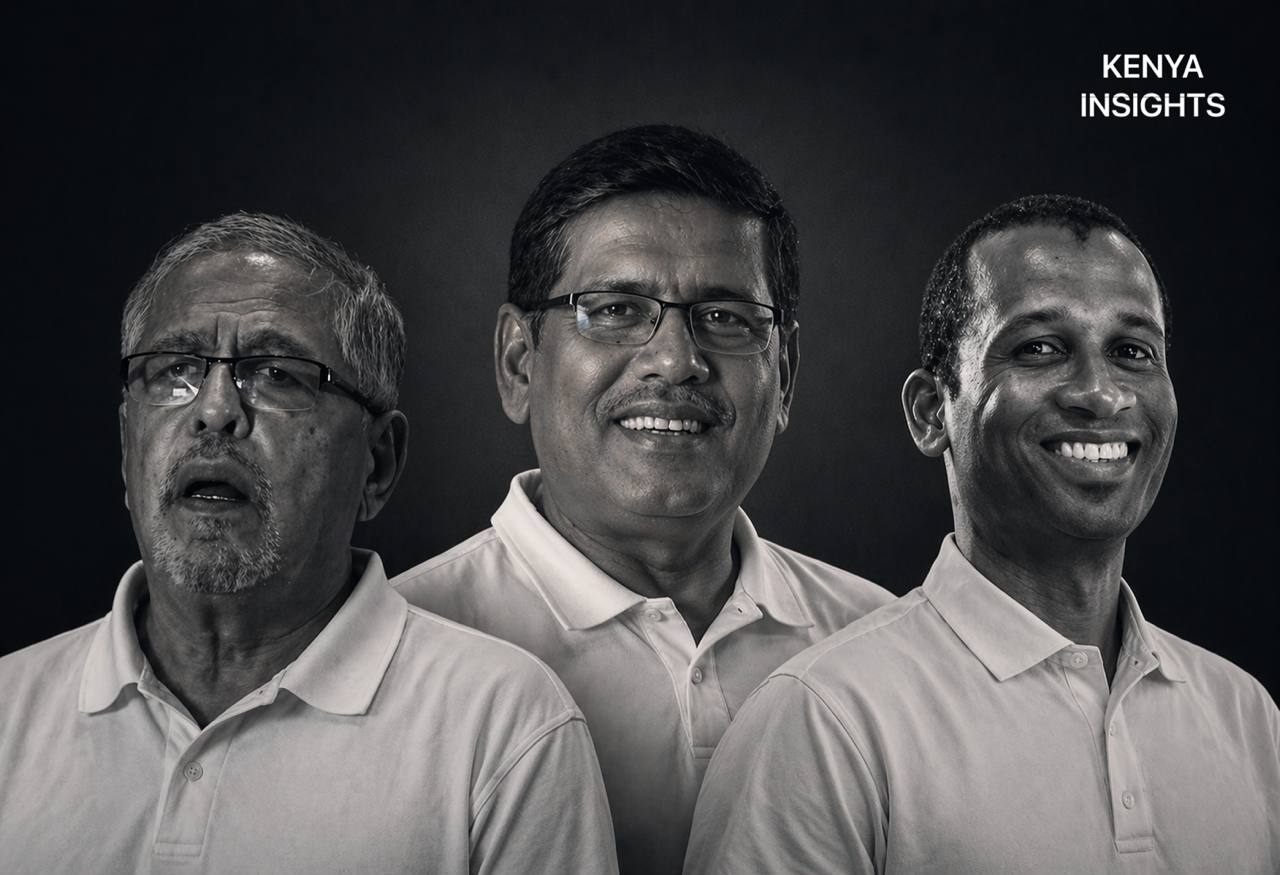
The Jaffer’s : How The Fuel Scandal Exposed The Sons Who Poisoned Kenya’s Fuel Tanks
How Mohamed Jaffer and his sons Mujtaba, Ali Abbas and Mohamed Husein built an empire on monopoly, political patronage and alleged fraud — and how a contaminated tanker called MT Paloma finally tore the silence apart

The ship was already gone. By the time Energy Cabinet Secretary Opiyo Wandayi stood before cameras on April 7, 2026, and ordered the withdrawal of 60,000 tonnes of condemned premium motor spirit, the MT Paloma had crossed into South African waters, sailing toward Port Elizabeth as if nothing had happened.
It docked at Mombasa on March 27.
It discharged.
It left on March 30. Three days. In those three days, a family whose empire has quietly choked Kenya’s ports, gas market and grain supply for three decades executed what Senator Ledama Ole Kina calls the most brazen act of energy-sector looting in the country’s recent history.
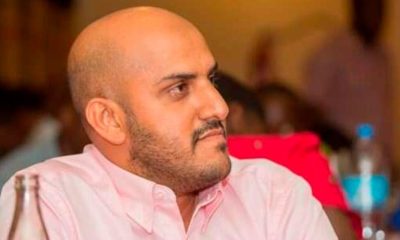
The family is the Jaffers. Mohamed Hussein Jaffer, 78, patriarch and chairman of the MJ Group, valued by The Africa Report at approximately KSh16.3 billion. His sons: Mujtaba Mohamed Jaffer, a man OCCRP investigators linked to a rigged government tender that overcharged every Kenyan driver for a digital driving licence; Ali Abbas Jaffer, listed as a director of One Petroleum Limited, the company at the centre of the fuel scandal; and Mohamed Husein Jaffer, equally installed on the One Petroleum board and equally summoned to record statements with the Directorate of Criminal Investigations.
Together, this quartet controls a web of companies spanning grain terminals, liquid petroleum gas, fuel importation and offshore structures that investigators say are engineered to move money beyond the reach of Kenya’s taxman.
Their names appear in court files, KRA seizure orders, EADB fraud suits, OCCRP investigations, Mombasa defamation proceedings and now a criminal probe into what may become the largest petroleum sector prosecution in Kenya’s history.
The MT Paloma did not just bring substandard fuel into Kenya’s veins. It brought the Jaffers into the daylight, and the daylight is merciless.
Benzene is a known human carcinogen. Elevated manganese destroys catalytic converters. High sulphur corrodes engines and raises toxic roadside emissions. Kenyan motorists who filled their tanks over the Easter weekend were, without their knowledge, poisoned.
THE ANATOMY OF A MANUFACTURED CRISIS
The anatomy of the scheme begins not at the Port of Mombasa but at the Office of the President, on March 9, 2026.
A National Security Council Committee meeting chaired by Chief of Staff Felix Koskei addressed the disruption caused by Iran’s closure of the Strait of Hormuz following drone attacks on Gulf oil facilities.
The meeting instructed Petroleum Principal Secretary Mohamed Liban to seek alternative fuel sources beyond the Gulf and to develop a national energy security plan.
That directive was legitimate. What happened next was not. Liban, working in tandem with Kenya Pipeline Company Managing Director Joe Sang and Energy and Petroleum Regulatory Authority Director-General Daniel Kiptoo, used the geopolitical disruption as cover to authorise emergency fuel imports outside Kenya’s government-to-government framework — the transparent, price-regulated arrangement under which Kenya sources fuel from Saudi Aramco, Emirates National Oil Company and Abu Dhabi National Oil Company at approximately KSh140,111 per tonne.
On March 25, Liban wrote to One Petroleum Limited director Ali Balala and Oryx Energies CEO Angeline Maangi, authorising each firm to import approximately 60,000 tonnes of premium motor spirit, with allowance to exceed that figure by up to ten percent.
One Petroleum’s cargo was priced at KSh198,855 per tonne. The government benchmark was KSh140,111. The difference of KSh58,744 per tonne, multiplied by 68,000 tonnes, produced a windfall estimated at approximately KSh4 billion — to be absorbed directly into EPRA’s national pump price formula for the April 15 pricing cycle.
In plainer language: every Kenyan motorist in the country was to be made to subsidise Mohamed Jaffer’s profit margin without being told.
One day later, on March 26, Liban wrote to Kenya Bureau of Standards Managing Director Esther Ngari requesting a temporary waiver on standard pre-export verification procedures, citing the Strait of Hormuz closure.
He copied the letter to Energy CS Wandayi and Industrialisation PS Juma Mukhwana. The morning of March 27, the MT Paloma — a Marshall Islands-flagged vessel whose most recent port of call before Mombasa was Fujairah in the UAE — docked at 4.14 pm.
It discharged 68,000 tonnes. It sailed away on March 30. Trade CS Lee Kinyanjui’s formal waiver letter, which acknowledged in writing that the cargo contained high levels of manganese, sulphur and benzene, was dated March 28 — a full 24 hours after the ship had already been sitting in Mombasa harbour.
The conditions Kinyanjui attached to his waiver, including destination inspection of the cargo and a written indemnity from the importer, were never confirmed as satisfied.
No one in government checked.
No one in government said stop.
Preliminary reports of engine damage from stations supplied by this consignment circulated before the DCI made its first arrests. On Good Friday, April 4, detectives swooped: Liban, Sang, Kiptoo, and Energy Ministry Deputy Director Joseph Wafula were arrested, briefly held and released on KSh100,000 cash bail each. L
All four subsequently resigned. KPC’s Supply and Logistics Manager Joel Mburu was also taken in. Five officials gone, and the Jaffer family still standing.
THE SONS: THREE NAMES ON ONE PETROLEUM’S BOARD
The corporate registry entry for One Petroleum Limited reads like a Jaffer family reunion. Directors: Solomon Esebwe Mwanjumwa Ondego, Mujtaba Mohamed Jaffer, Ali Abbas Jaffer, Mohamed Husein Jaffer and Ali Salaah Balala. Company secretary: Nicholas Kokita.
Shareholders: the Jaffer family interests alongside Mbaraki Holdings Limited, a Mauritius-registered entity holding 41,098 ordinary shares whose beneficial ownership structure is not on any public record.
These are not nominal directorships.
These are working executive positions in a company that imported 68,000 tonnes of contaminated fuel into Kenya, charged the Kenyan public three times the regulated government rate for the privilege, and then, when the scandal erupted, issued a statement claiming it had simply responded to an emergency request issued by the Ministry of Energy.
The sons were at the helm when that decision was made.
Their names were on the corporate filings.
They attended for questioning at DCI headquarters. Their father was in India.
When detectives confirmed that Mohamed Hussein Jaffer had not returned from India and was being awaited before they could proceed further, the family’s posture became clearer.
The sons gave statements. The patriarch stayed abroad. Meanwhile, the cargo — which One Petroleum publicly pledged to withdraw from the Kenyan market — had, according to multiple industry executives who spoke to Kenya Insights and other outlets, already been absorbed into the Kenya Pipeline Company’s national network, which does not segregate cargoes by importer and does not permit selective withdrawal of a specific consignment once it has entered the commingled storage and pipeline system.
The assurances were, in practical terms, worthless.
The poison was already in the bloodstream.
The sons gave statements. The patriarch stayed in India. The cargo was already in the pipeline. The assurances were worthless.
MUJTABA JAFFER: THE FIXER WHO CALLED THE SEMLEX CEO ‘BROTHER’
Of the three sons, Mujtaba Mohamed Jaffer carries the longest public trail of controversy.
He is described in a 2020 investigation by the Organised Crime and Corruption Reporting Project, The Elephant and Africa Uncensored as the central Kenyan broker who facilitated the award of a digital driving licence contract to Semlex, a Belgian biometric document firm, in 2008.
The investigation, based on a leak of more than 160,000 internal Semlex documents, laid bare a scheme in which Mujtaba Jaffer, Semlex CEO Albert Karaziwan and associated consultants planned to make millions of dollars personally from a contract that would be paid for by ordinary Kenyan drivers at prices the investigation concluded were significantly inflated.
The leaked emails are damning in their casualness
In one, Mujtaba referred to Karaziwan as ‘brother’. In another, he referenced a late-night meeting with the Minister of Transport.
In a third, he gave the late politician Njenga Karume his ‘blessing’ to make decisions on his behalf about the contract terms. The network Mujtaba used was one of nominee companies and interlocking directorships entirely characteristic of how the Jaffer family does business: Computer Source Point Limited and Infocard Africa Limited, two obscure Kenyan entities owned by Mohamed Jaffer and Mujtaba Jaffer, served as the vehicles through which brokers received their cuts.
Among those brokers was Sheila M’Mbijjewe, then serving simultaneously on a Central Bank of Kenya committee and as a director of Jaffer family companies.
She has since risen to become the Central Bank’s Deputy Governor.
Also involved was Brown Ondego, then executive chairman of the Rift Valley Railways consortium and previously head of the Kenya Ports Authority, who simultaneously sat as a director on two Jaffer companies: Grain Bulk Handlers Limited and African Gas and Oil Limited.
The same Solomon Ondego later appears as a director of One Petroleum Limited, the company at the centre of the 2026 fuel scandal.
The circle does not just overlap. It is the same circle, drawn at different points in time.
The Semlex contract, which required Kenyan drivers to pay KSh3,000 for a digital licence, was eventually abandoned amid what the Ministry of Transport called ‘political wrangling’.
The ministry never recovered the full cost from Semlex. Kenyan drivers paid the inflated prices regardless.
Mujtaba Jaffer said Computer Source Point and Infocard Africa were no longer active. Whether the profits from those entities were ever declared to the Kenya Revenue Authority is a question the taxman has never publicly answered.
THE EADB FRAUD CASE: KSH464 MILLION AND A DEAD PARTNER
In 2016, the East African Development Bank filed suit against three respondents seeking to recover USD 3.6 million, equivalent to KSh464 million at prevailing rates, plus interest at 12 percent per annum.
The loan had been extended to Kenya Bus Services Mombasa Limited in October 1998 under a special drawing rights agreement.
The three guarantors were Jaffer Manoj, now deceased, Amritlal Devani and Mujtaba Jaffer.
The loan was never repaid.
As of March 1, 2003, the full principal plus accumulated interest was outstanding.
The case dragged through the Mombasa High Court for years before a trial judge removed it from the docket on grounds that the Court of Appeal subsequently ruled were erroneous in law. Judges Wanjiru Karanja, Asije Mkahandia and Gatembu Kairu dismissed the lower court ruling and ordered the matter reheard afresh.
It now sits before a fresh judge in Mombasa, the debt growing with each compounding year, the principal respondent available in ways Mujtaba Jaffer, with his personal assistant and proxy networks, has ensured he does not personally have to be.
Court records from the associated Kenya Revenue Authority investigations of 2011 revealed further details of the financial opacity Mujtaba had constructed.
Investigators demanded personal bank statements and income tax returns. He provided accounts held in the names of Zainab Meghji and himself at Imperial Bank. What he did not disclose, and what investigators subsequently discovered independently, were the accounts at Cooperative Bank and Diamond Trust Bank in Mombasa where the proceeds from grain sales through Grain Bulk Handlers were actually deposited.
The funds were not declared.
The accounts were not volunteered. The KRA had to find them on its own.
THE KRA RAIDS: SH68 MILLION AND AN ESCAPE ON A TECHNICALITY
In October 2020, the Kenya Revenue Authority obtained a court order and executed a search and seizure operation across Mohamed Jaffer’s chain of companies. Investigators entered the premises of One Petroleum Limited, Africa Gas and Oil Company Limited, One Gas Limited and Grain Bulk Handling Limited.
They removed financial documents and began analysis.
What they found, according to filed court papers, was preliminary evidence of massive under-declaration or omission of sales across the family’s oil and gas entities, constituting an alleged revenue loss to the government of KSh68 million.
The shared directorship structure of Mujtaba Jaffer, Ali Abbas Jaffer and Mohamed Husein Jaffer across these entities was specifically cited by KRA as the reason for withdrawing tax compliance certificates for all companies simultaneously: because they were owned by the same families, investigations into any one entity would involve all of them. KRA demanded to hold the seized documents for six months to conduct a thorough investigation.
What happened next is the story of Kenya’s legal architecture being used by the wealthy to frustrate accountability.
The companies took KRA to court.
The taxman, in a procedural failure that the judiciary ultimately treated as fatal to its position, had withdrawn the compliance certificates by email without prior notice and without giving the companies an opportunity to be heard.
The court threw out the certificate cancellation on those grounds.
The companies walked.
The documents KRA had spent months analysing were no longer anchored by a valid legal process.
Whether those six months of work translated into any prosecution, any assessment, any recovery of the alleged KSh68 million, is not on any public record. The Jaffer family’s lawyers had done their work.
KRA found preliminary evidence of massive under-declaration across multiple Jaffer companies. The family escaped on a procedural technicality. The Sh68 million was never publicly recovered.
THE GRAIN EMPIRE: TWO DECADES OF MONOPOLY AND A FRAUD ON A WHEAT IMPORTER
The foundation of the Jaffer fortune was built not in petroleum but in grain. In 1992, after eight years of lobbying Kenya Ports Authority, Mohamed Jaffer secured Wayleave Agreement rights over berths three and four at the Port of Mombasa for grain handling.
The monopoly, formalised through a licence agreement in 2000 for a period of 33 years, gave Grain Bulk Handlers Limited sole mechanical bulk grain handling rights at Kenya’s principal port.
Every tonne of wheat, rice, maize and World Food Programme cargo destined for Kenya, Uganda, Rwanda, Burundi, South Sudan and the Democratic Republic of Congo passed through Jaffer’s hands. Competitors were charged at a tariff of USD 10.40 per metric tonne through conventional handling.
GBHL, operating under its exclusive licence, charged USD 3.85 per tonne.
The differential was not a market advantage. It was a structural regulatory barrier that locked competitors out of the most cost-effective handling method by design.
The fraud case against wheat importer Atta Kenya Limited illustrated what this monopoly enabled in practice. Between 2013 and 2014, Atta Kenya entered contracts with Louis Dreyfus Company Limited to purchase 38,500 metric tonnes of milling wheat.
After Atta Kenya fell into arrears on storage charges at GBHL’s Mombasa silos, the 13,000 tonnes remaining in storage were put up for auction.
The successful buyer was Grain Industries — a company that investigators and witnesses described in court as related to Grain Bulk Handlers itself.
The sale price was, by the importer’s account, suspiciously low. Total deductions left Atta Kenya short by over KSh730 million.
Witnesses testifying in Mombasa High Court were unable to adequately explain why trucks belonging to Grain Industries were already loading the wheat before the auction was formally concluded.
After 24 years, in February 2024, the Court of Appeal broke the monopoly. Judges Pauline Nyamweya, Imaana Laibuta and George Odunga upheld Kenya Ports Authority’s award of a second bulk grain handling facility to Portside Freight Terminals, a company associated with the Joho family.
The judges ruled that the High Court had erred in blocking the award. The Jaffer grain empire had lost its most structural advantage. By that point, however, the family had already pivoted to petroleum. The MT Paloma was less than two years away.
THE JOHO WAR: BLACKMAIL, DEFAMATION AND MATILDA KINZANI
When competition finally arrived at the Port of Mombasa, Mohamed Jaffer did not lower his prices. He went to war. The entry of Abubakar Ali Joho — elder brother of Mining Cabinet Secretary Hassan Joho — into port logistics through Autoport Freight Terminus and Portside Freight Terminal represented the first serious challenge to a monopoly Jaffer had enjoyed for three decades. The response was not commercial. It was personal.
Matilda Maodo Kinzani, identified in court proceedings as Mohamed Jaffer’s personal assistant, stands charged with four counts under the Computer Misuse and Cybercrime Act for publishing false information in a WhatsApp group.
The allegations are serious: she reportedly circulated a letter claiming that CS Hassan Joho and his brother Abubakar had defrauded Mombasa County of over KSh40 billion, had links to drug trafficking, and had stolen containers at the Kenya Ports Authority.
The defamatory letter, which police investigators traced to Kinzani, also allegedly linked Abubakar to criminal networks in language designed not merely to harm his reputation but to trigger law enforcement attention.
Abubakar Joho testified before Mombasa Senior Resident Magistrate David Odhiambo with unusual directness. He stated that Jaffer had held a monopoly at the port for 30 years and that their problems began only when he entered the same business.
He directly named Jaffer as the man he believed was behind the attacks.
‘He is the monopoly. I am not,’ Abu told the court. Kinzani, who faces KSh300,000 cash bail, denies the charges. She has told the court that artificial intelligence may have been responsible for the letter. Jaffer, whose secretary is on trial and whose name echoes through the testimony, has said nothing publicly about the case at all.
MBARAKI HOLDINGS: THE MAURITIUS GHOST COMPANY
At a 19th floor office in Newton Tower, Port Louis, Mauritius, sits a company called Mbaraki Holdings Limited. It holds 41,098 ordinary shares in One Petroleum Limited.
Its beneficial owner is not on any publicly accessible record. Its directors, if they exist on paper, are not named in any Kenyan registry document.
Its accounts are filed under Mauritian law, which provides a level of financial privacy that Kenyan law does not.
The Kenya-Mauritius Double Taxation Agreement allows dividends paid from a Kenyan company to a Mauritius-resident shareholder to attract preferential or zero withholding tax treatment.
By routing significant shareholding in One Petroleum through Mbaraki Holdings, the Jaffer family has constructed a mechanism by which profits generated from the Kenyan fuel market at inflated emergency premiums can be streamed into Mauritius without the full tax burden they would attract if held by a Kenyan-resident entity.
KRA has no automatic visibility into what Mbaraki Holdings does with those funds once they arrive in Port Louis.
The offshore structure is not the only financial architecture investigators are examining. One Petroleum’s registered debentures include two instruments dated September 2, 2024, each securing USD 95 million, and two deeds of assignment securing a further USD 395 million.
The aggregate of registered encumbrances approaches or exceeds USD 1 billion.
Under Kenyan tax law, interest payments on debt are deductible. A company carrying this level of registered debt, whether the full face value is drawn or not, creates a permanent mechanism for reducing declared taxable profit.
If the lenders on these debentures are related offshore entities, the interest rates and actual drawdowns become critical instruments of profit shifting. Kenya Insights has asked One Petroleum and Mbaraki Holdings for comment on the debt structure. No response was received at the time of publication.
THE LPG CHOKE: PRO GAS, SEA GAS AND 90 PERCENT OF KENYA’S COOKING FUEL
Petroleum is only the latest arena of Jaffer dominance. Through Africa Gas and Oil Company Limited, which operates a 25,000-tonne LPG import terminal at Mombasa upgraded in 2022, the family controls the handling of approximately 90 percent of Kenya’s imported liquefied petroleum gas.
Its subsidiary, Proto Energy Limited, manufactures and distributes LPG under the brands Pro Gas, Sea Gas and Oto Gas — the cylinders that sit in kitchens from Mombasa to Malaba.
The cooking gas market has been, functionally, a Jaffer franchise.
The entry of Tanzanian billionaire Rostam Aziz’s Taifa Gas into Kenya in 2023, following a groundbreaking ceremony attended by President William Ruto at Dongo Kundu Special Economic Zone, represented the first serious threat to this dominance.
Industry sources suggest that the years between Aziz’s initial 2017 inquiry and the 2023 licence approval, six years of official silence during which Kenya’s gas prices climbed to KSh3,266 per 13-kilogram cylinder, may partly reflect the success of lobbying to keep new entrants out of the market.
Whether that lobbying was formal, informal or conducted through the kind of political patronage networks that have sustained the Jaffer empire across four presidencies is a question investigators have not yet answered publicly.
In a notable land dispute related to this ecosystem, a company called Miritini Free Port, associated with the Jaffer family, received KSh1.8 billion in compensation from the National Land Commission for land that the High Court subsequently ruled had been acquired through fraudulent means.
The court found the compensation unlawful. The money had already been paid.
POLITICAL PATRONAGE: FROM MOI TO RUTO — A BUSINESS DYNASTY THAT SURVIVES EVERY ELECTION
Mohamed Jaffer’s most durable business asset is not a grain terminal or a petroleum storage facility. It is his ability to make himself indispensable to whoever holds power.
The pattern has been consistent across four decades. He leveraged Daniel arap Moi-era connections to secure his original grain handling exclusivity at the Port of Mombasa in 1992.
He survived the Kibaki transition.
He prospered during Uhuru Kenyatta’s tenure, expanding his grain, gas and petroleum operations.
He publicly supported Raila Odinga in the 2022 presidential race.
When Odinga lost, he recalibrated. By October 20, 2023, President William Ruto was honouring Mohamed Jaffer at a state ceremony for contributions to entrepreneurship and industry.
Shortly after that ceremony, One Petroleum was formally incorporated into the government-to-government fuel import framework, expanding the number of participating Kenyan oil firms from three to five.
The inclusion gave One Petroleum access to guaranteed import volumes and pricing structures under the most privileged procurement arrangement in Kenya’s energy sector.
EPRA Director-General Daniel Kiptoo, who subsequently resigned under arrest, disclosed this incorporation at the time as a sign of the government’s confidence in the private sector.
The question investigators are now pressing is whether the incorporation of One Petroleum into the G2G framework, and the emergency authorisation of March 2026, represent a continuum: the natural progression of a family that has spent decades converting political access into regulatory privilege, and regulatory privilege into commercial monopoly.
Senator Ole Kina’s statement before the Senate Energy Committee addressed precisely this continuum, describing the March 2026 scheme as premeditated planning rather than an opportunistic response to a genuine crisis.
Internal communications reviewed by Kenya Insights and other outlets show that KPC Supply and Logistics Manager Joel Mburu was in a position to have manipulated fuel inventory data to manufacture the appearance of a shortage that did not exist.
Whether Mburu acted independently or in coordination with One Petroleum is what the DCI is working to establish.
From Moi to Ruto, the Jaffer family has never missed a political cycle.
They back whoever wins, or they back both sides.
The grain licence of 1992 became the petroleum dominance of 2026.
THE PATRIARCH ABROAD: MOHAMED JAFFER’S SILENCE FROM INDIA
As detectives widened their investigation through April 2026, interviewing more than 20 suspects and persons of interest across government agencies and the private sector, one name remained conspicuously absent from the DCI interview rooms: Mohamed Hussein Jaffer himself.
His three sons had attended and given their accounts. His personal assistant was in the dock at Mombasa magistrate’s court.
His company’s cargo was the subject of a criminal probe stretching across multiple countries under mutual legal assistance frameworks. And Mohamed Jaffer was in India.
Reports circulating on social media and confirmed by investigative outlets cited DCI sources as saying that Jaffer was abroad and that investigators were waiting for his return to record his statement.
No arrest warrant had been issued at the time of publication.
No formal charges had been filed against any member of the Jaffer family.
All the family’s legal exposure, as of this report, remains at the stage of criminal investigation rather than prosecution.
But the pattern of the patriarch’s absence while his sons absorb the initial investigative pressure is consistent with how this family has historically managed risk.
When the Semlex scandal broke, it was Mujtaba who was named, not Mohamed. When the KRA raids came in 2020, the companies were all in the sons’ names as directors, and it was on procedural grounds involving notice by email that the case collapsed.
When the EADB came for its USD 3.6 million, Mujtaba was among the guarantors, not the patriarch. Mohamed Jaffer builds the empire.
His sons hold the directorships. His offshore structures hold the shares. And when accountability comes, it finds layers upon layers of corporate distance between the hand that signed and the money that moved.
THE POISON IN THE TANKS: WHAT BENZENE, MANGANESE AND SULPHUR DO TO A HUMAN BODY
Behind the billions and the boardroom manoeuvrings is a public health emergency that has received insufficient attention.
Benzene is classified by the International Agency for Research on Cancer as a Group 1 carcinogen, meaning there is sufficient evidence that it causes cancer in humans.
Chronic exposure at levels found in contaminated fuel exhaust has been linked to leukaemia and non-Hodgkin lymphoma.
Manganese at elevated levels in exhaust emissions is a neurotoxin, associated with a Parkinson-like syndrome called manganism, and is particularly harmful to children whose neurological development is ongoing.
High sulphur content in petrol increases particulate matter and sulphur dioxide in roadside air, exacerbating asthma, cardiovascular disease and chronic obstructive pulmonary disease.
The Trade CS’s letter of March 28, 2026, which granted the waiver for the MT Paloma’s cargo, acknowledged in writing that the fuel contained high levels of all three.
Kenyan motorists who filled their tanks at stations supplied from One Petroleum’s consignment between the date of discharge and the date the withdrawal order was issued — a gap of approximately eleven days — were exposed to this mixture without being told. No public health warning was issued.
No recall of motor vehicles was ordered.
No advisory was sent to hospitals about potential increases in respiratory or neurological presentations.
The government, in its scramble to manage the political and economic fallout of the scandal, did not address the people most harmed: the drivers, the hawkers, the commuters and the children breathing roadside air in Nairobi, Mombasa and every town in between.
THE RECKONING THAT KENYA IS OWED
The Jaffer family has not been convicted of any crime arising from the MT Paloma scandal or any of the other matters documented in this report.
All allegations are subject to the ongoing DCI investigation, to court proceedings that remain unresolved, and to the legal presumption of innocence that applies equally to billionaires and to ordinary citizens.
Kenya Insights does not prejudge outcomes.
It presents the documented record.
That record is this: a family that built its fortune on a grain handling monopoly secured through political connections in 1992, expanded it into LPG dominance that controls 90 percent of Kenya’s cooking gas imports, diversified into petroleum under a corporate architecture that routes profits through Mauritius and registers debentures of nearly USD 1 billion whose lenders are not publicly identified, deployed nominee companies and interlocking directorships to broker a rigged government tender for digital driving licences, failed to repay a KSh464 million loan to a development bank despite decades of accumulating wealth, evaded KRA scrutiny through procedural technicalities, and allegedly used a personal assistant to blackmail a Cabinet Secretary and a prominent businessman who had the temerity to compete in their territory.
Into that record, add March 2026. A tanker diverted from Angola.
An emergency authorisation signed two days before it docked.
A cargo of contaminated fuel priced at three times the government rate.
Waivers rushed through over a public holiday.
Five senior officials now without their jobs. Investigators in multiple countries.
A patriarch in India. Sons who gave their statements. And a pipeline full of fuel that cannot be withdrawn because pipelines do not work like that.
Kenya’s motorists, farmers, hawkers and taxpayers have been paying the Jaffer premium for thirty-four years.
They paid it in inflated grain handling charges at the port. They paid it in cooking gas prices that competitors were systematically barred from reducing.
They paid it in driving licence fees structured to fund private profit.
And in March 2026, they paid it in contaminated petrol that damaged their engines, poisoned the air around their children and made a small group of men richer by billions while the rest of the country fuelled up in ignorance.
The Senate Energy Committee has heard the testimony.
The DCI has the paper trail.
The Court of Appeal has ordered the EADB fraud case reheard.
The High Court has already ruled one land compensation unlawful.
The Semlex files sit in OCCRP’s archive.
The KRA’s six months of document analysis is somewhere in a filing cabinet.
All that is required is a government, a judiciary and a regulatory system willing to connect the dots that have been visible, in fragments, for three decades.
The dots have never been so clearly arrayed as they are today, illuminated by the searchlights of a scandal too large to bury and a cargo too toxic to pretend was never delivered.
The reckoning is long overdue.
Kenya Insights allows guest blogging, if you want to be published on Kenya’s most authoritative and accurate blog, have an expose, news TIPS, story angles, human interest stories, drop us an email on [email protected] or via Telegram







The Jaffer’s : How The Fuel Scandal Exposed The Sons Who Poisoned Kenya’s Fuel Tanks

THE FIXER IN THE FILE ROOM: How Parliamentary Health Committee Clerk Adan Gindicha Cleared Mediheal Hospital of Organ Harvesting Claims Despite Mounting Evidence

Report Reveals How Betika’s Empire Was Allegedly Built On Stolen Data

Nairobi Freezes Binance Accounts in Sweeping Anti-Fraud Crackdown as Global Scandal Record Haunts World’s Largest Crypto Exchange

EXCLUSIVE: Odibets Bought Stolen Data From Millions Of Kenyans

Taiwan President Cancels Trip After African Countries Close Airspace

Murkomen, Sudi and MP Fingered In Sh20 Billion Runda Land Grab

Sold, Pledged and Vanished: The Mounting Controversies Over The Saruni Apartments On Riverside Drive

Why the April 21 Flopped Protests Expose Kenya’s Rudderless Opposition

64-Year-Old KIM Faces Shutdown As Regulator Declares Its Certificates Worthless, Orders Employers To Shun Graduates

Forged Legacy: How Kaplan and Stratton’s Peter Gachuhi Is Accused of Faking a Top AG’s Will as State Claims Damning Evidence

Sold And Abandoned: How Diageo and Asahi Are Locking Kenya’s EABL Minority Shareholders Out Of East Africa’s Biggest Corporate Heist

Poison at the Pump: How Kenya’s Fuel Marking System May Be Exposing Millions to Cancer-Causing Chemicals

THE HANDSHAKE THAT BECAME A NOOSE: How Tuju’s Alleged Intimate Access to EADB’s Yeda Apopo Produced a Sh294 Million Deal With No Written Contract, and Why That Trust Destroyed an Empire

Inside Details Of Sh78 Billion Fraud in KPC’s Mombasa-Nairobi Line 5 Pipeline Project That Has Continued To Bleed The Country

How Firm Linked To Mombasa Tycoon Jaffer Was Allowed To Import Fuel At Bloated Price And Set To Make Billions In Profits From Iranian War Crisis In Kenya

THE ZAKHEM-ECOBANK MACHINE: How Kenya’s Courts Were Weaponised to Drain a State Corporation of Over KES 78 Billion

The Teflon Company: How Gulf Energy’s Insiders Built Billions on Kenya’s Fuel, and Walked Away Clean

The Debt They Would Not Pay: How Standard Group Ducked Sh50 Million In Regulatory Fee For Years, Then Called It A Witch-Hunt

The Lawyer at the Centre of Kenya’s State Machine: Eric Gumbo, the AG’s Bypassed Office, and the Half-Billion-Shilling Question
-
 Business2 weeks ago
Wattanga Fired Over Incompetence in Tech, Insiders Say
-
 Business1 week ago
Kenyan Motorists Stare At Possible Engine Damage And Heavy Losses As Report Confirms Substandard Fuel In Circulation
-
 Business1 week ago
Getting Away With It: How Kenya’s Most Politically Connected Fuel Company Gulf Energy Is Pocketing Billions While Rival Firms Face Public Wrath
-

 Business6 days ago
THE FUEL CABAL: How Mohamed Jaffer, a KPC Insider, and a Ministry Official Are Alleged to Have Manufactured Kenya’s Worst Petroleum Crisis in Three Years, While Kenyans Burned
-
 Business1 week ago
How Safaricom Could Sell You Out To KRA
-
 News1 week ago
The Kewota Racket: How Kenya’s Female Teachers Are Being Bled Dry
-

 Business1 week ago
Sugar Empire in the Dock: How Kibos’s Mombasa Refinery Landed 1,481 Phantom Tonnes at the Port — and Why Nine Government Agencies Are Now Watching Its Every Move
-
 Investigations2 weeks ago
Why Kisumu Senator Tom Ojienda Is Suspected as the Hidden Hand Behind the Brutal Beating of Senator Godfrey Osotsi