
Investigations
THE GHOST AT ELYSEE PLAZA: How Ghanaian Businessman Erick Agbeko Built a Two-Decade Empire of Land Fraud in Kenya
Why a Senior Counsel’s Public Verdict Changes Everything


NAIROBI — For more than two decades, Erick Agbeko presented himself to Kenya as a facilitator. A man who knew the right people, spoke the right languages, understood the local architecture of company formation, banking, and land registration well enough to smooth the way for foreign investors and property buyers who trusted him implicitly. Reunion Island-based businessmen trusted him.
Local buyers trusted him. Political connections orbited around him. Spire Bank’s predecessor institution, Equatorial Commercial Bank, lent tens of millions of shillings on his representations. And one by one, every party that extended that trust would come to regret it.
Now, for the first time, a man who faced him across a courtroom has given public voice to what Kenya’s judicial archives have been recording in excruciating detail for more than fifteen years.
Senior Counsel Ahmednasir Abdullahi SC, one of the most recognisable and combative litigators in the country’s history, a man with 2.5 million followers on X and a reputation for saying in public precisely what others refuse to utter, has stated without qualification that from the cases he personally handled against Agbeko, the Ghanaian national is “a LEADING LAND FRAUDSTER in Kenya.”
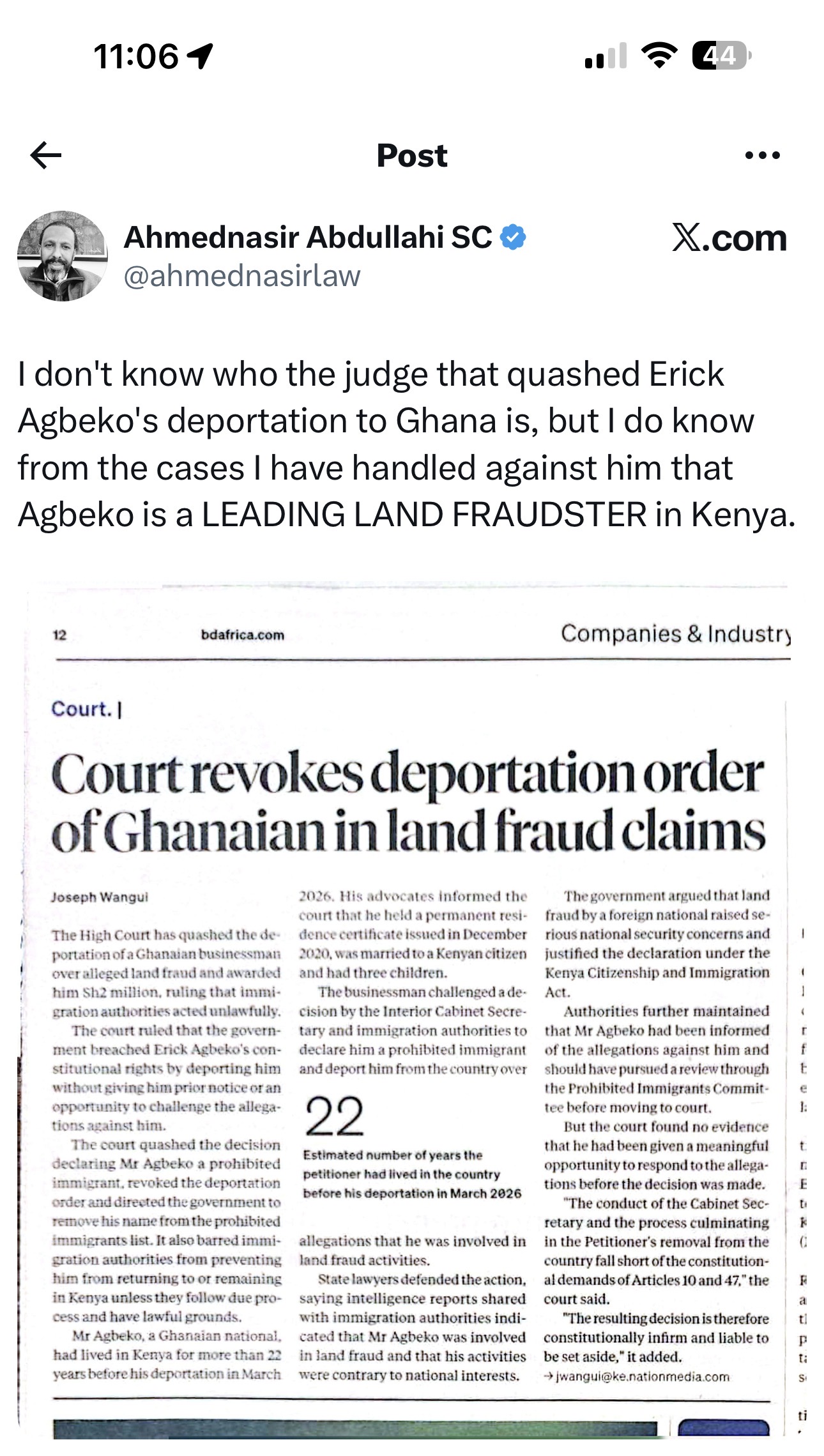
Screenshot
That assessment is not offered here as the final word of a court. It is offered as the verdict of a direct adversary a practising Senior Counsel who has litigated against Agbeko and watched his methods up close.
And it lands against a backdrop of civil judgments, criminal charges, victim accounts, environment and land court orders, appellate proceedings, and intelligence reports that together constitute one of the most comprehensively documented patterns of property fraud in Kenya’s modern legal history.
This newspaper has gone to the archives. We have gone to the charge sheets. We have spoken to the record as it sits in Kenya Law, in court files at Milimani, in the registers of the Environment and Land Court. What follows is the complete exposure of Erick Agbeko’s modus operandi laid bare, case by case, victim by victim, judgment by judgment.
“From the cases I personally handled against him, Agbeko is a LEADING LAND FRAUDSTER in Kenya.” — Senior Counsel Ahmednasir Abdullahi SC
THE MAN WHO ARRIVED TO HELP
Agbeko is a Ghanaian national who arrived in Kenya and embedded himself in the country’s commercial and real estate ecosystem so completely that by December 2020, he had obtained a permanent residence certificate.
He described himself publicly as a project manager, a trained linguist, the Chairman of Eagle Group International Kenya Limited a company whose website presented him as a figure who coordinates projects, contracts, and joint ventures between governments, companies, and financiers across the region.
That self-presentation is important context. Agbeko did not operate as a street-level fraudster. He operated at the upper end of the market approaching, or being approached by, foreign investors with deep pockets who needed a local interlocutor, buyers seeking prime Nairobi land deals, business partners who required someone fluent in English and French to move millions through Kenyan banking channels. His linguistic skills and apparent establishment connections were central to his value proposition. They were also, the courts would find, central to his predatory model.
The Elysee Plaza case is where his record is most comprehensively exposed. But it was not the last time he appeared in a dock or as a defendant in a court file. Nor, the evidence suggests, was it the first time he had deployed the particular brand of corporate manipulation that the Kilimani office block case would put on the permanent record.
ACT ONE: THE RAVASAM HIJACK AND THE ELYSEE PLAZA SWINDLE
The Elysee Plaza matter begins in 2008, when Farouk Ravate and Justin Samourgompoulle, businessmen from Reunion Island a French-administered island territory in the Indian Ocean decided they wanted to invest in Nairobi’s booming real estate sector.
Their inquiries led them to Erick Agbeko. According to court records filed in the consolidated High Court proceedings that would run for more than a decade Civil Cases 450 of 2011, 476 of 2015, and 637 of 2015 the two investors engaged Agbeko as their agent and local supervisor.
Their task was straightforward: acquire land, incorporate a company, and develop the property. The site they chose was LR No. 2/186, off Elgeyo Marakwet Road in Kilimani one of Nairobi’s most sought-after commercial zones.
A letter of instruction that would later be tendered in court proceedings read clearly: Ravate and Samourgompoulle were authorising their Kenyan advocate to register a company in which they and only they would be the sole directors and shareholders. The nominees used for incorporation purposes would hold shares as trustees, nothing more.
The company’s very name, Ravasam Development Company Limited, was coined from the names of Ravate and Samourgompoulle. The money Ravate would inject into the project ultimately acknowledged in court as at least Ksh 606.5 million covering both the land purchase price and construction was wired through Ecobank.
What Ravate and Samourgompoulle did not anticipate was that the man they had trusted to oversee the project had other plans for it entirely.
When the Reunion Island investors went to examine the registration records of Ravasam Development Company Limited, they were, in the words later used in court pleadings, “astounded to discover” that Agbeko and his Kenyan associate Philip Nyambok had registered themselves as the sole directors and shareholders.
The Declaration of Trust that Agbeko and Nyambok had signed explicitly stating that they held one share each in Ravasam in trust for Ravate and Samourgompoulle and disclaimed any personal interest in the company was apparently regarded by the defendants as a document of no legal significance.
In cross-examination, counsel for the defendants suggested to Ravate that the document had been used merely for fund-transfer purposes and had no ownership effect. Justice Francis Tuiyott, who presided over the consolidated trial, was unmoved.
But the fraudulent directorship capture was only the opening gambit. Once in formal control of Ravasam, Agbeko and Nyambok set about monetising the asset that Ravate’s hundreds of millions had created.
They approached Equatorial Commercial Bank Limited later renamed Spire Bank and eventually absorbed by Mwalimu National Sacco’s banking operations and secured lending facilities that would ultimately total Ksh 336 million, with the first tranche standing at Ksh 190 million.
This was done in the face of explicit written protests. Lawyers acting for Ravate and Samourgompoulle had written formally to the bank, notifying it of the alleged fraudulent actions of Agbeko and Nyambok, requesting that Ravasam’s accounts be frozen and that the disbursement of the initial loan be withheld. The bank disbursed the loan regardless.
The Kilimani property at the centre of the dispute by the time of judgment valued at Ksh 1.6 billion and now standing as the completed office complex known as Elysee Plaza was pledged as security for lending that had been secured through fraudulent means.
Of the Ksh 190 million advanced in the first facility, only a small fraction was alleged to have gone toward the actual construction of the building. The rest, the investors alleged, was misappropriated.
Litigation commenced. Civil Case 450 of 2011 was filed. Then Cases 476 and 637 of 2015. The three were ultimately consolidated. The proceedings consumed nearly a decade.
Agbeko filed an affidavit to the Judicial Service Commission making serious personal allegations against a judge who had been handling the case, including an accusation that a proxy had been sent to solicit a Ksh 10 million bribe from him.
That judge who flatly denied the allegation and reported the matter to the Directorate of Criminal Investigations at Kilimani was compelled to recuse himself from the proceedings.
Whether that allegation was true or a calculated litigation tactic to destabilise adverse proceedings is a question the record leaves open, but its effect was to prolong what was already an exhausting dispute.
Of the Ksh 190 million advanced to Ravasam, only a small fraction allegedly went toward construction of Elysee Plaza. The rest, investors alleged, was simply misappropriated.
Judgment in the consolidated cases was eventually delivered on 20 January 2020 by Justice Tuiyott. It was a comprehensive repudiation of Agbeko’s position. The court declared Farouk Ravate and Justin Samourgompoulle to be the true and rightful directors of Ravasam Development Company Limited. It ordered that the names of Eric Agbeko and Philip Nyambok be struck out from the company’s records and replaced with those of the Reunion Island investors.
A mandatory injunction was issued compelling Agbeko and Nyambok to transfer all shares they held in Ravasam to the plaintiffs or their designated entities within 30 days — failing which the Registrar of Companies would effect the transfer directly.
Permanent injunctions restrained Agbeko and Nyambok from dealing, in any form, with the company’s property at LR 2/186, its shares, its assets, or its bank accounts. The court also ordered a full accounting of all monies, assets, property and affairs of Ravasam including all rents collected and funds disbursed and declared restitution of everything unlawfully taken. A further declaration voided the mortgage that had been placed on the property.
The judgment did not end the matter. If anything, it exposed the next dimension of Agbeko’s operating method: defiance of judicial orders. Court records from a March 2020 application show that after the judgment, Agbeko and his associates continued to collect rents from the building, blocked legitimate access by the rightful directors, and deployed individuals who assaulted staff and stole property from Elysee Plaza.
That last incident was reported to Kilimani Police Station and logged under OB Number 104/13/3/2020. The plaintiffs were compelled to return to court to seek police assistance to enforce what the High Court had already ordered. Agbeko meanwhile launched an appeal to the Court of Appeal Civil Application No. 29 of 2020 seeking to maintain the status quo while the appeal was pending, though the appeal itself did not suspend the High Court’s findings.
The case has continued to generate related proceedings at least as recently as 2023, when a further ruling was recorded in Civil Case 450 of 2011.
ACT TWO: THE THOME ESTATE — LAND BELONGING TO THE DEAD
The Elysee Plaza case demonstrated what Agbeko could do with corporate structures and banking facilities. The Thome estate case revealed a different but equally calculated strand of the same predatory playbook: the peddling of land whose title is contested, compromised, or simply not his to sell.
In June 2022, Agbeko appeared in the dock at Milimani Chief Magistrate’s Court. Alongside him was Luke Kipchumba Metto. The charge: conspiracy to defraud Agnes Mwendwa Marete and Kennedy Obutua of Ksh 20.1 million. The mechanism: falsely pretending that Metto was the registered owner of land parcel NAIROBI/BLOCK/110/234, measuring 0.234 hectares in the Thome estate area of Nairobi, and inducing the victims to pay that sum toward the purchase of land whose title was tied to a deceased person’s estate, without proper succession having been concluded.
According to the charge, the offence was committed on diverse dates between 30 March 2018 and 23 May 2020, jointly with others not yet before the court. Metto faced a separate charge of forging a sale agreement purporting to be between himself and one Milka Wambui Wachira, dated 3 June 2015, with intent to defraud. Both men denied the charges. Metto was released on a bond of Ksh 1 million, with a cash bail alternative of Ksh 500,000. Agbeko was released on a Ksh 500,000 bond.
The anatomy of the scheme is instructive.
Deceased-estate land land registered in the name of someone who has died, without formal succession through the courts to transfer title to the lawful heirs is a perennial vulnerability in Nairobi’s property market. Sellers can present documentation suggesting ownership while the formal legal title remains in the name of the deceased, rendering any sale legally precarious and potentially worthless to a buyer.
By the time a buyer discovers the defect, the seller has disappeared with the deposit.
The victims in this case paid over twenty million shillings and received nothing that could withstand legal scrutiny. The criminal proceedings remain on foot.
ACT THREE: THE SENATOR’S INTRODUCTION — SYOKIMAU AND THE FRIENDSHIP BETRAYAL
If the Elysee Plaza case demonstrated Agbeko’s capacity to operate at the Ksh 600 million end of the market, and the Thome estate case exposed his appetite for working the mid-range property buyer, the Syokimau allegation shows the social and political dimension of his methodology: leveraging trusted personal relationships to introduce victims to land deals that leave them with nothing.
Lydia Wangui was a woman who trusted her friend.
Her friend was Gloria Orwoba, who would later become a nominated Senator. During the COVID-19 period in 2020, when the two women’s friendship was reportedly deepening, Lydia had shared with Gloria her aspiration to acquire land and build a family home.
Gloria, in turn, introduced her to two business associates: Reuben Yego and Erick Agbeko. The land in question was described as a subdivision in Syokimau, on the outskirts of Nairobi, in which plots were being sold to investors as the exercise was completed.
Lydia’s trust in her friend was total. In December 2020, she paid Ksh 900,000 to Reuben Yego, receiving in return a sale agreement witnessed by the Senator herself, along with an LR number for her designated plot. The land in question was registered in Yego’s name but had allegedly already been sold to Agbeko, with Lydia’s sale agreement made with Agbeko as the apparent principal. She never received her plot. Her attempts to secure a refund came to nothing.
When she reported the matter to the Directorate of Criminal Investigations at Mlolongo Police Station, she encountered what many Kenyans encounter when they seek redress for land fraud: a request for a “facilitation” fee. She reportedly parted with Ksh 10,000 before the initial ask of Ksh 100,000 was negotiated down, and received no justice in return.
What she did receive, however, was a revelation from the police that would have stopped anyone else in their tracks: Eric Agbeko already had multiple land-related court cases pending against him. The man her Senator friend had introduced her to as a trustworthy business partner was, by the time of that introduction in 2020, already a defendant or respondent in a growing catalogue of property litigation.
Gloria Orwoba subsequently told Lydia never to contact her again about the matter. The friendship was gone. So was the Ksh 900,000.
This allegation has not been the subject of a final court adjudication. It is documented in public accounts and social media records, and it fits the established pattern.
What makes it particularly significant is the network dimension: a sitting Senator as the point of introduction, a social bond as the instrument of trust, and a Ghanaian national who had no shortage of well-connected intermediaries to smooth the path to his victims.
ACT FOUR: RAHIL INTERNATIONAL AND THE FRAUDULENT TITLE
Beyond the headline cases, Agbeko’s fingerprints appear in a series of further property disputes that cumulatively paint a picture of someone who had embedded himself across multiple segments of Nairobi’s land market.
In the Environment and Land Court, Rahil International Limited v Eric Agbeko and Another (ELC Civil Case E204 of 2021) reveals yet another front. Court records from the ruling delivered on 3 November 2021 show that the plaintiff, Rahil International, sought injunctive orders against Agbeko in relation to parcels I.R. No. 49556 and L.R. No. 209/10801.
The application was premised on the allegation that Agbeko “purports to be the registered owner of the suit property through illegally, unlawfully and fraudulently acquired title” and that he had attempted to dispose of the parcels to third parties.
Interim orders of status quo had been granted as early as 2016, well before the current case reference, indicating that this dispute had been running for years before the 2021 proceedings were formalised. A February 2026 judgment in the same matter has also been recorded, suggesting the litigation remained unresolved for the better part of a decade.
A separate set of appellate proceedings Civil Appeal E723 of 2021, in which Agbeko Eric and one Mensah Bafour Kyei appeared as appellants against a respondent named Hadija Cheruto Hamisi emerged from a Chief Magistrate’s Court civil dispute in 2019.
The magistrate’s court had closed the defendants’ case in their absence, producing an adverse outcome that the appellants then sought to challenge on jurisdictional and procedural grounds. The pattern of appellate delay-seeking, apparent across multiple proceedings, is itself a signature.
Records at Kenya Law also reveal Agbeko’s involvement in matters touching on Spire Bank’s assets and loan portfolio matters connected to the Ravasam/Elysee Plaza saga that gave rise to subsidiary disputes involving the bank’s own recovery actions against the building, creating a cascade of secondary litigation that burdened multiple parties and institutions for years.
THE ANATOMY OF THE PLAYBOOK
Erick Agbeko did not operate the same way twice. But he operated with the same underlying logic repeatedly, adapting its surface form to the opportunity at hand while the core mechanism remained constant.
In the Ravasam case, the target was a foreign investor who needed a trusted local interlocutor and could not personally monitor events on the ground. Agbeko was hired as an employee and paid Ksh 50,000 a month.
From that position, he executed a corporate hijack registering himself and an associate as sole directors and shareholders of a company whose founding documents clearly named other people as the beneficial owners.
Having seized formal control, he then weaponised it: borrowing hundreds of millions against the asset, ignoring lawyers’ letters warning the bank to stop, and constructing a years-long litigation fortress to prevent the legitimate owners from recovering what was theirs. When the judgment finally came against him, he deployed physical enforcers to block its implementation.
In the Thome estate case, the target was a property buyer with liquid funds seeking a Nairobi plot. The tool was a co-conspirator presenting false ownership credentials over land registered in a dead person’s name. The payment was extracted before the title defect could be investigated, and by the time the victims understood what had happened, the money was gone.
In the Syokimau case, the tool was social capital: a Senator’s personal endorsement, a friendship bond, a witnessed sale agreement that gave the transaction the appearance of legitimacy. The structural vulnerability was the same selling land over which ownership was contested or had already been transferred but the lubricant was human trust rather than corporate documentation.
And in each case, when the fraud was exposed, the response was the same: denial, litigation, delay, and an apparent willingness to absorb years of court proceedings as a cost of doing business. In the Ravasam case, Agbeko even went so far as to file a bribery allegation against the presiding judge a manoeuvre that, whatever its truth, successfully triggered a recusal and extended the proceedings by additional months or years.
When the judgment finally came against him, Agbeko deployed physical enforcers at Elysee Plaza to block its implementation. The assault on staff was reported to Kilimani Police Station.
THE DEPORTATION THAT WAS OVERTURNED AND WHAT IT DOES NOT CHANGE
The latest chapter in the Agbeko saga opened in March 2026, when immigration authorities declared him a prohibited immigrant and deported him to Ghana.
The Interior Cabinet Secretary’s office acted on intelligence reports asserting that his land fraud activities were contrary to national interests. The government’s position, articulated in court, was that land fraud by a foreign national constitutes a national security concern and justified the declaration under the Kenya Citizenship and Immigration Act.
Agbeko challenged the deportation, and on 18 June 2026, the High Court in Petition E153 of 2026 quashed the order. Justice ruled that the process was unconstitutional: Agbeko, who had married a Kenyan citizen and had children in the country, held a permanent residence certificate that gave rise to a legitimate expectation of due process before any such drastic action.
No meaningful opportunity had been provided for him to respond to the allegations before he was put on a plane.
The court found the conduct of the Cabinet Secretary and the immigration authorities fell short of the constitutional demands of Articles 10 and 47 on national values and fair administrative action. It awarded him Ksh 2 million in compensation, removed his name from the prohibited immigrants list, and barred future interference without due process.
None of this is surprising as a legal outcome. The procedural deficiencies the court identified are precisely the kind of state overreach that constitutional human rights law exists to check. A permanent resident cannot be expelled from a country he has lived in for more than two decades, on the basis of a confidential intelligence report he was never shown, without so much as a letter informing him of the allegations or a chance to respond. The court was right to quash the order on those grounds.
But and this cannot be overstated the constitutional victory is a process victory, not a substantive one. The court was explicit: it made no determination on whether the fraud allegations against Agbeko were true or false. It could not and did not. The civil judgments remain on the record. The criminal charges remain live. The victims remain without full restitution. The fraud findings are not altered by the fact that the state attempted to address them through an unconstitutional shortcut.
SENIOR COUNSEL AHMEDNASIR: THE WEIGHT OF ADVERSARIAL TESTIMONY
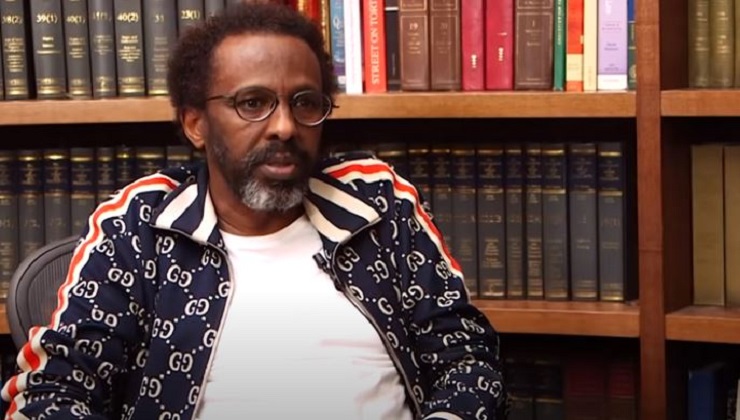
Ahmednasir Abdulahi.
Into this landscape, Ahmednasir Abdullahi SC delivered his public assessment. Ahmednasir is not a passive observer. He is one of Kenya’s most consequential legal figures: a constitutional lawyer with over three decades of practice, a Senior Counsel who has represented former presidents and electoral commissions, the publisher of Nairobi Law Monthly, a man who has crossed swords with the Supreme Court itself and had himself permanently barred from appearing before it for his public accusations of judicial corruption. Whatever one thinks of his methods, no one doubts his capacity for adversarial assessment.
When Ahmednasir states that from the cases he personally handled against Agbeko, the Ghanaian national is “a LEADING LAND FRAUDSTER in Kenya,” he is speaking from direct courtroom confrontation. He is not repeating media reports. He is not relying on victim hearsay. He is rendering the professional verdict of a Senior Counsel who has cross-examined witnesses, reviewed documents, and argued against Agbeko’s position in contested proceedings. That testimony, offered publicly on a platform with millions of followers, is now part of the permanent public archive.
It joins a record that already contained civil judgments ordering Agbeko struck from company registers, criminal charges for conspiracy to defraud more than Ksh 20 million, environment and land court orders against him for alleged fraudulent title acquisition, appellate delay tactics across multiple fronts, and a deportation order rooted in intelligence assessments of his threat to national interests.
THE VICTIMS: A HUMAN ACCOUNTING
It is easy, in a story of this scale and complexity, for the human cost to be buried beneath the legal citations. It should not be. Farouk Ravate injected at least Ksh 606.5 million of his personal funds into a Nairobi development project. He was defrauded of the company that project created, and spent more than a decade in litigation to recover it.
During those years, Agbeko collected rents from a building built with Ravate’s money, borrowed hundreds of millions against it, and deployed goons to block Ravate’s agents when judicial orders finally vindicated the Reunion Island investor.
Agnes Mwendwa Marete and Kennedy Obutua paid Ksh 20.1 million for land in Thome estate and received title to nothing, the alleged product of a scheme involving forged sale agreements and a deceased person’s unresolved estate.
Lydia Wangui paid Ksh 900,000 for a Syokimau plot that was never delivered, introduced to the deal by a sitting Senator who allegedly witnessed the sale agreement and then refused to speak to her again when the money disappeared. Lydia even paid Ksh 10,000 to police officers whose “facilitation” likewise produced nothing. She lost the money, the land, the friendship, and the justice.
Rahil International Limited has been locked in land title litigation with Agbeko since at least 2016, alleging that he fraudulently acquired title to parcels he then attempted to sell to third parties a legal battle that stretched at least a decade.
Behind each court file is a real loss: of money, of time, of trust in the systems that were supposed to protect them.
THE FINAL EXPOSURE
There is a version of Erick Agbeko’s story that his advocates have tried to construct over the years: a legitimate businessman caught in complex commercial disputes; a foreign national victimised by a judicial system he could not fully navigate; a permanent resident with a Kenyan family whose rights were violated by a state that took an unconstitutional shortcut. Some of those elements are true. The High Court agreed on the last point entirely.
But the full record does not support a narrative of victimhood or commercial misfortune. The Ravasam case was not a misunderstanding about the terms of an investment agreement. It was a finding by a High Court judge, after trial, that the plaintiffs were the true and rightful directors and shareholders of a company, that the names of Agbeko and Nyambok should be struck from the register, and that a full accounting and restitution was owed.
The criminal charges at Milimani are not civil disputes about contractual interpretation: they are allegations of conspiracy to defraud, backed by a magistrate’s determination that there was sufficient cause to charge and proceed.
The Syokimau account is not an isolated grievance: it fits the established pattern of leveraging social trust to extract payments for land the seller either did not own outright or had already disposed of to another party.
The Rahil International matter is not a one-off: it is another instance of a company alleging fraudulent title acquisition and disposition attempts.
Taken together, the pattern is unmistakable. A foreign national, fluent in the languages required to deal with both French-speaking investors and English-speaking Kenyan counterparts, embedded himself in Kenya’s land market and exploited every structural vulnerability that market offered: nominee company registration, the opacity of the Companies Registry, the trust deficit between absentee foreign principals and local agents, the slow pace of succession proceedings, the deference that buyers extend to a deal witnessed by a political figure, the willingness of some banks to disburse loans despite written warnings of fraud, and the capacity of the appellate system to be weaponised as a delay mechanism for years after adverse judgment.
That the state eventually tried to remove him without following due process does not validate Agbeko. It merely means the state made a procedural error. The underlying question of what he has done in this country’s land sector is answered not by the deportation proceeding but by the civil judgments, the criminal charge sheets, the ELC orders, and the words of a Senior Counsel who sat across from him in court.
Erick Agbeko won a constitutional battle in June 2026. He is entitled to that victory. But he cannot hide behind it. The files are open. The judgments are on Kenya Law. The charge sheets are public. The victims are real. The label from Ahmednasir Abdullahi SC is now part of the permanent public record. And the full, documented, judicially anchored portrait of his career in Kenya’s property sector is exactly what this report has laid bare.
This country’s land administration system is fragile enough without men who treat its every vulnerability as a revenue stream. The exposure is now complete. The only question remaining is whether Kenya’s prosecutorial and civil enforcement machinery will finish what the courts have begun.
Kenya Insights allows guest blogging, if you want to be published on Kenya’s most authoritative and accurate blog, have an expose, news TIPS, story angles, human interest stories, drop us an email on [email protected] or via Telegram










Justice Mong’are, the Machakos Injunction and the EABL-Asahi Questions Kenya Cannot Ignore

The EABL–Asahi Deal and the Growing Demand for Judicial Transparency

Samburu Governor Lati Lelelit Exposed For Paying Sh60 Million To Ghost Workers

THE GHOST AT ELYSEE PLAZA: How Ghanaian Businessman Erick Agbeko Built a Two-Decade Empire of Land Fraud in Kenya

Njuca Consolidated, Three Firms Faces Auction of 65 Properties Over Crippled Cash Flow

Why Absa Bank Is On The Spot For Enabling Sh150 Million Alleged Insider Fraud In Vetlab Club

Somalia’s Disputed President Allegedly Siphons Up to $6 Million Monthly from Kenyan Miraa Trade, Sharing the Spoils with Nairobi’s Shadow Cartels

Ahmed Adan Hefow: Governor Otuoma’s Trusted Right-Hand Man at the Centre of Busia’s Deepening Finance Scandal

Karua Detained at Entebbe as Uganda Blocks Besigye Lawyer From Entering Country

How KCB and Airtel Turned Kenya’s Unbanked Into a Data Goldmine Behind a ‘Financial Inclusion’ Deal

Businessman Philip Waithaka Kinuthia’s Minor Son Allegedly Drove Drunk, Killed Two Peponi Students in Ngong Road Horror Crash as Claims of Cover-Up Intensify

Inside NCBA’s Decline: How a Banking Giant Lost Its Strategic Edge

South Sudan: Adut Salva Kiir’s Shadow Treasury Exposed

Cement, Cash and Courts: How the Hashu Dynasty Crushed the Ramji Brothers for Fourteen Years and Why the Walls Are Now Closing In

Standard Chartered Ghosts Haunt Joshua Oigara At Stanbic As Whistleblower Spills Beans

Inside The Urban Planning Cartel That Owns Nairobi

THE VULTURE AND THE SCHEME How Nairobi West Hospital Became the Most Dangerous Institution in Kenya’s SHA Ecosystem and Why the Books Must Be Audited Now

The President’s Daughter and The Missing Witness: How Adut Salva Kiir’s Shadow Treasury Silenced Its Most Dangerous Critic

How Adil Popat Saved His Empire On The Eve Of Imperial Bank Collapse and Why Kenya’s Mainstream Media Buried The Story

Why John Ngumi Is Running From the EACC and Why the Sh415 Million Payday May Be the Least of His Worries
-
 News1 week ago
Businessman Philip Waithaka Kinuthia’s Minor Son Allegedly Drove Drunk, Killed Two Peponi Students in Ngong Road Horror Crash as Claims of Cover-Up Intensify
-
 Business2 weeks ago
Inside NCBA’s Decline: How a Banking Giant Lost Its Strategic Edge
-
 Africa2 weeks ago
South Sudan: Adut Salva Kiir’s Shadow Treasury Exposed
-
 Business2 weeks ago
Standard Chartered Ghosts Haunt Joshua Oigara At Stanbic As Whistleblower Spills Beans
-
 Investigations4 days ago
THE VULTURE AND THE SCHEME How Nairobi West Hospital Became the Most Dangerous Institution in Kenya’s SHA Ecosystem and Why the Books Must Be Audited Now
-
 Africa2 weeks ago
The President’s Daughter and The Missing Witness: How Adut Salva Kiir’s Shadow Treasury Silenced Its Most Dangerous Critic
-
 Business2 weeks ago
How Adil Popat Saved His Empire On The Eve Of Imperial Bank Collapse and Why Kenya’s Mainstream Media Buried The Story
-
 Business2 weeks ago
Why John Ngumi Is Running From the EACC and Why the Sh415 Million Payday May Be the Least of His Worries