
News
Rogue Developers, Engineers, Architects and City Hall Officials Charged Over Deadly Manzil Towers Collapse


The collapse of the 16-storey Manzil Towers building in Nairobi’s South C estate is rapidly emerging as one of the most consequential construction disaster prosecutions in Kenya’s history, with the Office of the Director of Public Prosecutions (ODPP) approving criminal charges against 37 individuals spanning developers, construction professionals and Nairobi County officials accused of enabling a project that ended in tragedy.
The January 2, 2026 collapse of the high-rise, which investigators say suffered a structural failure while under construction, sparked a multi-agency rescue operation that lasted several days. The disaster exposed longstanding concerns about Nairobi’s construction sector, where allegations of forged documents, illegal approvals, weak inspections and political protection have repeatedly surfaced following building failures.
Following months of investigations by the Directorate of Criminal Investigations, the ODPP concluded there is sufficient evidence and a realistic prospect of conviction against dozens of suspects connected to the project’s approval, design, supervision and regulatory oversight.
At the centre of the prosecution are four individuals whom investigators consider key actors in the project itself.
Engineer Daniel Alphonse Odhiambo, architect Gideon Chege Mwangi, and developers Abdishakur Muse Mohamed and Yussuf Mohamed Yussuf will face manslaughter charges over the deaths linked to the collapse. The four are also accused of commencing the project without an Environmental Impact Assessment licence as required under environmental law.
The architect, Gideon Chege Mwangi, together with the two developers, additionally faces charges related to allegedly making false documents, while the two developers are also accused of uttering false documents.
Prosecutors contend that the alleged falsification of records formed part of a broader pattern of regulatory breaches that allowed the project to proceed despite concerns over compliance and approvals.
Category One: The Developers
According to the charge sheet, the developers directly linked to the project are:
Abdishakur Muse Mohamed
Yussuf Mohamed Yussuf
They face manslaughter charges, environmental compliance offences and document-related charges. Prosecutors allege they were among the principal beneficiaries and decision-makers behind the project.
Category Two: The Professionals
The professional team now facing prosecution includes:
Engineer Daniel Alphonse Odhiambo
Architect Gideon Chege Mwangi
The charges against them strike at the heart of professional accountability in Kenya’s construction industry. Engineers and architects are legally required to ensure structural integrity, adherence to approved plans and compliance with statutory requirements. Prosecutors argue that failures at this level directly contributed to the collapse.
Category Three: Nairobi County Planning and Regulatory Officials
The largest group consists of Nairobi County officials and technical officers accused of abuse of office and neglect of official duty.
Among those charged are:
Patrick Analo Akivaga
Christopher Naicca
Brenda Nyawana
Alfred Eshitera
Tom Achar
Philomena Wanjui
Wilfred Masinde
Sammy Shileche
Judy Gitau
Patrick Nutunga
Stephen Mwadere
Kimani Stanley
Michael Nderitu
Teresia Njoki
Simon Omondi
Ian Lewiso Gichero
Eunice Ngaho
Josephine Nater
Philip Mbithi
Francis Odhiambo
Grace Kiburo
Moses Nyogesa
Larry Ochieng
Davis Mutinda
Joseph Mutua
Dominic Mwtegi
Mackline Saitera
Martha Maina
Vivian Adongo
Jassan Njani
Eluid Lemaiyan
Bowen Kwambai Kanda
Abraham Choti Arati
Investigators believe this network of county officers either participated in, ignored or failed to stop irregular approvals, inspections and enforcement failures that allowed the project to continue despite alleged breaches of planning and building regulations.
The most prominent public official on the charge sheet is Patrick Analo Akivaga, the suspended Nairobi County Chief Officer for Urban Development and Planning.
Analo is accused of abuse of office and neglect of official duty in relation to the approval and oversight processes surrounding Manzil Towers. The charges come just days after investigators from the Ethics and Anti-Corruption Commission raided his residence and reportedly recovered approximately KSh65 million in cash, alongside property documents and other assets, in a separate corruption investigation.
His inclusion in the Manzil Towers prosecution places one of Nairobi’s most powerful planning officials at the centre of a case that is increasingly being viewed as a test of whether Kenya can hold senior public officers accountable for deadly failures in the built environment.
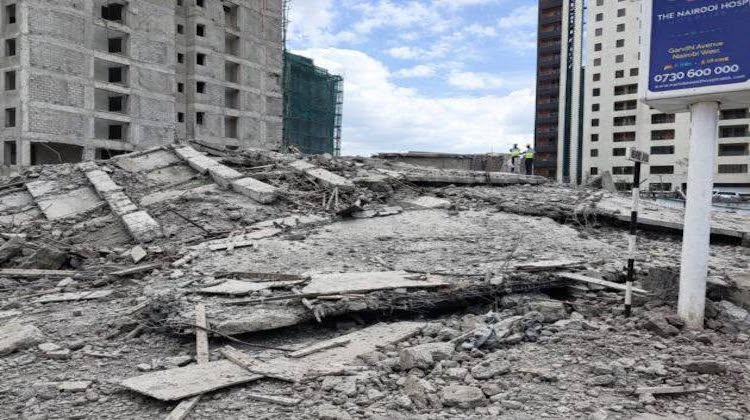
The collapsed Manzil Towers in Nairobi’s South C estate.
The prosecutions have already triggered resistance from sections of the professional community.
The Architectural Association of Kenya has criticised the decision to charge members associated with the Nairobi City County Urban Planning Technical Committee, arguing that the committee merely provides technical advice and does not possess final approval authority. The association warned that criminal liability should be attached to those who exercised executive decision-making powers rather than advisory members.
The dispute highlights what is likely to become a major battleground during the court proceedings: whether responsibility rests primarily with the developers and professionals who designed and built the project, or with the public officials who approved, supervised and allowed it to continue.
Beyond the individual suspects, the Manzil Towers case has exposed what investigators describe as a chain of failures stretching from private developers to technical professionals and county regulators. Prosecutors appear to be pursuing a theory that the collapse was not the result of a single mistake but a systemic breakdown involving multiple actors across the construction approval ecosystem.
The prosecutions now place Kenya’s construction industry under an unprecedented spotlight. For years, residents have watched high-rise buildings mushroom across Nairobi amid recurring allegations of illegal floors, forged approvals, compromised inspections and weak enforcement. The Manzil Towers collapse has transformed those concerns into one of the largest criminal accountability cases ever mounted against officials and professionals involved in a single building project.
As the accused prepare to take plea, the case is expected to test not only the criminal liability of the 37 suspects but also the integrity of the systems that regulate Nairobi’s rapidly expanding skyline.
Kenya Insights allows guest blogging, if you want to be published on Kenya’s most authoritative and accurate blog, have an expose, news TIPS, story angles, human interest stories, drop us an email on [email protected] or via Telegram


Rogue Developers, Engineers, Architects and City Hall Officials Charged Over Deadly Manzil Towers Collapse

Kalonzo Unveils His 2027 Presidential Campaign Platform

Artur Margaryan of Kenya’s Infamous Artur Brothers Seeks Prime Minister’s Office in Armenia

Sonko Re-Elected Head of Party

US Denied Visas to Team Officials for World Cup – Iran

Why Drivers Cheered Bolt’s Reported Exit: Inside the Slow Financial Strangulation of Thousands of Kenyan Drivers and Riders in Kenya

Court Halts NTSA Smart Driving Licence Rollout and Instant Traffic Fines: What This Means

Pentagon Raises Israel Spy Threat To Highest Level: Report

NIS Officer Found Dead Inside Locked House in Nyamira

‘He Stole My Car and Threatened My Life’: Australian Woman Accuses Ex-MP Farah Maalim in Bitter Divorce and Succession Battle

Cement, Cash and Courts: How the Hashu Dynasty Crushed the Ramji Brothers for Fourteen Years and Why the Walls Are Now Closing In

Why Ruto’s Favourite Candidate Adan Mohammed Could Be Locked Out of the KRA Top Job

LifeCare on the Brink: SHA Fraud, Stolen Wages, and the Rotten Empire Jayesh Saini Built

Este Medical Kenya Fights American’s Explosive Complaints

Safaricom’s Sh1.4 Billion Reckoning: How Kenya’s Most Profitable Company Stole a Man’s Idea and Got Caught

The Rot Inside Absa: How Bank Insiders Are Looting Nairobi’s Customers

Inside FAFSA Fraud: How Kenyan Cybercriminals Siphoned Millions from America’s Sh12 Billion Student Loan System

Denial Under Duress: The Untold Collapse Threatening David Lagat’s DL Group’s Empire

THE INSURER THAT TOOK YOUR PREMIUM AND FORGOT YOUR NAME: How ICEA Lion Left a Client Begging for Sh7.8 Million Across Four Months

Betika Faces DCI Probe, Directors Arrest and License Revocation Over Massive 29.5 Million Safaricom Customers’ Data Breach
-
 Investigations2 days ago
Cement, Cash and Courts: How the Hashu Dynasty Crushed the Ramji Brothers for Fourteen Years and Why the Walls Are Now Closing In
-
 Investigations2 weeks ago
LifeCare on the Brink: SHA Fraud, Stolen Wages, and the Rotten Empire Jayesh Saini Built
-
 News2 weeks ago
Este Medical Kenya Fights American’s Explosive Complaints
-
 Americas2 weeks ago
Inside FAFSA Fraud: How Kenyan Cybercriminals Siphoned Millions from America’s Sh12 Billion Student Loan System
-
 Investigations6 days ago
Betika Faces DCI Probe, Directors Arrest and License Revocation Over Massive 29.5 Million Safaricom Customers’ Data Breach
-

 News1 week ago
Eight Students Arrested In Kenya After Suspected Deadly School Arson Attack
-

 News1 week ago
How Uhuru’s Deal With Obama In 2015 Paved Way For America’s Ebola Plan In Kenya
-

 Investigations1 day ago
Inside The Urban Planning Cartel That Owns Nairobi