
Grapevine
‘He Stole My Car and Threatened My Life’: Australian Woman Accuses Ex-MP Farah Maalim in Bitter Divorce and Succession Battle
A Kenyan-Australian woman has gone to war with veteran MP and lawyer Farah Maalim, accusing him of car theft, attempted title deed fraud, death threats, and entanglement in a cross-border inheritance dispute that has dragged through courts in Nairobi, Garissa, and the United States. The politician has not responded.


She speaks from across the world, but her rage is unmistakably Nairobi. In a series of videos and Facebook posts that have since ricocheted through Somali-Kenyan online spaces, a woman named Mona Ali has levelled some of the most explosive personal allegations ever made against Farah Maalim Mohamed, the veteran Dadaab lawmaker, former Deputy Speaker of the National Assembly, and admitted advocate of the High Court of Kenya.
She says he stole her car. She says he has spent two years trying to remove her name from a Nairobi title deed and failed. She says that those around him have threatened to murder and rape her for speaking out. And she says she is not stopping.

The story behind those accusations is one that sprawls across continents and court systems, tangling together a bitter divorce in the United States, a contested family inheritance in Mogadishu and Nairobi, a divorced woman in Garissa who Mona says has no legal right to anything, and a sitting Member of Parliament who allegedly agreed to do dirty work in exchange for a promised share of property that was never his to give.
“Abuse of power. I get to catch Uber and Farah Maalim has my car. I’m not supposed to speak about it because I might get killed for it.”
Maalim, who has represented Dadaab since 2022 and previously sat for Lagdera across two separate parliamentary stints dating back to 1992, has said nothing publicly about any of these claims. His silence speaks loudly in a matter where every detail Mona Ali has put on the record is, by her account, documented in court filings spanning at least two jurisdictions.
THE WOMAN WHO WOULD NOT BE SILENCED
Mona Ali identifies herself as Kenyan-Australian with residency in the United States, a daughter of the late Saeed Haji Ali Baale, a man she describes as a figure of some standing in Somalia who worked for the Somali state and accumulated properties across the region.
Her father died several years ago. What he left behind has, according to Mona, become the subject of a prolonged and increasingly criminal scramble involving a woman her father divorced before his death and that woman’s associates, one of whom she names as Farah Maalim.
The central character in the inheritance dispute, as Mona tells it, is Khadra Adam Nimale, also rendered in her posts as Khadro Nimcale Khadro. Mona is categorical: Khadra is a woman her father divorced roughly thirty years before he died and has no legal claim over his estate under any applicable inheritance framework, Islamic or statutory.
She has taken Khadra to court. She has taken another individual, identified only as Ayan, to court. And she has warned, in terms that leave no room for ambiguity, that everyone else who has touched her father’s assets without authorisation will follow.
In a Facebook post timestamped from Mogadishu, Somalia in February of this year, Mona posted a stark public warning about a house listed at property number 2000, located near a school and fire station.
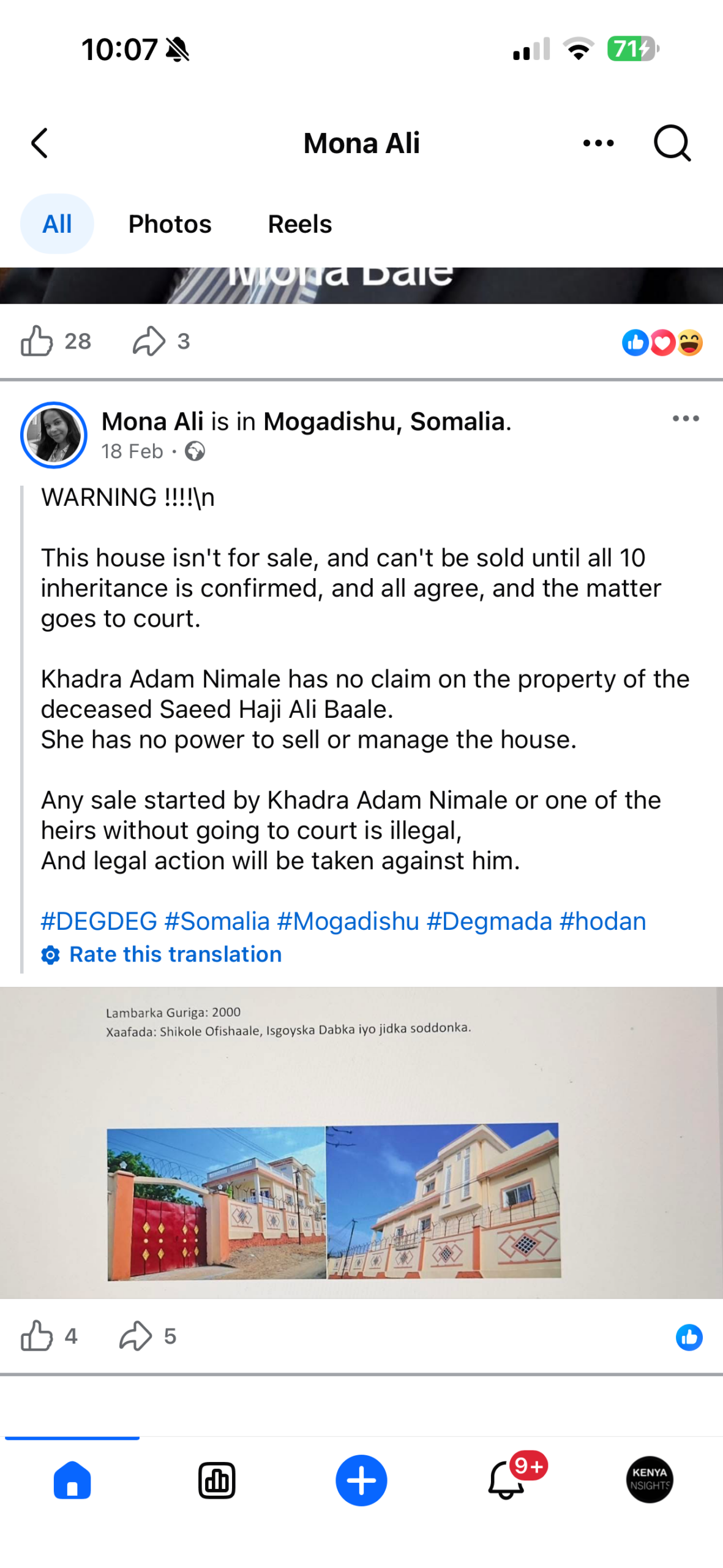
The post, written in what appears to be translated Somali, stated plainly that the house is not for sale, cannot be sold until all ten heirs have confirmed their shares and agreed, and that Khadra Adam Nimale has no power to sell or manage it. Any attempted sale, the post warned, is illegal, and legal action will follow.
That warning was not a first move. It was, by all indications, a response to an attempt already underway.
ENTER THE POLITICIAN-LAWYER
According to Mona Ali, Farah Maalim’s involvement in this saga began not as a politician but as a lawyer. He is, she says, the advocate for the man she divorced, a divorce whose proceedings have generated court records in the United States and whose orders she claims are being actively ignored and interfered with in Nairobi. The precise identity of her ex-husband has not been made public, but Mona has stated that Farah’s dual role as legal counsel for her former spouse and as an actor in her father’s inheritance dispute creates a conflict of interest so brazen it borders on contempt.
Contempt of court is, in fact, the phrase she has reached for directly. In one post she wrote to Maalim: ‘Farah, have you heard of contempt of court? My lawyer is fully aware of the conduct you and Khadra have allegedly been involved in.’ She added that falsifying government records is a serious crime, and that she is watching.
“Farah failed to remove my name from the title deed for the past two years. He stole my car, which he sold, and it is the only thing the common-day thug succeeded on.”
The allegation about the title deed is among the most serious. Mona states that for approximately two years, Maalim has been attempting to remove her name from a Nairobi property title deed, and that he has failed at every attempt. She believes a promised share of the Nairobi house, which she asserts was pledged to him despite not belonging to anyone with authority to make such a promise, was the incentive for his involvement. The house, she has repeatedly made clear, was her father’s asset, not Khadra’s to bargain with.
What Maalim allegedly did succeed at, she says, is the theft of her car. She has stated directly and without qualification: ‘He stole my car, which he sold, and it is the only thing the common-day thug succeeded on.’ In her videos she has been equally blunt, calling him a thief for holding her property and demanding its return. ‘As long as you hold onto it, Farah, you’re a thief who stole my car,’ she has said on camera, addressing him by name to his face across the bandwidth of the internet.
THREATS, INTIMIDATION AND A FAILED BREAK-IN
The personal safety dimension of Mona’s account is the one that has resonated most sharply with commenters online. She describes a pattern of intimidation in which Farah Maalim’s name is repeatedly invoked as a threat, as though his political profile is meant to function as a deterrent to anyone who might otherwise assist her or testify against those she has accused. She dismisses the tactic with a withering bluntness that has become her signature register.
‘For all the warnings and intimidation, I still have not been told who exactly was supposedly going to harm me in Nairobi, whether it was a man or a woman,’ she wrote. ‘Khadro Nimcale Khadro mentioned Farah Maalim, but beyond the noise and theatrics, where is this supposed threat everyone keeps talking about?’ She adds, pointedly, that if anyone genuinely knows of a threat against her, the appropriate response is to contact the police, not to call her.
She has also described an attempt to break into a property she owns in Nairobi, which she attributes to Khadra. ‘Hello Khadro Nimcale Khadro, after failing to break into my house in Nairobi, are you now waiting on Farah Maalim to do another illegal favour for you?’ she wrote in one post. The implication is clear: she views Maalim as an instrument deployed on behalf of Khadra in a campaign of harassment, property interference, and intimidation.
The threats she says have been made against her include murder and rape, issued by those around Khadra. She has not retreated. Instead, she has pointed out, with the particular confidence of a woman who holds both Australian and American status and understands that she operates under a different kind of legal protection than many Somali-Kenyan women: the threats have not silenced her, and they will not.
THE SUCCESSION DISPUTE AND ISLAMIC LAW
Underlying the personal fireworks is a legal and inheritance dispute with structural complexity. Under Islamic inheritance law, the fara’id system that Kenyan courts apply in Kadhis proceedings for Muslim estates, a divorced woman has no inheritance rights over a former husband’s estate. Mona Ali’s position is that Khadra was divorced from her father Saeed Baale more than thirty years before he died, eliminating any claim she could mount under either Islamic or statutory Kenyan law.
The Estate of Hajir Maalim Ibrahim succession matter, handled through Garissa’s Kadhis Court under Succession Cause E091 of 2023, has been cited in discussions connected to this dispute, though the precise linkages remain to be formally established in open proceedings.
What is clear from Mona’s account is that she is contesting any attempt to administer her father’s estate in a manner that includes Khadra as a beneficiary, and that she views Maalim’s alleged involvement as a deliberate attempt to circumvent court-determined outcomes.
The American dimension adds further complexity. Mona has referenced US court orders connected to her own divorce proceedings that, she says, are being ignored and interfered with from Nairobi.
Cross-border contempt of court in divorce and property matters is notoriously difficult to enforce, particularly when one party has assets and contacts embedded in a different legal system.
Mona’s strategy appears to be one of maximum public pressure combined with parallel legal actions: she has filed against at least two individuals, warned several others that they are next, and weaponised social media as her primary enforcement mechanism.
A PORTRAIT OF MAALIM’S ACCUMULATING CONTROVERSIES
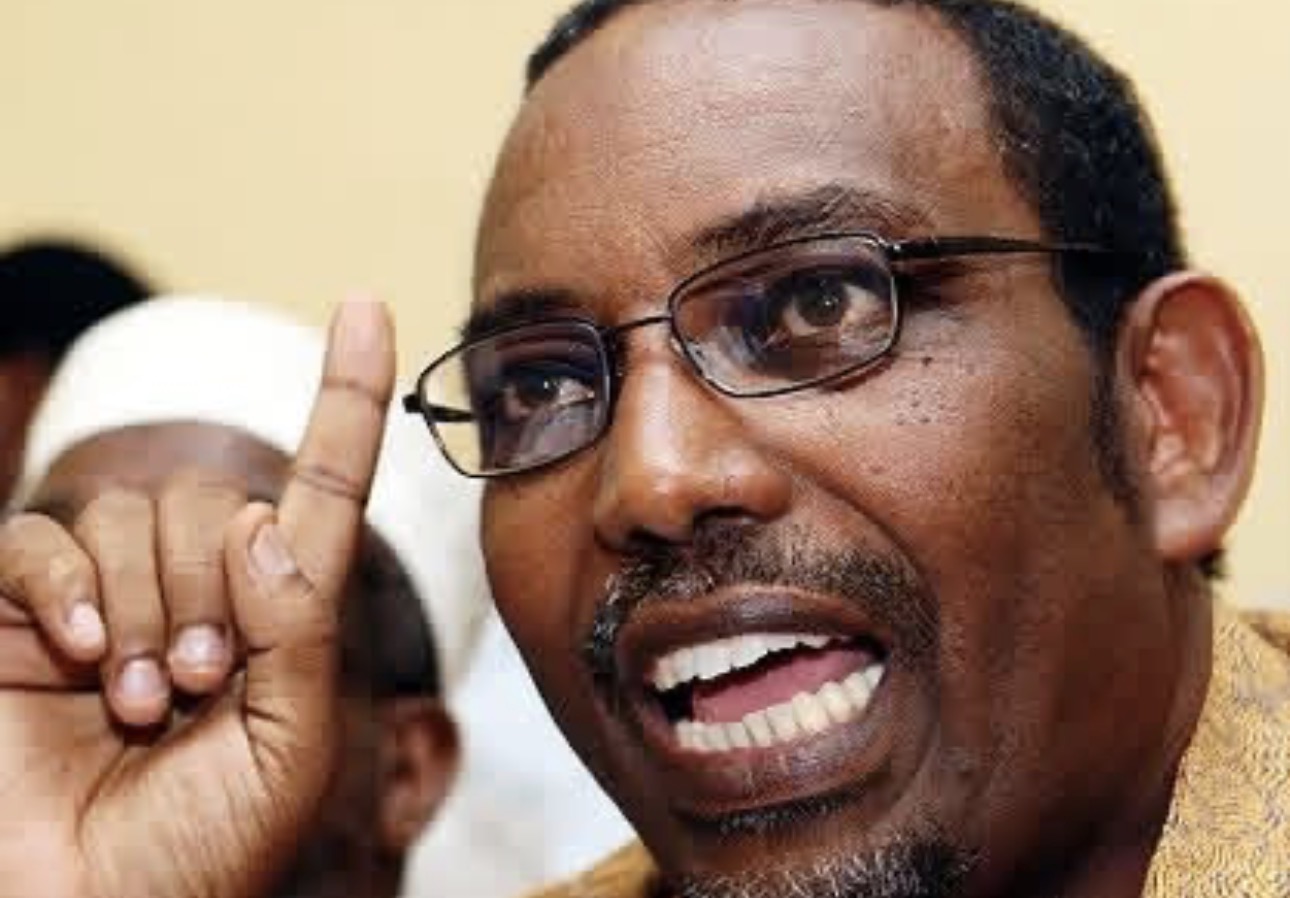
Farah Maalim.
For those tracking Farah Maalim’s career arc, Mona Ali’s allegations land against a politician who has spent the last two years accumulating exactly the kind of record that makes such claims easy to believe.
The Dadaab MP, who made a dramatic return to parliament in 2022 after nearly a decade in political exile, has since repositioned himself as a fervent ally of President William Ruto and, in doing so, appears to have misplaced whatever instinct for self-preservation once governed his public conduct.
In July 2024, a video emerged in which Maalim appeared to state that if he were president, he would have slaughtered five thousand Gen-Z protesters daily, criticising the youth-led demonstrations against the Finance Bill 2024. The backlash was immediate and severe.
The National Cohesion and Integration Commission summoned him to explain himself. His own party, the Wiper Democratic Movement, expelled him, calling his remarks a failure to uphold its ideals and demanding his removal from all parliamentary leadership roles. Sarova Whitesands Beach Resort in Mombasa publicly threw him out, issuing a statement that the hotel did not condone his inflammatory comments.
Maalim’s defence, that the video had been edited and manipulated by political opponents possibly operating from Somalia, satisfied almost no one. The NCIC continued its investigation. The damage was done.
It did not stop there. In January 2025, at a political rally in the Rift Valley alongside President Ruto, Maalim delivered remarks from the sunroof of a vehicle that reduced his remaining political capital further.
Speaking in Swahili, he directed a vulgar insult at young Kenyans critical of the government, using language that explicitly and crudely referenced the mothers of those he was addressing. The phrase ‘Kumanina zenu’ drew widespread condemnation from civil society organisations, political analysts, and ordinary Kenyans who noted the particular irony of a parliamentarian lecturing on discipline while unleashing abuse of the most personal kind on citizens. He was subsequently expelled from Wiper.
“You are an embarrassment to the Somali people. Your only talent is lying and stealing. Kenya does not belong to you, Farah.”
These controversies have fed a broader narrative about Maalim as a politician who has confused proximity to power with immunity from consequence.
His alignment with the Ruto administration has been absolute and, critics say, transactional: he has delivered the North Eastern vote bloc in exchange for access and relevance, and in doing so has adopted the kind of impunity that characterises those who believe the presidency’s favour insulates them from accountability.
The Afgab community’s move in late 2025 to formally endorse his 2022 rival Abdikheyr Dubow for the 2027 Dadaab seat suggests that even within his own political geography, the air is thinning.
With Kheirow having come within two thousand votes of defeating Maalim in 2022 as a virtual newcomer, and with unified clan backing now formalised behind his 2027 bid, the sitting MP’s hold on his constituency is no longer the foregone conclusion it once appeared.
THE IDENTITY WARS
Perhaps the sharpest exchange in the entire public saga has been the one in which Mona Ali went directly at Maalim’s sense of self. ‘Farah Maalim, I’m from Mogadishu and I am Somali,’ she wrote. ‘Unlike you, who seems to have an identity crisis, never Somali enough and never Kenyan enough.’ She went further, drawing a contrast between her late father’s service to the Somali state and what she characterised as Maalim’s subjugation to foreign interests, describing him as a ‘failed politician from an occupied territory, serving foreign interests like a colonial subject to your British masters.’
These are not merely personal insults.
They are calculated to strike at the most sensitive point of Maalim’s political identity, a man who has navigated decades of Kenyan politics as a Somali-Kenyan, whose entire career has been built on his ability to straddle the complicated loyalties that identity demands.
Mona’s suggestion that he has failed on both sides of that hyphen, being insufficient to either community, is the kind of attack that tends to resonate precisely because it mirrors anxieties that have always existed quietly beneath the surface of Somali-Kenyan political life.
She has also been direct about what she sees as the entitlement structure underlying his alleged conduct: ‘Stealing someone’s car does not make it your asset. Trying to remove people’s names from title deeds or illegally transfer property is criminal behaviour no matter what country it happens in.’ She addressed the broader cast of characters around Khadra directly as well: ‘This constant behaviour only proves what I have been saying for years: violence, intimidation, bullying, lies, abuse, and entitlement. Instead of building your own lives, buying your own cars, maintaining your own jobs, and creating your own stability, you are trying to benefit from your sister’s divorce and from assets that do not belong to you.’
NO POLICE REPORTS YET, BUT COURTS ARE WATCHING
As of the time of publication, no formal police report has been publicly confirmed linking both parties in the specific car dispute and property interference allegations. Kenyan police in Nairobi or Garissa have issued no public statements. Maalim has not responded to the specific claims, either through his office, through a spokesperson, or through his active social media presence.
What does exist is a paper trail of court proceedings in at least three jurisdictions: the United States, where Mona’s divorce orders were issued; Kenya, where she has filed against Khadra and Ayan; and the Garissa Kadhis Court, where the succession of her father’s estate continues to be litigated. Mona has stated that her legal team is fully aware of Maalim’s alleged conduct, and that she intends to pursue all remaining parties through formal channels.
The Facebook posts have been tagged to The Star and other Kenyan media outlets, signalling Mona’s deliberate strategy of building public pressure alongside her legal campaign.
Her dual international status, she has made clear, is the shield that allows her to speak where other Somali-Kenyan women in similar circumstances might feel compelled to remain silent. She has said as much explicitly, urging women who lack foreign passports or international residency to nonetheless find ways to speak out about similar patterns of property-related abuse and intimidation.
Farah Maalim faces a 2027 general election campaign in a constituency that is already mobilising against him, a parliamentary ethics environment in which his July 2024 and January 2025 remarks remain on the public record, and now a highly public accusation from a woman who has demonstrated both the willingness and the legal infrastructure to take the fight to every available forum.
Whether or not a formal criminal investigation is eventually opened into the car theft allegation, the attempted title deed manipulation, or the alleged interference with foreign court orders, the political cost of these allegations landing in this particular moment cannot be overstated.
Maalim has cultivated, through his Gen-Z massacre remarks and his obscene Rift Valley performance, the public image of a man for whom accountability applies to everyone except himself. Mona Ali is, among other things, a direct challenge to that image.
She has said she will continue until everything stolen is returned and everyone who threatened her faces consequences. For a politician who has spent the last two years making enemies of Kenya’s youth, being expelled from a luxury hotel, being thrown out of his own party, and watching his 2027 seat slip into contest, adding a cross-border property theft and intimidation scandal to that ledger is not a minor development.
It is, if Mona Ali has anything to say about it, just the beginning.
Kenya Insights allows guest blogging, if you want to be published on Kenya’s most authoritative and accurate blog, have an expose, news TIPS, story angles, human interest stories, drop us an email on [email protected] or via Telegram


Court Halts NTSA Smart Driving Licence Rollout and Instant Traffic Fines: What This Means

Pentagon Raises Israel Spy Threat To Highest Level: Report

NIS Officer Found Dead Inside Locked House in Nyamira

‘He Stole My Car and Threatened My Life’: Australian Woman Accuses Ex-MP Farah Maalim in Bitter Divorce and Succession Battle

House Helps to Earn Minimum Salary of Sh18,047 Under New Law, Employers Who Refuse Face Jail

Inside The Urban Planning Cartel That Owns Nairobi

Absa Bank Kenya: The Lender That Declares War On Its Own Clients

Putin Rejects Zelensky Meeting Proposal

Burkina Faso Junta Intensifies Crackdown on Critics

Analo Was Just the Tip of the Iceberg: Alai Names Powerful Nairobi Planning Cartel Linked to City Hall

Why Ruto’s Favourite Candidate Adan Mohammed Could Be Locked Out of the KRA Top Job

LifeCare on the Brink: SHA Fraud, Stolen Wages, and the Rotten Empire Jayesh Saini Built

Este Medical Kenya Fights American’s Explosive Complaints

Safaricom’s Sh1.4 Billion Reckoning: How Kenya’s Most Profitable Company Stole a Man’s Idea and Got Caught

The Rot Inside Absa: How Bank Insiders Are Looting Nairobi’s Customers

THE INSURER THAT TOOK YOUR PREMIUM AND FORGOT YOUR NAME: How ICEA Lion Left a Client Begging for Sh7.8 Million Across Four Months

Denial Under Duress: The Untold Collapse Threatening David Lagat’s DL Group’s Empire

Inside FAFSA Fraud: How Kenyan Cybercriminals Siphoned Millions from America’s Sh12 Billion Student Loan System

Court Confirms Safaricom Customers Data Was Sold To Betting Companies In Seven-Year Cover-Up

Betika Faces DCI Probe, Directors Arrest and License Revocation Over Massive 29.5 Million Safaricom Customers’ Data Breach
-
 Investigations2 weeks ago
LifeCare on the Brink: SHA Fraud, Stolen Wages, and the Rotten Empire Jayesh Saini Built
-
 News2 weeks ago
Este Medical Kenya Fights American’s Explosive Complaints
-
 Americas2 weeks ago
Inside FAFSA Fraud: How Kenyan Cybercriminals Siphoned Millions from America’s Sh12 Billion Student Loan System
-
 Investigations5 days ago
Betika Faces DCI Probe, Directors Arrest and License Revocation Over Massive 29.5 Million Safaricom Customers’ Data Breach
-

 Investigations1 day ago
Cement, Cash and Courts: How the Hashu Dynasty Crushed the Ramji Brothers for Fourteen Years and Why the Walls Are Now Closing In
-

 News1 week ago
Eight Students Arrested In Kenya After Suspected Deadly School Arson Attack
-
 News6 days ago
How Uhuru’s Deal With Obama In 2015 Paved Way For America’s Ebola Plan In Kenya
-

 Investigations2 weeks ago
LSK On The Spot For Renewing Rogue Lawyer Dennis Onyango’s Licence Despite Mounting Evidence He Held Foreign Investors’ Millions Hostage