
Investigations
Forged KCSE Certificate Scandal Exposed as EACC Nabs County Worker Who Pocketed Over Ksh9 Million

A county job. A fake KCSE certificate. And over Ksh9 million in taxpayer money down the drain.
This is the latest scandal shaking the Nairobi City Water and Sewerage Company (NAWASCO) after the Ethics and Anti-Corruption Commission (EACC) nabbed one of its employees, Edwin Amagola Munyeti, for using forged academic credentials to secure a high-paying position.
The arrest exposes a deep rot in public recruitment processes and signals a crackdown on fake qualifications in government agencies.
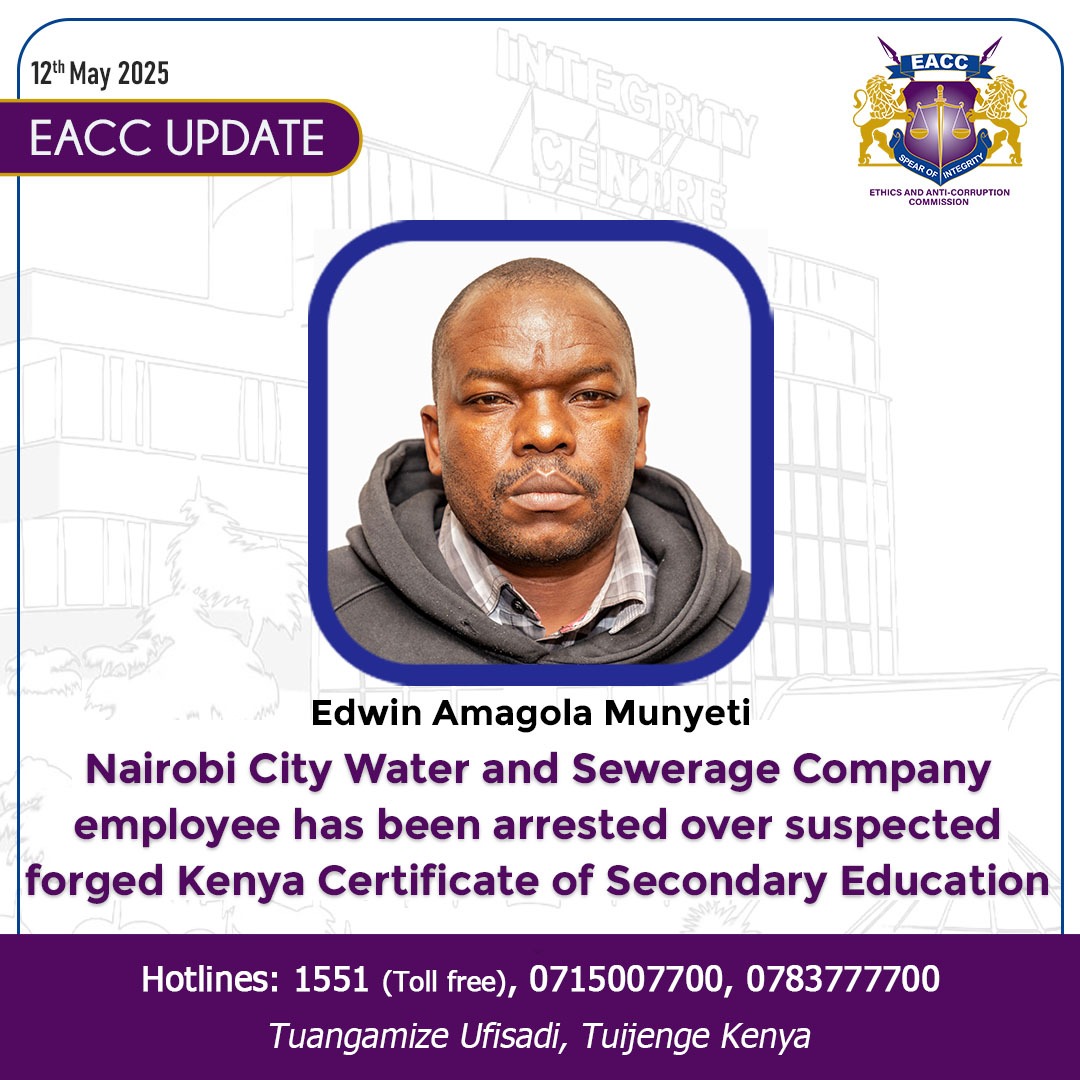
The commission stressed that using forged documents to gain public office is not just fraud; it is theft of public resources and an abuse of public trust. [Image: X/EACC]
EACC Uncovers Shocking Forged KCSE Certificate Scam
The EACC arrested Edwin Amagola Munyeti, a staff member at NAWASCO, for using a forged Kenya Certificate of Secondary Education (KCSE) certificate to secure employment at the utility company.
Investigations revealed that Munyeti submitted the fake document, allegedly issued by the Kenya National Examinations Council (KNEC), during his job application.
This forged KCSE certificate opened the door to a position that earned him a total of Ksh9,061,398 between March 2010 and December 2023.
For nearly 14 years, Munyeti enjoyed the benefits of a legitimate employee — a steady income, allowances, and public trust — all built on deception.
The matter came to light after a tip-off prompted the anti-graft agency to verify the authenticity of the academic documents submitted. Upon cross-checking with KNEC, EACC confirmed that the KCSE certificate in Munyeti’s file was not genuine.
In an official statement, EACC disclosed, “The Commission launched investigations following allegations that the accused used a forged Kenya Certificate of Secondary Education (KCSE) certificate, falsely presented as genuine and issued by the Kenya National Examinations Council (KNEC), to secure employment at the Nairobi City Water and Sewerage Company.”
After concluding its investigation, EACC forwarded the file to the Office of the Director of Public Prosecutions (ODPP), which recommended prosecution.
Legal Trouble Looms Over the Use of Forged KCSE Certificate
Munyeti now faces a litany of serious charges. He is likely to be prosecuted for forgery under Section 349 of the Penal Code, which carries a jail term of up to three years, a fine, or both.
Also, under Section 41 of the Anti-Corruption and Economic Crimes Act (ACECA), knowingly giving false information to a principal (in this case, the employer) to gain employment is punishable by up to 10 years in prison.
The charges do not end there. The EACC is also pushing for Munyeti to be held accountable for the fraudulent acquisition of public property — the Ksh9 million he unlawfully earned.
The commission stressed that using forged documents to gain public office is not just fraud; it is theft of public resources and an abuse of public trust.
Legal experts note that this case could set a precedent for how aggressively authorities pursue similar crimes.
It also exposes the gaps in recruitment systems within county governments and state agencies, many of which still fail to conduct proper vetting of documents submitted by job applicants.
Case of Fake Academic Credentials Becoming Alarmingly Common
Munyeti’s case is not isolated. In fact, it comes just weeks after EACC exposed another major scandal involving forged academic certificates.
In March, investigators discovered that four former officials of the Independent Electoral and Boundaries Commission (IEBC) had forged certificates to secure jobs and fraudulently earned over Ksh35 million in salaries.
This rising trend points to a growing problem of individuals bypassing academic qualifications through forged KCSE certificates and other fake documents to secure public jobs.
It also signals the need for all government institutions to collaborate with bodies like KNEC and the Kenya National Qualifications Authority (KNQA) to verify credentials before hiring.
The cost of inaction is clear. Unqualified individuals handle sensitive roles, genuine job seekers miss opportunities, and corrupt officials drain public funds.
EACC has emphasized the importance of vigilance and routine audits, warning that this is just the beginning of more arrests and public exposures. “The war against corruption must also target fraudulent entry into public service,” the commission stated.
Kenya Insights allows guest blogging, if you want to be published on Kenya’s most authoritative and accurate blog, have an expose, news TIPS, story angles, human interest stories, drop us an email on [email protected] or via Telegram


Al-Shabaab Issues Statement Defending Omar Artan, Accuses U.S. of Discrimination After Referee’s Deportation

Netanyahu To Run For Re-Election, His Party Says, After Trump Raises Doubts

US Cracks Down on Birth Tourism Schemes

Microsoft Limits Employee Use Of Anthropic’s Claude Fable 5 Over Data Retention Concerns, The Verge Reports

Standard Chartered Ghosts Haunt Joshua Oigara At Stanbic As Whistleblower Spills Beans

Caleb Amisi Says Linda Mwananchi Has Lost Direction, Announces Plans To Form A New Movement

Air Canada Pilot Flew Passengers For Years With A Fake Pilot’s License, Police Say

Itumbi Claims Kalonzo Has Settled on Sifuna as Running Mate

THE KURIA NETWORK TAKES THE BOARDROOM: How Moses Kuria’s Inner Circle Seized Control of Africa Mega Agricorp And the Paper Trail That Links It All

Who Is The Somali Referee Barred From Entering The US For The World Cup?

Cement, Cash and Courts: How the Hashu Dynasty Crushed the Ramji Brothers for Fourteen Years and Why the Walls Are Now Closing In

Inside The Urban Planning Cartel That Owns Nairobi

Why Ruto’s Favourite Candidate Adan Mohammed Could Be Locked Out of the KRA Top Job

LifeCare on the Brink: SHA Fraud, Stolen Wages, and the Rotten Empire Jayesh Saini Built

Este Medical Kenya Fights American’s Explosive Complaints

Betika Faces DCI Probe, Directors Arrest and License Revocation Over Massive 29.5 Million Safaricom Customers’ Data Breach

The Rot Inside Absa: How Bank Insiders Are Looting Nairobi’s Customers

Inside FAFSA Fraud: How Kenyan Cybercriminals Siphoned Millions from America’s Sh12 Billion Student Loan System

Fresh Move Launched to Remove Kenya Railways MD Mainga From Office After Awarding Sh817 Million Consultancy Contract

Court Confirms Safaricom Customers Data Was Sold To Betting Companies In Seven-Year Cover-Up
-
 Investigations6 days ago
Cement, Cash and Courts: How the Hashu Dynasty Crushed the Ramji Brothers for Fourteen Years and Why the Walls Are Now Closing In
-
 Investigations5 days ago
Inside The Urban Planning Cartel That Owns Nairobi
-
 Investigations1 week ago
Betika Faces DCI Probe, Directors Arrest and License Revocation Over Massive 29.5 Million Safaricom Customers’ Data Breach
-
 Investigations6 days ago
Fresh Move Launched to Remove Kenya Railways MD Mainga From Office After Awarding Sh817 Million Consultancy Contract
-

 News2 weeks ago
Eight Students Arrested In Kenya After Suspected Deadly School Arson Attack
-

 News2 weeks ago
How Uhuru’s Deal With Obama In 2015 Paved Way For America’s Ebola Plan In Kenya
-

 Business1 week ago
TRUST BETRAYED: How Senior DTB Bank Insiders Allegedly Looted Sh149 Million From a Customer’s Account Over Five Years
-

 Investigations5 days ago
Why Drivers Cheered Bolt’s Reported Exit: Inside the Slow Financial Strangulation of Thousands of Kenyan Drivers and Riders in Kenya