
Business
NCBA’s Repossession Empire: How Borrowers Lose Their Cars While the Bank Profits at Every Step
How NCBA built a vertically integrated repossession empire and why every Kenyan with a car loan should read this before signing

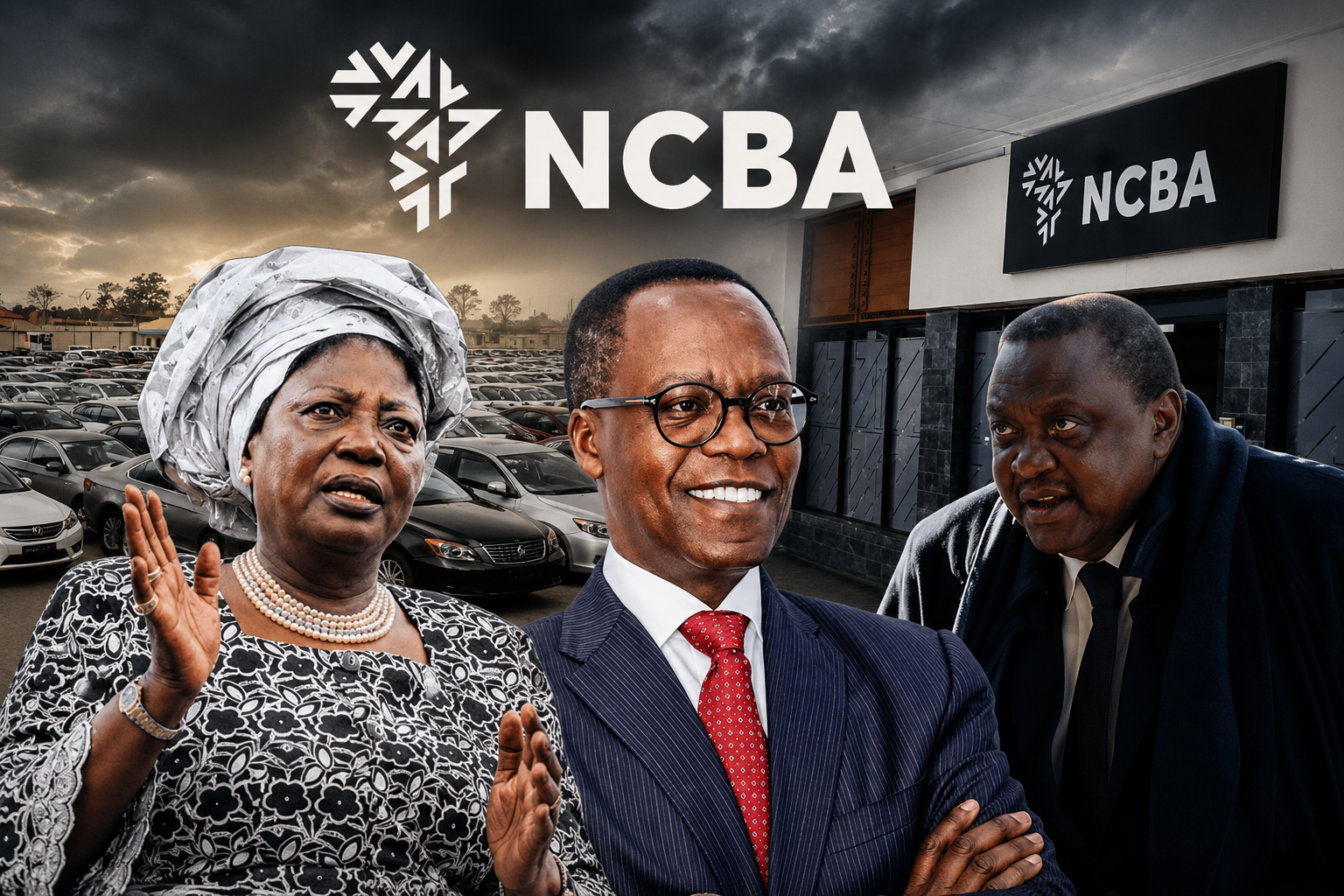
Somewhere in a holding yard off Bunyala Road in Nairobi, a 2024 Toyota Land Cruiser 300 valued at KSh 20.8 million sits under a tarpaulin. Someone’s asset. Someone’s debt. Someone’s former life. And now, via a few clicks on a platform called CarDuka, it is about to become someone else’s bargain and NCBA Group’s triple payday.
That Land Cruiser is not an outlier. In March 2026, NCBA auctioned 70 vehicles in a single batch. In April, 34 more. In June, 31 additional units and 35 more within the same fortnight. Thousands of Kenyans scrolled through those listings thinking they were hunting for a deal on a second-hand car. What they were actually browsing was the human cost of Kenya’s credit economy, curated, commodified, and re-monetised by the same bank that originated the loan in the first place.
This is not a story about bad loans. It is a story about a machine. A machine built over years, piece by quiet piece, that has turned the ordinary tragedy of default into a structured profit event. NCBA has built something that most banks can only dream of: a closed loop in which it lends the money to buy the car, holds the car as collateral, repossesses the car when the borrower defaults, sells it through its own digital platform, collects commission on the sale, underwrites insurance for the new owner, and then if the buyer needs financing lends them the money to buy the very car it just repossessed.
That loop now runs at scale. NCBA commands a 32 per cent market share in vehicle and asset finance in Kenya as of Q1 2026. CarDuka, the bank’s digital vehicle marketplace, has onboarded nearly seven million users. The bank posted a profit before tax of KSh 27.9 billion for the full year 2025. Its cost of risk the metric that measures net credit losses as a proportion of loans sat at a controlled 1.9 per cent for 2025, well within the bank’s stated target range of 1.5 to 2.0 per cent.
The numbers are impressive. The architecture behind them is more impressive still and almost entirely invisible to the borrowers feeding it.
“NCBA lends you the money, holds your car as security, takes the car when you default, sells it on its own platform, earns commission, sells you insurance, and offers the buyer a new loan. All in one loop.”
PART I: THE ANATOMY OF THE LOOP
Understanding the machine requires understanding how its parts connect. Most Kenyans know NCBA as a bank. Fewer know that it has systematically vertical-integrated the entire lifecycle of a vehicle loan into a single, self-reinforcing commercial system.
The sequence begins at origination.
NCBA offers vehicle finance with loan-to-value ratios of up to 90 per cent on new vehicles and up to 80 per cent on quality used vehicles, repayment terms of up to 60 months, and in a feature designed to ease financial on-boarding a 60-day repayment holiday.
The bank boasts that conditional approval can be obtained in as little as 15 seconds through its digital platforms, and an offer letter delivered within an average of 1.4 days. One in every three cars on Kenyan roads, by the bank’s own account, carries an NCBA loan.
When that loan goes bad as an increasing proportion are doing in Kenya’s strained economy the Movable Property Security Rights Act of 2017 hands NCBA a formidable toolkit. The MPSR Act allows secured lenders to repossess and sell collateral without prior court intervention, provided they have served compliant default notices, allowed the borrower a cure period, and conducted the subsequent sale in a commercially reasonable manner. The threshold for compliance, as courts have increasingly affirmed, is procedural rather than substantive: serve the right notices in the right form, document the service, and the law is on your side.
Data from the Business Registration Service confirms how aggressively the market is exploiting this framework. Security notices filed at the MPSR registry jumped 43 per cent in 2025 alone, reaching 151,057 initial filings against 105,617 the prior year. That is not a spike. That is a structural surge, driven by an economic environment in which Kenyan borrowers are exhausting their financial buffers at a rate lenders have not seen in recent memory.
Once the vehicle is repossessed, it flows into CarDuka. And here is where the machine’s sophistication becomes most visible.
CARDUKA: THE PLATFORM INSIDE THE LOOP
CarDuka relaunched in June 2025 as a fully AI-powered marketplace. The platform now brings together dealers, private sellers, new car buyers, and auction participants in a single digital ecosystem. NCBA is simultaneously the dominant lender and the owner of the platform through which its own repossessed vehicles are sold.
Revenue streams identified in public disclosures include: buyer’s commissions on auction sales (particularly repossessed vehicles), embedded NCBA insurance products through NCBA Insurance Company Limited (formerly AIG Kenya, fully acquired July 2024), and new vehicle financing originated through the platform for winning bidders.
The bank has stated publicly that since acquiring its own car yard and moving repossession sales in-house, it achieved a 15 per cent increase in the realised selling price of repossessed vehicles compared with auctioneer-managed sales.
Higher proceeds mean lower loss-given-default. Lower loss-given-default means a lower cost of risk. A lower cost of risk means better reported metrics. Better reported metrics mean a higher share price.
By Q1 2026, CarDuka had crossed seven million users cited in investor disclosures as evidence of NCBA’s dominance in “automotive commerce” as well as lending.
The timed auction mechanic deployed on CarDuka is worth examining in detail, because it is not a neutral tool. Auctions running for 24 to 72 hours, with real-time bidding and proxy auto-increment algorithms, are specifically designed to maximise competitive tension and, therefore, final sale price.
The system automatically increments a bidder’s offer by the minimum required amount to maintain the leading position, driving prices toward the ceiling of what the market will bear.
Reserve prices protect the bank from fire-sale losses. The “as-is, where-is” sale condition means the buyer assumes all risk relating to the vehicle’s mechanical condition from the moment the gavel falls.
And then, in the same interface where the bidder wins a repossessed vehicle, they are offered NCBA financing to pay for it. A new loan. On a car that NCBA just recovered from another loan that went wrong. The loop closes.
PART II: WHAT THE T&CS DON’T ADVERTISE
Somewhere in the loan documentation that Kenyans sign when they take NCBA vehicle finance documents that run to dozens of pages of dense legal prose in a commercial setting where the bank’s lawyers wrote every clause is a set of provisions that most borrowers never read, and that the bank is not incentivised to explain.
The MPSR Act and the loan agreement together create a rights structure that is dramatically asymmetric. The bank can repossess without going to court. It can serve default notices via email or WhatsApp a position affirmed in the High Court’s 2025 ruling in Laichena v Platinum Credit Limited and another [2025] KEHC 14729, which accepted electronic service as compliant with the Act’s notice requirements. It can appoint its own agents to take physical possession of the vehicle. And it can sell that vehicle through its own platform, where it also earns the buyer’s commission and sells the insurance.
The borrower’s rights, by contrast, exist primarily as procedural hooks. They can challenge the adequacy of the default notice. They can argue the sale was not conducted in a commercially reasonable manner. They can seek an injunction before the sale is concluded. But they must act quickly, in a jurisdiction where legal costs are prohibitive, and against an institution whose internal processes are specifically engineered to be procedurally compliant.
Legal practitioners who have advised borrowers in MPSR default proceedings note that the practical reality for most defaulters is stark. By the time a borrower realises that enforcement is imminent, the notice period has often already elapsed. By the time they consult a lawyer, the vehicle has frequently been moved to a yard. By the time an injunction application is drafted and filed, the auction has sometimes concluded. The law provides rights on paper. The machine operates on timelines.
Equally important and almost entirely unreported is the deficiency claim. When NCBA sells a repossessed vehicle on CarDuka for less than the outstanding loan balance, the borrower does not simply lose the car. Under standard loan agreements, the borrower remains personally liable for the shortfall. This is the deficiency. It is a debt that survives repossession, follows the borrower to their next lender, and appears on their credit file. NCBA does not publicise deficiency claims in its investor communications. They surface in court filings and in the quiet arithmetic of ruined credit histories.
“When NCBA sells your repossessed car for less than you owed, you don’t walk away clean. You still owe the difference. The car is gone. The debt remains.”
The “as-is, where-is” clause deserves particular scrutiny in the context of NCBA’s platform. When a vehicle is repossessed, it typically enters a holding yard. Some vehicles sit in those yards for weeks or months. They may not be started, maintained, or protected from weather.
NCBA has noted that, since building its own car yard, it now conducts basic maintenance including cleaning and tyre pressure checks to “restore value” before sale. The bank frames this as a service to buyers. It is also, more fundamentally, a service to the bank’s own loss-given-default calculation. Higher sale proceeds, less depreciation in the yard, better recovery rate.
The buyer who wins that auction takes the vehicle as found, with no warranty, no mechanical guarantee, and no recourse to NCBA if the engine fails on the way home from the yard. The bank’s liability for the physical condition of the vehicle it sold ends at the reserve price.
PART III: THE NUMBERS NCBA IS HAPPY TO REPORT
NCBA’s investor communications are, in the vocabulary of corporate reporting, exemplary. The bank publishes detailed quarterly results, holds regular investor days, and narrates its performance with the confidence of an institution that has been winning for long enough that it expects to keep winning.
The numbers do support that confidence. Profit after tax rose 9 per cent year-on-year to KSh 6 billion in Q1 2026. Net interest income for Q1 2026 reached KSh 12.17 billion, its highest level in the post-merger group’s history.
Return on average equity held at 18.4 per cent. The group’s NPL ratio, while at 11.9 per cent elevated by any international standard remains materially below the Kenyan banking industry average of 15.5 per cent. Cost of risk, the key metric linking credit quality to profitability, dropped to 1 per cent in Q1 2025 before settling at 1.9 per cent for the full year.
What these numbers do not tell you, because corporate reporting is not designed to tell you, is how the machine produces them.
The cost of risk is contained not primarily by lending carefully NCBA’s NPL ratio is still nearly 12 per cent but by recovering efficiently from the defaults that inevitably occur at scale. CarDuka’s auction algorithms, the MPSR Act’s self-help remedies, the embedded insurance commissions, and the new financing originated for auction winners are the mechanisms that turn a 12 per cent NPL book into a 1.9 per cent cost of risk. The machine consumes bad loans and excretes controlled metrics.
|
METRIC |
FIGURE |
CONTEXT |
|
Asset Finance Market Share |
32% |
Q1 2026 — 1 in 3 cars on Kenyan roads |
|
CarDuka Users |
~7 million |
As of Q1 2026 investor disclosure |
|
Q1 2026 Profit After Tax |
KSh 6.0 billion |
+9% year-on-year |
|
FY2025 Profit Before Tax |
KSh 27.9 billion |
+11% vs FY2024 |
|
Cost of Risk (FY2025) |
1.9% |
Within 1.5–2.0% target band |
|
NPL Ratio (Q1 2025) |
11.9% |
Below industry average of 15.5% |
|
Impairment Coverage |
63%+ |
Cushion against further defaults |
|
MPSR Filings (2025) |
+43% YoY |
151,057 security notices nationally |
|
Kenyatta Family Stake |
~13.2% |
Via Enke Investments |
|
Ndegwa Family Stake |
14.94% |
Via First Chartered Securities |
|
Nedbank Offer Valuation |
KSh 109.6 billion |
66% stake acquisition, closes July 2026 |
What these numbers also do not tell you is the timing of what is about to happen to this machine. In January 2026, NCBA announced a proposed transaction with South Africa’s Nedbank Group, in which Nedbank would acquire a 66 per cent controlling stake in NCBA Group, valuing the transaction at approximately KSh 109.6 billion.
The Nedbank tender offer opened on 28 May 2026 and closes on 10 July 2026.
The Kenyatta and Ndegwa families NCBA’s dynastic founding shareholders have both signed irrevocable commitments to participate, standing to receive a combined windfall of more than KSh 21.9 billion, equivalent to approximately US$170 million, in a mix of cash and Nedbank stock.
The machine, in other words, is being sold at peak valuation. And CarDuka with its seven million users, its embedded insurance capability, and its repossession pipeline is a centrepiece of what Nedbank is buying.
PART IV: THE QUESTIONS NCBA HAS NOT BEEN ASKED
Kenya’s banking regulation is robust by regional standards. The Central Bank of Kenya supervises commercial banks under the Banking Act. The Competition Authority of Kenya theoretically polices market structure. The Capital Markets Authority monitors listed companies. Consumer protection provisions exist in multiple statutes.
Yet no regulator appears to have formally scrutinised whether a single institution being simultaneously the dominant vehicle lender, the operator of the primary platform through which repossessed vehicles are sold, the seller of insurance to buyers on that platform, and the provider of new financing to those same buyers constitutes a conflict of interest that should be disclosed, managed, or constrained.
The conflict is not hypothetical. It is structural. When NCBA sets the reserve price on a CarDuka auction for a vehicle it has repossessed from its own defaulting borrower, it is making a decision that simultaneously affects three commercial outcomes: the recovery rate on its own loan book (which drives cost of risk), the commission income it earns on the sale (which flows to non-interest income), and the eligibility of the buyer for new NCBA financing (which generates fresh interest income). The bank is seller, auctioneer, insurer, and prospective new lender, all at once.
The former borrower, meanwhile, has no seat at that table. They are not consulted on the reserve price. They have no visibility into whether the reserve price reflects fair market value or whether it has been set at a level that optimises the bank’s aggregate economics rather than their individual recovery. They will not know the final sale price until after the sale. And if there is a deficiency between the sale price and their outstanding balance, they will receive a demand letter.
There is a further dimension to this that regulators should examine: the information asymmetry embedded in CarDuka’s auction algorithm.
The platform’s proxy bidding system means that NCBA, as platform operator, can observe in real time the maximum bids submitted by every participant. It knows, before the auction closes, the ceiling of the market’s willingness to pay. A borrower challenging the commercial reasonableness of a sale price does not have access to this data. Their lawyer does not have access to this data. The court, unless it orders discovery, does not have access to this data.
“NCBA is simultaneously your lender, your car’s auctioneer, the commission-earner on the sale, the insurer of the buyer, and the potential financier of the buyer’s new loan. Name one of those roles that is not a conflict of interest.”
There is also the question of what happens to borrowers who challenge repossessions and win.
Kenya’s courts have consistently held that procedural compliance with MPSR notice requirements is what determines whether repossession is lawful. But compliance is a matter of internal documentation. Whether a WhatsApp message was genuinely received by a borrower who may have changed numbers, or whether an email reached someone whose inbox was inactive, turns on records that are held exclusively by the bank. Courts have accepted electronic service as valid. The burden of disproving receipt lies with the borrower.
Legal practitioners note that most borrowers who attempt to challenge repossessions do so without adequate documentation, without understanding the short timelines for injunctive relief, and without the funds to sustain litigation against an institution that employs legal departments and retains external counsel.
The procedural hooks that the law provides exist in theory. In practice, they are accessible primarily to defaulters with resources which is a paradox, since it is financial distress that caused the default.
PART V: THE POLITICAL ECONOMY OF DYNASTY
No accounting of NCBA’s business model is complete without acknowledging who owns it. The Ndegwa family heirs to the late Philip Ndegwa, who served as Governor of the Central Bank of Kenya from 1967 to 1982 — hold 14.94 per cent of NCBA Group through First Chartered Securities.
The Kenyatta family heirs to Kenya’s founding president Jomo Kenyatta, whose son Uhuru Kenyatta served as the country’s fourth president from 2013 to 2022 hold approximately 13.2 per cent through Enke Investments. Uhuru’s brother Muhoho Kenyatta was appointed to NCBA’s board as a non-executive director in December 2025 and holds 227 million shares directly and indirectly.
Together, the two families control approximately 28 per cent of East Africa’s third-largest banking group by assets. Both have signed irrevocable commitments to participate in the Nedbank acquisition, a transaction that will deliver them a combined windfall of over KSh 21.9 billion before the end of 2026.
This ownership structure is not a conspiracy. It is disclosed in regulatory filings, audited accounts, and CMA circulars.
But it does raise a question that sits at the intersection of corporate governance and public interest: when a financial institution whose ownership connects directly to the political and regulatory establishment has spent years building a machine that systematically strips defaulting borrowers of their assets, and is now selling that machine to a foreign bank at a valuation that converts those family stakes into nine-figure paydays, who is asking the questions that the borrowers cannot afford to ask?
NCBA’s board includes Andrew and James Ndegwa as directors. Muhoho Kenyatta sits alongside them.
The bank’s governance disclosures note that, for the year under review, no conflicts of interest were identified or reported that would impair board independence.
Whether the design and operation of CarDuka as an integrated repossession-and-refinancing platform constitutes a matter on which those particular directors have interests that require recusal is a question for the governance framework a framework they themselves supervise.
PART VI: WHAT NEDBANK IS REALLY BUYING
Nedbank’s public rationale for acquiring NCBA centres on the group’s digital banking reach 60 million customers across multiple African markets, primarily through M-Shwari and NCBA NOW and its strong position in corporate and SME banking. Analysts covering the transaction have focused on the platform value of NCBA’s digital channels and the cross-selling opportunity presented by its scale.
What receives less coverage is CarDuka.
Seven million users on an AI-powered vehicle commerce platform with embedded insurance, integrated financing, and a structural pipeline of repossessed inventory from the dominant vehicle lender in the market is not a marginal asset.
It is, in the language of corporate finance, a proprietary distribution channel with captive supply and recurring revenue streams across multiple product lines.
Nedbank is buying, in effect, a machine that has been engineered to profit systematically from the economic distress of Kenyan borrowers, wrapped in the branding language of digital innovation and automotive convenience. Whether Nedbank’s South African regulators, or indeed the Competition Authority of Kenya in reviewing the transaction, will probe the vertical integration embedded in CarDuka’s design is an open question.
What is not open to question is the legal reality facing the Kenyans whose repossessed vehicles currently sit in those holding yards in Nairobi, Meru, Mombasa, and Narok: their misfortune, structured and processed by a machine they signed into without fully understanding it, will shortly contribute to the profit metrics of a South African bank they have never heard of.
WHAT BORROWERS SHOULD KNOW BEFORE IT IS TOO LATE
This investigation does not argue that NCBA is acting unlawfully. On the evidence available, it is not. The MPSR Act is the law. The enforcement procedures it requires are onerous enough to maintain a veneer of fairness. CarDuka’s auction is conducted transparently in the sense that bids are visible to participants.
What this investigation argues is that the gap between what is legal and what borrowers understand when they sign a vehicle finance agreement is wide enough to drive an armoured Land Cruiser through. And NCBA has built its entire CarDuka architecture in that gap.
If you have an NCBA vehicle loan or are considering one the following matters deserve your attention before you sign.
First, understand the deficiency risk: if your car is ever repossessed and sold below your outstanding balance, you remain personally liable for the shortfall regardless of the sale.
Second, understand that electronic notices sent to your registered email or WhatsApp number are legally valid under current case law, whether or not you actually read them.
Third, understand that the timeline between formal default notice and lawful repossession can be as short as a few working days if the contractual cure period is brief.
Fourth, understand that when you bid on CarDuka for a vehicle and win, you are bidding on a platform owned by the same institution that repossessed it and that will offer you financing if you need it.
These are not arguments against taking car finance. They are arguments for reading what you sign. And for understanding that the sophistication of the institution on the other side of that contract vastly exceeds anything the standard borrower brings to the table.
NCBA will, almost certainly, continue to post strong results. The machine works. The machine will keep working. Whether it should work quite this way, in a regulatory environment that was designed to protect both lenders and borrowers, is a question that Kenya’s Central Bank, its Competition Authority, and the incoming Nedbank ownership have an opportunity and arguably an obligation to answer.
Kenya Insights allows guest blogging, if you want to be published on Kenya’s most authoritative and accurate blog, have an expose, news TIPS, story angles, human interest stories, drop us an email on [email protected] or via Telegram


City Tycoon Chris Obure Returns To Senteu Plaza After Court Victory

NCBA’s Repossession Empire: How Borrowers Lose Their Cars While the Bank Profits at Every Step

Ex-First Lady Margaret Kenyatta and Siblings Move to Block Widow from Late Brother’s Sh50 Million Estate

Inside the Billion-Shilling Betrayal: How Senior Treasury Officials Plundered a UN Poverty Fund and Built a Real Estate Empire on the Backs of Kenya’s Rural Poor

Tribunal Allows ODM To Take Disciplinary Action Against Sifuna

The Shadow Banker of Harare

Wicknell Chivayo’s VIP Airport Access Raises Serious Questions Over Security Protocols at JKIA

UAE Bans Children Under 15 Years From Using Social Media

‘They Come At Night’: Gachagua Claims Ruto Insiders Secretly Supporting and Advising Him

Lawyer In High-Profile Ugandan Treason Case Charged With Related Offence

Businessman Philip Waithaka Kinuthia’s Minor Son Allegedly Drove Drunk, Killed Two Peponi Students in Ngong Road Horror Crash as Claims of Cover-Up Intensify

Inside NCBA’s Decline: How a Banking Giant Lost Its Strategic Edge

Cement, Cash and Courts: How the Hashu Dynasty Crushed the Ramji Brothers for Fourteen Years and Why the Walls Are Now Closing In

Standard Chartered Ghosts Haunt Joshua Oigara At Stanbic As Whistleblower Spills Beans

Inside The Urban Planning Cartel That Owns Nairobi

South Sudan: Adut Salva Kiir’s Shadow Treasury Exposed

Why John Ngumi Is Running From the EACC and Why the Sh415 Million Payday May Be the Least of His Worries

How Adil Popat Saved His Empire On The Eve Of Imperial Bank Collapse and Why Kenya’s Mainstream Media Buried The Story

The President’s Daughter and The Missing Witness: How Adut Salva Kiir’s Shadow Treasury Silenced Its Most Dangerous Critic

Betika Faces DCI Probe, Directors Arrest and License Revocation Over Massive 29.5 Million Safaricom Customers’ Data Breach
-
 News4 days ago
Businessman Philip Waithaka Kinuthia’s Minor Son Allegedly Drove Drunk, Killed Two Peponi Students in Ngong Road Horror Crash as Claims of Cover-Up Intensify
-
 Business1 week ago
Inside NCBA’s Decline: How a Banking Giant Lost Its Strategic Edge
-
 Business1 week ago
Standard Chartered Ghosts Haunt Joshua Oigara At Stanbic As Whistleblower Spills Beans
-
 Investigations2 weeks ago
Inside The Urban Planning Cartel That Owns Nairobi
-
 Africa1 week ago
South Sudan: Adut Salva Kiir’s Shadow Treasury Exposed
-
 Business1 week ago
Why John Ngumi Is Running From the EACC and Why the Sh415 Million Payday May Be the Least of His Worries
-
 Business1 week ago
How Adil Popat Saved His Empire On The Eve Of Imperial Bank Collapse and Why Kenya’s Mainstream Media Buried The Story
-
 Africa1 week ago
The President’s Daughter and The Missing Witness: How Adut Salva Kiir’s Shadow Treasury Silenced Its Most Dangerous Critic