
Business
Regulator Finds GT Bank Kenya Guilty of Unfair Loan Terms After Throwing Longtime Customer Under the Bus
A Nigerian-owned lender that publicly prides itself on the motto ‘The Customer is King’ has been found by Kenya’s competition watchdog to have done the very opposite — squeezing a client it had banked for over two decades out of hundreds of millions of shillings through backdated charges, misleading offers, and the calculated abuse of its superior bargaining power.

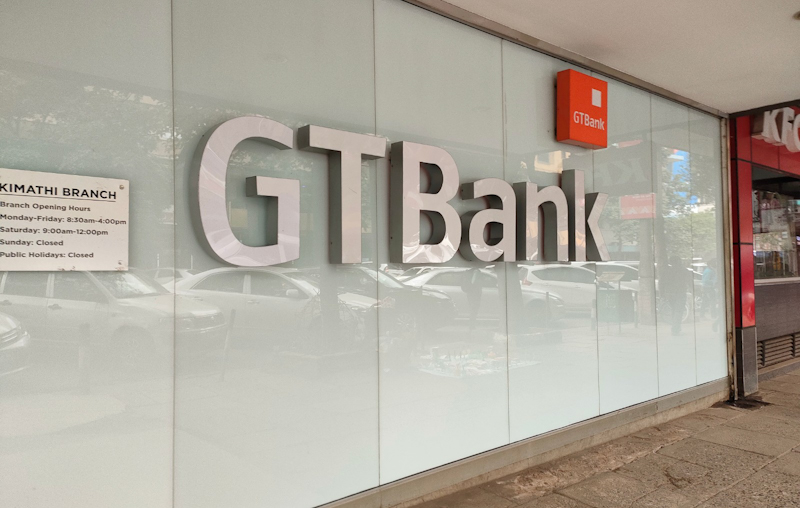
The Competition Authority of Kenya (CAK) has slapped Guaranty Trust Bank Kenya with a Sh33.18 million penalty after investigators established that the lender subjected ASL Limited, a long-standing corporate borrower, to false representations and unconscionable conduct during the troubled renewal of critical business facilities — conduct that ultimately forced the manufacturer to flee to a rival bank after clearing a staggering Sh417.85 million in overdraft balances under duress.
The ruling, dated January 29, 2026, and made public on February 24, is one of the most consequential consumer protection decisions in Kenya’s banking sector in recent memory.
CAK set the penalty at exactly two percent of GT Bank’s gross annual turnover for 2023 — a figure the regulator calculated at Sh33,180,000 — well below the ten percent statutory ceiling, a margin that signals the authority chose punishment over ruin, even as it described the bank’s behaviour in terms that left little room for charitable interpretation.
Beyond the headline fine, the regulator ordered GT Bank to refund ASL Sh13,211,285 within 30 days, a sum representing default interest and related charges the authority found were applied retroactively and without the notice the law demands.
GT Bank has since appealed the ruling to the Competition Tribunal, and the matter is now sub judice. The bank insists its conduct was fully consistent with its contractual obligations and applicable banking law, and has pledged to let the appellate process run its course before commenting further.
Two Decades of Loyalty, Then a Default Notice
ASL Limited is not a fly-by-night operation. The diversified manufacturer and distributor, which serves Kenya’s construction, electrical and industrial sectors, had banked with GT Bank since 2001 — a relationship stretching across more than two decades. In July 2021, the company secured a suite of credit facilities from the lender: overdrafts, letters of credit, asset financing, guarantees and working capital support.
These were backed by company assets and the personal guarantees of ASL’s directors, indicating the depth of commitment on both sides.
The facilities were due to expire in May 2022. ASL did the responsible thing: it applied for renewal as early as January 2022, well within the required timeline.
What followed, according to CAK’s findings, was not a straightforward renewal negotiation but a prolonged exercise in institutional ambiguity that left ASL in a state of suspended financial animation for the better part of eighteen months.
Despite months of back-and-forth engagement, GT Bank failed to communicate a clear position on the renewal. It was not until June 2023 — more than a year after the expiry date — that the bank offered a three-month extension. The offer came with strings: additional security requirements and reduced facility limits. ASL accepted.
“The bank leveraged its substantially higher negotiating power as a commercial lender to treat ASL unfairly by unilaterally recalling the facilities and backdating charges and fees.” — Competition Authority of Kenya
But the concessions did not end there. GT Bank subsequently issued a revised offer that cut the limits further still. That was the moment ASL began exploring a transfer of its facilities to I&M Bank. In the middle of those transition discussions — with the ink barely dry on preliminary arrangements — the company received a formal default notice on October 31, 2023, accompanied by a demand for Sh13.2 million in default interest that ASL said had been calculated back to August 2023, while the renewal process was still ostensibly ongoing.
To clear the path for the I&M Bank takeover and protect the continuity of its operations, ASL had little choice but to pay. It cleared outstanding overdrafts totalling Sh417,848,415 and a further USD 197,802.
GT Bank subsequently offered to refund Sh2.8 million as a goodwill gesture — a figure ASL rejected as wholly inadequate and lodged a formal complaint with CAK on October 5, 2024.
A Regulator Reads Between the Lines
The Competition Authority’s sixteen-month investigation parsed the facts with the rigour of a court of law.
Investigators found that GT Bank had violated Section 55(a)(ii) of the Competition Act on false or misleading representations and Section 57(1) on unconscionable conduct in business transactions — two distinct legal pillars that together frame a picture of a lender that knowingly exploited a client’s vulnerability.
On the question of misrepresentation, the authority found that the bank continued charging fees for facilities it had not formally approved, misled ASL on the status and availability of its banking services, and applied default interest retroactively without prior notice — thereby misrepresenting the state of ASL’s account to the company’s profound financial detriment.
Crucially, CAK also found that GT Bank dressed up materially altered facility offers as renewals, a characterisation that obscured from ASL the true nature and continuity of what was being offered.
The bank also made a partial refund without proper admission or transparency, a move the regulator said could confuse or mislead customers about the accuracy of service charges.
The unconscionable conduct finding cuts deeper still. CAK was unsparing in its assessment of the power dynamics at play.
As a commercial lender with substantial financial resources, GT Bank held vastly superior bargaining power relative to ASL.
The regulator found the bank exploited that asymmetry in three ways: it unilaterally reduced facility limits while demanding additional security; it recalled facilities during active negotiations rather than after a breakdown; and it backdated charges at a moment calculated to maximise pressure on the borrower.
GT Bank’s defence — that ASL’s failure to execute a July 2023 offer triggered legitimate contractual default provisions and that the interest was not backdated — was rejected.
A Pan-African Bank Under Scrutiny
The ruling falls on a lender that is both a regional heavyweight and a relative niche player within Kenya’s competitive banking landscape.
GT Bank Kenya is a subsidiary of Guaranty Trust Holding Company (GTCO), the Lagos-headquartered financial conglomerate that owns one of Nigeria’s most valuable banking franchises, listed on both the Nigerian Stock Exchange and the London Stock Exchange. GTCO entered Kenya in 2013 through a US$100 million acquisition of the Fina Bank Group, rebranding the network the following year.
As of December 2022, GT Bank Kenya held total assets of Sh54.23 billion and reported a profit of Sh753.29 million — solid numbers that make the Sh33 million penalty sting in symbolic rather than financial terms.
The bank is led in East Africa by Managing Director Jubril Adeniji, a veteran Nigerian banker who previously established GT Bank’s Tanzania franchise before being posted to Nairobi in July 2022.
The institution markets itself on eight core principles branded as the Orange Rules, promising excellence, integrity and a culture in which the customer is king. That brand promise now sits in uncomfortable tension with a regulatory finding that the bank’s most senior conduct toward one customer was neither fair nor transparent.
Why This Ruling Matters
For Kenya’s banking sector, the CAK decision carries implications that extend well beyond ASL Limited and Guaranty Trust Bank.
The ruling arrives at a moment when regulators across East Africa are sharpening their scrutiny of how financial institutions behave during credit renewal negotiations — a phase in the lending cycle where the power imbalance between bank and borrower is at its most acute.
Borrowers whose facilities are under review often cannot simply walk away; their operations, payroll and supplier relationships depend on the continuation of credit lines. It is precisely this vulnerability that CAK found GT Bank exploited.
The authority was deliberate in its choice of language. It defined unconscionable conduct expansively to include situations where a business coerces a consumer into contracts they do not fully understand, withholds material information, or uses ambiguous wording to influence decisions — conduct it said applies as much in corporate lending as in consumer retail banking.
That framing matters because it signals that CAK is prepared to apply consumer protection principles to the boardroom, not only the counter.
The penalty computation is equally instructive. By pegging the fine to two percent of gross annual turnover rather than a fixed sum, CAK has established a precedent for scaling punishment to the size of the offender — a methodology familiar from competition law enforcement in Europe and which concentrates the minds of larger institutions more effectively than flat fines.
Whether the Competition Tribunal will uphold the ruling remains to be seen. GT Bank has signalled it will mount a full defence, arguing the authority’s findings do not reflect the evidence.
The matter is now sub judice and the refund order is, for the moment, in abeyance. But whatever outcome emerges from the appellate process, the CAK’s initial findings have already drawn a line in the sand: in Kenya, a bank that holds all the cards is not free to play them any way it pleases.
Kenya Insights allows guest blogging, if you want to be published on Kenya’s most authoritative and accurate blog, have an expose, news TIPS, story angles, human interest stories, drop us an email on [email protected] or via Telegram



Blocked: How Mombasa Tycoon Ashok Doshi Has Stopped Imperial Bank Depositors From Getting Their Money

SEX SCANDAL ROCKS KISUMU POLYTECHNIC: Top Officials Linked as Secretary Accuses New Council Chairman of Naivasha Advances

Why Ruto’s Favourite Candidate Adan Mohammed Could Be Locked Out of the KRA Top Job

DCI Arrests Woman in Sh55.7 Million Gold Fraud Targeting American Citizen in Nairobi

Court Confirms Safaricom Customers Data Was Sold To Betting Companies In Seven-Year Cover-Up

Paybill 585555: How Airtel Kenya’s Interoperability Gateway Became A Criminal Pipeline Draining Millions From Unsuspecting M-Pesa Users

The Man Who Starved Kenya’s Voice

The Rot Inside Absa: How Bank Insiders Are Looting Nairobi’s Customers

The President’s Helicopter: How Ruto’s Aviation Empire Lands a Historic Airbus Milestone While His Government Writes the Tax Code

“TikTok Who? YouTube Sorry. A Kenyan-Built Platform Just Dropped—and 20 African Ministers Showed Up To Launch It.”

How Did a Sh468K KRA Salary Allegedly Turn Into Sh30 Billion? Questions Deepen Over Commissioner George Obel and Ciala Resort Owner’s Wealth

Nairobi Freezes Binance Accounts in Sweeping Anti-Fraud Crackdown as Global Scandal Record Haunts World’s Largest Crypto Exchange

THE UNTOUCHABLE CLERK: How Fatuma Mwalupa Allegedly Turned Kwale Assembly Into a Personal Treasury and Outsmarted Scrutiny

The Man Behind the Badge: How Prof. Erastus Kanga Turned Kenya’s Premier Wildlife Agency into a Theatre of Corruption, Fear and Impunity

THE BRAZEN RETURN: Triton Thief Yagnesh Devani, Who Pillaged Kenya of Sh7.6 Billion and Fled, Now Asks the Same Courts He Escaped to Restore His Stolen Wealth

Green Gold, Rotten Roots: How Kenya’s Biggest Avocado Firms Hijacked a Sh5.8 Billion Harvest Ban
Why Ruto’s Favourite Candidate Adan Mohammed Could Be Locked Out of the KRA Top Job

Why the April 21 Flopped Protests Expose Kenya’s Rudderless Opposition

KETRACO CEO Advert Marred By Controversies As Fears Grow That Kipkemoi Kibias Is A Predetermined Candidate

THE PHANTOM COVER: Unlicensed Broker Vanishes With Sh42M, Hussein Mohammed Fingered In The Alleged CHAN 2024 Insurance Scandal
-
 News2 days ago
Why Ruto’s Favourite Candidate Adan Mohammed Could Be Locked Out of the KRA Top Job
-

 Business2 weeks ago
Safaricom’s Sh1.4 Billion Reckoning: How Kenya’s Most Profitable Company Stole a Man’s Idea and Got Caught
-

 Investigations2 weeks ago
Denial Under Duress: The Untold Collapse Threatening David Lagat’s DL Group’s Empire
-

 Business2 weeks ago
THE INSURER THAT TOOK YOUR PREMIUM AND FORGOT YOUR NAME: How ICEA Lion Left a Client Begging for Sh7.8 Million Across Four Months
-
 Business6 days ago
The Rot Inside Absa: How Bank Insiders Are Looting Nairobi’s Customers
-

 Business2 weeks ago
Bush Air Safaris Founder John Ndiritu Risks Losing Property Over Disputed Loan Claim
-
 Business7 days ago
The President’s Helicopter: How Ruto’s Aviation Empire Lands a Historic Airbus Milestone While His Government Writes the Tax Code
-

 Africa2 weeks ago
Stung By West Africa Rejections, France Courts Rest Of Continent at Kenya Summit