
Investigations
How Did a Sh468K KRA Salary Allegedly Turn Into Sh30 Billion? Questions Deepen Over Commissioner George Obel and Ciala Resort Owner’s Wealth
KRA Commissioner George Obell draws a Sh468,000 monthly salary. Court documents allege he has accumulated wealth approaching Sh30 billion. A Nairobi court is now being asked to answer the question Kenya cannot afford to ignore: how?

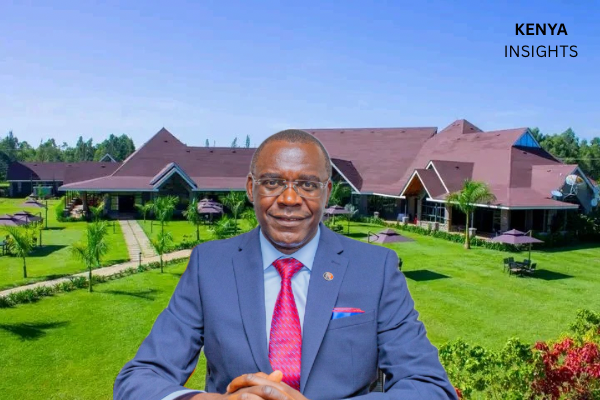
He is the man charged with hunting down Kenya’s smallest tax evaders, the roadside trader who forgets to file, the boda boda owner who operates on a nil return, the corner-shop proprietor who thinks nobody is watching.
George Obell, Commissioner for the Micro and Small Taxpayers Department at the Kenya Revenue Authority, has made headlines for his aggressive crackdowns, his data-driven rhetoric, his WhatsApp chatbots and his USSD platforms.
He speaks at press conferences about the sacred duty of every Kenyan to pay their fair share.
He is, by every official account, the Republic’s man on the ground, collecting the crumbs while protecting the national granary.
What nobody at KRA’s gleaming Times Tower headquarters appears willing to discuss is the allegation that has now landed before the High Court’s Anti-Corruption Division: that Obell, drawing a monthly salary of Sh468,000, has allegedly accumulated wealth running into the vicinity of Sh30 billion over a two-decade career as a mid-ranking tax official.
That is not a rounding error.
That is not a clerical dispute.
That is a figure so astronomically disproportionate to any conceivable accumulation of lawful income that it has triggered concurrent investigations by the Asset Recovery Agency and the Ethics and Anti-Corruption Commission, and inspired a citizen to petition the courts before Obell collects one more shilling in expanded powers.
Kenya Insights has reviewed court documents in the matter filed before the Anti-Corruption Division by Nairobi resident Jemimah Wafula, who is seeking orders to block the KRA chairman and board of directors from assigning Obell his new responsibilities as Commissioner in charge of Small Taxpayers while both the ARA and EACC investigations remain pending.
Her petition reads less like a legal document and more like an indictment of the entire governance architecture of an institution that cannot police its own house while demanding compliance from millions of ordinary Kenyans.
THE ARITHMETIC OF IMPOSSIBILITY
Let us do the arithmetic that apparently no one inside KRA has been willing to do publicly.
Obell has spent approximately 28 years at the Kenya Revenue Authority, a career that stretches back to the late 1990s.
For the majority of that career, he held the rank of Chief Manager, a position that, according to court documents, attracted a monthly salary averaging Sh468,000.
Over 20 years at that salary, before taxes and deductions, the gross cumulative earnings would amount to approximately Sh112 million. That figure, generous in its assumptions and ignorant of the tax that would have been deducted from it, sits against an alleged accumulated wealth of Sh30 billion.
‘Obell infiltrated EACC and obtained a document purporting to be a Clearance Certificate while the ARA and EACC are investigating his accumulation of billions.’ – Court documents
The gap between Sh112 million in earned income and Sh30 billion in alleged assets is not a gap. It is a chasm of Sh29.888 billion, a figure that demands explanation.
It is a figure that, if substantiated, would make Obell one of the most successful accumulators of unexplained wealth in the history of Kenyan public service, a category that, given the competition, requires some doing.
It is a figure that the ARA and EACC have apparently found credible enough to investigate. And it is a figure that the KRA board apparently found no impediment to promoting him past.
THE INTERNATIONAL TAX OFFICE: WHERE THE CLOCK STARTED TICKING
The court documents point specifically to Obell’s tenure as a Chief Manager in the International Tax Office as the period during which the alleged accumulation of unexplained wealth began to accelerate. This is a detail that deserves more than passing attention. The International Tax Office at KRA is not where one processes the tax returns of mama mboga. It is the unit responsible for monitoring multinational corporations, transfer pricing arrangements, Base Erosion and Profit Shifting schemes, and the extraordinarily complex transactions that large international businesses conduct across jurisdictions.
It is, in the taxonomy of KRA corruption risk, precisely the kind of posting where an officer with questionable integrity could do the most damage to the national revenue, and extract the most personal benefit.
It is no accident that KRA’s own published case studies on staff integrity identify international tax administration as among the highest-risk environments for corruption.
Transfer pricing negotiations, for example, involve officers making judgment calls on billions of shillings in disputed tax liabilities.
A well-placed official willing to look the other way, or better still, willing to offer a favourable assessment in exchange for consideration, sits at the confluence of extraordinary opportunity.
Whether any such conduct occurred in Obell’s case is precisely what investigators are now tasked with establishing. But the pattern is one that Kenyan law enforcement agencies know well.
In 2019, the DPP directed the DCI to investigate KRA staff who had allegedly colluded with taxpayers to reduce liabilities running into hundreds of millions of shillings.
In 2020, the EACC was simultaneously investigating ten senior KRA officials, including two commissioners, over their conduct in the Darasa Investment sugar importation matter that cost the country billions in uncollected duty.
A fresh Auditor-General report in 2025 found that KRA had issued tax compliance certificates to over 3,000 taxpayers who owed Sh3.12 billion in unpaid taxes without the required repayment plans.
The institution’s internal controls have been described, in official audit language, as fragmented, largely manual, and prone to manipulation.
It is within this institutional environment that George Obell built his career.
THE CLEARANCE CERTIFICATE THAT SHOULD NOT EXIST
Perhaps the most explosive allegation in the court documents is not about the alleged billions. It is about what Obell allegedly did after he found out he was being investigated.
According to the petition filed by Jemimah Wafula, Obell infiltrated the Ethics and Anti-Corruption Commission and obtained a document purporting to be a Clearance Certificate, even as the EACC was simultaneously conducting an active investigation into how he accumulated his alleged billions.
‘KRA’s decision to appoint Obell as Commissioner while investigations are ongoing is an act of impunity.’ – Petition to the High Court Anti-Corruption Division
The implications of this allegation are severe and layered.
First, it raises the question of whether someone at the EACC issued a clearance certificate to an active investigation subject, either through negligence, corruption, or institutional failure.
The EACC itself has not publicly addressed this allegation.
Second, it raises the question of how a clearance certificate obtained under such alleged circumstances was then presented to the KRA board in the first place, and whether the board made any effort to verify its authenticity or the circumstances under which it was obtained before proceeding to confirm Obell’s appointment.
Third, and most disturbingly, it raises the possibility that the very institution mandated to investigate public sector corruption in Kenya can be penetrated by a subject of its own investigation.
The Auditor-General’s 2025 report, published just months before this petition landed before the court, had already flagged the issuance of tax compliance certificates to non-compliant taxpayers as a systemic problem within KRA itself, noting that 265 such certificates were automatically generated for taxpayers with outstanding liabilities.
The spectre of a similar dynamic, a clearance being issued to a subject under active investigation, is one that the EACC’s leadership will need to answer in court and in public.
CIALA RESORT AND THE PROBLEM OF CONSPICUOUS WEALTH
The court documents allege that Obell has not been shy about his material circumstances.
Jemimah Wafula’s petition claims he has been boasting at social events in Westlands hotels that he funds political aspirants and regularly hosts KRA board members at his rural home and at his Ciala Resort in Kisumu County.
Kenya Insights can confirm that Ciala Resort is a substantial commercial hospitality establishment situated on 35 acres of land approximately 12 kilometres from Kisumu International Airport.
The resort, which opened in August 2018, operates 56 rooms, a rooftop infinity pool, a spa and sauna, multiple conference facilities capable of accommodating up to 3,000 guests, and a restaurant with a full cocktail bar.
It is, by any reasonable measure, a multi-hundred-million-shilling asset.
The petition further alleges that KRA board members visited the resort and received hospitality there without declaring those benefits as required.
If accurate, this allegation speaks to a far larger problem than one officer’s unexplained wealth.
It speaks to the capture of an oversight structure, a scenario in which the very people responsible for vetting and approving senior appointments are dining at the expense of the man they are supposed to be vetting.
The Constitution of Kenya is unambiguous that public officers must not place themselves in situations of conflict of interest. A board member accepting hospitality from an appointment candidate is not an administrative technicality. It is a constitutional question.
Obell holds the Moran of the Order of the Burning Spear, awarded by the President of Kenya, as well as a Master of Business Administration from the University of Nairobi and a Bachelor of Science in Accounting from the United States International University Africa.
He chairs the African Tax Administration Forum’s VAT Technical Committee and has represented Kenya before the United Nations Committee of Experts on International Cooperation in Tax Matters.
He is, on paper, a distinguished public servant.
None of these distinctions, however, answer the question of how a career civil servant on Sh468,000 a month allegedly finds himself in possession of assets approaching Sh30 billion.
THE PROMOTION THAT DEFIED LOGIC
In March 2025, KRA restructured its domestic taxes architecture and created an entirely new department specifically targeting micro and small taxpayers.
It was, KRA’s communications team assured the public, a bold institutional reform. Obell was installed as acting commissioner of this new department from the very day of its creation.
By November 10, 2025, he was confirmed in the post on a permanent basis, a process that the KRA Commissioner General Humphrey Wattanga Mulongo described publicly as a recognition of Obell’s visionary leadership and 28 years of experience.
What the Commissioner General’s effusive statement omitted is that by the time of that confirmation, both the ARA and the EACC had already opened investigations into Obell’s alleged wealth accumulation.
The court documents filed by Jemimah Wafula characterise the board’s decision as a leap over the heads of two active law enforcement investigations, an act described in the petition as a slap in the face of the Constitution and an act of impunity.
Kenya Insights sought comment from KRA on whether the board was aware of the ARA and EACC investigations at the time of Obell’s confirmation. No response was received by the time of publication.
A career civil servant on Sh468,000 a month has, according to investigators, assets approaching Sh30 billion. The KRA board promoted him anyway.
The confirmation of an officer under dual-agency investigation to a senior regulatory role carries consequences that extend far beyond the individual.
It sends a signal, clear and unmistakable, to every other public officer watching: that accumulating unexplained wealth will not foreclose promotion, that investigations are inconveniences to be managed rather than reckonings to be respected, and that the board of the Kenya Revenue Authority is either unaware of, or untroubled by, the contradiction of having an officer under a wealth investigation lead a department charged with enforcing tax compliance on millions of Kenyan businesses.
WHAT THE OVERSIGHT AUTHORITIES MUST DO
The High Court’s Anti-Corruption Division is the immediate forum.
The court has directed Jemimah Wafula to serve the KRA chairman and board with the petition, with mention set for May 4.
The court should, at that hearing, seriously consider the interim orders sought. Allowing an officer under active investigation by both the ARA and the EACC to continue exercising regulatory authority over Kenya’s small business taxpayers while those investigations are unresolved is not merely procedurally questionable. It is substantively corrosive to the integrity of the tax system itself.
Beyond the courts, there are institutional actors who cannot credibly remain silent.
The EACC must publicly clarify whether a clearance certificate was issued to Obell during the currency of its investigation, and if so, by whom, under what authority, and whether that issuance is itself under review.
The Asset Recovery Agency must clarify the status and scope of its investigation into Obell’s alleged assets.
The KRA board must account to Parliament and to the public for whether it conducted any integrity verification before confirming Obell’s appointment, and whether any board member received hospitality at Ciala Resort or any other Obell-associated property.
The Director of Public Prosecutions should be closely monitoring the progress of both investigations.
Kenya has an institutional habit of opening high-profile corruption investigations that quietly expire without conclusion, a graveyard of cases that began with fanfare and ended in silence.
The Obell matter has now been placed before a court of record. The EACC and ARA no longer have the luxury of indefinite delay.
Parliament’s relevant committee, whether the Public Accounts Committee or the Committee on Delegated Legislation, should summon KRA’s board for a full accounting of the appointment process, the clearance certificate question, and the board hospitality allegations.
The Kenya National Audit Office should flag the appointment in its next audit of KRA governance. The Financial Reporting Centre, which sits directly in the chain of agencies that track unexplained wealth, should ensure that any suspicious transaction reports related to Obell’s alleged assets have been properly filed and actioned.
THE AUDACITY OF THE TAX HAWK
There is a particular cruelty in the allegation that is worth naming plainly.
Obell has been the public face of KRA’s crackdown on small taxpayers, the man behind press conferences announcing that 392,162 individuals and businesses filed nil returns despite transactional evidence to the contrary.
He warned Kenyans in January 2026 that their data was being harvested at every level, that every transaction would be visible, that there was no place to hide.
He said, with evident relish, that travel bans, asset freezes, and PIN deactivations awaited the non-compliant.
The irony of an officer allegedly sitting atop Sh30 billion in unexplained assets delivering those warnings to small business owners who may have failed to account for a few hundred thousand shillings is not lost on anyone watching.
The roadside trader who files a nil return faces a travel ban.
The KRA Commissioner who allegedly cannot account for the source of Sh30 billion gets a promotion, a government award, and a seat at the African Tax Administration Forum.
Kenya Insights reached out to George Obell for comment on the allegations contained in the court documents prior to publication.
No response was received. We reached out to KRA’s communications department for the authority’s position on the court petition and on whether the board was aware of the dual investigations at the time of Obell’s confirmation.
No response was received.
We attempted to establish through public land records and company registry filings the ownership structure of Ciala Resort.
Those inquiries are ongoing and will be the subject of a follow-up report.
The matter is now before the Anti-Corruption Division of the High Court.
A tax administrator who built a career on the principle that every Kenyan must account for every shilling will shortly be required, one way or another, to account for his own. The courtroom, unlike the boardroom, does not offer freebies.
Kenya Insights allows guest blogging, if you want to be published on Kenya’s most authoritative and accurate blog, have an expose, news TIPS, story angles, human interest stories, drop us an email on [email protected] or via Telegram



Caleb Amisi Says Linda Mwananchi Has Lost Direction, Announces Plans To Form A New Movement

Air Canada Pilot Flew Passengers For Years With A Fake Pilot’s License, Police Say

Itumbi Claims Kalonzo Has Settled on Sifuna as Running Mate

THE KURIA NETWORK TAKES THE BOARDROOM: How Moses Kuria’s Inner Circle Seized Control of Africa Mega Agricorp And the Paper Trail That Links It All

Who Is The Somali Referee Barred From Entering The US For The World Cup?

Inside NCBA’s Decline: How a Banking Giant Lost Its Strategic Edge

Shiquo wa Hii Style Counts Costly Lesson After Anti-Counterfeit Raid Wipes Out Shop Stock

“Are They Giving Kickbacks To Government Officials?” The Scandalous Record Behind Kenya’s Most Favoured Chinese Contractor

Two MPs Defrauded of Sh93.5 Million in Karen Land Scam

Gachagua Rejects Sh50 Million Court Compensation, Calls It An Insult

Cement, Cash and Courts: How the Hashu Dynasty Crushed the Ramji Brothers for Fourteen Years and Why the Walls Are Now Closing In

Inside The Urban Planning Cartel That Owns Nairobi

Why Ruto’s Favourite Candidate Adan Mohammed Could Be Locked Out of the KRA Top Job

LifeCare on the Brink: SHA Fraud, Stolen Wages, and the Rotten Empire Jayesh Saini Built

Este Medical Kenya Fights American’s Explosive Complaints

Betika Faces DCI Probe, Directors Arrest and License Revocation Over Massive 29.5 Million Safaricom Customers’ Data Breach

The Rot Inside Absa: How Bank Insiders Are Looting Nairobi’s Customers

Inside FAFSA Fraud: How Kenyan Cybercriminals Siphoned Millions from America’s Sh12 Billion Student Loan System

Fresh Move Launched to Remove Kenya Railways MD Mainga From Office After Awarding Sh817 Million Consultancy Contract

Court Confirms Safaricom Customers Data Was Sold To Betting Companies In Seven-Year Cover-Up
-
 Investigations6 days ago
Cement, Cash and Courts: How the Hashu Dynasty Crushed the Ramji Brothers for Fourteen Years and Why the Walls Are Now Closing In
-
 Investigations4 days ago
Inside The Urban Planning Cartel That Owns Nairobi
-
 Investigations1 week ago
Betika Faces DCI Probe, Directors Arrest and License Revocation Over Massive 29.5 Million Safaricom Customers’ Data Breach
-
 Investigations6 days ago
Fresh Move Launched to Remove Kenya Railways MD Mainga From Office After Awarding Sh817 Million Consultancy Contract
-

 News2 weeks ago
Eight Students Arrested In Kenya After Suspected Deadly School Arson Attack
-
 News1 week ago
How Uhuru’s Deal With Obama In 2015 Paved Way For America’s Ebola Plan In Kenya
-

 Business6 days ago
TRUST BETRAYED: How Senior DTB Bank Insiders Allegedly Looted Sh149 Million From a Customer’s Account Over Five Years
-

 Investigations4 days ago
Why Drivers Cheered Bolt’s Reported Exit: Inside the Slow Financial Strangulation of Thousands of Kenyan Drivers and Riders in Kenya