
Business
Blocked: How Mombasa Tycoon Ashok Doshi Has Stopped Imperial Bank Depositors From Getting Their Money
How Ashok Doshi’s decade-long judicial campaign to extract Sh1 billion from the wreckage of Imperial Bank has held 5,000 fellow depositors hostage — and why the Court of Appeal has finally said enough

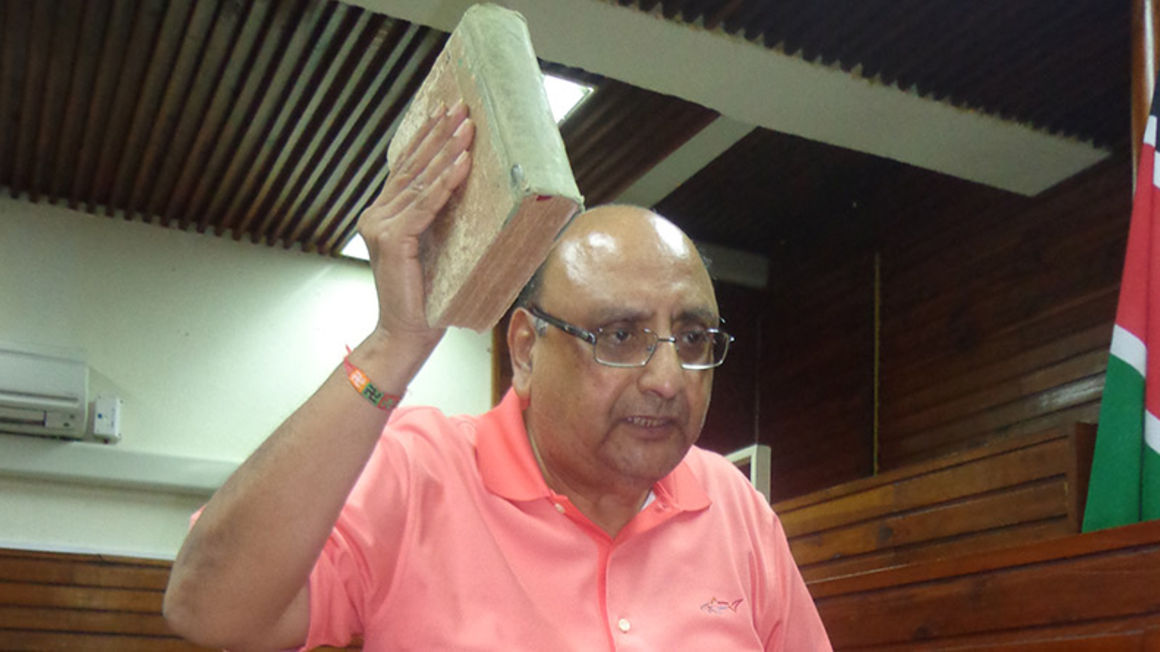
There is a version of the Ashok Doshi story that Kenya’s mainstream media has been more than happy to print for a decade: the ageing tycoon, reportedly battling colon cancer, who retreated to London with his wife Amit and found himself unable to access a billion shillings locked inside a bank destroyed by other men’s greed. It is a story of victimhood, elegantly packaged. It is also, the Court of Appeal now makes clear, a story that has been weaponised against the very people it claimed to stand alongside.
On Monday, a three-judge bench of the appellate court set aside a High Court undertaking that had directed Imperial Bank Limited (IBL) to pay the Doshi family approximately Sh1 billion should they prevail in their suit against the Central Bank of Kenya and the collapsed lender.
The ruling does not merely resolve a procedural squabble.
It tears apart the legal scaffolding that Doshi’s lawyers have carefully erected over ten years of sustained litigation, and it does so by invoking the most basic architecture of banking insolvency law: when a bank is placed under liquidation, the moratorium is absolute, the creditor queue is inviolable, and no side-arrangement, no consent, no undertaking signed during receivership can leapfrog one depositor over another.
The bench held that from the moment IBL was placed under receivership, a moratorium on all payments and preferential treatment of any depositor outside the framework of the law took immediate effect and remained in force.
Section 56(3) of the Kenya Deposit Insurance Act is not a suggestion.
It states, with a clarity that needed no judicial interpretation, that no attachment, garnishment, execution or other method of enforcement of a judgment or order against an institution placed under liquidation may take place or continue.
The court applied that provision directly to the consent agreement of July 2016 that Doshi’s legal team had treated as their trump card for nearly ten years and found it void against the liquidation framework. The consent, the bench concluded, could not breathe new life of its own.
“Those principles apply in equal measure to the winding up and liquidation of banking institutions. The learned Judge erred in granting the impugned orders.” — Court of Appeal
It is worth dwelling on what that consent actually was. In July 2016, three months after Imperial Bank was placed under receivership, IBL signed an undertaking to pay whatever sums were found due to the Doshis at the conclusion of their suit.
Their lawyers have cited it in court after court, in city after city, for nearly a decade as though it were a promissory note signed in peacetime.
What the appellate court has now confirmed is that a bank already under statutory management, already subject to a moratorium, had no legal authority to make any such promise. The undertaking was, from the day it was signed, constitutionally void against the insolvency framework.
A DECADE OF JUDICIAL ATTRITION
The scale of the litigation that Ashok Doshi and his wife have deployed against the Kenya Deposit Insurance Corporation, the Central Bank of Kenya and Imperial Bank’s liquidation process is difficult to overstate.
The first case arrived in 2016, the same year the bank was placed under receivership, when Doshi filed before the Mombasa High Court accusing CBK of colluding with or turning a blind eye to IBL’s shareholders in running the bank into the ground.
In that application he also demanded that KDIC deposit $7.27 million in a joint interest-earning account held in the names of advocates as security for any eventual decree.
What followed was a procession of applications, appeals, injunctions, forum-shopping across courts in Mombasa and Nairobi, and emergency orders obtained without notice to the other side.
On December 22, 2021, High Court Justice John Onyiego issued ex-parte orders suspending CBK’s decision to appoint KDIC as the liquidator of the bank.
The liquidation process halted. In November 2022, Justice Njoki Mwangi directed that IBL should not be placed under liquidation until CBK and IBL deposited $7.27 million in a joint account as security, or alternatively gave a binding undertaking to pay the Doshis if they won.
KDIC, which by then was trying to pay 4,300 remaining depositors at least Sh500,000 each, watched its plans evaporate.
In April 2023, as KDIC prepared to advertise a claims validation process for protected depositors, Doshi appeared before Justice Gregory Mutai in Mombasa and obtained fresh interim orders halting the liquidation again, suspending the gazette notice through which KDIC had been formally appointed.
That case was dismissed by Justice Kizito Magare in May 2023 as an outright abuse of the court process.
Within weeks, Doshi had migrated to Nairobi and obtained yet more temporary orders from a different court.
In July 2023 he secured an injunction nullifying KDIC’s notices on claims lodging and payments that had been issued in April and June of that year.
A High Court in Nairobi subsequently dismissed that petition as sub-judice, citing abuse of the court process, and directed him back to the proceedings already pending in Mombasa and before the Court of Appeal.
David Irungu, KDIC’s head of bank resolution, stated in an affidavit submitted during the proceedings that the delay in the conclusion of the liquidation, and the tethering of protected deposit payments to its conclusion, does not act in the best interests of depositors and destroys confidence in the financial sector.
It is a measured formulation.
The reality is less diplomatic.
For the approximately 4,300 depositors who remained unpaid as of the most recent KDIC notices, each court filing by a Mombasa billionaire operating through multiple senior advocates across multiple jurisdictions represented another month, another quarter, another year without access to money that belongs to them under statute.
THE FRAUD THAT CREATED THE QUEUE
None of this, of course, would exist without the fraud that destroyed Imperial BankThe lender collapsed in October 2015 after the sudden death of its founding group managing director, Abdulmalek Janmohamed, exposed a parallel banking operation that had been running inside the institution for at least thirteen years.
FTI Consulting, the American forensic audit firm appointed by KDIC, found that Janmohamed, assisted by then head of credit Naeem Shah and chief finance officer James Kaburu, had constructed an elaborate system of fictitious accounts, manipulated general ledger entries and suppressed postings from the core banking system to create the illusion of a financially healthy institution.
The audit traced at least Sh34 billion in losses, with Sh3.4 billion found in eight accounts registered to fictitious or proxy identities including Gulshan, Ali Shah, Barkat Khan, M Khan, B Mohamed, Jionesh Shah, and Zulfikar, names that court documents confirm were not genuine customers.
Proceeds were routed through at least twelve companies, the most prominent of which was E. Tilley (Muthaiga) Limited, a name that had also appeared in the collapse of Charterhouse Bank as a suspected money laundering conduit.
E. Tilley alone admitted receiving Sh10 billion from the bank.
The KDIC and CBK subsequently sued Janmohamed’s estate, his mother Gulshan and brothers Mehdi and Salim, his nieces and nephew, along with Shah and Kaburu, for recovery of the looted funds.
The bank’s directors, including principal shareholder and chairman Alnashir Popat, were separately sued by KDIC for allegedly allowing the use of fictitious accounts to facilitate transactions on their behalf and benefiting from those accounts.
The suit alleged that Popat’s own accounts were used to move Sh240 million through the scheme.
The directors countered by accusing CBK officials of obstructing the investigation and pressing for liquidation to cover their own tracks, with Popat telling Parliament’s Finance Committee that CBK officers had manipulated the receivership process to deflect attention from themselves.
The DPP confirmed at the time that the probe had extended to CBK officials.
As of this reporting, the primary recovery suit against Janmohamed’s relatives is a decade old and on the verge of collapse, with KDIC having failed repeatedly to bring FTI Consulting’s American investigators to Nairobi to testify, having failed to agree a fee arrangement with the firm whose forensic report forms the foundation of the entire recovery case.
Imperial Bank depositors cannot be held hostage without their deposits on mere apprehension of the plaintiff. — KDIC affidavit, 2023
It is in this landscape of institutional failure that Ashok Doshi’s litigation takes on its full character.
The fraud was not his making.
The regulatory failure that allowed Janmohamed to operate a parallel bank for thirteen years was not his responsibility. His grievance is real, and Sh1 billion is not a trivial sum even for a man of his reported wealth.
But the legal structure through which he has pursued that grievance has treated the moratorium framework of the KDIC Act as an inconvenience to be navigated rather than a constraint to be respected, and the depositors at the back of the queue as an abstraction rather than a constituency.
THE MAN BEHIND THE GRIEVANCE
Ashok Labhshankar Doshi is the patriarch of the Doshi Group, a Mombasa-based conglomerate founded in 1923 with interests spanning steel manufacturing, building materials, power cables, water infrastructure and telecommunications.
The group grew organically and through acquisition to become one of the largest manufacturing firms on the Kenyan coast.
Doshi is, by any measure, a wealthy man.
His family holds stakes in multiple companies and has extensive property interests across Mombasa and Nairobi. It is this backdrop that renders his litigation posture all the more difficult to accept at face value.
In April 2023, the same month that Doshi obtained fresh court orders halting KDIC’s liquidation process, he was arrested by detectives from the DCI’s Land Fraud Unit and arraigned before Milimani Chief Magistrate Lucas Onyina on four criminal counts.
The charges arose from a prime parcel of land along Processional Way in Nairobi, valued at approximately Sh2 billion and claimed by Greenview Lodge Limited and its director Jennifer Nthenya Wambua. Doshi, his company Magnum Properties Limited, and a co-accused named Harit Sheth faced charges of conspiracy to defraud the government of Sh1.2 million in stamp duty through a forged receipt, making a document without authority, forgery, and forcible detainer of land belonging to Greenview Lodge.
The charge sheet alleged that between May 1992 and September 1992, Doshi and Sheth jointly conspired to forge a stamp duty receipt purporting to be issued and signed by the Commissioner of Lands.
The DCI’s Land Fraud Unit had in an earlier phase of the investigation recommended that Greenview’s own director be charged, before reversing that recommendation in 2020 and redirecting prosecution toward Doshi.
The tycoon denied all counts, was released on Sh500,000 cash bail and ordered to deposit his passport.
By January 2025, his lawyer Noel Okwach was before the same magistrate reporting that the DPP had recalled the file from the DCI for review and indicating a possibility that the charges could be dropped altogether.
In March 2023, weeks before the Processional Way charges landed, the Ethics and Anti-Corruption Commission moved separately against Doshi in Mombasa.
The EACC filed a suit at the Environment and Land Court naming Doshi, his wife Pratibha Ashok Doshi, children Anish and Sunir and Sheila Doshi, the Doshi Group of Companies, and sixteen other individuals and companies including former Kiambu Governor William Kabogo, as defendants in an alleged scheme to fraudulently acquire Kenya Revenue Authority land valued at Sh358.5 million in the Kizingo area of Mombasa.
The EACC alleged that the prime 2.5-acre property, which housed KRA executive staff quarters, was originally reserved for public use and was illegally subdivided and allocated to private hands through collusion with former Commissioners of Lands Wilson Gachanja and Sammy Mwaita.
According to EACC’s pleadings, the disputed plot MSA/XXVI/1082 was initially allotted to Kabogo before being transferred to Delgreen Limited, Doshi, Pratibha Doshi and the Doshi Group, who were registered as the current owners.
Other parcels in the same scheme were distributed among a network of individuals and their associated companies.
The EACC sought court declarations that all title deeds held by the named defendants were invalid, null and void, with ownership reverted to KRA. The commission also sought orders that the former land commissioners pay general damages to the public for fraud, breach of fiduciary duty and abuse of office.
THE BROADER IMPERIAL BANK WRECKAGE
The Court of Appeal’s ruling arrives as the wider Imperial Bank recovery operation, now ten years old, continues its dispiriting stall.
The primary criminal case against former directors, management and officials runs in the courts with the grinding pace that large-scale financial crime litigation has made routine in Kenya.
The civil recovery suit against the Janmohamed estate and his family, which KDIC filed in 2015 and which KDIC’s liquidation agent Andrew Rutto has consistently cited as the mechanism through which depositors will ultimately be made whole, is on a self-executing dismissal warning from Justice Gikonyo after the corporation failed for the seventh time to bring its American forensic witnesses to testify.
FTI Consulting, the US firm whose report forms the evidentiary spine of the recovery case, has been unable to reach a fee agreement with KDIC that would cover its witnesses’ travel and accommodation costs to appear in Nairobi.
In March 2025, Justice Gikonyo issued a last-chance ruling: if KDIC fails to prosecute the case on the next appointed date for reasons attributable to itself, the suit will stand dismissed.
The judge noted that the case has a public-interest element that deserves a final opportunity, but that ten years of delay has exhausted the court’s patience.
Were the case to collapse, the Sh44.8 billion in losses that FTI traced to Janmohamed’s parallel banking operation would be unrecovered, and the remaining depositors’ prospects of anything beyond the insured floor would effectively close.
In November 2025, one of Doshi’s primary cases, the one challenging KDIC’s appointment as liquidator, was withdrawn by consent between Doshi and CBK, with no orders as to costs.
That quiet withdrawal, reported with minimal fanfare in the mainstream press, was effectively an acknowledgement that the core legal argument about the legality of KDIC’s appointment had run its course.
The cases that remain are the ones now addressed by the Court of Appeal.
WHAT THE LAW ACTUALLY SAYS
The appellate court’s reasoning on Monday is not legally complicated, which is perhaps the most damning aspect of the proceedings below.
Sections 33 and 57 of the Kenya Deposit Insurance Act define the framework for payment of claims by the liquidation agent with precision.
Section 57 establishes a priority waterfall for the distribution of a failed institution’s assets.
Depositors sit within that waterfall, but they sit alongside other creditors, and their position in the queue is determined by the statute, not by any consent, undertaking or court order obtained in side proceedings.
The provisions do not classify depositors who have filed claims in court, or those holding secured judgments, as entitled to priority over other creditors.
Section 56(3), cited directly by the bench, is categorical: no attachment, garnishment, execution or other method of enforcement of a judgment or order against an institution placed under liquidation may take place or continue.
The court held that any undertaking given by IBL after it was placed under liquidation would violate this provision.
The High Court judge who had allowed the November 2022 application erred, the appellate bench found, in granting orders designed to breathe new life into the terms of a consent agreement entered into when IBL was still in receivership, before the full liquidation framework had crystallised.
The appellate court further noted that the learned judge erred in granting leave for the Doshi applications and the main suit to be heard while Imperial Bank was still in liquidation.
The procedural architecture of the KDIC Act does not permit a parallel adjudicatory stream that could produce a binding money judgment against an institution mid-liquidation.
The queue exists precisely to prevent that outcome. One depositor’s judgment, however large, cannot step ahead of another depositor’s statutory claim simply because the former hired better lawyers and filed more applications.
The queue is the law. It always was.
WHAT HAPPENS NEXT
KDIC has been attempting to resume payments to protected depositors across multiple waves of litigation.
As of the most recent reports, approximately 4,300 depositors representing the final eight percent of Imperial Bank’s customer base had not received full repayment of their deposits.
The corporation had set Sh500,000 per depositor as the initial protected threshold and had been attempting to begin a formal claims validation and payment process since at least mid-2023, each attempt blocked by Doshi’s applications before courts in two cities.
With the Court of Appeal now having set aside the undertaking that formed the centrepiece of the Doshi family’s claim to priority treatment, the legal basis for any further suspension of the liquidation process has substantially narrowed.
The appellate ruling does not extinguish Doshi’s underlying claim to his deposits.
He remains a creditor of IBL in liquidation and will be treated as such under section 33, entitled to the same statutory recovery as every other depositor in his class, whatever the liquidation’s realised assets eventually permit.
The court has simply confirmed that he cannot be treated differently from any other depositor, that no consent signed during receivership could have created a binding priority, and that the moratorium that crystallised upon liquidation extinguished any such arrangement.
Whether the KDIC’s recovery suits, particularly the primary case against the Janmohamed estate and the Tilley network, survive long enough to generate meaningful restitution for depositors remains the deeper question.
The appellate court’s ruling on Monday, while significant, addresses the procedural fairness of the queue.
Whether there is anything in that queue to distribute is a matter the Nairobi courts will determine on a timeline that has already consumed a decade and shows every sign of consuming more.
The Doshi Group and Ashok Doshi’s lawyers had not responded to requests for comment at the time of publication. CBK and KDIC declined to comment on proceedings that remain before the courts.
Kenya Insights allows guest blogging, if you want to be published on Kenya’s most authoritative and accurate blog, have an expose, news TIPS, story angles, human interest stories, drop us an email on [email protected] or via Telegram





Two MPs Defrauded of Sh93.5 Million in Karen Land Scam

Gachagua Rejects Sh50 Million Court Compensation, Calls It An Insult

Ghost Firm, Ghost Justice: Two Judges Fingered In KETRACO’S Sh10 Billion Scandal

SH2 BILLION HEIST EXPOSED: How Tatu City’s Foreign Masters Used Dirty Offshore Traps, London Arbitration & Mauritius Liquidation to Strip Local Investors of Their Stake

Dimba Accused of Extorting Bank Executives in Escalating Feud

Humiliated, Handed Sh1,000 and Sent Away: Furious Residents Return Nathif Jama’s Money, Accuse Governor of Arrogance and Inhumane Treatment of Sick Woman

ICC’s Karim Khan Suspended Over Sexual Misconduct Claims

The Conquest of Tatu City, A New Zealander Story

VANISHING ACT: How China Jiangxi International Pocketed Billions in Kenyan Public Contracts, Then Walked Away

THE GROUP CHAT THAT BROKE THE CARTEL: How Kenya’s Biggest Mattress Firms Used WhatsApp to Fix Your Prices, Then Used It to Destroy Themselves

Cement, Cash and Courts: How the Hashu Dynasty Crushed the Ramji Brothers for Fourteen Years and Why the Walls Are Now Closing In

Inside The Urban Planning Cartel That Owns Nairobi

Why Ruto’s Favourite Candidate Adan Mohammed Could Be Locked Out of the KRA Top Job

LifeCare on the Brink: SHA Fraud, Stolen Wages, and the Rotten Empire Jayesh Saini Built

Este Medical Kenya Fights American’s Explosive Complaints

Betika Faces DCI Probe, Directors Arrest and License Revocation Over Massive 29.5 Million Safaricom Customers’ Data Breach

The Rot Inside Absa: How Bank Insiders Are Looting Nairobi’s Customers

Inside FAFSA Fraud: How Kenyan Cybercriminals Siphoned Millions from America’s Sh12 Billion Student Loan System

Fresh Move Launched to Remove Kenya Railways MD Mainga From Office After Awarding Sh817 Million Consultancy Contract

Court Confirms Safaricom Customers Data Was Sold To Betting Companies In Seven-Year Cover-Up
-
 Investigations5 days ago
Cement, Cash and Courts: How the Hashu Dynasty Crushed the Ramji Brothers for Fourteen Years and Why the Walls Are Now Closing In
-
 Investigations4 days ago
Inside The Urban Planning Cartel That Owns Nairobi
-
 Investigations1 week ago
Betika Faces DCI Probe, Directors Arrest and License Revocation Over Massive 29.5 Million Safaricom Customers’ Data Breach
-
 Investigations5 days ago
Fresh Move Launched to Remove Kenya Railways MD Mainga From Office After Awarding Sh817 Million Consultancy Contract
-

 News2 weeks ago
Eight Students Arrested In Kenya After Suspected Deadly School Arson Attack
-
 News1 week ago
How Uhuru’s Deal With Obama In 2015 Paved Way For America’s Ebola Plan In Kenya
-

 Investigations2 weeks ago
The Invisible Hand: Al Jazeera Further Exposes How Safaricom Became The Regime’s Most Powerful Spy
-

 Business6 days ago
TRUST BETRAYED: How Senior DTB Bank Insiders Allegedly Looted Sh149 Million From a Customer’s Account Over Five Years