
Investigations
Baraton College Russia Labour Programme Accused of Recruiting Kenyans into Ukraine War
Mwangi accused Baraton College, run by Director Bethwel Kimutai, of operating as a recruitment agency funnelling youths from Nandi and Uasin Gishu counties to Russia.

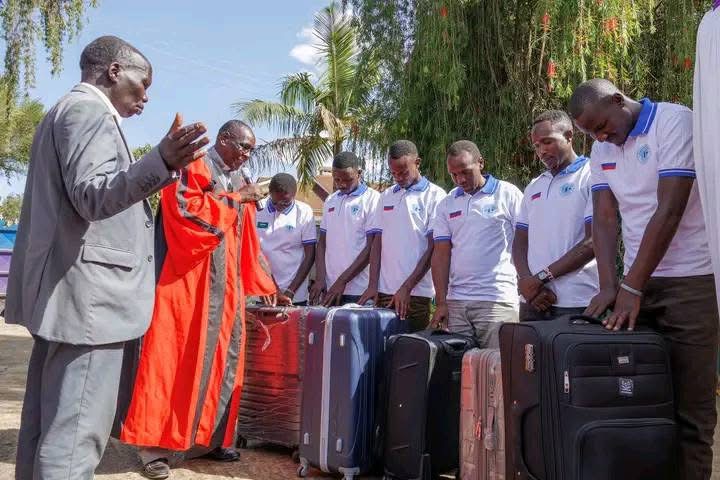
A private college in Kenya’s Rift Valley has come under sharp scrutiny after launching a labour export programme to Russia, with fears growing that desperate young jobseekers from communities already scarred by migration scams could be walking into a war zone without knowing it.
Activist and 2027 presidential aspirant Boniface Mwangi ignited the debate on Monday with a post on social media.
Mwangi accused Baraton College, run by Director Bethwel Kimutai, of operating as a recruitment agency funnelling youths from Nandi and Uasin Gishu counties to Russia.
These are the same communities where residents lost an estimated Sh1.1 billion in a botched government-linked scheme that promised work and study placements in Finland and Canada that never materialised.
“Either the parents don’t know their children are being sent to a war zone, or they are simply desperate,” Mwangi wrote. “This Kasongo policy of sending our sons and daughters to slave-like jobs abroad must stop.”
Baraton College, which operates campuses in Eldoret and Kapsabet, openly promotes its “MAJUU” or “Twende Majuu” (Let’s Go Abroad) labour programme on Facebook, TikTok and its dedicated website.
The college has held prayer and dedication services for at least 14 documented cohorts departing for Russia.
It advertises roles as meat processors, packaging operators and livestock workers on two-year contracts that include food, accommodation and transport.
For those without qualifications, it offers a one-month Certificate in Meat Processing. Advertised salaries range from approximately Sh77,000 to Sh79,000 per month.
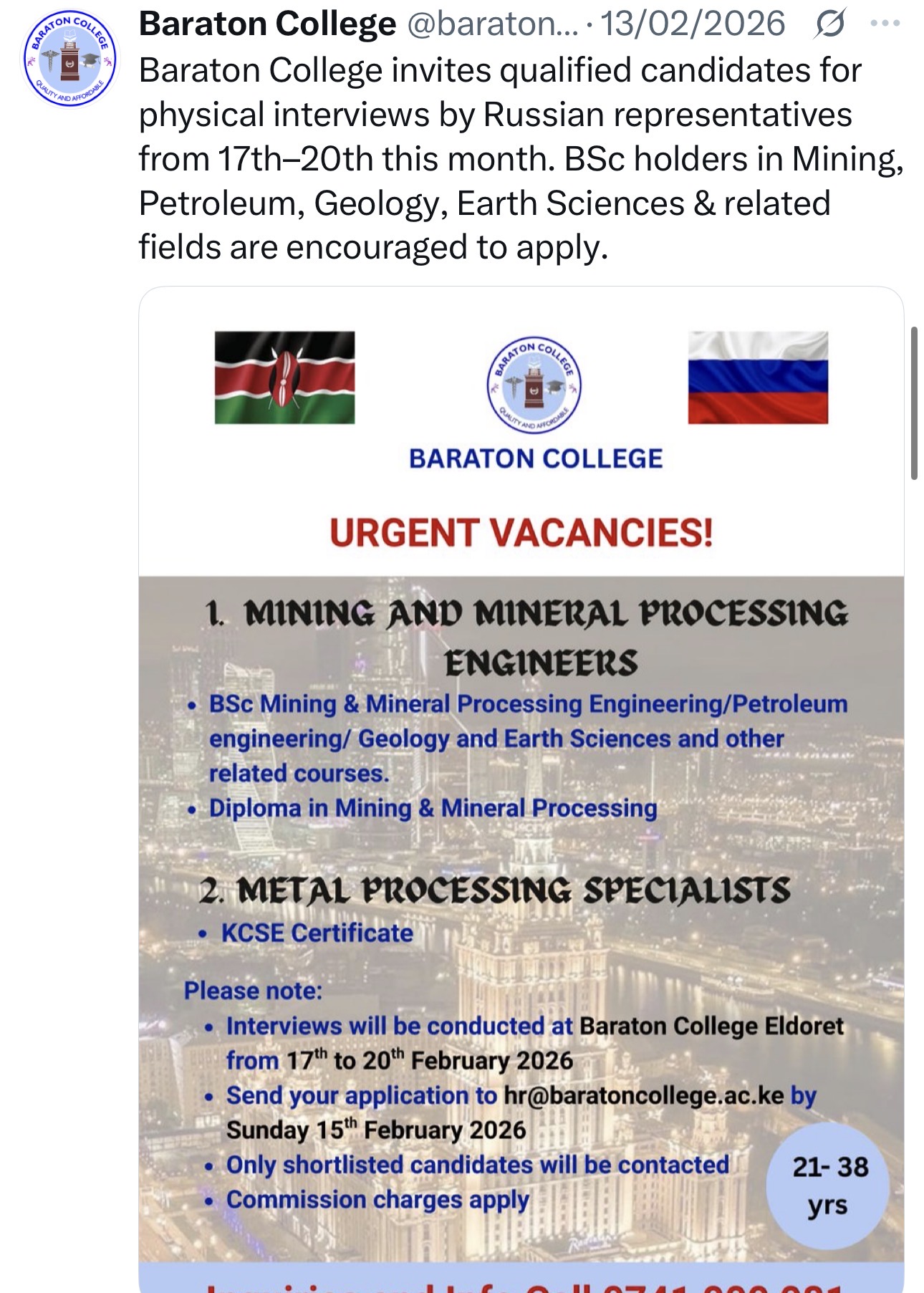
Screenshot
The college frames the programme in unambiguously glowing terms. One post declares: “Through our exclusive Russia Work Program, students and staff now have the opportunity to work, grow, and thrive beyond borders.” Videos show smiling candidates receiving blessings before departure.
The timing could not be more alarming.
Just days before Mwangi’s post, Kenya’s National Intelligence Service briefed Parliament that more than 1,000 Kenyans had been recruited to fight on Russia’s side in Ukraine, five times the government’s previous estimate.
Of those, 89 were confirmed on the frontline as of this month, 39 had been hospitalised and 28 were missing in action.
The NIS found that recruitment agencies had colluded with rogue Kenyan airport staff, immigration officials and personnel at both the Russian Embassy in Nairobi and the Kenyan Embassy in Moscow to facilitate travel.
Recruits left on tourist visas and transited through Turkey or the UAE. After Kenya tightened surveillance at Jomo Kenyatta International Airport, traffickers rerouted them through Uganda, South Africa and the Democratic Republic of Congo.
The anatomy of Russia’s recruitment machine targeting Africans has been laid bare in a series of international investigations.
Moscow has deployed an elaborate web of tactics that security analysts say are specifically designed to exploit economic desperation.
The Russian Ministry of Defence has contracted informal recruiters across Africa who are paid per head: according to BBC investigations, handlers receive up to 150,000 roubles for every foreigner signed up, compared to 50,000 for a Russian national.
A website called “Fight for Russia,” launched in January 2025 and hosted in Russia, carries an online application form for any foreigner wishing to join the war.
Fake Facebook pages, Telegram channels, WhatsApp groups and even gaming apps such as Discord carry offers promising high salaries, visas, housing and eventual Russian citizenship.
Investigators from the International Network of Private and Advanced Civilian Technology, known as INPACT, found that Russian Federal Security Service-linked shell companies coordinated much of the operation, using travel agencies as logistical cover, local pro-Russian influencers as recruitment ambassadors and former recruits to lure their own communities.
One of the most documented recruiters, a former Russian teacher named Polina Alexandrovna Azarnykh, ran a Facebook group that once helped Arab students study in Moscow. She now runs a Telegram channel through which she has posted hundreds of invitations to men from Côte d’Ivoire, Egypt, Morocco and Nigeria to join the Russian army.
The playbook applied to Kenyans is almost always the same. Promises of work as security guards, warehouse staff or logistics personnel are made with salaries of up to Sh3 million as a signing bonus.
Recruits enter Russia on tourist visas, and their passports are confiscated on arrival.
They are given weeks, sometimes just three, of basic military training before being deployed to frontline positions in Ukraine.
Military contracts, written entirely in Cyrillic, are signed by men who cannot read them. Ukrainian officials have described those contracts as “equivalent to signing a death sentence.” One Kenyan who spoke to CNN recalled that a Russian soldier forced him at gunpoint to hand over his bank card and PIN, draining nearly Sh2 million from his bonus account.
Kenyan carpenter Patrick Kwoba, who paid a local agent Sh80,000 on the promise of a Sh3 million signing bonus, told CNN he survived four months of combat in Ukraine before escaping to St. Petersburg and making it to the Kenyan Embassy in Moscow.
He still needs surgery to remove shrapnel fragments from his body.
For those who try to escape, or fall wounded, the prognosis is grim.
A security analyst quoted by Al Jazeera was blunt: “What the Russian military is looking for are bodies, just bodies to fill holes in the ranks and keep the war going.” Ukrainian commanders on the front have said African recruits are sent on “meat assaults,” hurled at fortified positions so that more experienced Russian troops can advance behind them.
No evidence has emerged directly linking Baraton College participants to combat.
Defenders of the programme online argue that similar agriculture and livestock placements reportedly existed before Russia’s full-scale invasion in 2022. Yet the parallels with the methods used to lure other Kenyans are glaring.
The agriculture and food processing sectors being targeted by Baraton’s programme are the same sectors that intelligence reports say Russia has strained through military mobilisation, and the same sectors used to justify tourist-visa travel before recruits are coerced into signing military contracts.
The earlier Rift Valley scandal that Mwangi references involved former Uasin Gishu Governor, now Senator, Jackson Mandago and associates, who allegedly collected millions from parents for nonexistent placements in Europe. Court proceedings are ongoing.
Neither Baraton College nor Director Kimutai had issued any public response to the allegations as of Tuesday.
The college’s website continues to list its MAJUU portal prominently.
Families of Kenyans already on the front lines have staged protests in Nairobi demanding repatriation. Prime Cabinet Secretary Musalia Mudavadi has said the government had facilitated the return of 27 Kenyans from the front and would raise the issue of fraudulent recruitment at a planned meeting with Russian officials.
President William Ruto has personally spoken with Ukrainian President Volodymyr Zelenskyy and asked for the release of any Kenyan in Ukrainian custody. The Russian Embassy in Nairobi insists that no illegal recruitment has taken place and that the reports amount to a “coordinated propaganda campaign.”
Kenya’s youth unemployment rate remains one of the highest in the region, making overseas job offers, however dubious, almost impossible to resist for many families.
As fresh cohorts prepare to fly out from the Rift Valley with prayers and blessings, the question hanging over Baraton College and every other institution operating in this space is the same one Mwangi posed: do the parents know where their children are really going?
Kenya Insights allows guest blogging, if you want to be published on Kenya’s most authoritative and accurate blog, have an expose, news TIPS, story angles, human interest stories, drop us an email on [email protected] or via Telegram












Govt Plans to Monetise eCitizen Data in New Revenue Drive

Dennis Onyango: Why Raila Won Elections But Never Became President

Israel, Iran Trade Fire Despite Trump’s Call For Restraint

Dennis Onyango Lifts Lid on Raila’s Inner Circle, Says Sifuna Lost Baba’s Trust While Babu Was Viewed as a Threat

Sibling Rivalry? Cracks Emerge Within Linda Mwananchi

Instant Traffic Fines Still Active Despite Court Order, NTSA Clarifies

Why All Eyes Are On Gambling Authority CEO Peter Karimi As Kenya’s Betting Firms Race To Beat The June Licence Renewal Deadline

The Deal Behind Nairobi Animal Orphanage: Is This Really About Animals Or Billions In Prime Park Land

Iran Launches Missiles At Israel For First Time Since Mideast Truce

Rogue Developers, Engineers, Architects and City Hall Officials Charged Over Deadly Manzil Towers Collapse

Cement, Cash and Courts: How the Hashu Dynasty Crushed the Ramji Brothers for Fourteen Years and Why the Walls Are Now Closing In

Why Ruto’s Favourite Candidate Adan Mohammed Could Be Locked Out of the KRA Top Job

Inside The Urban Planning Cartel That Owns Nairobi

LifeCare on the Brink: SHA Fraud, Stolen Wages, and the Rotten Empire Jayesh Saini Built

Este Medical Kenya Fights American’s Explosive Complaints

The Rot Inside Absa: How Bank Insiders Are Looting Nairobi’s Customers

Inside FAFSA Fraud: How Kenyan Cybercriminals Siphoned Millions from America’s Sh12 Billion Student Loan System

Betika Faces DCI Probe, Directors Arrest and License Revocation Over Massive 29.5 Million Safaricom Customers’ Data Breach

Denial Under Duress: The Untold Collapse Threatening David Lagat’s DL Group’s Empire

Court Confirms Safaricom Customers Data Was Sold To Betting Companies In Seven-Year Cover-Up
-
 Investigations3 days ago
Cement, Cash and Courts: How the Hashu Dynasty Crushed the Ramji Brothers for Fourteen Years and Why the Walls Are Now Closing In
-
 Investigations2 days ago
Inside The Urban Planning Cartel That Owns Nairobi
-
 Investigations2 weeks ago
LifeCare on the Brink: SHA Fraud, Stolen Wages, and the Rotten Empire Jayesh Saini Built
-
 Americas2 weeks ago
Inside FAFSA Fraud: How Kenyan Cybercriminals Siphoned Millions from America’s Sh12 Billion Student Loan System
-
 Investigations1 week ago
Betika Faces DCI Probe, Directors Arrest and License Revocation Over Massive 29.5 Million Safaricom Customers’ Data Breach
-
 Investigations3 days ago
Fresh Move Launched to Remove Kenya Railways MD Mainga From Office After Awarding Sh817 Million Consultancy Contract
-
 News1 week ago
Eight Students Arrested In Kenya After Suspected Deadly School Arson Attack
-
 News1 week ago
How Uhuru’s Deal With Obama In 2015 Paved Way For America’s Ebola Plan In Kenya