
News
Why Ruto’s Favourite Candidate Adan Mohammed Could Be Locked Out of the KRA Top Job
He is the Harvard-trained banker, the State House insider, the President’s right hand. But between his age, the ghost of scandals past, and the rank smell of political capture, Adan Mohammed’s path to Times Tower may be shorter than his backers think.

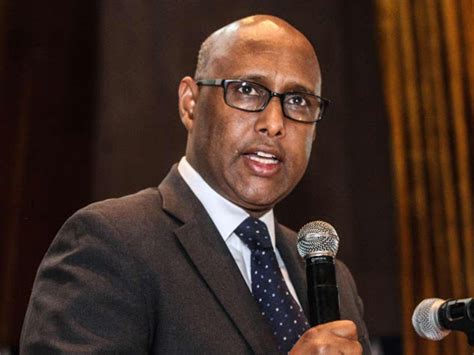
When the Kenya Revenue Authority board sat down this past week to shortlist seven candidates for the most consequential tax appointment in Kenya’s history, one name rose immediately above the rest.
Not because he had applied quietly and let his credentials speak.
But because the whisper networks inside State House had been working overtime for months, laying the groundwork for a political appointment dressed in the costume of competitive recruitment.
Adan Abdulla Mohammed, born in El Wak in Mandera to a Garre Somali family, is by any conventional measure a remarkable Kenyan story.
He emerged from a village where reaching secondary school was itself an act of almost supernatural ambition, worked his way through the University of Nairobi with a first-class BCom degree, trained as a chartered accountant with PricewaterhouseCoopers in London, spent three years as a consultant to Shell in Nigeria, and then built a towering corporate career at Barclays Bank across East and West Africa.
He later added a Harvard Business School MBA to a CV that, by the time President Uhuru Kenyatta plucked him from the private sector in 2013, already read like a dream shortlist.
Nine years as Cabinet Secretary across two ministries and two presidential terms later, a failed bid for the Mandera governorship in 2022, and a post at State House as President William Ruto’s Chief of Strategy Execution, Mohammed is now positioning himself for what may be his final act in public life: running Kenya’s revenue machinery at Times Tower.
The problem is that this appointment, should it happen, would be many things. A merit-based competitive outcome is not among them.
The KRA board has gone to the extraordinary length of commissioning a private legal opinion to justify appointing a man who, by the ordinary rules of Kenyan public service, is already past the mandatory retirement age.
THE AGE QUESTION NOBODY WANTS TO ANSWER HONESTLY
Mohammed turned 62 in December last year. He is, by his own publicly stated biography, two years above the mandatory public service retirement age of 60.
Under normal circumstances, no state corporation board would shortlist such a candidate without attracting immediate legal challenge.
The Kenya Revenue Authority Act and the broader public service framework have been clear on this threshold for decades.
Yet the KRA board, chaired by former Laikipia Governor Ndiritu Muriithi, has reportedly sought and obtained a legal opinion dated May 7, 2026 from Independent Legal Counsel concluding that Mohammed may lawfully be appointed on a fixed-term contract basis.
The advisory reportedly anchors itself to the same statutory provision used to extend former Commissioner-General John Njiraini beyond the retirement age.
The provision exists. The precedent exists.
The question that nobody in the room is asking loudly is why an institution that has consistently failed to meet its revenue collection targets is prepared to bend its own rules for a man whose primary qualification, at this stage of the process, appears to be his proximity to the occupant of State House.
The KRA has set a revenue target of Sh2.78 trillion for the current financial year. As of the third quarter ending March 31, the taxman had collected Sh2.038 trillion.
That is a deficit that will define whoever sits in the corner office on the 30th floor. It requires institutional credibility, operational depth, and the kind of independence from political pressure that is structurally impossible to maintain when the Commissioner-General owes his appointment to a legal workaround engineered at the direction of the same executive he is supposed to audit on behalf of taxpayers.
THE KEBS SHADOW THAT NEVER FULLY LIFTED
Mohammed’s nine-year Cabinet tenure was not without its embarrassments, and the public record deserves closer scrutiny than the celebratory narrative being promoted by his supporters in State House corridors.
When Mohammed was Cabinet Secretary for Industrialisation, he appointed his former Barclays Bank colleague Charles Ongwae to head the Kenya Bureau of Standards in 2014. The appointment would later haunt the ministry.
Ongwae was arrested and charged in connection with the importation of substandard fertilizer, an episode that became one of the uglier regulatory failures of the Jubilee era. Under Mohammed’s watch, KEBS and the Anti-Counterfeit Agency were also embroiled in the contraband sugar scandal that convulsed Kenya in 2018.
Hundreds of thousands of metric tonnes of contaminated brown sugar reached Kenyan consumers and traders, with KEBS unable to demonstrate that it had discharged its regulatory mandate with the rigour that a food safety body demands.
Mohammed’s response at the time was instructive.
When Interior CS Fred Matiangi declared publicly that seized sugar contained mercury and cited Government Chemist tests, Mohammed contradicted him on the record, creating a damaging public split between two Cabinet Secretaries that left Kenyans unable to determine whether the food on their tables was poisoning them.
The subsequent parliamentary joint committee hearings became a spectacle of blame-shifting, with Cabinet Secretaries queueing up to point fingers at the National Treasury, at each other, at port authorities, and at importers.
Mohammed appeared before the joint committee flanked by his Principal Secretary, but the accountability trail led persistently back to the ministry he ran.
The leather industry, which Mohammed had promised to transform into a domestic manufacturing powerhouse anchored on government procurement by the Kenya Defence Forces and the National Police Service, also recorded a conspicuous failure on his watch.
Leather product imports rose from Sh9 billion in 2013 to Sh35 billion by 2016, precisely the opposite trajectory of what the Jubilee administration had pledged and what Mohammed had been appointed to deliver.
These are not ancient history. They are the documented record of a man who is being positioned to run the institution that is supposed to hold the entire Kenyan economy to account.
A man who cannot account for Sh35 billion in imported leather while running the Industrialisation docket is now being positioned to collect Sh2.78 trillion in taxes on behalf of 55 million Kenyans.
COP28, THE ADANI GHOST, AND THE RUSSIAN BILLION
The more recent period of Mohammed’s career raises questions of a different and more troubling character.
As Ruto’s Chief of Strategy Execution, Mohammed has sat at the centre of the presidential economic advisory apparatus during a period when that apparatus has been implicated in some of the most controversial transactions in Kenya’s post-independence history.
Former Public Service Cabinet Secretary Justin Muturi, in a bombshell television interview that aired in April 2025 and that the State House has never formally refuted, named Mohammed directly in his account of how he came to learn about the Adani airport deal.
Muturi said it was Mohammed who invited him to COP28 in Dubai in 2023, and that it was at that gathering that he received detailed information about the planned Adani concession over Jomo Kenyatta International Airport.
Muturi went further, recounting that during the same period, Russian oligarchs had offered to invest one billion US dollars in Kenya, and that Ruto called him personally at Dubai airport and instructed him to sign documents with the Russians immediately, without prior review. Muturi said he refused.
Mohammed has not publicly addressed these allegations. Ruto cancelled the Adani deals in November 2024, hours after the Indian conglomerate’s billionaire founder faced bribery charges in the United States.
The optics of that timeline, the deals that were built, the speed with which they collapsed, and the silence of the advisors who facilitated them, constitute a question that should be put directly to Mohammed before any KRA appointment proceeds.
It is not a peripheral question.
The KRA Commissioner-General oversees the taxation of every significant commercial transaction in Kenya, including the kind of large-scale infrastructure concessions and sovereign investment arrangements that defined the Adani episode.
Placing a man at the centre of that machinery who was himself embedded in the advisory structure that brought those arrangements to life is precisely the kind of appointment that erodes institutional independence in ways that are difficult to reverse.
STATE HOUSE INSIDER TURNED TAX COLLECTOR: THE INDEPENDENCE PROBLEM
There is a structural impossibility at the heart of this appointment that the KRA board has chosen not to address publicly. Mohammed is not simply a former civil servant or a retired corporate executive coming in from the cold.
He is the sitting Chief of Strategy Execution in the presidency of the man who appointed the board that is now interviewing him. He attends State House. He advises on the very economic agenda that his future institution would be expected to enforce without fear or favour.
The Kenya Revenue Authority Act establishes the Commissioner-General as the accounting officer for the authority, responsible for its operations and its funds without reference to political direction.
In practice, the KRA boss is expected to resist executive pressure to grant exemptions, to pursue politically connected tax debtors, and to publish accurate collection data even when it embarrasses the Treasury.
Every one of those functions is compromised when the Commissioner-General is a presidential appointee whose elevation was engineered through a special legal opinion obtained by a board whose chairman serves at the pleasure of the same executive.
The optics are compounded by the precedent. Humphrey Wattanga, whose departure from KRA opened this vacancy, was himself a political appointee whose tenure was marked by persistently missed revenue targets.
Under Wattanga, the taxman consistently fell short of its mandated collections.
The response of the executive is, apparently, to appoint another insider rather than a professional drawn from the institution’s own meritocratic pipeline or from the international tax administration community.
Nancy Nyawanda, who has been serving as acting Commissioner-General since April 8 following Wattanga’s departure, is herself a credentialed professional. She holds a Bachelor of Commerce from the University of Nairobi, an MBA from USIU, a PhD in Public Policy and Administration from Walden University, and a Master of Philosophy in Public Policy, with over twenty years of experience in customs and domestic tax administration.
She knows the institution from the inside. She has managed the crisis of transition. She has done so quietly and without scandal. Her candidacy, and those of other shortlisted professionals including KRA insiders, represents exactly what competitive recruitment is supposed to produce.
Instead, the board is seeking legal cover to install the President’s personal advisor.
When the taxman’s boss owes his job to the same man he is supposed to audit, the independence of the institution becomes a polite fiction maintained for the benefit of donor reports and press releases.
THE ETHNIC FRONTIER AND ITS DOUBLE EDGE
Supporters of Mohammed’s candidacy have pointed to the symbolic importance of a KRA Commissioner-General of Somali descent, noting that the Northern Kenya community has historically been excluded from the apex of revenue and security institutions.
The argument has genuine resonance. Structural underrepresentation in state institutions is a documented injustice in Kenya, and the Somali community’s contribution to the Kenyan economy, particularly in trade and commerce, is wholly disproportionate to its representation in institutions like KRA.
But symbolic inclusion achieved through the circumvention of merit processes and retirement age rules does not serve the community it is meant to honour.
It merely provides political cover for an executive appointment while attaching an ethnic justification that cannot be challenged without appearing to attack the community itself.
This is a well-worn playbook in Kenyan public appointments, and the Somali community deserves better than to have its representation used as the alibi for a deal that was cooked long before the shortlist was announced.
A genuine commitment to inclusive excellence would mean building an institutional pipeline at KRA and across the revenue administration that brings professionals from all communities into senior roles through transparent and consistent processes.
It would not mean bending the retirement age rules for a specific individual who happens to serve the President while simultaneously being of a particular ethnicity.
THE BOTTOM LINE
Adan Mohammed is a man of demonstrable intelligence and a career that, in its early chapters, represented the best of what meritocratic institutions can produce.
But the version of Adan Mohammed who now seeks the KRA top job is not the PwC-trained analyst or even the Barclays executive.
He is the State House insider, the man who was at COP28 when the Adani deal was being structured, the Cabinet Secretary whose decade at the Industrialisation docket saw KEBS collapse into scandal, sugar contamination consume the country, and leather imports triple instead of collapsing.
He is also, by any ordinary reading of Kenyan law, a man who should already have retired from public service two years ago.
The KRA board has obtained a legal opinion. Legal opinions are not law. They are paid arguments. The question that any serious accountability institution, any parliamentary committee, any taxpayer association, any court should now be asking is whether that opinion was sought in order to answer a genuine legal question or in order to provide retrospective justification for an appointment that was decided long before the interviews began.
In a year when KRA must collect Sh2.78 trillion to fund a government that is already borrowing against its future, Kenya deserves a Commissioner-General whose first loyalty is to the institution, to the taxpayer, and to the law. Not to the occupant of State House who engineered his installation.
The interviews are scheduled. The outcome, if the whisper networks inside Harambee House are to be believed, is already known. The only question is how loudly the public will object before it is announced as a competitive outcome.
Kenya Insights allows guest blogging, if you want to be published on Kenya’s most authoritative and accurate blog, have an expose, news TIPS, story angles, human interest stories, drop us an email on [email protected] or via Telegram


Why Ruto’s Favourite Candidate Adan Mohammed Could Be Locked Out of the KRA Top Job

DCI Arrests Woman in Sh55.7 Million Gold Fraud Targeting American Citizen in Nairobi

Court Confirms Safaricom Customers Data Was Sold To Betting Companies In Seven-Year Cover-Up

Paybill 585555: How Airtel Kenya’s Interoperability Gateway Became A Criminal Pipeline Draining Millions From Unsuspecting M-Pesa Users

The Man Who Starved Kenya’s Voice

The Rot Inside Absa: How Bank Insiders Are Looting Nairobi’s Customers

The President’s Helicopter: How Ruto’s Aviation Empire Lands a Historic Airbus Milestone While His Government Writes the Tax Code

“TikTok Who? YouTube Sorry. A Kenyan-Built Platform Just Dropped—and 20 African Ministers Showed Up To Launch It.”

Denial Under Duress: The Untold Collapse Threatening David Lagat’s DL Group’s Empire

Stung By West Africa Rejections, France Courts Rest Of Continent at Kenya Summit

How Did a Sh468K KRA Salary Allegedly Turn Into Sh30 Billion? Questions Deepen Over Commissioner George Obel and Ciala Resort Owner’s Wealth

Nairobi Freezes Binance Accounts in Sweeping Anti-Fraud Crackdown as Global Scandal Record Haunts World’s Largest Crypto Exchange

THE UNTOUCHABLE CLERK: How Fatuma Mwalupa Allegedly Turned Kwale Assembly Into a Personal Treasury and Outsmarted Scrutiny

The Man Behind the Badge: How Prof. Erastus Kanga Turned Kenya’s Premier Wildlife Agency into a Theatre of Corruption, Fear and Impunity

THE BRAZEN RETURN: Triton Thief Yagnesh Devani, Who Pillaged Kenya of Sh7.6 Billion and Fled, Now Asks the Same Courts He Escaped to Restore His Stolen Wealth

Green Gold, Rotten Roots: How Kenya’s Biggest Avocado Firms Hijacked a Sh5.8 Billion Harvest Ban

Why the April 21 Flopped Protests Expose Kenya’s Rudderless Opposition

KETRACO CEO Advert Marred By Controversies As Fears Grow That Kipkemoi Kibias Is A Predetermined Candidate

THE PHANTOM COVER: Unlicensed Broker Vanishes With Sh42M, Hussein Mohammed Fingered In The Alleged CHAN 2024 Insurance Scandal

64-Year-Old KIM Faces Shutdown As Regulator Declares Its Certificates Worthless, Orders Employers To Shun Graduates
-

 Business1 week ago
Safaricom’s Sh1.4 Billion Reckoning: How Kenya’s Most Profitable Company Stole a Man’s Idea and Got Caught
-

 Africa2 weeks ago
The $24 Million Heist at the End of the World
-
 Business1 week ago
THE INSURER THAT TOOK YOUR PREMIUM AND FORGOT YOUR NAME: How ICEA Lion Left a Client Begging for Sh7.8 Million Across Four Months
-
 Investigations1 week ago
Denial Under Duress: The Untold Collapse Threatening David Lagat’s DL Group’s Empire
-
 Business4 days ago
The Rot Inside Absa: How Bank Insiders Are Looting Nairobi’s Customers
-

 Business1 week ago
Bush Air Safaris Founder John Ndiritu Risks Losing Property Over Disputed Loan Claim
-

 Arts & Culture2 weeks ago
KDC Accelerates the Creative Economy, Innovation and Youth-Led Enterprise Growth at Africa Forward Summit
-
 Africa1 week ago
Stung By West Africa Rejections, France Courts Rest Of Continent at Kenya Summit