
Investigations
Revealed: How Kibaki and His Men Stole Raila’s Victory in the 2007 Election
A new NTV documentary and a cascade of damning admissions from insiders have peeled back the final layer of secrecy from the most catastrophic election fraud in Kenya’s history. The men who planned it, executed it, and watched it from State House have now spoken. What they describe is not a disputed election. It is a coup.

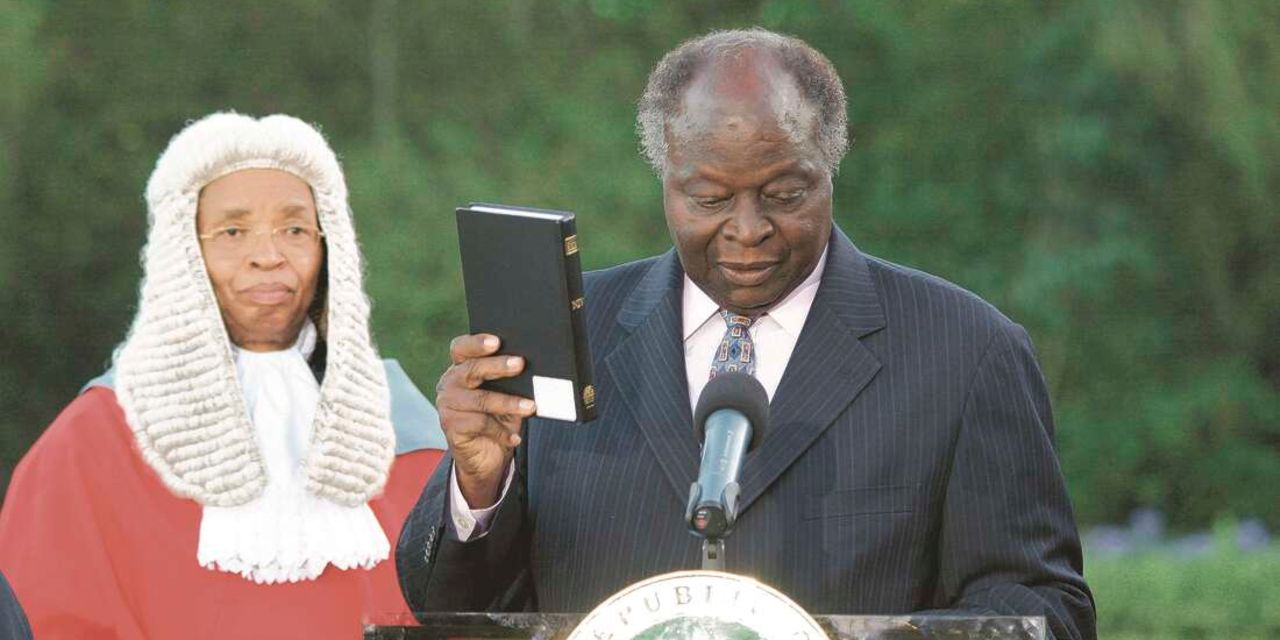
The afternoon of Sunday, December 30, 2007, was supposed to be the moment Kenya demonstrated to the world that it could manage a peaceful democratic transition.
Instead, it became the hour in which a group of powerful men gathered in a State House boardroom and decided that the will of the people was an obstacle to be managed rather than a verdict to be honoured.
What follows is drawn from NTV’s landmark investigative documentary Stolen Ballot, which aired this week to convulse a country still carrying the wounds of the violence that erupted hours after that stolen declaration, as well as from contemporaneous reporting, the public admission of Royal Media Services chairman Samuel Kamau Macharia in March 2025, international election observer records, and the findings of the Kriegler Commission.
Together, they construct an account so detailed, so corroborated, and so chilling in its institutional precision that it can no longer be described as allegation. It is history.
The Room Where It Was Decided
Inside a State House boardroom, five men knew everything. President Mwai Kibaki sat among them. Flanking him were his government spokesman Alfred Mutua, the Deputy Chief of the General Staff General Julius Karangi, Head of the Public Service Francis Muthaura, and Internal Security minister John Michuki, one of the most feared political operators in the country.
Each man had a role. Each man understood the stakes. And each man understood that what was being planned carried the seed of the violence that would follow.
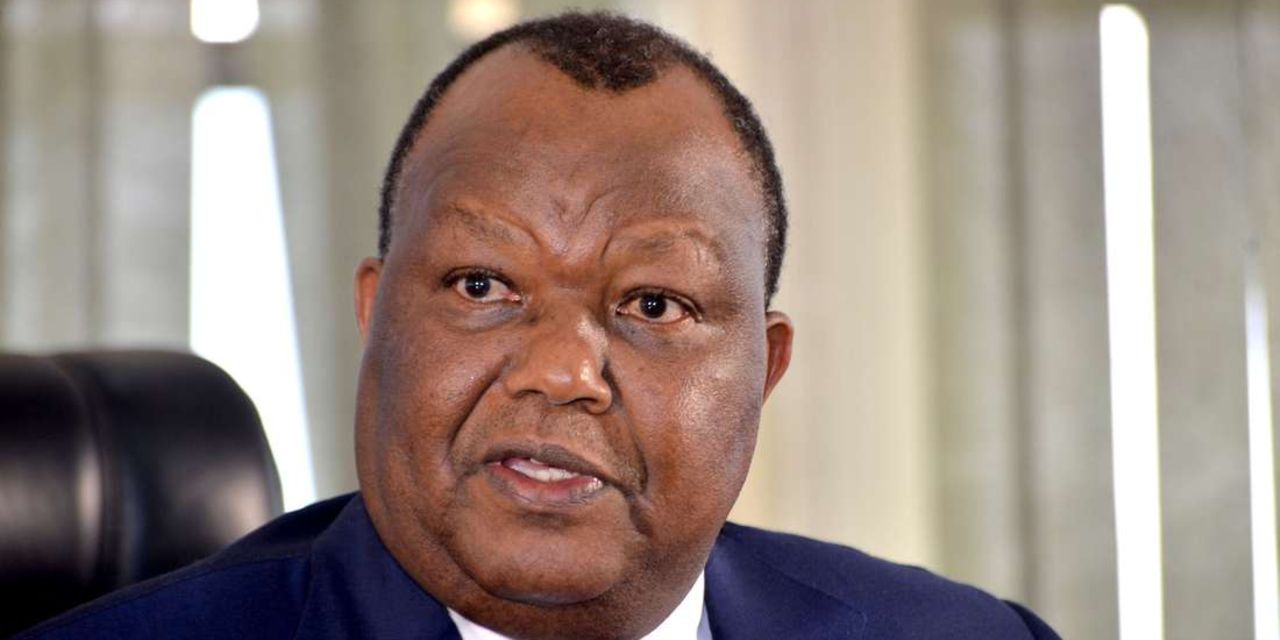
Former Chief of the Defence Forces Gen (Rtd) Julius Karangi.
The operation was structured, according to those who later spoke on record, with the deliberate architecture of a military mission. Information was shared on a strict need-to-know basis. Different operatives were assigned isolated tasks. No one outside the five was permitted to see the full picture.
It was General Karangi, Kenya’s most celebrated tactical commander, the man who would later mastermind the bloodless recapture of the Somali port city of Kismayu from Al-Shabaab without losing a single soldier, who gave the operation its discipline.
His presence in that room was not incidental. He was there because what was being planned required the kind of precise, compartmentalised execution he had perfected on the battlefield.
“I was told: we do not know how the day will end, but we know Kibaki must remain president.” — Nimrod Mbai, Kitui East MP, then police sergeant
Mutua has since confirmed the composition of that room himself, speaking on national television in the days after Kibaki’s death in 2022.
He described the President’s anxiety, the calls being monitored, and the mood of controlled urgency that gripped State House as the hours wore on. He did not use the word fraud. But what he described was something far more deliberate than a disputed result.
The Tallying Centre in Chaos
To understand what happened in State House, one must first understand what was happening at the Kenyatta International Convention Centre, where the Electoral Commission of Kenya was conducting the national tally. By the morning of December 30, the count had taken on a deeply suspicious character.
Former ECK commissioner Jack Tumwa told NTV that commissioners had expected results to begin arriving by 10pm on election night, December 27. They did not. The following morning, results were still trickling in at a pace that mystified officials who had run elections before.
More troublingly, some returning officers from constituencies in Nairobi itself could not be reached by telephone. Nairobi is not a remote constituency. There was no logistical excuse for the silence.
Early results showed Raila Odinga of the Orange Democratic Movement holding a commanding lead. Media houses running parallel tallies were reporting it.
The Nation Media Group had prepared a front page carrying the words “President-Elect” with Odinga’s photograph. It was never published.
Then, without explanation, the character of the count changed. Results from constituencies in the Mount Kenya region, which had been conspicuously absent, arrived in a cluster.
The numbers were startling.
ECK chairman Samuel Kivuitu himself had been overheard remarking that if the returning officers from Kiambaa had been cooking the results, they were now overcooking them, and that even if they had decided to walk to the tallying centre on foot they would already have arrived.
Commissioner Muturi Kigano later tried to characterise the remark as a tasteless joke. Commissioner Tumwa characterised it differently. “Really, there was something wrong,” he said. “We were very suspicious.”
Four commissioners issued a formal statement expressing reservations about the process. They asked for transparency. They were ignored.
Outside the hall, the government was furious with the media. Minister John Michuki convened an emergency meeting with media executives at Harambee House and accused broadcasters of inflaming tensions by reporting Odinga’s early lead from their own parallel tallies.
KBC editor-in-chief Waithaka Waihenya was present. He described Michuki as agitated.
The one person he recalled as calm was Muthaura, who spoke quietly. The contrast between the two men was telling. Muthaura, as events would show, already knew exactly how the situation was going to resolve.
The Phone Call to Cut the Power
By Sunday afternoon, the pace of events inside KICC had become unmanageable. The opposition was on the stage. William Ruto, then the Eldoret North MP, was pressing Kivuitu at close quarters, demanding verification of constituency tallies that did not match the forms signed by ODM agents.
Martha Karua and the late Mutula Kilonzo were pressing from the Kibaki side. GSU officers had been deployed to the floor. Someone passed word that one of the politicians present was armed with a grenade.
The government was watching and growing increasingly alarmed. The fear, Mutua later explained, was specific and legal. If Kibaki was declared the winner by the commission, Raila’s team would immediately seek a court injunction to block the swearing-in. The declaration had to happen, and it had to happen fast, and it had to happen under conditions where no judge could intervene in time.
Mutua picked up the phone and called Philip Kisia, the managing director of KICC. The instruction was direct: cut the power to the tallying hall. Kisia declined.
A second call came. This time, Mutua placed a cabinet minister on the line. Kisia later confirmed that the minister read out the names of officials sitting with the President at State House.
The message was unmistakable: this was a direct order from the highest level of government.
Kisia walked to the power room with a technician named Ombati. The rest of the staff had gone home. He threw the switch himself.
“I told him, because I know how cameras work, to turn off the lights at KICC.” — Alfred Mutua, then Government Spokesman
The vast hall of the KICC plunged into darkness. Opposition politicians who had been monitoring the tally table were suddenly disoriented. In the confusion, the next phase of the plan moved.
The Secret Recording
Before the blackout, Kivuitu had been under sustained pressure from multiple directions. He had been refusing to take Mutua’s calls. Kisia eventually persuaded him to speak with the government spokesman, and the two men spoke in Kamba for approximately ten minutes. No one present understood what was said. When the call ended, Kivuitu asked Kisia for a desk.
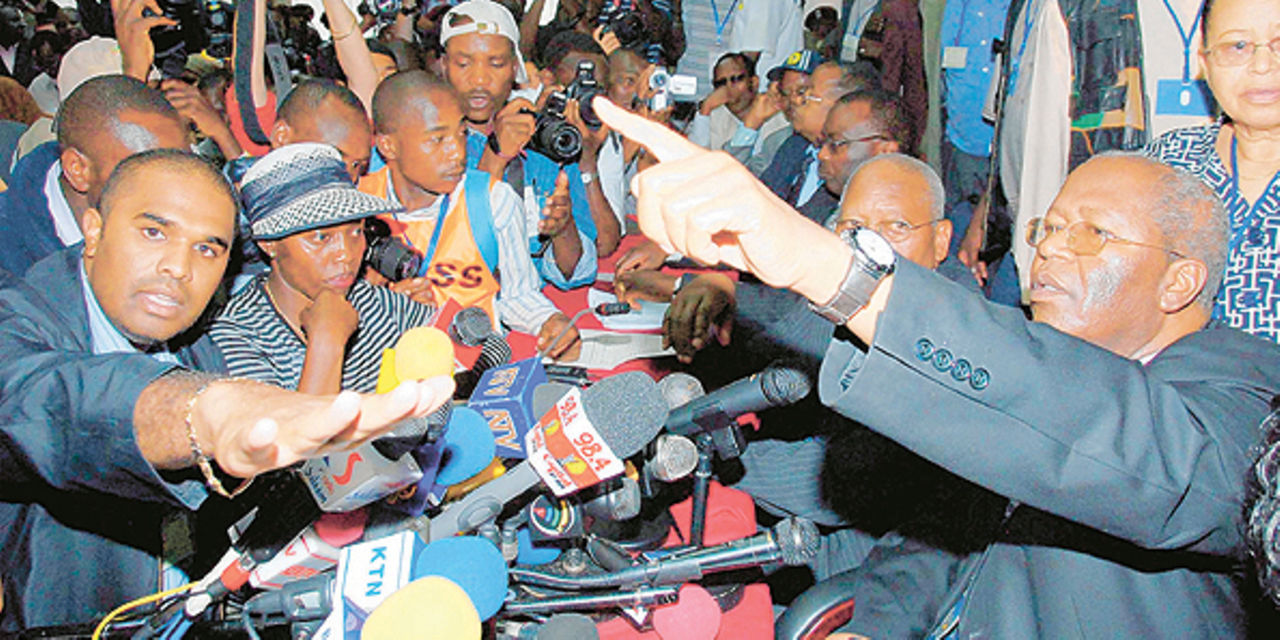
Former Election Commission Chairman Samuel Kivuitu (right) addressing a press conference at KICC just before the announcement of the results of the disputed 2007 General Elections.
He was then walked to a separate room within KICC where a KBC camera crew was waiting. The recording was done there, away from the chaotic hall, away from the rival politicians, in a controlled environment that the government had arranged. Kisia took a deliberate decision that only the national broadcaster would record the moment.
Waihenya, receiving orders simultaneously from Mutua, Muthaura, Michuki, and a senior military officer, had already dispatched an Outside Broadcast van to State House before the declaration had even been made. He had not been told the result. He did not need to be.
Kivuitu’s voice on that tape declared Mwai Kibaki the winner of the 2007 presidential election. The tape was then placed inside a sock worn by a member of the KBC team, as Waihenya had instructed, and taken out of the building.
The opposition realised something was happening. They tried to break down the door of the room where the recording had been made. They were too late.
The Extraction
Police Sergeant Nimrod Mbai had been placed on standby since that afternoon. He had been called in from his day off by Mutua, who had brought him to the third floor of KICC and briefed him on a mission involving Kivuitu. His task was to ensure the ECK chairman could be evacuated safely if violence broke out inside the tallying centre.
Mbai was not selected at random. He was one of a small number of officers with a special access card that allowed movement through every section of the building.
He had been taken to a CID shooting range earlier that afternoon where his weapon, a Ceska pistol, was test-fired. Officers then offered him a second firearm in case the first jammed.
He declined the second gun. He had been told, in terms he found unmistakable, that what was about to happen was expected to be dangerous.
The two men, Mbai and Kivuitu, had met earlier and agreed on a coded password. When it was spoken, Kivuitu would know it was time to move.
The moment the lights went out, Mbai stepped forward, tapped Kivuitu on the shoulder, and said the word. He took a green file from the table, which he was told contained the electoral results.
The two men left through a side exit and descended to the basement parking. Kivuitu was elderly and asked to be taken slowly.
The walk that Mbai, an athlete, could have completed in one minute took four. His own description of what was running through his mind in those four minutes belongs to the historical record of what Kenya did to itself that evening: “This was war in my mind.”
Outside KICC, a vehicle was waiting. Alfred Mutua was driving. The car was immediately flanked by a security convoy. It moved through Nairobi toward State House at speed. At the gate, officers were already waiting.
Five Minutes to Air
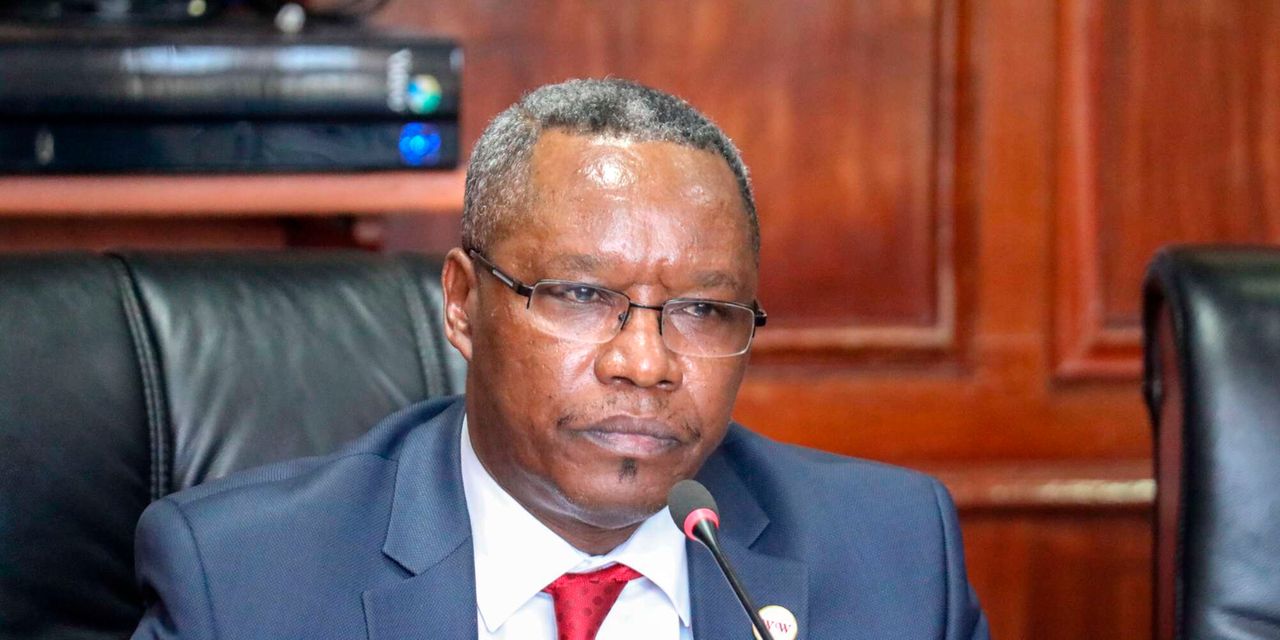
Former Kenya Broadcasting Corporation Editor-in-Chief Waithaka Waihenya.
Back at KBC’s studios, Waihenya was surrounded by GSU officers. He could not move to the toilet without an armed escort. One of the calls he received that evening threatened him directly. He was told the situation was bigger than him and that he had better announce the results.
He refused to be pressured, but he had the tape, and he had his orders, and within five minutes of returning to the studio, Kivuitu’s pre-recorded declaration was broadcast on the national broadcaster.
Waihenya later revealed that as the broadcast went live, he could hear the President’s voice on a speakerphone that had not been switched off. Kibaki said, in Swahili, that he wanted to see it on television. He saw it.
Minutes later, at State House, Mutua walked into the room and told the President what had happened. “Kibaki hugged me,” Mutua said. “It was the first time he hugged me.” Muthaura and Michuki embraced. The relief was physical. Outside the compound, Kenya was beginning to burn.
The Macharia Confession
The NTV documentary did not emerge in a vacuum. Its most devastating corroboration came not from the documentary itself but from a speech delivered a year before it aired, at a funeral in Machakos on March 15, 2025.
Royal Media Services chairman Samuel Kamau Macharia stood up to honour a dead friend, retired Colonel James Gitahi, and fulfilled a pact they had made: whichever of them died first, the other would tell the truth about 2007.
Macharia told the mourners that his network’s parallel tallying system had given him complete data showing Odinga had won the election. His data showed a margin of 1.8 million votes in Odinga’s favour. He was then, he said, taken from his home at night. All the returning officers from the Mount Kenya region were rounded up.
Their official Forms 16A were taken. Macharia was transported to his own office, where he found men whose names he chose not to give. Together, they changed the figures. Kibaki won.
The Macharia statement was reported widely and dismissed by some as the grieving embellishments of an elderly political partisan. In light of the NTV documentary and the accounts of Mbai, Kisia, Waihenya, and the ECK commissioners, it is considerably harder to make that dismissal.
“Our data was showing Raila had won with 1.8 million votes. I was picked from my house at night… we changed all those figures, and Kibaki won.” — S.K. Macharia, RMS Chairman, March 2025
What the International Record Shows
Kenya did not conduct this operation unobserved. The European Union’s chief election observer, Alexander Graf Lambsdorff, declared the elections flawed, finding that the ECK had failed to establish the credibility of the tallying process to the satisfaction of all parties.
The EU noted specific constituencies where results read out in the presence of their observers did not match the tallies later announced by the commission. In the Molo constituency, the discrepancy was flagged explicitly.
The Carter Center raised similar concerns. A diplomatic cable from the United States Embassy in Nairobi, declassified and published in 2012, showed that Ambassador Michael Ranneberger assessed the situation in five different scenarios and concluded that in all of them the margin of victory for either side was slim and ultimately unknowable.
His cable did note evidence of rigging on both sides, a qualification that has been cited by Kibaki’s defenders but which does not in any way address the specific sequence of institutional fraud described by the insiders who have now spoken.
ECK chairman Kivuitu himself, speaking on January 2, 2008, told journalists outside his Nairobi home that he did not know whether Kibaki had won the election. He said he had been pressured by the PNU to announce the results. He said he had contemplated resignation.
He did not resign. He went to a room in KICC, he spoke in Kamba for ten minutes with Mutua, he asked for a desk, and he read a result into a KBC camera.
The Kriegler Commission, established under the terms of the Kofi Annan-brokered peace deal, found that electoral fraud had been rampant and had begun at the polling station level.
Its central and devastating conclusion was that the errors and manipulations in the tallying process were so great and so widespread that it was impossible to reconstruct from the formal record who had actually won.
That conclusion has often been cited as grounds for ambiguity. It is more accurately read as a legal description of evidence destruction.
The Legal Vacuum and the Price Paid
The declaration triggered violence within minutes. Across Nairobi and in the Rift Valley, the Nyanza region, and Mombasa, communities that had voted for Odinga in overwhelming numbers took to the streets. Police opened fire with live ammunition.
In Eldoret, a church sheltering Kikuyu families was set alight. More than 1,000 Kenyans died. Six hundred thousand were displaced. The country did not recover its institutional confidence for years and arguably has not recovered it fully even now.
Kofi Annan brokered a power-sharing deal that installed Odinga as Prime Minister under a Grand Coalition Government. Kenya got a new constitution in 2010. The ECK was dissolved. But no one was charged with the theft of the election.
No one was prosecuted for the midnight roundup of returning officers in the Mount Kenya region.
No one answered in court for the switching of the KICC power supply, the pre-arranged recording, the pre-positioned OB van at State House, the password-activated extraction of Kivuitu through a darkened building by an armed officer who had been told this was war.
Commissioner Tumwa has since said plainly that he believes Odinga was denied the presidency by manipulation. He said, with the weight of having been in that hall, that he thinks Raila Odinga would have won.
A Reckoning Eighteen Years Late
What is remarkable about the week in which the NTV documentary Stolen Ballot has aired is not that new facts have emerged. Most of these facts have been in circulation in fragments for years. What is remarkable is that the men who were present have now spoken with a directness that the passage of time and the deaths of Kibaki and Kivuitu have made possible. Mutua confirmed the core of the operation on national television years ago.
Mbai, now a member of parliament, has given chapter-and-verse testimony. Kisia has confirmed he threw the switch. Waihenya has described the sock, the GSU escort, the speakerphone on which he heard the President’s voice. Macharia has described the night abduction and the altered forms.
Against this record, Commissioner Kigano’s insistence that the Electoral Commission simply announced whatever the returning officers delivered is not a defence. It is a description of the mechanism by which the fraud was laundered through an institution designed to provide it with legal cover.
What the country is owed is not merely acknowledgement but a formal reckoning: a truth process with legal authority, the ability to compel testimony, and the mandate to establish an official record. Kenya paid for the absence of such a process in blood.
It continues to pay for it in the corrosive distrust that attaches to every election result, every commission, every announcement from a podium about the people’s choice.
The lights at KICC went out at Mutua’s instruction. They have not fully come back on since.
Kenya Insights allows guest blogging, if you want to be published on Kenya’s most authoritative and accurate blog, have an expose, news TIPS, story angles, human interest stories, drop us an email on [email protected] or via Telegram


Maraga’s 2027 Bid Hit by Explosive Sexual Harassment Claims as Former Insider Alleges Cover-Up and Victim Intimidation

Tanzanian President Visits Russia

Why PayPal Is Freezing Kenyan Accounts in Massive Crackdown

Inside Bharat Thakrar’s Plot for a Hostile Scangroup Takeover

The Man Who Keeps Coming Back: How a Corrupt History and a Missing Masters Degree Could Finally Lock Wamukota Out of the KETRACO Corner Office

Yet Another Blow for Bia Tosha as Court Rejects Bid to Halt Diageo–Asahi Transaction

US to Slash Number of African Embassies Processing Visas from 50 to 20, Kenya Remains a Key Hub

Trump Picks Veteran Crisis Diplomat Henry Wooster as New U.S. Ambassador to Kenya

Former Catholic Priest Arrested Over Alleged Treasonous Social Media Posts

Hundreds Protest Against Planned US Ebola Quarantine Facility in Kenya

Why Ruto’s Favourite Candidate Adan Mohammed Could Be Locked Out of the KRA Top Job

Este Medical Kenya Fights American’s Explosive Complaints

Safaricom’s Sh1.4 Billion Reckoning: How Kenya’s Most Profitable Company Stole a Man’s Idea and Got Caught

LifeCare on the Brink: SHA Fraud, Stolen Wages, and the Rotten Empire Jayesh Saini Built

The Rot Inside Absa: How Bank Insiders Are Looting Nairobi’s Customers

The $24 Million Heist at the End of the World

Denial Under Duress: The Untold Collapse Threatening David Lagat’s DL Group’s Empire

THE INSURER THAT TOOK YOUR PREMIUM AND FORGOT YOUR NAME: How ICEA Lion Left a Client Begging for Sh7.8 Million Across Four Months

Court Confirms Safaricom Customers Data Was Sold To Betting Companies In Seven-Year Cover-Up

Inside FAFSA Fraud: How Kenyan Cybercriminals Siphoned Millions from America’s Sh12 Billion Student Loan System
-
 News1 week ago
Este Medical Kenya Fights American’s Explosive Complaints
-
 Investigations1 week ago
LifeCare on the Brink: SHA Fraud, Stolen Wages, and the Rotten Empire Jayesh Saini Built
-
 Americas1 week ago
Inside FAFSA Fraud: How Kenyan Cybercriminals Siphoned Millions from America’s Sh12 Billion Student Loan System
-
 News5 days ago
Eight Students Arrested In Kenya After Suspected Deadly School Arson Attack
-
 Business1 day ago
THE GREAT HOLLOWING: How James Mworia Extracted KES 750 Million While 33,000 Centum Shareholders Lost Everything
-
 Investigations1 week ago
LSK On The Spot For Renewing Rogue Lawyer Dennis Onyango’s Licence Despite Mounting Evidence He Held Foreign Investors’ Millions Hostage
-

 Investigations2 days ago
Betika Faces DCI Probe, Directors Arrest and License Revocation Over Massive 29.5 Million Safaricom Customers’ Data Breach
-
 News3 days ago
How Uhuru’s Deal With Obama In 2015 Paved Way For America’s Ebola Plan In Kenya