
News
Named: Havi Says Mutava Confessed He Was Collecting The Bribe For Lady Justice Josephine Mongare, So Why Is JSC Still Silence?
A former judge confesses. A sitting High Court judge is named. A bribery scheme worth Sh10.4 million is dismantled on the same day the presiding judge delivers her verdict. The Judicial Service Commission, which has now been told directly by Nelson Havi who the money was meant for, has issued no statement. Former Cabinet Secretary Raphael Tuju vows to die before vacating his Karen property. And the institution that is supposed to hold the bench accountable has, once again, chosen silence.

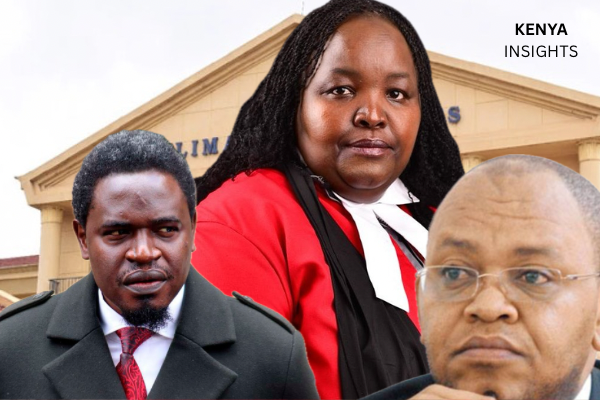
The story of the Tuju property dispute has taken many dramatic turns over the decade it has consumed the Kenyan legal system. It has wound through courts in London and Nairobi.
It has produced a UK judgment, a Kenyan enforcement order, Court of Appeal affirmations and a Supreme Court refusal to suspend execution. It has generated receivership proceedings, auctioneer deployments and police-escorted property visits.
But nothing in the preceding ten years of litigation matches what Nelson Havi, Senior Counsel and former president of the Law Society of Kenya, placed on public record this week when he posted a single, detonating claim on his verified social media account.
Havi stated, without qualification and without apparent concern for the personal jeopardy in which such a statement might place him, that former High Court judge Joseph Mutava had confessed to investigators that he was collecting the Sh10.4 million bribe on behalf of Lady Justice Josephine Wayua Wambua Mongare, the presiding judge of the very commercial dispute in which the money was allegedly being solicited.
“Joseph Mutava (he used to be a Judge) confessed that he was collecting the bribe on behalf of Lady Justice Josephine Mongare,” Havi wrote. Then he turned to the institution built to police the bench: “Why has the JSC not taken action or issued a statement on the matter?”
The question landed on a Commission that, as of the time of publication, had produced no response. Not a statement of receipt. Not a notice of investigation. Not even a procedural assurance that it was aware of the allegation.
The Judicial Service Commission, the constitutionally mandated guardian of judicial integrity, has been publicly informed by a senior advocate of 30 years’ standing that a sitting High Court judge was the intended recipient of a bribe in an active commercial matter. Its response, so far, is silence.
The Confession That Changes Everything
To understand why Havi’s post is not merely incendiary commentary but a statement of profound legal consequence, it is necessary to recall the sequence of events on Monday, March 9, 2026. On that day, Ethics and Anti-Corruption Commission detectives arrested Mutava, advocate Kimani Wachira and two other suspects at Tuju’s Karen property, where Tuju alleged they had arrived claiming to act on behalf of a judge and seeking money to influence the outcome of his case.
The EACC confirmed the arrests, describing the alleged demand as USD 80,000, approximately Sh10.4 million, to influence a commercial dispute before the High Court.
Also on that same day, Justice Josephine Mongare delivered her ruling in the matter of Dari Limited and Raphael Tuju versus the East African Development Bank and Garam Investment Auctioneers.
She struck out the amended plaint filed by Tuju and Dari Limited, describing it as what she called a blatant abuse of court process meant to frustrate lawful recovery efforts after years of default and litigation. The way was cleared for auctioneers to proceed against Tuju’s Entim Sidai Wellness Sanctuary and properties linked to Dari Business Park.
The ruling and the arrests occurred on the same calendar date.
If Havi’s account of Mutava’s confession is accurate, and Havi has made this claim as a named Senior Counsel on a verified public platform, then the money was being solicited by a man now claiming to carry the instruction of the judge who, within hours, was disposing of the case.
The logical consequences of that sequence, if the confession is corroborated, are of a gravity that the EACC, the JSC and the Director of Public Prosecutions will need to confront in the most direct terms.
A Prior History the JSC Has Already Seen
For those tracking Havi’s relationship with both Mongare and Justice Alfred Mabeya, the second half of his post carries equal weight.
Having demanded accountability from the JSC over the Mutava confession, he added a statement that reads as a prosecutorial indictment of the commission itself: “The last time a complaint against her and Mr Justice Alfred Mabeya was made to the JSC, the two bribed their way out.”
That is not a vague allegation. The JSC complaint against Lady Justice Mongare is a matter of documented public record. In July 2025, Havi filed a formal petition to the Judicial Service Commission, sworn on affidavit, seeking the removal of Justice Mongare from the bench over her conduct in case HCCCOMM/E610/2024, a dispute between Gikomba Business Centre Limited and Pumwani Riyadha Mosque Committee.
Havi described her handling of the matter as gross misconduct, misbehaviour and incompetence, and declared that the injury to his clients could only be remedied by her removal. The JSC received the petition. Nothing of consequence followed.
The complaint against Justice Mabeya runs deeper and further back. In December 2024, Havi publicly named two senior advocates who he alleged had never lost a case before Mabeya at the Milimani Commercial and Tax Division, suggesting an industry of judicial corruption linking the judge to specific practitioners.
In January 2025, the JSC received a formal petition from Havi alleging gross misconduct and misbehaviour against Mabeya. That petition joined a separate complaint filed in December 2024 by Edwin Harold Dande raising similar concerns. In August 2025, the JSC dismissed Havi’s petition against Mabeya, ruling that the application amounted to an invitation to the commission to sit on appeal over a matter already determined, which fell outside its jurisdiction.
What Havi is now alleging, in terms that his standing as a senior advocate makes impossible to simply dismiss, is that the dismissal of his petition against Mabeya was not a jurisdictional finding.
It was the product of bribery. That the commission, which is constitutionally charged with safeguarding judicial integrity, was itself corrupted in the process of evaluating a complaint about a corrupt judge. And that the same fate now awaits any complaint about Mongare, unless the arrest of Mutava and his alleged confession have altered the calculus in ways that even the JSC cannot navigate around.
Mongare’s Rulings: A Trail Through the Tuju Matter
Lady Justice Josephine Wayua Wambua Mongare was appointed to the High Court in 2022, assigned to the Commercial and Tax Division at Milimani. She holds a Master of Laws degree from Loyola Law School in Los Angeles, a Bachelor of Laws from the University of Nairobi and a postgraduate diploma from the Kenya School of Law. Before the bench she had served as a senior partner and as a governance consultant for the United Nations Office on Drugs and Crime, the Red Cross and UNICEF. The record of her appointment is one of considerable professional distinction.
Her engagement with the Tuju property dispute has been the most consequential of her tenure.
The dispute originates in a loan facility agreement signed in April 2015 between Dari Limited, Tuju’s company, and the East African Development Bank. After default, the High Court of Justice in England ordered repayment of over USD 15 million in June 2019. That judgment was recognised by Kenyan courts in 2020, upheld by the Court of Appeal in 2023, and left intact when the Supreme Court declined to suspend enforcement. The path to auction of Tuju’s Karen properties, the Dari Business Park on Ngong Road and the Entim Sidai Wellness Sanctuary, had been confirmed at every level of the judicial hierarchy before the matter returned to Mongare’s bench.
In May 2025, Mongare had issued interim orders halting the auction.
She extended protections and maintained the status quo, a posture that Tuju’s lawyers welcomed as evidence that their client’s applications were being taken seriously.
But the orders proved fragile. Tuju’s court filings alleged that a transfer of title to one of the properties was processed in November 2024 and completed in February 2025 while her orders were still in force. He reported the violation to police. He wrote to the Chief Land Registrar.
He alleged that a DCI officer accompanied buyers from Ultra Eureka Limited to the property in January 2025.
None of these interventions produced relief before Justice Mongare.
Her ruling of March 9, 2026 was categorical. She found that the issues raised by Tuju and Dari Limited had already been adjudicated and were res judicata. The amended plaint was struck out. The bank’s recovery process was cleared to proceed.
That ruling arrived on the day detectives were arresting men who, if Havi’s account of the confession is accurate, had been dispatched to collect money on her behalf.
Tuju at the Gate
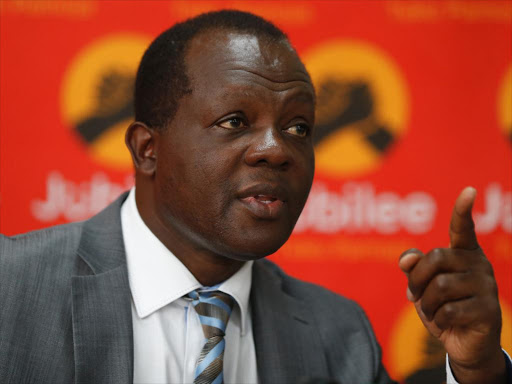
Raphael Tuju.
Raphael Tuju’s response to the unfolding situation has been the response of a man who believes the courts have become the machinery of his destruction. Standing at the disputed Dari Business Park this week, he told journalists that individuals identifying themselves as Mr Chebet, Mr Kiprono and Mr Kiprop had arrived claiming to have purchased the property. He accused them of intimidation. He said the ownership dispute remained live in court. And then he delivered the statement that has circulated across Kenya’s legal and political classes with the velocity of something that cannot be unsaid.
“They will have to kill me first and organise a big burial for me in Rarieda before they take this property,” Tuju said. It is the declaration of a man for whom the language of law has been exhausted and replaced by the language of physical survival.
That a former Cabinet secretary, a former member of Parliament, a man who has contested his dispossession through every tier of the Kenyan and international judicial system, has arrived at this formulation, is a statement about the state of the courts that no bar association communique or JSC press release can adequately absorb.
Tuju’s identification of the arrested suspects as individuals claiming to act on behalf of a judge was the thread that the EACC pulled.
The arrests that followed gave investigators Mutava, Wachira and two others. Mutava was released on Sh200,000 police cash bail alongside his co-suspects.
The EACC confirmed it would forward the completed investigation to the Director of Public Prosecutions for review and potential charging. The DPP has not yet indicated whether the confession reported by Havi forms part of the material before it.
The Anatomy of a Captured Commission
Havi’s second accusation, that the JSC allowed both Mongare and Mabeya to bribe their way out of previous complaints, is the more structurally devastating of his two claims.
The EACC arrest of Mutava is a criminal matter. It will produce a prosecution or it will not. But the allegation that the institution responsible for judicial discipline is itself corruptible, that complaints about judges are resolved not through due process but through the financial persuasion of commission members, is an allegation about the entire architecture of judicial accountability in Kenya.
The Mabeya record gives the allegation specific texture.
A 2015 JSC complaint against Mabeya was withdrawn by the complainant after the judge’s accusers were unable to produce evidence. Mabeya denied all wrongdoing.
In 2020, a second petition seeking Mabeya’s removal was filed and subsequently withdrawn, with reporting at the time suggesting the petitioner had been financially induced to abandon the complaint. In December 2024, Havi named specific advocates alleged to have an unbroken winning record before Mabeya, raising structural questions about the relationship between the judge and those practitioners. In January 2025, the JSC received Havi’s formal petition. In August 2025, the commission dismissed it, citing jurisdictional grounds.
Havi’s characterisation of that sequence as bribery, and his linking of the Mongare complaint to the same pattern, means that he is not merely alleging that individual judges are corrupt.
He is alleging that the mechanism for holding corrupt judges accountable is under the control of those same judges. That the JSC is not a check on judicial corruption but a clearing house for it.
This is an allegation of constitutional dimension. It is also an allegation that, if true, explains everything about the Tuju case that has so far defied explanation: why protections granted were not enforced, why property transfers proceeded through ostensibly subsisting orders, why no action was taken against those who allegedly violated court directions, and why a man who has litigated his case at every available level still finds himself facing auctioneers at his gate.
The Question That Demands an Answer
At the time of publication, the Judicial Service Commission has not issued any statement about Nelson Havi’s public allegation that Joseph Mutava confessed to collecting a bribe on behalf of Lady Justice Josephine Mongare.
Justice Mongare has not commented. The JSC Chairperson has not commented. The Office of the Director of Public Prosecutions has not indicated whether the confession is part of its review file. The Chief Justice, whose office carries constitutional responsibility for the supervision of the judiciary, has been silent.
Lady Justice Josephine Mongare is a sitting judicial officer. She has not been charged with any offence. She has not been suspended.
She has not been called before any tribunal. She is, as far as the formal record shows, an active member of the Commercial and Tax Division bench at Milimani, available to preside over commercial disputes involving Kenyan citizens and foreign institutions alike.
What the formal record also shows is this: a disgraced former judge has been arrested and is alleged by Kenya’s most prominent accountability lawyer to have confessed that the money he was collecting was for her.
A JSC complaint about her conduct was filed months ago and produced no outcome.
A parallel complaint about her alleged colleague in corruption was dismissed in circumstances that Havi describes as the product of bribery.
And the ruling that cleared the way for a former Cabinet secretary to be evicted from his property was delivered on the same day as the arrests, by the same judge whose name now sits at the centre of Kenya’s most explosive judicial scandal in a generation.
Nelson Havi has asked why the JSC has taken no action. It is the right question, and it deserves an answer in public, under oath, and without further delay.
UPDATE:
Tuju has been allowed to appeal a High Court ruling that cleared the way for the auction of his Karen properties over a Sh1.9 billion debt dispute.
Justice Josephine Mongare certified his application as urgent and granted him and his company Dari Limited leave to appeal the March 9 ruling.
However, the court declined to stop the execution of the decision, meaning the properties could still be auctioned as the case proceeds.
The matter will be mentioned again on March 17 for further directions.
Kenya Insights allows guest blogging, if you want to be published on Kenya’s most authoritative and accurate blog, have an expose, news TIPS, story angles, human interest stories, drop us an email on [email protected] or via Telegram










Kenya’s gambling industry pushes back against a licensing bill

Kenya’s betting tax reform and why it matters

KETRACO CEO Advert Marred By Controversies As Fears Grow That Kipkemoi Kibias Is A Predetermined Candidate

I Will Bribe Every Judge in Town- MP Jack Wamboka

KNH ON THE BRINK: How Corruption, Revenue Plunder and State Neglect Are Destroying Kenya’s Flagship Hospital

Receivers In TransCentury Sh6B KRA Tax Arrears Are Biased And Must Be Removed, COFEK Claims

The Man Behind the Badge: How Prof. Erastus Kanga Turned Kenya’s Premier Wildlife Agency into a Theatre of Corruption, Fear and Impunity

City Lawyer Conrad Maloba Arrested Over Fake Ambulance Fraud

THE FIXER IN THE FILE ROOM: How Parliamentary Health Committee Clerk Adan Gindicha Cleared Mediheal Hospital of Organ Harvesting Claims Despite Mounting Evidence

Nairobi Freezes Binance Accounts in Sweeping Anti-Fraud Crackdown as Global Scandal Record Haunts World’s Largest Crypto Exchange

Forged Legacy: How Kaplan and Stratton’s Peter Gachuhi Is Accused of Faking a Top AG’s Will as State Claims Damning Evidence

Inside Details Of Sh78 Billion Fraud in KPC’s Mombasa-Nairobi Line 5 Pipeline Project That Has Continued To Bleed The Country

The Lawyer at the Centre of Kenya’s State Machine: Eric Gumbo, the AG’s Bypassed Office, and the Half-Billion-Shilling Question

Sold And Abandoned: How Diageo and Asahi Are Locking Kenya’s EABL Minority Shareholders Out Of East Africa’s Biggest Corporate Heist

Poison at the Pump: How Kenya’s Fuel Marking System May Be Exposing Millions to Cancer-Causing Chemicals

How Firm Linked To Mombasa Tycoon Jaffer Was Allowed To Import Fuel At Bloated Price And Set To Make Billions In Profits From Iranian War Crisis In Kenya

THE ZAKHEM-ECOBANK MACHINE: How Kenya’s Courts Were Weaponised to Drain a State Corporation of Over KES 78 Billion

The Teflon Company: How Gulf Energy’s Insiders Built Billions on Kenya’s Fuel, and Walked Away Clean

Kenyan Motorists Stare At Possible Engine Damage And Heavy Losses As Report Confirms Substandard Fuel In Circulation

Mombasa Lawyer Exposed In Sh600 Million Alleged Double-Dealing Diani Property Transaction
-
 Business2 weeks ago
Kenyan Motorists Stare At Possible Engine Damage And Heavy Losses As Report Confirms Substandard Fuel In Circulation
-
 Business7 days ago
Nairobi Freezes Binance Accounts in Sweeping Anti-Fraud Crackdown as Global Scandal Record Haunts World’s Largest Crypto Exchange
-

 Business2 weeks ago
THE FUEL CABAL: How Mohamed Jaffer, a KPC Insider, and a Ministry Official Are Alleged to Have Manufactured Kenya’s Worst Petroleum Crisis in Three Years, While Kenyans Burned
-

 Investigations7 days ago
EXCLUSIVE: Odibets Bought Stolen Data From Millions Of Kenyans
-

 Business2 weeks ago
Getting Away With It: How Kenya’s Most Politically Connected Fuel Company Gulf Energy Is Pocketing Billions While Rival Firms Face Public Wrath
-

 Investigations1 week ago
THE BRAZEN RETURN: Triton Thief Yagnesh Devani, Who Pillaged Kenya of Sh7.6 Billion and Fled, Now Asks the Same Courts He Escaped to Restore His Stolen Wealth
-
 Investigations6 days ago
THE FIXER IN THE FILE ROOM: How Parliamentary Health Committee Clerk Adan Gindicha Cleared Mediheal Hospital of Organ Harvesting Claims Despite Mounting Evidence
-

 Business2 weeks ago
Sugar Empire in the Dock: How Kibos’s Mombasa Refinery Landed 1,481 Phantom Tonnes at the Port — and Why Nine Government Agencies Are Now Watching Its Every Move