
Investigations
How Little-Known Pesa Print, Linked to State House Tycoons, Won NTSA Tender Worth Sh42 Billion in Traffic Fines
Pesa Print, the little-known Nairobi firm at the centre of a Sh42 billion smart driving licence project, is part-owned by two businessmen whose financial and personal ties to President William Ruto have now been laid bare by company registry searches. As NTSA rolls out instant fines and a thousand cameras go live on Kenyan roads, questions multiply about how the project was awarded without competitive bidding, who stands to profit from two decades of mandatory traffic collections, and why the government signed the Conflict of Interest Act with one hand while sealing this deal with the other.

On the morning of March 9, 2026, NTSA Director General Nashon Kondiwa stepped before cameras at the Sarova Stanley in Nairobi and announced that Kenya had entered a new era of automated traffic enforcement.
More than a thousand cameras were live, fines would arrive by SMS, and motorists had seven days to pay or face lockout from every NTSA service.
The country, he declared, would no longer tolerate the culture of bribery that had made Kenyan roads among the deadliest on the continent.
What Kondiwa did not dwell on at that morning briefing was the commercial architecture beneath the road safety rhetoric.
The cameras, the digital licences, the automated fines system, the entire Sh42 billion machine now grinding into gear, exist principally to generate revenues for a private consortium over the next 21 years.
At the core of that consortium sits Pesa Print Limited, a firm that only months earlier had drawn the attention of investigators for the identity of its newest shareholders.
Two men, Faryd Abdulrazak Sheikh and Jabir Abdul Nassir Abdalla Al-Kindy, had quietly acquired a combined 41.17 percent stake in Pesa Print through companies incorporated in August and October 2023, respectively.
The timing was not coincidental. The National Treasury had approved the smart driving licence project’s feasibility study in July 2023. By the time the ink had dried on those government approvals, Simbabanc Investments and Cropharmony Africa, the vehicles through which Faryd and Jabir made their entry, were already registered.
“If these guys are as powerful as you say, why are we being given more steps to follow?” — David Njane, Pesa Print founder
The men are not, by conventional measure, strangers to power. Faryd is the co-owner of the Dolphin Resort in Shanzu, Mombasa, a Sh600 million beachfront property that then Interior Cabinet Secretary Fred Matiang’i listed in Parliament in 2021 among assets linked to the then-Deputy President William Ruto and afforded round-the-clock police protection at taxpayer expense.
President Ruto did not dispute the inclusion of the Dolphin Resort in Matiang’i’s list, even as he rejected other allegations.
That defence of public funds for a private commercial interest was itself a scandal. That the same co-owner now holds a 41 percent stake in the company positioned to earn billions from Kenyan motorists is the more consequential one.
Jabir’s links to presidential property are, if anything, more direct. Company registry searches establish him as a shareholder of North Mogor Holdings, the entity through which President Ruto is reported to have acquired the Murumbi Farm, a roughly 1,000-acre tract in Kilgoris, Narok County. The property was among those Matiang’i identified as belonging to Ruto and guarded by the State.
When the former Interior CS made his parliamentary disclosure, North Mogor Holdings was a company whose ownership records had, curiously, vanished from the government’s online portal. They have since resurfaced.
Jabir is listed alongside Abdul Karim Abdulrak, who himself serves as a director of Kazi ni Kazi Ventures, a company whose sole shareholder is the United Democratic Alliance, President Ruto’s own political party. The web does not so much connect these men as wrap itself around them.
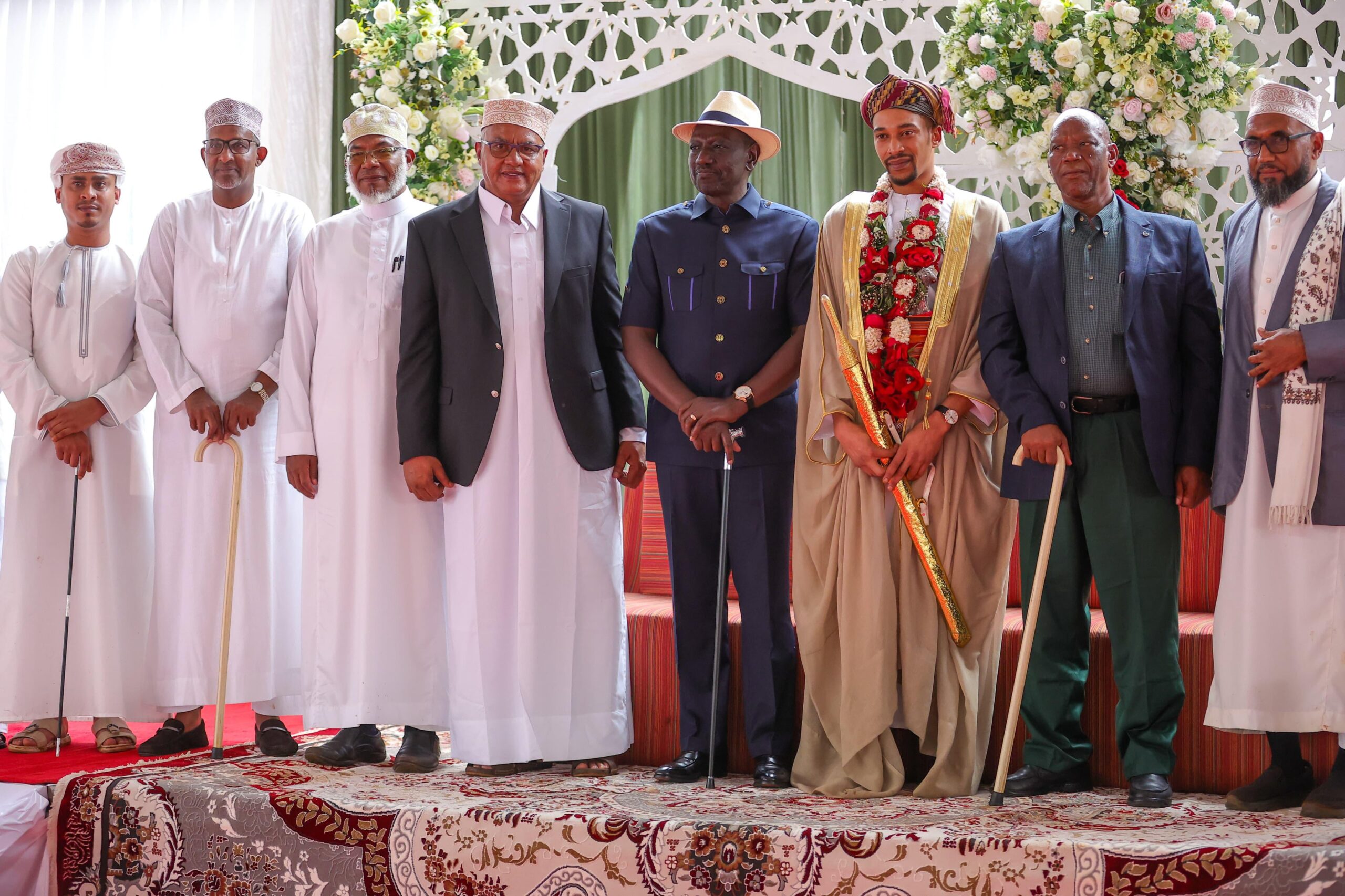
The depth of the presidential relationship extends into social ceremony. In May 2023, President Ruto attended the wedding of Faryd’s son Idris to Salma Konse. Health Cabinet Secretary Aden Duale, who accompanied the President, marked the occasion on social media.

Screenshot
The attendance of a sitting head of state at the nuptials of a man who would subsequently acquire a controlling stake in a company seeking a 21-year, Sh42 billion state contract is the kind of detail that, in a functioning transparency architecture, would have been disclosed and scrutinised. It was not.
A PROJECT BORN IN DELAY, SHAPED BY CRISIS
The smart driving licence project is not new. Its origins trace to March 2017, when NTSA signed a Sh2.03 billion contract with a consortium led by the National Bank of Kenya and Pesa Print for the supply, installation, and maintenance of five million second-generation chip-embedded licences.
The contract was budgeted from public coffers and was meant to run three years.
It ran into the ground instead.
By the time the Kenya Kwanza administration came to power in 2022, the Auditor-General Nancy Gathungu had recorded the project as four years behind schedule. NTSA had managed to produce fewer than two million licences against a target of five million.
Meanwhile the government had accumulated close to Sh2 billion in pending bills owed to Pesa Print. The state, in short, had failed as a client. It turned to the private sector to fix what public procurement had broken.
The restructuring into a PPP was, on its face, defensible. Kenya’s roads kill more than 5,100 people annually. The economic cost of road accidents has been pegged at Sh450 billion per year, equivalent to approximately five percent of GDP.
The case for digital enforcement, biometric licences, and a merit-and-demerit points framework is a real one. The problem is not the policy logic. The problem is the procurement.
The government opted for direct procurement under the PPP Act rather than competitive bidding. NTSA has offered the explanation that Pesa Print is the only company with the relevant technology and that the project’s history makes competitive tendering impractical.
David Njane, Pesa Print’s founder, who holds 58.83 percent of the company through Kenya Twelve Ventures and his own personal shares, echoed the same justification. ‘We designed the licences from scratch, using Kenyan artists,’ he has said. The PPP Directorate confirmed that contract negotiations are underway.
What neither NTSA nor Pesa Print has adequately addressed is how the PPP Act’s direct procurement provision, designed for rare circumstances of unique capability, came to be applied to a project where the primary beneficiary has, at precisely the moment of government approval, welcomed shareholders with documented proximity to the presidency.
The question is not whether Pesa Print has a legitimate historical claim to the project. It is whether the entry of Faryd and Jabir into the company’s ownership structure, timed as it was to the approval of the feasibility study, represents the kind of political capture of public procurement that Kenya’s laws are supposed to prevent.
Sources familiar with the deal estimate a gross return of at least 120 percent on the initial Sh42 billion investment over 21 years.
THE ECONOMICS: WHO EARNS, AND HOW MUCH
The financial architecture of this project is extraordinary by any measure. The KCB-Pesa Print consortium is committing an estimated Sh42 billion in capital over the first two to three years, entirely through private debt and equity.
Not a single shilling of public money is meant to fund the implementation phase. In exchange, the consortium will operate and maintain the infrastructure for 21 years and recoup its investment through user charges.
Sources familiar with the deal indicate a projected return of at least 120 percent over the concession period, suggesting gross earnings in the region of Sh50 billion on the initial investment.
The revenue streams are layered. Motorists will pay Sh3,000 for the issuance, renewal or replacement of each smart driving licence.
With a target of five million licences every three years, that licensing fee alone is projected to yield around Sh15 billion to the consortium and NTSA combined. Then come the fines.
Treasury data shows Kenya collected an average of Sh1.7 billion annually in traffic fines over the five years to June 2024.
The new system is designed to multiply that figure dramatically. Over 1,000 cameras, 700 fixed and 300 mobile, deployed across the major highways and high-risk corridors of the country will detect violations in real time, transmit offence data to a central command system, and generate fines payable electronically within seven days.
The scale of potential fine revenue, across an enforcement system that detects at least 37 categories of offence ranging from Sh500 for a missing seatbelt to Sh10,000 for driving without a valid inspection certificate, is not projected in any public document. What is clear is that the private investors have modelled returns on a very different order of magnitude than anything the current system generates.
KCB’s role in the project came about through the acquisition of National Bank of Kenya by Nigeria’s Access Bank, completed on May 30, 2025. The Central Bank of Kenya approved the transfer and issued Gazette Notice No. 4666 in April 2025 clearing KCB to assume all functions NBK had held under the original 2017 contract.
The bank will now handle enrolment, distribution and licence issuance, while Pesa Print manages card design and production.
NTSA retains oversight of enforcement and data governance. At the end of the 21-year concession, core infrastructure including cameras, enrolment systems and the command centre will revert to NTSA. The private partners will retain non-core assets.
THE CONFLICT OF INTEREST PARADOX
There is a bitter irony embedded in the timing of all this. Shortly before the NTSA announced the rollout of its instant fines system, President Ruto signed the Conflict of Interest Act into law.
The legislation, demanded by the International Monetary Fund as part of Kenya’s fiscal adjustment programme, was intended to bring greater transparency to public appointments and government contracts. In practice, lawmakers diluted the bill’s most critical provisions before passing it, rendering the final version significantly weaker than the original draft.
The Conflict of Interest Act, in its enfeebled form, did not reach backward to examine contracts already in the pipeline. It did not trigger a review of the ownership structures of companies positioned to receive state revenues through PPP arrangements.
It did not ask why two men with documented personal relationships with the President had, within weeks of a Treasury feasibility approval, incorporated new companies and immediately acquired a combined 41 percent stake in the project vehicle.
The man who directly connects these threads is Charles Tela Alusala, Faryd’s business partner in the Dolphin Resort. Alusala co-owns Easton Industrial Park alongside President Ruto’s daughter June Ruto.
He is a shareholder in Jipe Fisheries with First Lady Rachel Ruto.
At Amaco Insurance, where Alusala holds 100,000 shares amounting to a 10.83 percent stake, the Ruto family’s investment vehicle Yegen Farms, owned by the First Lady and her daughter Charlene, holds 190,000 shares.
Alusala is listed as the contact person at Koilel Farm, where the First Lady and her son Nick are co-owners, and at Urban Groove Apartments, where Rachel Ruto and Charlene hold equity. The business constellation between Faryd’s circle and the first family of Kenya is dense, documented, and commercially active.
In that context, Pesa Print’s Njane insists the political affiliations of his co-shareholders are irrelevant to the company’s operations and its legitimate historical claim to the project. His frustration at persistent scrutiny is understandable.
He built the company, won the 2015 competitive tender under the previous administration, and has waited through years of state failure to be paid and to have the project advanced.
Yet the question of whether Faryd and Jabir’s entry was motivated by technical value or political access is not answered by the sincerity of Njane’s belief. It is answered by the evidence of timing, ownership structure, and the network of relationships that surrounds the deal.
LEGAL BATTLES ALREADY QUEUING
This is not the first time NTSA has attempted instant fines and been slapped down by the courts. In 2016 and again in 2020, the High Court invalidated similar frameworks, with Justice Roselyne Aburili ruling that any instant fines regime that does not give a motorist the option to either pay or contest the matter in court violates the constitutional right to a fair trial.
The current system has already attracted a constitutional petition from Nairobi motorist Kennedy Maingi Mutwiri, filed on March 10, 2026, one day after the system went live. Mutwiri argues that the automated framework, fully operational without human intervention and requiring payment within seven days on pain of interest accrual and service lockout, presumes guilt, bypasses judicial oversight, violates the separation of powers, and constitutes an unconstitutional exercise of quasi-judicial authority by an executive agency.
The High Court declined an urgent injunction but scheduled the matter for mention on April 9.
The Motorists Association of Kenya has written to the NTSA Director General raising procedural concerns about due process and accountability in the revenue management framework.
Transport operators, while broadly supportive of the road safety rationale, have called for clarity on how liability is allocated between vehicle owners, drivers, and SACCO management when cameras detect violations in PSVs.
The Federation of Public Transport Sector, in a statement welcoming the system’s anti-corruption potential, simultaneously flagged the absence of a clear and publicised offence register and warned of compliance failures if motorists remain uninformed.
The legal and operational challenges facing the system are not, in themselves, fatal to the project. The government has cleared multiple procedural milestones: the PPP Committee conditionally approved the project in June 2024, the Attorney General signed off in January 2025, and Cabinet gave final approval in December 2025.
The project is, by every administrative measure, properly authorised. The constitutional objections to the instant fines mechanism, however, represent a genuine vulnerability.
If the courts rule, as they twice have before, that the administrative fine regime violates the right to a fair trial, the revenue projections undergirding the entire 21-year investment case collapse.
The courts have twice ruled instant fines unconstitutional. A third challenge is already in court.
The NTSA smart driving licence project is not an isolated procurement anomaly. It is the latest and perhaps most financially significant chapter in a pattern of politically connected investors securing stakes in infrastructure concessions structured as PPPs under the Kenya Kwanza administration.
The Rironi-Mau Summit superhighway land valuations, the SGR Phase 2B contractor selection, the Affordable Housing Programme procurement controversies, each story traces the same anatomy: private investors with verifiable personal ties to the political establishment acquiring positions in high-value public projects at the precise moment those projects gain government momentum.
The PPP model, conceived as a mechanism for attracting competent private capital to compensate for a constrained public purse, has in practice become the preferred instrument through which political access is converted into generational commercial advantage. The 21-year concession period is not incidental. It means the men who entered Pesa Print in 2023, weeks after a Treasury approval, will be drawing revenues from Kenyan motorists’ fines and licence fees until 2047, irrespective of who governs after Ruto.
Faryd Abdulrazak Sheikh’s business biography has been described by those who have studied it as a masterclass in strategic proximity to power. He has built and dissolved companies, entered and exited sectors, and emerged consistently from each transition closer to the next contract. He is the kind of businessman who surfaces in the margins of every major procurement story of this administration, photographed at presidential weddings, registered in company records just ahead of approvals, invisible during the hard work of implementation and entirely present when revenues begin to flow.
Kenya’s legal and constitutional architecture theoretically prohibits this dynamic. The Conflict of Interest Act, however weakened in its parliamentary passage, establishes at minimum that public officials must not advance private interests that intersect with their public duties. The PPP Act requires that direct procurement be justified by genuine uniqueness of the private partner’s capability. The Constitution mandates transparency and accountability in the use of public resources. Against that framework, the story of how Faryd and Jabir entered Pesa Print and positioned themselves to earn a share of Sh42 billion from Kenya’s roads demands more than the silence currently emanating from State House and the relevant ministries.
Njane, the man who built Pesa Print and endured years of non-payment and administrative obstruction to reach this moment, says his company represents a Kenyan solution to a Kenyan problem. He is probably right. The solution, however, now carries passengers whose journey into this deal was not earned through technical innovation or competitive risk-taking. It was purchased through proximity to power at exactly the moment that power had money to distribute.
Kenya Insights allows guest blogging, if you want to be published on Kenya’s most authoritative and accurate blog, have an expose, news TIPS, story angles, human interest stories, drop us an email on [email protected] or via Telegram



Blocked: How Mombasa Tycoon Ashok Doshi Has Stopped Imperial Bank Depositors From Getting Their Money

SEX SCANDAL ROCKS KISUMU POLYTECHNIC: Top Officials Linked as Secretary Accuses New Council Chairman of Naivasha Advances

Why Ruto’s Favourite Candidate Adan Mohammed Could Be Locked Out of the KRA Top Job

DCI Arrests Woman in Sh55.7 Million Gold Fraud Targeting American Citizen in Nairobi

Court Confirms Safaricom Customers Data Was Sold To Betting Companies In Seven-Year Cover-Up

Paybill 585555: How Airtel Kenya’s Interoperability Gateway Became A Criminal Pipeline Draining Millions From Unsuspecting M-Pesa Users

The Man Who Starved Kenya’s Voice

The Rot Inside Absa: How Bank Insiders Are Looting Nairobi’s Customers

The President’s Helicopter: How Ruto’s Aviation Empire Lands a Historic Airbus Milestone While His Government Writes the Tax Code

“TikTok Who? YouTube Sorry. A Kenyan-Built Platform Just Dropped—and 20 African Ministers Showed Up To Launch It.”

How Did a Sh468K KRA Salary Allegedly Turn Into Sh30 Billion? Questions Deepen Over Commissioner George Obel and Ciala Resort Owner’s Wealth

Nairobi Freezes Binance Accounts in Sweeping Anti-Fraud Crackdown as Global Scandal Record Haunts World’s Largest Crypto Exchange

THE UNTOUCHABLE CLERK: How Fatuma Mwalupa Allegedly Turned Kwale Assembly Into a Personal Treasury and Outsmarted Scrutiny

The Man Behind the Badge: How Prof. Erastus Kanga Turned Kenya’s Premier Wildlife Agency into a Theatre of Corruption, Fear and Impunity

THE BRAZEN RETURN: Triton Thief Yagnesh Devani, Who Pillaged Kenya of Sh7.6 Billion and Fled, Now Asks the Same Courts He Escaped to Restore His Stolen Wealth
Why Ruto’s Favourite Candidate Adan Mohammed Could Be Locked Out of the KRA Top Job

Green Gold, Rotten Roots: How Kenya’s Biggest Avocado Firms Hijacked a Sh5.8 Billion Harvest Ban

Why the April 21 Flopped Protests Expose Kenya’s Rudderless Opposition

THE PHANTOM COVER: Unlicensed Broker Vanishes With Sh42M, Hussein Mohammed Fingered In The Alleged CHAN 2024 Insurance Scandal

KETRACO CEO Advert Marred By Controversies As Fears Grow That Kipkemoi Kibias Is A Predetermined Candidate
-
 News3 days ago
Why Ruto’s Favourite Candidate Adan Mohammed Could Be Locked Out of the KRA Top Job
-

 Business2 weeks ago
Safaricom’s Sh1.4 Billion Reckoning: How Kenya’s Most Profitable Company Stole a Man’s Idea and Got Caught
-
 Investigations2 weeks ago
Denial Under Duress: The Untold Collapse Threatening David Lagat’s DL Group’s Empire
-
 Business2 weeks ago
THE INSURER THAT TOOK YOUR PREMIUM AND FORGOT YOUR NAME: How ICEA Lion Left a Client Begging for Sh7.8 Million Across Four Months
-
 Business7 days ago
The Rot Inside Absa: How Bank Insiders Are Looting Nairobi’s Customers
-

 Business2 weeks ago
Bush Air Safaris Founder John Ndiritu Risks Losing Property Over Disputed Loan Claim
-
 Business1 week ago
The President’s Helicopter: How Ruto’s Aviation Empire Lands a Historic Airbus Milestone While His Government Writes the Tax Code
-
 Arts & Culture2 weeks ago
KDC Accelerates the Creative Economy, Innovation and Youth-Led Enterprise Growth at Africa Forward Summit