
Business
The Founder’s Ransom: How Titus Muya Had to Be Paid Sh231 Million to Let Go of Family Bank and Why That Bill Is Now Yours
An investigation into the decade-long governance paralysis, the CEO carousel, the humiliating rights issue failure, the Mansa-X rescue, and the staggering ex-gratia payments that were the financial lubricant needed to finally move Kenya’s most founder-captured bank from private legacy to public liability. The listing on June 23, 2026 was not a triumph of vision. It was the completion of a transaction. And new shareholders are the ones who bought it.

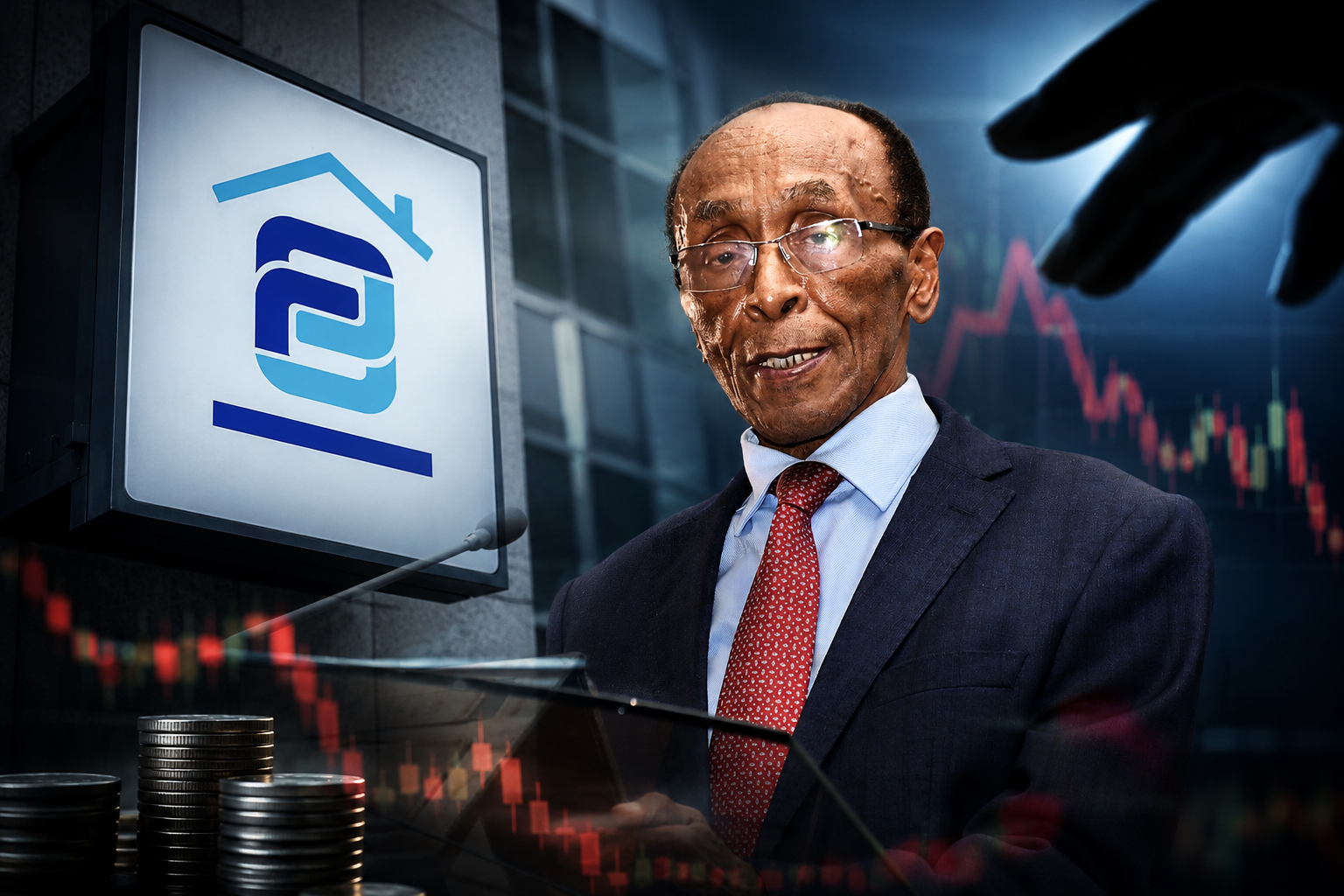
There is a version of the Family Bank story in which everything makes perfect sense. A visionary founder builds an institution from nothing, grows it for four decades, graciously accepts recognition for his service, and finally takes it to the Nairobi Securities Exchange where the market celebrates his life’s work with a 44 percent debut surge. Titus Kiondo Muya, resplendent at the bell-ringing ceremony on June 23, 2026, is that story’s hero.
There is another version.
In this one, the ex-gratia payments are not a thank-you. They are a price. The listing did not happen because Family Bank was finally ready. It happened because the bank spent over a decade being unable to move without the founder’s approval, burned through five CEOs in twenty years, watched its shareholders reject 97 percent of a capital raise, required an institutional rescue from a single investment fund to finally anchor a credible valuation, and ultimately concluded through a process of painful financial negotiation that the only way to transition out of the founder’s grip was to pay him out of it.
The second version is the one the numbers actually tell. This is that story.
I. The Founder Who Could Not Let Go
The Family Bank problem is not unique to Kenya.
Across East Africa and across the world, the story of visionary founders who build great institutions and then become their greatest obstacle is a recurring corporate tragedy.
What makes the Family Bank version notable is its duration, its financial cost, and the precision with which the governance failure can be traced through the institution’s capital markets history.
Titus Muya founded Family Finance Building Society in November 1984 in Kiambu with a single branch and a premise: to serve the Kenyan who the established banks did not want to see. He was not merely the founder.
He was, by his own account, simultaneously the CEO, the chairman, the HR department, the loan officer, and the accountant. The institution ran on his energy, his relationships, and his instincts. For the conditions of a start-up building society in 1980s Kenya, this centralisation was not just acceptable it was essential.
The problem was that it never fully stopped.
When Family Bank converted to a commercial banking licence in 2007, the structural demands of a regulated deposit-taking institution required professional management, independent governance, arms-length decision-making, and the clear separation of the founder’s personal interests from the bank’s institutional ones.
These requirements were acknowledged but only partially met. Muya stepped down as CEO in June 2006 required by the CBK’s regulations on the conversion to commercial bank status and took the chairmanship instead. He remained chairman until December 2012. He has sat on the board as a non-executive director ever since.
The title changed. The influence did not. Industry observers who dealt with the bank during the Kiboro era when the respected former Nation Media Group CEO Dr. Wilfred Kiboro served as chairman from 2012 for roughly twelve years consistently note that even a board chairman of Kiboro’s stature found the founder’s presence on the board, combined with the family’s then-dominant shareholding and the network of family-linked corporate relationships, a constraining force on genuinely independent governance.
For all Kiboro’s achievements in modernising the bank’s systems and expanding its branch network to over 90 locations, the bank remained in the words of one capital markets observer ‘too large to be a family shop, but too constrained to act as a truly independent public institution.’
Five CEOs in twenty years. An average tenure of under four years per leader. Each departure marked by some version of the same underlying tension: professional management colliding with founder control that formal titles did not diminish.
The governance overhang had a direct financial cost that went far beyond the ex-gratia payments.
It cost Family Bank two decades of capital market access at the moment when that access would have been most transformative.
II. The CEO Carousel and What It Really Cost
Between Muya’s departure as CEO in 2006 and the appointment of Nancy Njau in January 2024, Family Bank cycled through five managing directors. Peter Kinyanjui served the transition period through approximately 2011. Peter Munyiri was appointed from a senior role at KCB in June 2011 and served his five-year fixed-term contract until June 2016. David Thuku, promoted internally, served approximately two and a half years before resigning in late 2018 the shortest recent tenure.
Rebecca Mbithi, promoted from Company Secretary, served from 2019 through late 2023, credited with meaningful turnaround efforts before leaving to join Ecobank Kenya. Nancy Njau, another internal promotion, took over in January 2024.
An average tenure of under four years per CEO leader is not the profile of an institution in command of its professional management. It is the profile of an institution where the conditions for sustained independent leadership are structurally difficult to maintain.
The pattern of internal promotions in later years Thuku, Mbithi, Njau is consistent with a board that preferred candidates who were already inside the family’s institutional orbit to external professionals who might push more forcefully for structural change.
The Peter Munyiri chapter deserves particular examination, because it reveals what happens when professional management and founder influence meet head-on.
Munyiri came from KCB with genuine banking credentials. During his five-year tenure, he oversaw significant growth: assets roughly quadrupled, net profit increased more than fivefold from approximately Sh391 million to over Sh2.5 billion, and the branch network expanded from 54 to 87 locations.
He also oversaw Family Bank’s implication in the 2015 National Youth Service scandal, which resulted in the dismissal of nine employees and was a reputational low point.
Munyiri’s contract was not renewed when it expired in June 2016 a decision characterised publicly as mutual. What was not publicly characterised was the aftermath.
A prolonged legal dispute over his gratuity and exit package wound through the courts for years, ultimately resolved by a Court of Appeal award in 2025.
The dispute was never fully aired in public. But its existence a departing professional CEO litigating his exit package from a founder-influenced institution for nearly a decade speaks volumes about the conditions of separation.
Meanwhile, Equity Group, which listed on the NSE in 2006 from a comparable starting point, operated under James Mwangi’s continuous multi-decade CEO tenure throughout this same period.
Mwangi had the institutional stability to execute a regional expansion strategy that took Equity into six East African markets. By mid-2026, Equity Group’s total assets stand at approximately KSh2.04 trillion roughly nine times the size of Family Bank’s KSh230 billion.
Both institutions began their commercial banking journeys at roughly similar scale around 2006-2007.
The divergence is not explained by the quality of the underlying customer base or the sophistication of the product range. It is explained by what professional management with genuine autonomy can achieve when it is not fighting a governance constraint at every strategic turn.
Equity Group and Family Bank started commercial banking at roughly comparable scale in 2006-2007. Equity is now nine times larger. The variable that explains the divergence is not the market, the product, or the customer. It is governance.
III. The Capital Drought: When the Market Sends a Message
By the early 2020s, the governance overhang had produced a consequence that was impossible to misread.
Family Bank was fundamentally cut off from the institutional capital that its peers were accessing to fund their growth.
Equity Group could go to the market for fresh equity and find a queue of institutional buyers. KCB could execute capital raises with institutional confidence. Family Bank could not.
The most diagnostic moment came in December 2023, when the bank convened a special Annual General Meeting to approve a rights issue targeting Sh9.3 billion.
The terms were reasonable: 643.5 million new shares at Sh14.50 each, representing a discount on the OTC trading price, offered to existing shareholders. The bank said the proceeds would fund technology investment, balance sheet capitalisation, and regional expansion into Uganda and the DRC.
Management urged shareholders to participate. The deadline was extended multiple times from November 2023, to December, to January 2024. Every extension was accompanied by a fresh call for shareholders to ‘take advantage of the discounted offer.’
The exercise closed on January 31, 2024. It had raised Sh252 million. Against the Sh9.3 billion target, the failure rate was 97.3 percent.
This was not a market-conditions problem alone. Kenya’s equity market was difficult in 2023 and 2024, and MSME credit conditions were stressed. But these conditions applied to every bank raising capital in the same environment.
The difference at Family Bank was that the investors who knew the institution best the very shareholders who had been holding OTC stock through years of illiquid trading declined to commit meaningful new capital.
They were not uninformed. They were not panicking. They were making a considered judgement about the institution they owned, and they voted no.
The message that rejection sent to institutional capital markets was unambiguous: Family Bank carried what sophisticated investors had come to call ‘Founder Risk.’ Pension funds and asset managers who had been watching from the sidelines did not need to conduct fresh due diligence to know that the governance structure, the related-party ecosystem, the CEO carousel, and the ownership concentration made this an institution they were not prepared to back at scale. The rights issue failure was not the cause of that reputation. It was the public confirmation of it.
IV. The Mansa-X Rescue: How One Fund Saved the Listing
By early 2026, the mood surrounding Family Bank’s planned NSE entry was not optimistic. Previous capital raising at Sh14.50 per share had found almost no takers. The governance questions were unresolved. The listing appeared to be stalling. What changed the trajectory was a single act of institutional conviction by Standard Investment Bank’s Mansa-X Special Fund.
According to the fund’s Q1 2026 fact sheet, Mansa-X had acquired a significant 4.89 percent stake in Family Bank 81.3 million shares and was carrying those shares on its books at an internal valuation of approximately Sh24.70 per share. This was a premium of 70 percent over the Sh14.50 at which the rights issue had been rejected just over a year earlier.
The significance of this was not merely financial. In a market where institutional capital had been standing at the exit, Mansa-X’s entry at a dramatically higher valuation served as what capital markets practitioners call an anchor.
It signaled that at least one sophisticated, locally embedded institutional investor, with the analytical capacity to conduct deep-dive fundamental research rather than relying on governance optics alone, had concluded that Family Bank’s underlying value justified a price closer to Sh25 than Sh14. That signal gave the December 2025 private placement a credibility baseline to price against.
The private placement which came after the Mansa-X position had been established raised Sh8 billion against a Sh6.09 billion target, oversubscribed by 31 percent.
Fund managers, pension funds, insurance companies, and high-net-worth individuals who had declined to participate in the rights issue at a lower price bought in at Sh18.
The Mansa-X valuation anchor, communicated through the fund’s published fact sheet, had moved the market’s perception of where this stock belonged.
Without the Mansa-X intervention, there may have been no listing. A single fund’s conviction carrying shares at Sh24.70 when the market had just rejected them at Sh14.50 reframed the entire pricing narrative and made the Sh8 billion private placement possible.
When Family Bank listed on June 23, 2026 at Sh18 per share, the stock surged to an intraday high of Sh50 on debut day before settling around Sh26.
The Mansa-X thesis was validated.
The fund’s internal carrying price of Sh24.70 had been almost precisely correct as a fair value estimate for where the stock would find equilibrium after the debut volatility.
The lesson the capital markets should draw from the Mansa-X intervention is not that it saved Family Bank. It is that it took a single locally-grounded fund with the willingness to do the forensic work and take a contrarian position to break an institutional standoff that had frozen the bank out of public markets for over a decade.
Without that intervention, the listing may not have happened in the form it did.
The governance questions that had driven the 97 percent rights issue rejection had not been resolved between January 2024 and December 2025. What had changed was one fund’s bet that the value was there despite those questions and that the listing itself would impose enough new accountability to make the underlying franchise worth the governance discount.
V. The Ex-Gratia: Bribe, Gratuity, or Both?
Against this backdrop a decade of governance friction, a rights issue collapse, an institutional rescue from a single fund, and a private placement that required an anchor investor to make it work the ex-gratia payments to Titus Muya acquire a context that mainstream coverage has entirely missed.
In 2024, Muya received Sh138.24 million in ex-gratia from the bank, plus Sh22.64 million in director’s fees and Sh4.98 million in allowances a total of Sh165.86 million.
In 2025, he received Sh93.13 million in ex-gratia, Sh21.8 million in fees, and Sh13.64 million in allowances a total of Sh128.57 million.
The combined two-year total across all components exceeded Sh294 million. The ex-gratia component alone was Sh231.37 million.
These payments are described in the 2025 annual report the first to break them out on a per-director basis as recognition for ‘long service.’ The framing treats them as a voluntary gesture of institutional gratitude.
The Boardlot Sultan Substack, which has analysed the Family Bank journey in depth, offers a more structurally honest characterization: these payments were ‘the financial lubrication required to facilitate a handover that had been stalled for nearly two decades.’ They were, in effect, the price of the listing.
This framing is not merely interpretive.
Consider the sequence. The decade from 2012 to 2022 produced no meaningful progress on the listing ambition, despite repeated statements of intent. The rights issue of 2023-2024 was designed in part to build the capital base and governance profile needed for listing.
It catastrophically failed. In 2024, coinciding with the post-collapse period, the bank paid Muya Sh138.24 million in ex-gratia. In 2025, as the private placement and listing were finalised, it paid him Sh93.13 million more. The listing happened in June 2026.
The question of what exactly the ex-gratia was compensating Muya for is one the bank has not been required to answer publicly.
The service it ostensibly recognises his time as CEO and chairman ended in 2006 and 2012 respectively. Equity Group gave its founder a Sh50 million one-off gratuity for thirty-five years of continuous active service at the moment he actually stepped down. Family Bank paid its founder Sh231 million in ex-gratia for service that concluded more than a decade before the payments were made, at the moment the bank was attempting to complete a capital transition that required him to reduce his grip.
The timing overlap with the Peter Munyiri dispute adds another layer. The former CEO’s exit package was litigated for nearly a decade and was only resolved by Court of Appeal award in 2025 the same year the bank was completing its listing preparations. The resolution of that long-running professional management dispute, concurrent with the finalisation of the founder’s ex-gratia package, paints a picture of an institution conducting a wholesale settlement of its governance debts in the run-up to public accountability.
The bank paid its founder Sh231 million in ex-gratia for service that ended over a decade before the payments were made at the precise moment he was being asked to step back far enough for a listing to occur. If that is not a founder’s ransom, the English language has run out of words.
None of this constitutes a legal violation. Ex-gratia is a board-approved mechanism.
The CBK’s oversight of related-party transactions and board governance covers the structural arrangements but does not impose a formula on discretionary goodwill payments. The 2025 annual report disclosed the amounts.
The problem is not legality. The problem is the principle: that concentrated founder control of a listed institution creates the conditions under which an individual can effectively extract a transitional payment from the institution as the cost of its own liberation, while simultaneously retaining a 35.67 percent equity stake in the institution that paid it.
VI. The Ecosystem That Listing Does Not Touch
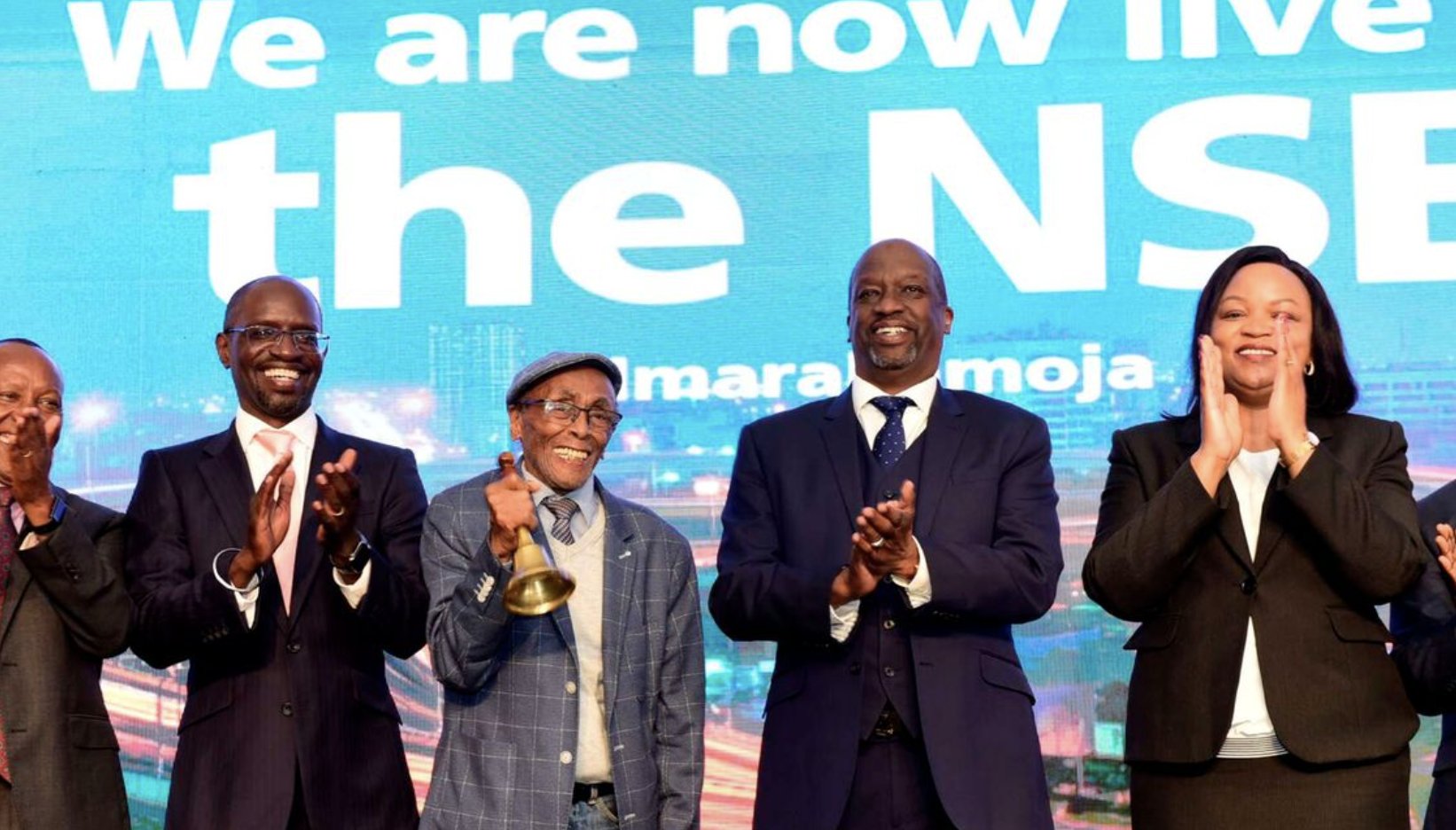
Family Bank Founder T.K. Muya (third left) rings the bell joined by Family Bank Chair Lazarus Muema (left), CBK Chair Andrew Musangi, NSE Chair Kiprono Kittony, Family Bank CEO Nancy Njau during the bank’s listing on the NSE by way of introduction where the shares opened trading at Ksh.22.58 per share above the introductory price of KES 18.00.
The ex-gratia story would be simpler if it were about one founder, one bank, and one payment. It is complicated by the fact that Titus Muya’s financial relationship with Family Bank extends far beyond his direct shareholding.
Daykio Plantations Limited, the real estate company Muya founded in 1986 and in which he holds 91 percent, sits with a 9.53 percent stake in Family Bank. It is the fourth-largest single shareholder on the post-listing register.
On Daykio’s own website, the company publicly advertises a formal partnership with Family Bank that provides diaspora customers with a bundled land purchase and mortgage financing product. The marketing language is unambiguous: Family Bank provides ‘the security and competent handling of your investments, including financing and other banking solutions’ for buyers purchasing Daykio land.
What this means in structural terms is that Family Bank’s mortgage lending and its primary collateral base, which consists predominantly of first-ranking charges over financed property includes properties sold by a company that is majority-owned by the bank’s largest related-party shareholder bloc and that holds 9.53 percent of the bank itself.
The bank lends to buyers of the founder’s property.
The founder’s property company generates sales partly enabled by the bank’s financing. The bank holds mortgages as its primary collateral. The collateral backs the loan book that underpins the bank’s metrics that support the listing valuation.
Kenya Orient Life Assurance and Kenya Orient Insurance, both associated with Muya, together hold approximately 2.22 percent of Family Bank. Mark Keriri, the bank’s vice-chairman, sits on the boards of both Orient entities and of Daykio Plantations, while holding approximately 2.01 percent of Family Bank in his own right.
The overlap between the bank’s governance structure and the founder’s commercial empire is not concealed. It is disclosed, in aggregated form, in the related-party notes of the annual report. But it is disclosed in terms that make it structurally difficult to assess without forensic disaggregation.
The listing changed the disclosure frequency and the oversight framework. It did not change the underlying commercial relationships. Daykio still sells land. Family Bank still finances the buyers.
The same related-party disclosures that appeared in the 2025 annual report will appear in the 2026 annual report, and the 2027 annual report, unless the regulatory sell-down of the Muya family’s combined stake below 25 percent eventually severs the economic incentive for the partnership to continue.
VII. What the Credit Book Is Actually Saying
Family Bank’s 2025 full-year profit after tax of Sh5.38 billion, a 55.4 percent surge, is the headline that anchors the listing’s financial narrative. It deserves the same forensic treatment as the governance structure.
The profit engine is not, at its core, a lending story.
It is a government securities story. In the nine months to September 2025, the bank’s interest income from Treasury bills and bonds grew 43.1 percent to Sh5.5 billion. Net interest income for the full year rose 44.5 percent a figure that was the dominant profit driver. Family Bank, like most of its peers, had rotated deposits into sovereign paper as private sector credit risk rose to two-decade highs. The strategy was rational. It was also temporary.
The Central Bank of Kenya has cut its benchmark rate from 13 percent in early 2024 to 8.75 percent by mid-2026. Treasury bond yields are compressing. Private sector credit growth is recovering rising to 9.3 percent in May 2026 from 7.1 percent in April. The environment that produced the government securities windfall is softening precisely as Family Bank arrives in the public markets with its windfall profit metrics on full display. The 55 percent profit growth is the trailing edge of a macro trade that is already unwinding.
On the credit book itself, the numbers tell a more uncomfortable story. Gross non-performing loans rose 21.6 percent to Sh17.56 billion in 2025. The NPL ratio peaked at 17.6 percent mid-year. Provisions for loan losses nearly tripled to approximately Sh1.97 billion.
These figures are not a collapse the collateral coverage is genuine and the provisions are rebuilding coverage ratios but they represent the real credit cycle reality of serving the SME and MSME market at a time of maximum economic stress.
The SME loyalty paradox that Standard Investment Bank’s own research acknowledged is structural, not cyclical. Family Bank builds its brand on serving the market trader in Gikomba and the agribusiness operator in Kiambu. When those customers succeed, grow, and formalize their operations, they become attractive to Equity Group, KCB, NCBA, and Co-operative Bank institutions with cheaper funding, wider digital platforms, and more diversified product ranges. Family Bank’s own transaction adviser described this customer churn dynamic as the bank’s ‘Achilles’ heel.’ That heel does not heal because the bank is now listed.
VIII. The December Clock, the Overhang, and the Reckoning
Six months after listing day, on December 17, 2026, a Sh4 billion medium-term note matures. The MTN was issued in 2021 at a 13 percent annual coupon and is the bank’s primary outstanding public debt instrument. Family Bank’s management says it does not require additional capital for the redemption. The current capital position, with total shareholders’ funds of Sh34.77 billion and a core capital ratio of 16.9 percent, is superficially comfortable.
The risk is not solvency. The risk is the interaction between the MTN maturity and the secondary market conditions created by the listing.
If Family Bank’s stock underperforms in the months following listing because of thin liquidity, because of the family bloc’s regulatory sell-down pressure, because of the H1 2026 NPL numbers that will arrive around August, or because the cost-to-income ratio above 60 percent draws unfavourable comparison to Tier 1 peers the bank’s ability to access public markets for refinancing at favourable rates will be constrained.
The listing by introduction raised no new equity. The execution window for the MTN refinancing is six months wide and opens with the debut volatility barely settled.
The family bloc overhang is the most structurally persistent feature of this stock. At 35.67 percent of 1.662 billion shares, the Muya family and associated entities hold a known quantity of stock that must be reduced to 31.93 percent under the regulatory concession and eventually to 25 percent for full compliance.
The family was explicitly exempted from the standard two-year post-listing lock-in period, meaning they can sell from day one. The economic incentive to reduce the holding both to achieve regulatory compliance and to realise the paper gains from the debut surge is immediate. Sustained selling from a concentrated holder into a thin market is a suppressive force on price. This is not speculation. It is how capital markets work.
New shareholders buying the Family Bank debut surge are not buying into a clean governance story with the founder’s shadow fully removed.
They are buying into the next phase of a very long transition that is still in progress, with the founder’s bloc still at 35.67 percent, the commercial relationships between the bank and the founder’s other enterprises unchanged, the MTN redemption six months away, and the government securities profit engine softening.
The listing is not the end of the Family Bank governance story. It is the beginning of the accountability period for everything that happened before the cameras arrived.
IX. What Must Be Watched, and What New Shareholders Must Demand
The H1 2026 results, due around August 2026, are the first real post-listing accountability document. They will show whether the NPL ratio, which peaked at 17.6 percent mid-2025 before easing to approximately 16.5 percent by year-end, is continuing to recover or is deteriorating again as government payment delays persist and interest rate relief takes time to flow through to SME borrower serviceability. They will also reveal the trajectory of the government securities income as the rate environment continues to shift.
The family bloc sell-down timeline is the second critical variable.
The CBK’s concession allows the family to hold up to 31.93 percent as an interim ceiling. From 35.67 percent to 31.93 percent requires the sale of approximately 62 million shares worth over Sh1.5 billion at current prices. From 31.93 percent to the full regulatory cap of 25 percent requires the sale of another 114 million shares worth over Sh2.8 billion.
The pace at which these sales occur, and their effect on secondary market depth and price, will determine whether this stock develops genuine institutional following or remains a thinly traded family-controlled counter with a public listing label.
The December MTN redemption is the third variable. Whether the bank refinances through a new public bond, draws on existing liquidity, or negotiates a private placement of debt instruments will be a signal of its access to capital markets and its financial health in the months immediately after listing.
Beyond these immediate tests, the structural questions persist. Will the commercial partnership between Daykio Plantations and Family Bank be wound down as part of the transition to full public market standards? Will the related-party disclosure in future annual reports become sufficiently granular for minority investors to assess the scale and terms of transactions between the bank and the founder’s other entities? Will the board recruit genuinely independent directors who are not connected to the Muya family ecosystem? Will the cost-to-income ratio above 60 percent come down as the bank scales? Will Nancy Njau’s tenure be long enough and empowered enough to break the CEO carousel pattern?
These questions do not have answers yet. They are the ones that will determine whether Family Bank’s NSE listing is the beginning of a story like Equity Group’s a genuine governance transformation catalysed by public market accountability or the beginning of a story like I&M’s early listed years: decent underlying quality, but years of thin liquidity and governance discount before institutional depth develops.
X. The Verdict
The Family Bank listing is a milestone. It is also a transaction in which every participant extracted value before the public arrived.
The founder received Sh231 million in ex-gratia as the financial cost of his reduced operational role, while retaining a 35.67 percent equity stake worth billions.
The private placement investors, led by institutional anchors including Mansa-X which bought at an internal valuation of Sh24.70, gained immediate paper appreciation when the stock listed at Sh18 and traded to Sh26 on debut.
The Muya family bloc gained Sh4.74 billion in paper value on debut day alone, adding to the Sh294 million in cash emoluments received in the preceding two years.
The public shareholders who bought in the debut surge and the secondary market that follows are buying the residual.
They are buying a bank with real strengths genuine franchise, improving profitability, effective collateral management, DFI credibility layered over unresolved structural features that the listing did not dissolve.
The founder’s commercial ecosystem remains entangled with the bank’s operations. The family stake requires years of sell-down. The profit growth is partially a macro artefact. The CEO leadership is just two years old.
The bell rang on June 23. Titus Muya’s forty-year journey from a Kiambu building society to the NSE trading floor deserves its recognition.
But the institution he built, the one now owned in part by thousands of public shareholders, is not the story of that journey’s triumphant completion. It is the story of what that journey left behind and whether the accountability of public markets, which Family Bank was able to avoid for a decade longer than its peers, can now do what four decades of private ownership could not: make this bank fully independent of the man who created it.
That story has no ending yet. It is being written every trading day.
SELECTED KEY FIGURES — FAMILY BANK NSE LISTING DOSSIER
|
Metric |
Figure |
|
Ex-gratia to Muya (2024 alone) |
Sh138.24 million |
|
Ex-gratia to Muya (2025 alone) |
Sh93.13 million |
|
Total ex-gratia 2024–2025 |
Sh231.37 million |
|
Total emoluments (fees + allowances + ex-gratia) 2024–2025 |
~Sh294 million |
|
Equity Group’s Peter Munga payout (one-off, 35+ years active service, 2019) |
Sh50 million |
|
Peter Munyiri gratuity dispute — Court of Appeal award (resolved 2025) |
Undisclosed millions (reported multi-year litigation) |
|
2023/24 rights issue target |
Sh9.3 billion |
|
2023/24 rights issue actual raised (97% failure rate) |
Sh252 million (2.7% of target) |
|
2025 private placement raised (131% oversubscribed) |
Sh8 billion |
|
Mansa-X stake acquired ahead of listing |
4.89% / 81.3 million shares |
|
Mansa-X internal carrying price per share |
~Sh24.70 |
|
Listing entry price |
Sh18/share |
|
Listing day intraday high |
Sh50/share |
|
Listing day close |
~Sh26/share |
|
Muya bloc paper gain on debut day |
Sh4.74 billion |
|
Gross NPLs 2025 (YoY growth) |
Sh17.56 billion (+21.6%) |
|
NPL ratio peak mid-2025 |
17.6% |
|
Provisions 2025 (approx. tripling) |
~Sh1.97 billion |
|
Full-year 2025 profit after tax |
Sh5.38 billion (+55.4%) |
|
Govt securities interest income growth (9M 2025) |
+43.1% YoY |
|
MTN maturing December 17, 2026 |
Sh4.0 billion at 13% coupon |
|
Muya bloc stake at listing |
35.67% (vs. 25% regulatory cap) |
|
Regulatory concession ceiling |
31.93% |
|
SIB fair value estimate (Aug 2025) |
Sh16.54/share |
|
Book value per share Q1 2026 |
~Sh20.91 |
|
Price-to-book at listing price |
~0.86x |
|
Equity Group total assets mid-2026 |
~KSh2.04 trillion |
|
Family Bank total assets mid-2026 |
~KSh230 billion |
|
Equity vs Family Bank size differential (same starting point, 2006) |
Equity ~9x larger |
This investigation draws on Family Bank’s 2024 and 2025 annual reports; the Standard Investment Bank initiation of coverage report (August 2025); GCR Ratings’ pre-listing credit assessment; CBK sector data; NSE listing documentation; Mansa-X Q1 2026 fund fact sheet; Daykio Plantations’ public commercial disclosures.
Kenya Insights allows guest blogging, if you want to be published on Kenya’s most authoritative and accurate blog, have an expose, news TIPS, story angles, human interest stories, drop us an email on [email protected] or via Telegram






Somalia Deputy PM Held at JKIA, Deported Over Questionable Acquisition of Kenyan Passport

The White-Coat Heist: How MP Shah Hospital Ran a Decade-Long Double-Extraction Racket While Hiding Behind Charity Status

The Patriarch, His Children, and a Buried Sh3.9 Billion Fraud: The Story of Titus Muya That Kenya Was Never Meant to Read

The Founder’s Ransom: How Titus Muya Had to Be Paid Sh231 Million to Let Go of Family Bank and Why That Bill Is Now Yours

Kenya’s gambling industry pushes back against a licensing bill

Kenya Airways Sinks Into Deeper Turbulence As American Supplier Sues In New York Court Over Sh129 Million Unpaid Debts

Kenyan player wins a Ksh3.2 million jackpot

IEBC Sets August 10 Date For 2027 General Election

Furious Ruto Lashes Out at Gideon Moi Over Repeated ‘Blackmail, Extortionist’ Headlines on The Standard and KTN

Mombasa Gripped by ‘Male Organ Theft’ Panic as Social Media Fuels Mob Attacks and Fear

Businessman Philip Waithaka Kinuthia’s Minor Son Allegedly Drove Drunk, Killed Two Peponi Students in Ngong Road Horror Crash as Claims of Cover-Up Intensify

Inside NCBA’s Decline: How a Banking Giant Lost Its Strategic Edge

South Sudan: Adut Salva Kiir’s Shadow Treasury Exposed

Cement, Cash and Courts: How the Hashu Dynasty Crushed the Ramji Brothers for Fourteen Years and Why the Walls Are Now Closing In

Standard Chartered Ghosts Haunt Joshua Oigara At Stanbic As Whistleblower Spills Beans

Inside The Urban Planning Cartel That Owns Nairobi

THE VULTURE AND THE SCHEME How Nairobi West Hospital Became the Most Dangerous Institution in Kenya’s SHA Ecosystem and Why the Books Must Be Audited Now

The President’s Daughter and The Missing Witness: How Adut Salva Kiir’s Shadow Treasury Silenced Its Most Dangerous Critic

How Adil Popat Saved His Empire On The Eve Of Imperial Bank Collapse and Why Kenya’s Mainstream Media Buried The Story

Why John Ngumi Is Running From the EACC and Why the Sh415 Million Payday May Be the Least of His Worries
-
 News2 weeks ago
Businessman Philip Waithaka Kinuthia’s Minor Son Allegedly Drove Drunk, Killed Two Peponi Students in Ngong Road Horror Crash as Claims of Cover-Up Intensify
-
 Investigations1 week ago
THE VULTURE AND THE SCHEME How Nairobi West Hospital Became the Most Dangerous Institution in Kenya’s SHA Ecosystem and Why the Books Must Be Audited Now
-
 Business2 weeks ago
How Adil Popat Saved His Empire On The Eve Of Imperial Bank Collapse and Why Kenya’s Mainstream Media Buried The Story
-

 Business4 days ago
BURRIED TWICE: The Victoria Bank CEO Yogesh Pattni Files
-

 Business7 days ago
Inside the Billion-Shilling Betrayal: How Senior Treasury Officials Plundered a UN Poverty Fund and Built a Real Estate Empire on the Backs of Kenya’s Rural Poor
-
 Business1 week ago
The Listing That Doesn’t Lie: What the Market Isn’t Saying About Family Bank’s NSE Debut
-

 Business1 week ago
The Banker Who Walked Away: How Yogesh Pattni Survived a Financial Crime Scandal That Shook Kenya
-

 News6 days ago
My Life Is In Danger: Investor Drops Bombshell Expose On Thomas Ogutu CEO VeGrid Ltd And Fugitive Nairobi CEC Charles Kerich – DCI Inaction And Corruption Network Exposed