
Business
Kenya Airways Sinks Into Deeper Turbulence As American Supplier Sues In New York Court Over Sh129 Million Unpaid Debts
A federal lawsuit from a JFK-based aviation parts distributor is the latest and most public symptom of a national carrier that has accumulated Sh206.8 billion in losses, carries Sh131.4 billion in concessional government debt it cannot service, operates aircraft its own auditors flag under going-concern uncertainty, and has now run out of suppliers willing to wait. This is the story Kenya Airways does not want published.

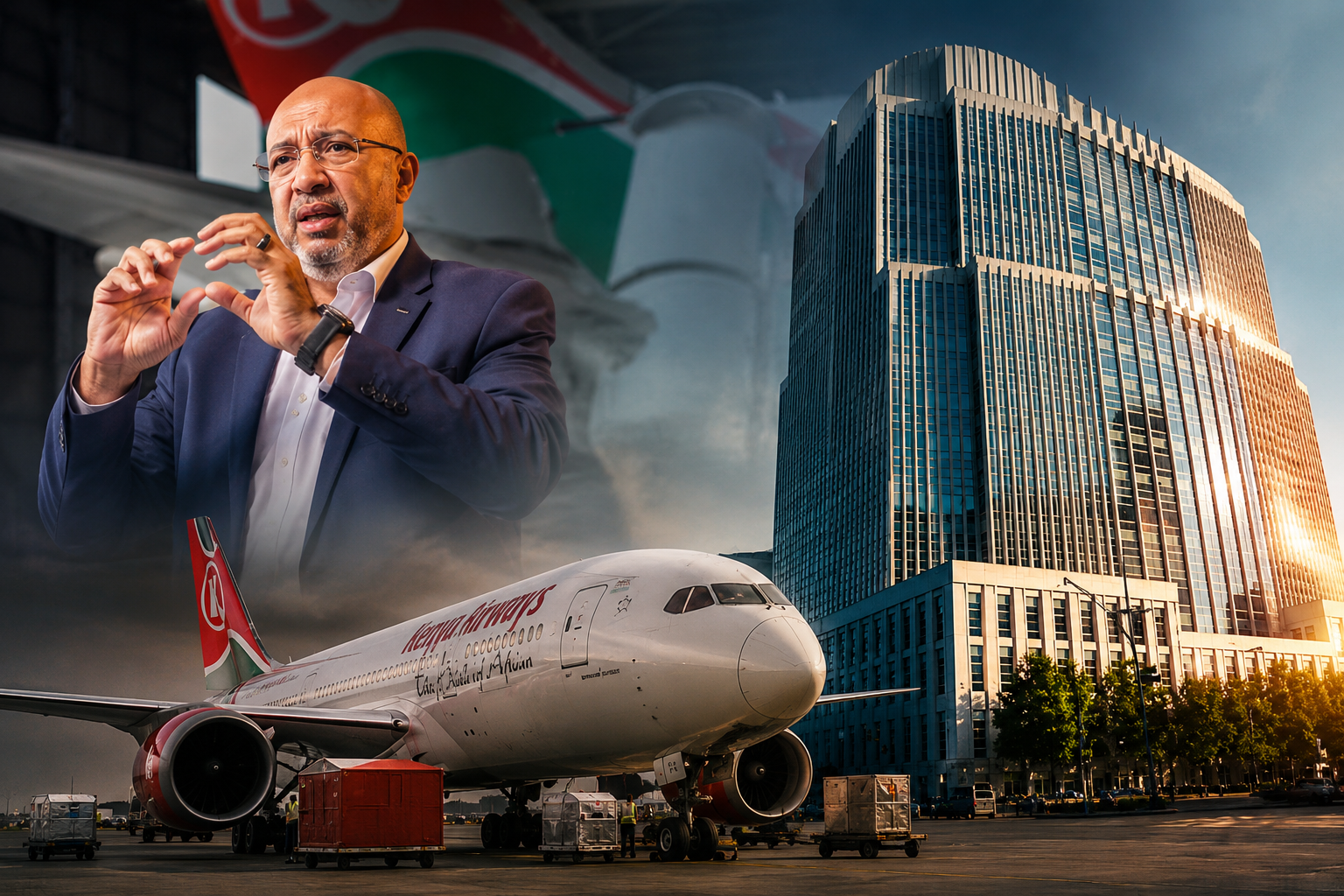
The Summons Served at the World’s Most Visible Address
There is a particular cruelty in the geography of this story. Kenya Airways the self-styled Pride of Africa, the airline that operates a prestige direct service between Nairobi and New York has been sued for unpaid bills in a federal courthouse in the very city it flies to.
On 2 June 2026, Aero Industrial Supply Co. Inc., a long-established FAA-accredited distributor of OEM and third-party aviation spares, avionics, chemicals, and ground support equipment operating from the apron of John F. Kennedy International Airport, filed Case No. 1:26-cv-03309 in the United States District Court for the Eastern District of New York.
The claim exceeds one million US dollars roughly Sh129 million. Supplies already delivered. Summons served 10 June. Answer due 1 July.
Initial conference before Chief Magistrate Judge Vera M. Scanlon scheduled for September. The plaintiff’s attorney is David Michaeli of Hogan Lovells.
This is not a case about a contract dispute over delivery terms or a technical disagreement over specifications. Aero Industrial Supply is alleging breach of contract for goods it already handed over aviation parts that in all likelihood went into aircraft carrying Kenyan passengers to New York, London, Paris, and Amsterdam.
The supplier fulfilled its obligation. Kenya Airways, according to the lawsuit, did not fulfil its own. What makes this filing extraordinary is not its size.
Sh129 million is small against the dimensions of Kenya Airways’s crisis.
What makes it extraordinary is what it reveals: that the national carrier’s inability to pay ordinary trade creditors has now spilled into the judicial system of a foreign country, in the airline’s own flagship market, at a courthouse it could not be farther from in the public consciousness.
“The Sh129 million claim is modest against the overall hole yet devastatingly symbolic: even safety-critical vendors have lost patience.”
The filing is the externalisation of what creditors, suppliers, and counterparties have been experiencing privately for months. When an airline cannot pay for the very parts that keep its aircraft airworthy, and when that supplier is forced to seek redress in federal court across the ocean, the commercial relationships that underpin safe aviation operations are fracturing. Kenya Airways’s public relations machinery will insist this is an isolated dispute in the ordinary course of business. The audited financial statements, the going-concern notes, the four consecutive years of waived government interest, and a balance sheet in Sh132 billion negative equity say otherwise.
A Decade of Broken Promises: From Mawingu to Kifaru, the Turnaround That Never Sticks
To understand why a New York parts supplier is pursuing Kenya Airways in federal court in 2026, one must understand a history of strategic and financial failure that stretches back fourteen years. The national carrier last sustained a full year of profit in 2012. Everything that has followed the colourful project names, the boardroom announcements, the cautious optimism has been noise around a structural problem that has never been solved.
In April 2012, riding a modest profit and emboldened by the global aviation recovery, Kenya Airways launched Project Mawingu the Swahili word for clouds.
The vision was genuinely ambitious: grow the fleet from 31 passenger aircraft to 107, expand the network to 115 destinations across 77 countries and six continents, position Nairobi’s Jomo Kenyatta International Airport as the primary hub for East-bound traffic from India and China, and raise Sh387 billion to finance the whole undertaking.
The airline ordered nine Boeing 787 Dreamliners, Boeing 777-300ERs, and Embraer E-190s. A Sh20 billion rights issue was launched. The government’s stake rose to 29.8 percent. KLM co-signed the ambition.
Mawingu hit headwinds immediately. Dreamliner deliveries were delayed by three years, forcing the airline into costly B777 leases at higher unit economics than planned.
Terrorist attacks in 2013 and 2014 decimated European tourist arrivals. The Westgate mall attack, the Garissa University massacre, and persistent travel advisories hollowed out the revenue assumptions on which routes to Europe depended.
The Ebola outbreak in West Africa wiped out a market the airline had planned as a cornerstone of its westward expansion.
And then, in 2015, the airline compounded its own misfortune by entering fuel hedging contracts at precisely the moment global oil prices collapsed producing a loss of Sh26 billion, the largest single corporate loss in Kenyan history at the time.
By 2016, Kenya Airways was in deep financial distress. Operation Pride, a Sh72 billion restructuring, followed: government and local bank loans converted into equity, the government’s stake rising to 48.9 percent, eleven local banks acquiring 38.1 percent through KQ Lenders Company 2017 Limited.
Then came Project Safari, addressing liquidity and operational inefficiencies through further debt restructuring. Then Project Kifaru named after the rhinoceros, a symbol of resilience launched in 2021 under CEO Allan Kilavuka. And then the COVID-19 pandemic grounded the global industry entirely.
What Parliament was told in October 2025 by Kilavuka himself, testifying before the Committee on Public Debt and Privatisation, was the full and damning sequence: Mawingu collapsed. Safari failed. Kifaru achieved what it could.
The committee heard that each plan had required government support that ultimately could not be avoided and that the accumulated debt burden from Mawingu-era expansion loans continues to weigh on the airline’s balance sheet to this day.
The Afrexim-Aircraft loan taken during the Mawingu years accrued an average interest rate of 5.39 percent between 2012 and 2025. Fourteen years later, Kenya Airways is still paying for that expansion.
“Four turnaround strategies in fourteen years. A different name each time. The same result every time: more debt, more government support, and promises of profitability pushed just around the corner.”
The 2024 “Miracle Year” That Was Not a Miracle
When Kenya Airways announced in March 2025 that it had recorded a net profit of Sh5.4 billion for the full year 2024 the first net profit in over a decade the celebrations were genuine. CEO Allan Kilavuka was lauded as the man who turned around the Pride of Africa.
The board extended his contract. The carrier won four awards at the 2025 World Travel Awards. Project Kifaru was declared a success. The Nairobi Securities Exchange relisted shares that had been suspended. Shares opened at Sh4.05 and the market cheered.
What the headline number concealed is the deeper truth buried in the 2024 accounts and later confirmed when 2025 results destroyed the narrative. The 2024 profit was substantially a creature of currency. The Kenyan shilling had strengthened against the dollar, generating Sh10.55 billion in foreign exchange gains. Strip those gains out and the underlying operational picture looks considerably less impressive.
EBITDAR the measure the then-acting CEO George Kamal chose to emphasise when the 2025 collapse arrived, because it is a measure of operational health before lease rentals came in at Sh14.5 billion for 2024, described as the carrier’s best since 2012. But EBITDAR is not profit. It is a metric that deliberately excludes the enormous cost of aircraft leases that Kenya Airways cannot avoid. The full-year 2024 net equity position, even after the celebrated profit, stood at negative Sh118.2 billion.
In other words, the “first profit in eleven years” was earned by an airline whose liabilities exceeded its assets by Sh118.2 billion, and whose profit was magnified by a currency movement that reversed in 2025.
When the shilling gave back its gains and the three Boeing 787 Dreamliners were grounded, the profit evaporated with the same speed with which it had appeared. This is the hidden story of Kenya Airways’s 2024 miracle: it was a one-year reprieve built on a forex tailwind, not evidence of structural financial health. The auditors at PricewaterhouseCoopers, who have issued going-concern qualifications year after year, knew this. The board knew this. The market, briefly euphoric, did not.
The 2025 Collapse: What the Financial Statements Actually Say
The 2025 annual results, released in late March 2026, are a document of financial catastrophe presented in the measured language of accounting. Kenya Airways’s total revenue fell 14.3 percent to Sh161.47 billion, down from Sh188.5 billion in 2024. The airline swung from a Sh16.62 billion operating profit to a Sh5.61 billion operating loss. Net finance costs consumed Sh12.32 billion. Pre-tax loss was Sh17.93 billion.
After a tax credit of Sh764 million, the net loss attributable to shareholders was Sh17.16 billion erasing the 2024 profit and then some. The operating margin fell from positive 8.8 percent to negative 3.5 percent. Basic loss per share was Sh2.94, against earnings of Sh0.95 the prior year. Passenger numbers dropped 13 percent. Available seat kilometres fell 17 to 18 percent. Cargo volumes declined 8 percent.
But it is the balance sheet that should be read slowly, line by line, by every member of Kenya’s National Assembly and Senate who has ever approved a bailout for this airline.
Accumulated losses as at 31 December 2025 stand at Sh206.88 billion. Total liabilities exceed total assets by Sh132.07 billion negative equity of that magnitude. Net current liabilities the gap between what the airline owes within the next twelve months and what it can call upon to meet those obligations stand at Sh91.5 billion. Cash and cash equivalents: Sh5.333 billion. Against Sh145 billion in total borrowings. Against Sh48.729 billion in lease liabilities. Against purchase commitments for parts and equipment exceeding Sh35 billion.
The government’s shareholder loan stands at Sh131.488 billion, extended at a concessional 3 percent interest rate.
That interest Sh8.5 billion that fell due in June 2025 was not paid. It was waived and deferred, for the fourth consecutive year in a row. This means that Kenya Airways has not paid its single largest creditor a single shilling of interest in at least four years. The government, as the airline disclosed, has committed through a formal letter of support to continue providing financial support for at least the next twelve months from the date of approval of the 2025 accounts.
That letter is what stands between Kenya Airways and insolvency. The going-concern basis of the financial statements rests entirely on that political commitment, and the airline’s auditors have made this explicit.
“Kenya Airways has not paid its largest creditor a single shilling of interest in at least four years. The going-concern basis of its own financial statements rests on a political promise.”
The audit notes from PricewaterhouseCoopers contain several additional details that have received insufficient public attention. Deferred tax assets of Sh53.412 billion were not recognised because of uncertainty over future taxable profits meaning the airline’s own auditors do not believe the carrier will generate sufficient taxable income to utilise those assets.
Impairment testing on aircraft and right-of-use assets conducted under conditions of material uncertainty, with grounded capacity and stressed cash flows resulted in a Sh349 million charge on owned aircraft.
Prepaid maintenance assets of Sh21.218 billion sit on the books against return-condition provisions of nearly Sh19 billion: in plain language, this is money the airline has paid or will pay to return leased aircraft to lessors in the condition required by their contracts.
Covenant breaches on commercial borrowings forced the reclassification of long-term debt as current meaning debt that would otherwise have been shown as long-term has been moved into current liabilities because Kenya Airways has violated the terms under which those loans were issued. That reclassification adds to the Sh91.5 billion net current liabilities figure and tightens the noose.
The Fleet Grounding: How One-Third of the Backbone Became a Financial Catastrophe
At the centre of the 2025 revenue collapse are three Boeing 787-8 Dreamliners one-third of Kenya Airways’s nine-aircraft wide-body fleet grounded for extended periods due to maintenance delays on their GE Aerospace GEnx-1B engines.
The groundings began in early 2025, when engine overhaul times that had historically run sixty days extended to ninety to one hundred and twenty days amid global supply chain bottlenecks. By March to June 2025, all three aircraft were simultaneously sidelined. One returned to service in July 2025. The others followed slowly through the second half of the year.
The Dreamliner is not a peripheral aircraft to Kenya Airways. It is the backbone of every route that generates the high-yield, long-haul premium revenue upon which the airline’s economics depend.
Nairobi to London. Nairobi to Amsterdam. Nairobi to Paris. Nairobi to New York. Without those aircraft, the airline could not operate at the seat capacity or cargo belly capacity those routes require. It had to thin schedules, swap to smaller aircraft, and in some cases reduce frequency.
Ethiopian Airlines and Gulf carriers absorbed market share that Kenya Airways could not defend. The damage to the New York route the airline’s flagship intercontinental service, a symbol of its continental ambition was particularly acute, and particularly ironic: it was while operating under those constraints that the American supplier whose parts help keep those very Dreamliners in the air filed suit in New York.
What the official narrative has consistently understated is the degree to which Kenya Airways’s chronic liquidity crisis amplified what should have been a manageable supply chain disruption. Kenya Airways is a small carrier by global standards thirty-four aircraft and it is at the back of the priority queue when GE Aerospace allocates scarce overhauled engines and replacement parts.
Larger, better-capitalised airlines with deeper maintenance relationships and stronger credit terms get priority. An airline operating with Sh5.333 billion in cash against Sh91.5 billion in net current liabilities does not carry the negotiating leverage to jump that queue.
The same financial weakness that produced the New York lawsuit stretched payables, eroded trade credit directly slowed the parts flows that might have cut weeks off the grounding periods. Kenya Airways’s liquidity crisis and its fleet grounding crisis are not parallel problems. They are the same problem expressed in different currencies.
As of mid-2026, the situation has not fully resolved. Reports as recently as 18 June 2026 confirm that at least five aircraft across Kenya Airways’s fleet of approximately thirty-four remain grounded a combination of Boeing 787s and Embraer regional jets with available seat capacity down by between fifteen and eighteen percent.
The airline has postponed its planned Nairobi-Beijing route.
Domestic capacity in Kenya has declined by 18.7 percent according to OAG aviation data. The airline is simultaneously pursing short-term emergency financing, a Sh194 billion long-term capital raise, and the establishment of a secondary hub at Kotoka International Airport in Accra. It is doing all of this with an acting chief executive, a board-led search for a substantive CEO, and a going-concern qualification in its most recent annual accounts.
The Bailout Architecture: What Kenyan Taxpayers Actually Own
The government of Kenya is Kenya Airways’s largest shareholder at 48.9 percent. It is also the airline’s largest creditor, holding Sh131.488 billion in shareholder loans. In 2025 alone, the government’s total financial intervention in the airline exceeded Sh52 billion: Sh8.5 billion in waived and deferred interest on the shareholder loan, plus Sh19.7 billion paid out under called bank guarantees when the airline could not service those commercial obligations and the eight guarantor banks triggered their claims against the state.
The government has further pledged to meet any pressing financial needs at the airline throughout 2026 as the search for a strategic investor continues. Finance Minister John Mbadi confirmed to the International Monetary Fund that Kenya will no longer provide direct cash injections once a new investor is secured an implicit admission that those injections have been occurring and are expected to continue until such time as a buyer materialises.
The cumulative scale of state support is staggering.
Between 2020 and 2025 just five years the government extended more than Sh105 billion in direct support and shareholder loans. The 2017 Operation Pride restructuring alone involved converting over Sh41.4 billion of government and bank loans into equity and extending government guarantees of up to Sh77.8 billion.
The total historical exposure of Kenyan taxpayers to the national carrier, across debt, equity, guarantees, and waived obligations, is not a figure that is reported in a single consolidated place. It is scattered across budget documents, guarantee registers, and audit notes, disaggregated in a way that prevents any single stakeholder from grasping its true scale.
This is the hidden architecture of Kenya Airways’s survival.
The airline’s 2024 “profit” was enabled partly by the government absorbing Sh83 billion in loans a transaction that reduced the airline’s finance costs and helped it cross into positive net income.
The October 2024 bond swap, in which the government offered a Sh19 billion bond to several of the airline’s lenders, was another intervention buried in the accounting. Each of these moves has a logic of its own: they prevent the airline from failing, they reduce its immediate financing burden, and they kick the structural problem down the road.
But the structural problem Sh206.88 billion in accumulated losses, negative equity of Sh132 billion, and a commercial model that has not generated sustainable free cash flow in over a decade does not disappear because a government has the political will to keep absorbing it.
“The airline’s 2024 profit was enabled partly by the government absorbing Sh83 billion in loans. The ‘miracle year’ was, in material part, a fiscal transfer dressed as a turnaround.”
New rules from the African Union Civil Aviation Commission, published in April 2026, now restrict state aid to airlines that would distort competition, unless such support is economically or socially justifiable. The regulatory environment in which Kenya’s bailouts have operated may be tightening.
If those rules are applied and if Kenya Airways’s competitors within the continent begin to invoke them the government’s ability to provide the kind of open-ended backstop described in the 2025 annual report will face challenge from a direction that has not previously existed.
The Capital Raise That Has Been “In Good Stages” for Two Years
The solution that Kenya Airways management, the board, and the National Treasury have been promising the market since at least 2024 is a strategic capital raise that will, in one form or another, resolve the negative equity, retire the government debt, recapitalise the balance sheet, and fund fleet expansion.
The target has been stated variously as Sh155 billion, Sh194 billion, and Sh259.3 billion at different points in time ranging from USD 1.2 billion to USD 2.0 billion, with the most recent figure attributed to Chairman Kiprono Kittony settling at USD 1.5 billion, or Sh194.4 billion.
An international tender for a strategic investor is expected “in the coming months.” The capital raise is expected to conclude by the first quarter of 2027. Government debt may be converted to equity as part of the transaction though this has been deferred because it would make the government a majority shareholder and breach agreements with other shareholders.
The government is expected to attach other assets to sweeten the transaction for a company operating in negative equity
A Middle Eastern airline and a Singapore-based firm were reportedly in discussions at various points, though the Singaporean firm subsequently denied the report and Kenya Airways neither confirmed nor denied the talks.
What has not been sufficiently interrogated in public is the fundamental challenge facing any strategic investor who examines the Kenya Airways books in detail. Total liabilities stand at Sh315.2 billion against assets of Sh183.2 billion.
In a liquidation scenario, shareholders would recover nothing the auditors have said so explicitly. The airline’s going-concern basis rests on political commitment, not commercial cashflow. Its accumulated losses of Sh206.88 billion represent a deeply negative retained earnings position that any equity injection would need to absorb or restructure.
Fleet ownership costs increased 29 percent in 2025 even as revenues fell. The airline’s deferred tax assets of Sh53.412 billion are not recognised because its own accountants do not believe it will generate the taxable profits to utilise them.
An investor performing genuine due diligence will see all of this.
The question is not whether the airline has value as a going concern in a growing East African aviation market it does. The question is whether any investor will pay a price for that value that is acceptable to a government still holding Sh131.488 billion in concessional loans it has not been repaid.
Bloomberg first reported Kenya Airways seeking USD 1.5 billion in capital in March 2024. It is now June 2026. The tender has not been launched. The investor has not been announced. The capital has not arrived. Management promises huge change by the end of 2026.
The airline has been promising transformative external capital since at least 2017, when it hired global advisory firm PJT Partners to assist with capital-raising. What has arrived, consistently and reliably, is not external capital but government support. The difference is significant: government support preserves the airline as a going concern but does not resolve the structural insolvency. External capital, if structured correctly, could. But the market has not yet decided that the price is right.
The Competitive Position: While KQ Circles, Ethiopian Airlines Laps
No examination of Kenya Airways’s crisis is complete without placing it against the trajectory of Ethiopian Airlines, its closest continental rival and the airline that has methodically absorbed the market share that Nairobi’s flag carrier has been unable to defend. Ethiopian Airlines operates 2 million seats in June 2026, having grown 10 percent year-on-year. The airline’s intra-Africa available seat kilometre share rose from 6 percent in 2005 to 22 percent by 2019 and has continued to expand.
Its Addis Ababa hub now processes traffic at volumes that dwarf JKIA. Ethiopia is spending USD 12.5 billion on Bishoftu International Airport, projected to be Africa’s largest. Ethiopian Airlines carries more passengers, operates more routes, and commands stronger margins than any African competitor, without the structural debt legacy that chains Kenya Airways to government dependence.
Kenya Airways has, in fairness, benefited from a recent geopolitical windfall. Disruptions to Middle Eastern air hubs have redirected transit traffic through African gateways, and Nairobi has captured some of that flow. The airline is adding frequencies on Amsterdam and Paris from July 2026 and launched Nairobi to London Gatwick in 2025.
A Nairobi-Beijing route is planned when fleet capacity permits. In the first quarter of 2026, management reports increased demand for international transit traffic. These are genuine opportunities.
But opportunity and capacity are not the same thing.
Kenya Airways is pursuing those opportunities with a fleet of approximately thirty-four aircraft, at least five of which are currently grounded, with an 18 percent capacity deficit, with Sh91.5 billion in net current liabilities, and with a capital raise that has not closed. Ethiopian Airlines is pursuing the same opportunities with more aircraft, lower unit costs, deeper maintenance capacity, and a balance sheet that does not require a government letter of commitment to keep the going-concern basis intact. The structural competitive disadvantage is not a matter of strategy or management. It is a matter of capital.
The Leadership Exodus and the Acting CEO
There is a detail in Kenya Airways’s recent history that deserves more attention than it has received. Allan Kilavuka the CEO who delivered the 2024 “first profit in eleven years,” who was awarded the African Aviation Leadership Award, whose contract was extended by the board, whose Project Kifaru was held up as the framework that had finally cracked the carrier’s structural problems went on terminal leave in December 2025 and departed the airline a month after it issued a profit warning. His contract, extended in 2024 to run through April 2026, was allowed to expire without renewal amid the 2025 financial collapse.
This is Kenya Airways’s recurring institutional pattern. Sebastian Mikosz, the Polish airline executive hired in 2017 with enormous fanfare as the man who would bring international discipline to the carrier, departed in December 2019 ahead of contract expiry amid nationalisation plans and was later revealed to have received severance pay, suggesting dismissal rather than resignation.
Mbuvi Ngunze, before Mikosz, held the role for approximately two years until 2016 amid the Mawingu collapse.
The turnover of chief executives at Kenya Airways is not incidental to its financial crisis. It reflects an institutional environment in which the structural problems outlast every leader appointed to solve them, and in which the space between a celebrated turnaround announcement and the next set of losses is narrow.
Captain George Kamal, the current acting CEO, comes with genuine operational credentials: twenty-nine years of aviation leadership across the Middle East and Africa, experience at Etihad Airways, Air Arabia, and Iraqi Airways, a Doctorate in Business Administration, and a reputation as an operational expert.
He stepped into the role on 16 December 2025. The board has initiated a competitive search for a substantive CEO. As of the date of this report, that search has not produced an appointment.
Kenya Airways is pursuing a Sh194 billion capital raise, managing five grounded aircraft, facing a federal lawsuit in New York, operating on a government letter of comfort, and carrying Sh132 billion in negative equity under the leadership of an acting chief executive and a chairman who made headlines in May 2026 by announcing that Kenya Airways plans to bid to become the national airline of another country.
The Story Hidden in the Audit Notes: A Going Concern Dressed as a Going Airline
The most consequential disclosure in Kenya Airways’s 2025 financial statements is contained not in the headline figures but in the auditor’s report and Note 2(e) of the accounts.
PricewaterhouseCoopers LLP the same firm that has audited Kenya Airways through multiple years of going-concern qualifications issued an unmodified audit opinion on the 2025 accounts. But embedded in that opinion is a material uncertainty paragraph relating to going concern.
The directors themselves admit that continued operations depend on government financial support, evidenced by a formal letter of commitment, and on a successful capital raise. Without both, the going-concern basis the foundational assumption that a company will continue in business for the foreseeable future cannot be supported.
This is not boilerplate language.
It is the auditors of the national carrier of Kenya telling the world that Kenya Airways’s ability to continue operating as a business depends on political decisions made in Nairobi’s Treasury building. The airline is not surviving because it is commercially viable in the conventional sense of that phrase.
It is surviving because the government of Kenya has chosen to make it survive, has absorbed its losses, has waived its interest obligations four years running, has paid its called guarantees, and has pledged to meet obligations as they fall due for the next twelve months. Take away that commitment, and the going-concern basis collapses. The airline does not have the cash, the equity, or the commercial cash generation to support itself.
This is the story that the airline’s press releases, award ceremonies, and route announcements are designed to obscure.
The carrier won Africa’s Leading Airline at the 2025 World Travel Awards while its auditors were writing going-concern paragraphs. It launched Nairobi-London Gatwick while its accumulated losses crossed Sh200 billion.
It carried 4.55 million passengers while its suppliers were filing breach-of-contract claims in New York. These things can all be simultaneously true in the peculiar accounting of a politically supported national carrier. But they cannot all be simultaneously part of a coherent narrative of recovery.
The shareholders who have lifted the stock 68.2 percent in 2026 to Sh5.94 per share as of late June are buying into the expectation of a transformative capital raise and the windfall it might generate.
Among them are prominent Members of Parliament: Ndindi Nyoro of Kiharu constituency, reported to have purchased over 10.3 million shares, and Alice Ng’ang’a of Thika Town, reported to have acquired approximately 2.3 million shares. Political proximity to a stock whose fundamental value, in the absence of state support, is negative, raises questions that institutional analysis alone cannot answer.
The airline’s negative book value Sh129.5 billion as at the June 2025 half-year means that what shareholders are buying is the option on a government-facilitated restructuring, not an underlying business that justifies its market capitalisation on conventional metrics.
“The airline’s shareholders are buying an option on a government-facilitated restructuring, not a commercially viable enterprise. In a liquidation today, they recover nothing. The auditors said so.”
The Suppliers Who Cannot Wait
Aero Industrial Supply Co. Inc. is not the first vendor to find that Kenya Airways’s promises of payment have been insufficient. The airline’s financial statements disclose trade payables and other current liabilities that constitute the accumulated arrears of ordinary commercial relationships under strain. The Sh91.5 billion net current liabilities figure encompasses not just the government loan and commercial debt reclassifications but the full stack of short-term obligations leases, maintenance commitments, supplier payables, and operational creditors that the airline cannot meet from its existing cash position of Sh5.333 billion without the government’s continued backstop.
What an American parts distributor has done by filing in federal court in the Eastern District of New York is to make visible what has been invisible in the published accounts: the texture of commercial relationships under financial distress.
Aviation supply chains run on credit.
Parts distributors, MRO providers, fuel suppliers, and ground handlers extend terms to airlines they trust and tighten or cut terms for airlines they do not.
When Kenya Airways carries Sh132 billion in negative equity and has spent four years failing to pay interest on its largest single loan, the risk premium attached to doing business with it increases. Vendors who previously extended sixty-day terms may move to thirty days.
Those who extended thirty days may demand payment in advance. Those operating on cash terms may simply decline to supply. The New York lawsuit is the sound of that process breaking through into legal proceedings.
There is also a safety dimension to this dynamic that deserves explicit acknowledgement. Aviation parts are not ordinary commercial goods. They are safety-critical components whose provenance, storage conditions, and certification documentation are regulated by aviation authorities on every continent.
An airline that cannot reliably pay its parts distributors will, over time, find its access to FAA-accredited, OEM-certified suppliers constrained. The alternative sourcing parts from lower-tier or unverified suppliers, or deferring maintenance beyond recommended intervals introduces risks that no airline should be willing to accept.
Kenya Airways is not at that point, but the trajectory of its commercial relationships with aviation suppliers is a safety-proximate issue that the Kenya Civil Aviation Authority and the airline’s own board should be treating with greater urgency than their public statements suggest.
The Reckoning That Politicians, Boards, and Markets Have Deferred
The Kenya Airways story, stripped of its awards and its route launches and its turnaround plan names, is the story of a medium-sized African airline that made a catastrophic strategic error in 2012, paid for it with years of losses, was rescued by the government multiple times, benefited briefly from currency movements it could not sustain, and now carries Sh206.88 billion in accumulated losses against assets that cannot cover its liabilities. It is being kept alive by political commitment, not commercial viability. It is being promised salvation by a capital raise that has been two years in the making and has not arrived. It is operating with a grounded fleet, an acting CEO, a federal lawsuit in New York, and a going-concern qualification in its annual accounts.
The stakeholders who deserve the unvarnished truth are not difficult to identify. Kenyan taxpayers own 48.9 percent of this airline and have absorbed hundreds of billions of shillings in support without being told, clearly and in one place, what the total exposure is or what the conditions are under which the government will say enough.
Public shareholders who have bought into the recent NSE rally deserve to understand that their shares trade at a price that can only be justified if the Sh194 billion capital raise succeeds on terms that leave them with something.
Employees the 4,500 directly employed deserve to understand that their employer’s going-concern basis rests on a letter, not a balance sheet. Passengers deserve to understand what it means to fly on an airline whose parts supplier has sued it in New York for unpaid bills.
The IMF has been told the government will stop direct injections once a strategic investor arrives. That formulation once an investor arrives contains within it the implicit admission that injections will continue until one does. Finance Minister Mbadi has confirmed an international tender will be launched. The board has promised huge change by the end of 2026. These are the same categories of promise that have been made, in different language, since 2017 when PJT Partners was hired.
The tender has not launched. The investor has not arrived. The change has not come. What has arrived, with metronomic consistency, is the next crisis: the next profit warning, the next waived interest payment, the next called guarantee, the next grounded aircraft, and now the next lawsuit this time served in the United States District Court for the Eastern District of New York, Case No. 1:26-cv-03309, by a parts supplier from JFK, for Sh129 million in unpaid debts.
Kenya Airways cannot fly indefinitely on waivers, deferrals, and political goodwill. The New York lawsuit is not a warning siren.
It is the accumulated consequence of choices made over fourteen years, and it is ringing in a courthouse the airline cannot avoid because it flies there twice a week. The Pride of Africa is grounded in ways that no route launch can obscure and no award can paper over. The reckoning, deferred so many times by so many instruments of state support, is already in progress. The question is only who will be left holding the bill when it finally lands.
Kenya Insights allows guest blogging, if you want to be published on Kenya’s most authoritative and accurate blog, have an expose, news TIPS, story angles, human interest stories, drop us an email on [email protected] or via Telegram


Kenya Airways Sinks Into Deeper Turbulence As American Supplier Sues In New York Court Over Sh129 Million Unpaid Debts

Kenyan player wins a Ksh3.2 million jackpot

IEBC Sets August 10 Date For 2027 General Election

Furious Ruto Lashes Out at Gideon Moi Over Repeated ‘Blackmail, Extortionist’ Headlines on The Standard and KTN

Mombasa Gripped by ‘Male Organ Theft’ Panic as Social Media Fuels Mob Attacks and Fear

TOO MUCH PR, NOTHING TO SEE: How Gladys Wanga Built a Perfect Story of Transformation While Homa Bay Bled

Netanyahu Says Israel Must ‘Break Free from Dependence’ After Tensions With Trump Administration

Niger pulls Out Of International Criminal Court After Calling It Neo-Colonialist

Kenya Awards Sh154 Billion JKIA Upgrade Tender To Chinese Firm CRBC

The Untouchable: How KURA’s Silas Kinoti Has Survived A Decade Of Corruption Storms While Kenya’s Roads Bled

Businessman Philip Waithaka Kinuthia’s Minor Son Allegedly Drove Drunk, Killed Two Peponi Students in Ngong Road Horror Crash as Claims of Cover-Up Intensify

Inside NCBA’s Decline: How a Banking Giant Lost Its Strategic Edge

South Sudan: Adut Salva Kiir’s Shadow Treasury Exposed

Cement, Cash and Courts: How the Hashu Dynasty Crushed the Ramji Brothers for Fourteen Years and Why the Walls Are Now Closing In

Standard Chartered Ghosts Haunt Joshua Oigara At Stanbic As Whistleblower Spills Beans

Inside The Urban Planning Cartel That Owns Nairobi

THE VULTURE AND THE SCHEME How Nairobi West Hospital Became the Most Dangerous Institution in Kenya’s SHA Ecosystem and Why the Books Must Be Audited Now

The President’s Daughter and The Missing Witness: How Adut Salva Kiir’s Shadow Treasury Silenced Its Most Dangerous Critic

How Adil Popat Saved His Empire On The Eve Of Imperial Bank Collapse and Why Kenya’s Mainstream Media Buried The Story

Why John Ngumi Is Running From the EACC and Why the Sh415 Million Payday May Be the Least of His Worries
-
 News1 week ago
Businessman Philip Waithaka Kinuthia’s Minor Son Allegedly Drove Drunk, Killed Two Peponi Students in Ngong Road Horror Crash as Claims of Cover-Up Intensify
-
 Africa2 weeks ago
South Sudan: Adut Salva Kiir’s Shadow Treasury Exposed
-
 Investigations6 days ago
THE VULTURE AND THE SCHEME How Nairobi West Hospital Became the Most Dangerous Institution in Kenya’s SHA Ecosystem and Why the Books Must Be Audited Now
-
 Business2 weeks ago
How Adil Popat Saved His Empire On The Eve Of Imperial Bank Collapse and Why Kenya’s Mainstream Media Buried The Story
-
 Business2 weeks ago
Why John Ngumi Is Running From the EACC and Why the Sh415 Million Payday May Be the Least of His Worries
-

 Business1 week ago
The Listing That Doesn’t Lie: What the Market Isn’t Saying About Family Bank’s NSE Debut
-

 Business3 days ago
BURRIED TWICE: The Victoria Bank CEO Yogesh Pattni Files
-
 Business6 days ago
Inside the Billion-Shilling Betrayal: How Senior Treasury Officials Plundered a UN Poverty Fund and Built a Real Estate Empire on the Backs of Kenya’s Rural Poor