
Development
TOO MUCH PR, NOTHING TO SEE: How Gladys Wanga Built a Perfect Story of Transformation While Homa Bay Bled
When a county is spending more than half its income on payroll, there is almost nothing left for the roads, the medicines, the dispensary equipment and the development projects that feature so prominently in press releases.

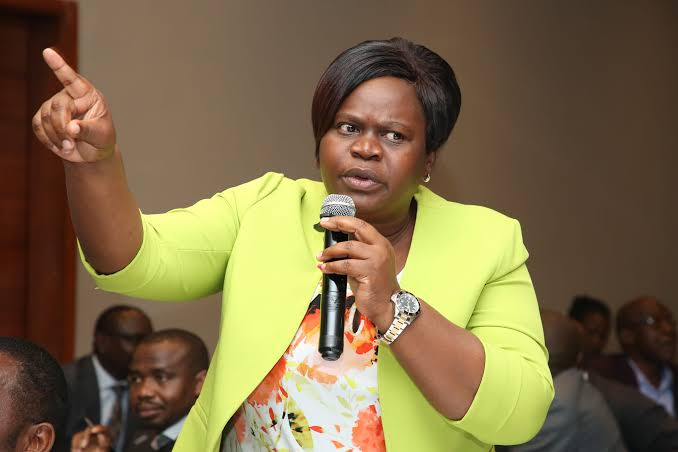
The county government website of Homa Bay loads in a blaze of colour. A cancer centre operationalised. A stadium rising from the lakeshore. A cashless revenue system eliminating leakages. Dispensaries photographed gleaming and freshly painted.
Quote after quote from Governor Gladys Atieno Nyasuna Wanga, ODM national chairperson, Kenya’s most photographed governor, a woman who has mastered the art of making a county look better on a screen than it does in the flesh. The photography is professional. The copy is tight. The launches are frequent. The press releases go out before the ink is dry on any ribbon cut.
On the ground, a different county exists. Suppliers wait years for money they are legally owed. Health workers in peripheral dispensaries show up to facilities described online as ‘upgraded’ and find no medicines.
A referral hospital that is supposed to anchor county healthcare has an incomplete Accident and Emergency Centre. A maize milling plant meant to anchor agro-processing sits idle. Sh700 million in hospital revenue cannot be accounted for.
A company linked to the governor’s own family walked away with nearly Sh20 million in public contracts within its first year of existence, converting the cash into untraceable withdrawals almost immediately. The county’s wage bill is consuming more than half of all revenue, a rate so far above the legal ceiling of 35 percent that, if it were a private company, it would be insolvent.
This investigation draws together three years of audit reports, Senate oversight hearings, EACC findings, PwC forensic disclosures, court records and the accounts of suppliers, health workers and contractors to document the full picture that the PR machine is designed to prevent the public from seeing. It is a picture not of a county being transformed but of one being systematically drained behind a facade of transformation.
“The county slogan — Endless Potential — now reads as endless opportunities for those connected to power rather than ordinary citizens.” — Odoyo Owidi, Lake Victoria South Water Works Development Agency
I. THE NUMBERS THEY DON’T PUT IN THE PRESS RELEASES
Start with the most basic measure of a functioning government: does it pay its debts? The Auditor-General’s report for the 2024/25 financial year found that Homa Bay County carried pending bills of Sh1.52 billion. Of that figure, Sh1.09 billion was more than a year old. Sh700 million had been outstanding for more than three years.
Under the Public Finance Management (County Government) Regulations 2015, pending bills are supposed to be treated as a first charge on county revenue they are not optional. They are the most legally urgent obligation a county government holds.
When Senate County Public Accounts Committee chairman Moses Kajwang’ noted that Sh148 million of those bills had been sitting unresolved for over three years, he did not mince his words. ‘It is indicative of a problem,’ he told the governor during hearings on June 16, 2026.
Wanga’s response was a payment plan: structured tranches of Sh370 million, Sh379 million, Sh363 million and Sh411 million to be paid by June 2026.
The same response, in different numbers, had been given to the same question the year before. The year before that. Meanwhile suppliers whose bills are older than some of the county government’s projects have had their businesses brought to collapse.
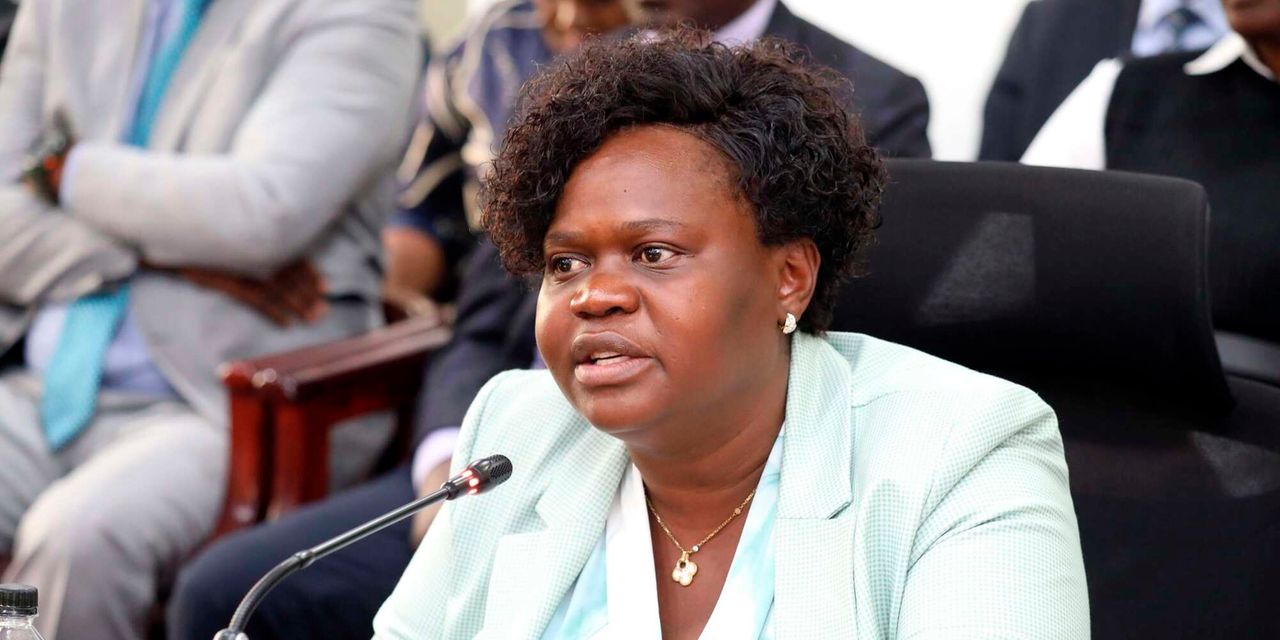
Homa Bay Governor Gladys Nyasuna Wanga when she appeared before the Senate County Public Accounts Committee (CPAC), chaired by Homa Bay Senator Moses Otieno Kajwang’, during a session at Bunge Tower, Nairobi, on Tuesday, June 16, 2026. Governor Wanga appeared before the committee to respond to audit queries.
One supplier, identified in public social media posts only as Maina KE, wrote last week that his patience had cost him his father’s life. He had been promised payment ‘many, many times.’ He is still waiting.
Another supplier, identified as Kamanga Junior, revealed that a friend had supplied computers and printers worth Sh7.3 million to county dispensaries across forty wards. The goods were delivered. The paperwork was completed. Years later the bill remains unpaid.
These are not abstract financial irregularities on a spreadsheet. They are destroyed businesses, broken families and the compounding costs of the county’s deliberate choice to defer what is legally owed while the governor’s photo ops continue.
The wage bill tells an equally damning story. The Auditor-General found that in the 2022/23 financial year, Homa Bay spent Sh4.276 billion 52 percent of its total revenue of Sh8.3 billion on salaries and wages.
The statutory limit is 35 percent. By the 2024/25 financial year, the CPAC had received information indicating the wage bill stood at 54 to 55 percent.
When a county is spending more than half its income on payroll, there is almost nothing left for the roads, the medicines, the dispensary equipment and the development projects that feature so prominently in press releases.
What makes this worse is that a significant portion of that wage bill has been going to workers who, by the government’s own commissioned audit, should not have been on the payroll at all.
II. 1,786 GHOSTS AND THE GOVERNOR WHO COMMISSIONED THE AUDIT
In November 2022, three months after taking office, Governor Wanga did something that looked, at the time, like genuine reformist instinct. She hired PricewaterhouseCoopers to conduct a payroll and personnel census audit to find the ghost workers that had long haunted Homa Bay under former Governor Cyprian Awiti. It was a bold announcement. It generated headlines. It produced photographs of the governor receiving the report with the gravity of a leader serious about accountability.
The PwC report, delivered in August 2023, was damning in scope.
It identified 1,786 irregular employees drawing from the county payroll. Among them: 556 individuals who presented no appointment letters or employment documents. 479 people who were on the payroll but could not be traced to any departmental list. 287 individuals who failed to show up for verification at all. 129 who had no files in the county registry.
Ten people caught generating fake employment documents at a cybercafé in Homa Bay town. And three individuals who were being paid from public funds despite being minors, below the minimum employment age under Kenyan law.
PwC estimated these ghost workers were costing the county Sh300 million every year. Wanga announced at the press briefing that she would implement the recommendations ‘forthwith’ and would take ‘administrative and legal action’ against those earning illegally. She said it was unfortunate. She said it would stop. That was August 2023.
Three years later, as of the CPAC hearing in September 2025, Senator Kajwang’ was still confronting the governor about ghost workers.
The committee had received updated data showing 1,327 ghost workers still on the Homa Bay payroll their names, ID numbers and payroll numbers documented in Appendix Two of a report the governor’s own administration had access to. ‘If you accept that they exist, then you must move quickly to exorcise these ghosts from your system,’ Kajwang told her.
The wage bill, far from falling after the PwC audit, had risen. The 52 percent of 2022/23 had become 54 to 55 percent by 2025. The press release announcing the PwC audit was a PR masterstroke. The implementation was a failure. The 52 employees found sharing a single bank account a detail buried in the Auditor-General’s 2025 report on county payroll anomalies tells you what operational compliance actually looks like in Homa Bay.
PwC identified 1,786 ghost workers costing Sh300 million a year. Three years later, 1,327 remained on the payroll. The wage bill had grown, not shrunk.
III. THE COMPANY THAT APPEARED SIX MONTHS AFTER THE OATH
The most forensically significant corruption allegation currently documented against the Wanga administration involves a company called Exxel Fortune Enterprises Limited.
The timeline is precise and revealing. Gladys Wanga was sworn in as governor on August 25, 2022. Six months later, Exxel Fortune Enterprises Limited was registered.
Within twelve months of that registration, the company had secured contracts worth Sh19.92 million from the County Government of Homa Bay and from the Homa Bay Teaching and Referral Hospital.
The company’s signatories were Maxwel Nyasuna and Collins Okoth. Maxwel Nyasuna shares a surname with the governor, whose full name is Gladys Atieno Nyasuna Wanga.
He is widely identified including by Odoyo Owidi, former chairman of the Lake Victoria South Water Works Development Agency, who has gone on record as a close relative of the governor, specifically her brother. What followed the contract payments is the signature of money that was never intended to pay for legitimate services.
Maxwel Nyasuna withdrew Sh9.74 million in cash. Collins Okoth withdrew Sh12.19 million in cash. The combined cash withdrawal Sh21.93 million exceeded the total contract value of Sh19.92 million, a discrepancy that suggests transfers from other sources also passed through the account. Additional sums moved through M-Pesa: Sh200,000 to a Richard Ogindo and Sh850,670 to Okoth through separate phone numbers he controlled.
There were further transfers to unnamed individuals, some of whom were reportedly too young to have any meaningful connection to the contracts in question.
The pattern immediate cash conversion, layered mobile money transfers, use of multiple numbers to fragment the trail is not consistent with a business that delivered value and paid its taxes. It is consistent with a system designed to extract money from the public purse and disperse it beyond audit reach.
The connection to the referral hospital is particularly important. The same hospital whose facility improvement fund generated Sh1.6 billion in the 2024/25 financial year and where only Sh915 million reached the legally required Special Purpose Account was a contracting party to a company that appeared to exist primarily to receive and immediately withdraw public money.
The Sh685 million variance between what 24 health facilities collected and what reached the designated account remains unexplained.
When Nandi Senator Samson Cherargei asked the governor during the CPAC session where the money went, the answer he received addressed a different question: Wanga explained that only Sh915 million had been received as reimbursement from the Social Health Authority and that Sh350 million was still owed. The question was about why collected revenue did not reach the SPA. The answer was about reimbursements. The variance was not explained.
IV. THE REFERRAL HOSPITAL: REVENUE IN, SERVICES OUT
The Homa Bay Teaching and Referral Hospital is the county’s flagship health facility. It features prominently in Wanga’s communications a renovated maternity unit, a dental unit operationalised, a cancer centre launched. What the county website does not feature is the Accident and Emergency Centre, which remains incomplete despite years of budget allocations.
A county that markets its healthcare transformation cannot explain why the most critical entry point to its main hospital the room where trauma patients, road accident victims and obstetric emergencies arrive has not been finished.
Senator Kajwang’ noted during the March 2026 CPAC session that Homa Bay derives more revenue from its hospitals than from any other source. The Auditor-General confirmed that those funds are not being reinvested into the health facilities to sustain service delivery.
The cycle is circular and corrosive: patients generate revenue through fees and insurance claims; that revenue fails to reach the accounts where it is legally required to be held; the facilities it was meant to fund deteriorate; patients pay more in bribes and out-of-pocket costs to receive care; the reported revenue figures rise while actual service quality falls.
The EACC’s 2024 National Ethics and Corruption Survey placed Homa Bay fourth nationally in average bribe size paid by residents to access public services, at Sh12,381 per transaction. Only Uasin Gishu, Baringo and Embu ranked higher.
Homa Bay also accounted for 5.32 percent of all national bribe payments the fourth-highest county share in the country. These are not abstract statistics. They represent the cost borne by the county’s poorest residents every time they try to access a health facility, a land service or any county-administered programme.
Under Wanga’s watch and despite her announced Corruption Prevention Committees and EACC partnerships Homa Bay’s corruption burden as measured by the national regulator has placed it among the country’s worst performers.
At the peripheral level the consequences are documented with specificity. Nyandiwa Dispensary received Sh19.9 million in facility improvement funds. Odoyo Owidi has described the facility as a neglected, bushy structure with no visible progress.
A facility in Rachuonyo North received Sh54 million one of the highest single-facility allocations in the country. Progress has been minimal. These are not allegations. They are the findings of oversight visits, community reports and the accounts of a named public official who has staked his credibility on the record. The county website shows other dispensaries. It does not show Nyandiwa or Rachuonyo North.
Homa Bay ranked 4th nationally for average bribe size at Sh12,381 per transaction, and 4th in share of national bribes paid even as the governor launched anti-corruption committees.
V. FUEL, VERBAL INSTRUCTIONS AND THE ART OF UNDOCUMENTED SPENDING
The 2024/25 Auditor-General’s report flagged a Sh43.46 million fuel expenditure where instructions to draw fuel at the petrol station were given verbally, with no detailed orders maintained and no record kept for reconciliation between supplier invoices and fuel actually drawn.
This is not a technical accounting lapse.
It is a procurement control failure that makes it impossible to determine whether Sh43.46 million in public money was spent on fuel that the county government actually used, or on fuel that was drawn, diverted and sold elsewhere. In a county whose development budget is being crowded out by a swollen and partially fraudulent wage bill, nearly Sh44 million in fuel spending that cannot be traced to actual government operations is significant.
Wanga’s response was to describe the verbal instructions as ‘supplementary operational communications’ that did not replace the formal authorisation process, and to state that controls had been strengthened.
The auditor’s finding was that no record existed to compare the supplier invoice with fuel drawn. There is no way to verify that the controls described in the governor’s Senate submission correspond to what actually happened in the petrol station queues.
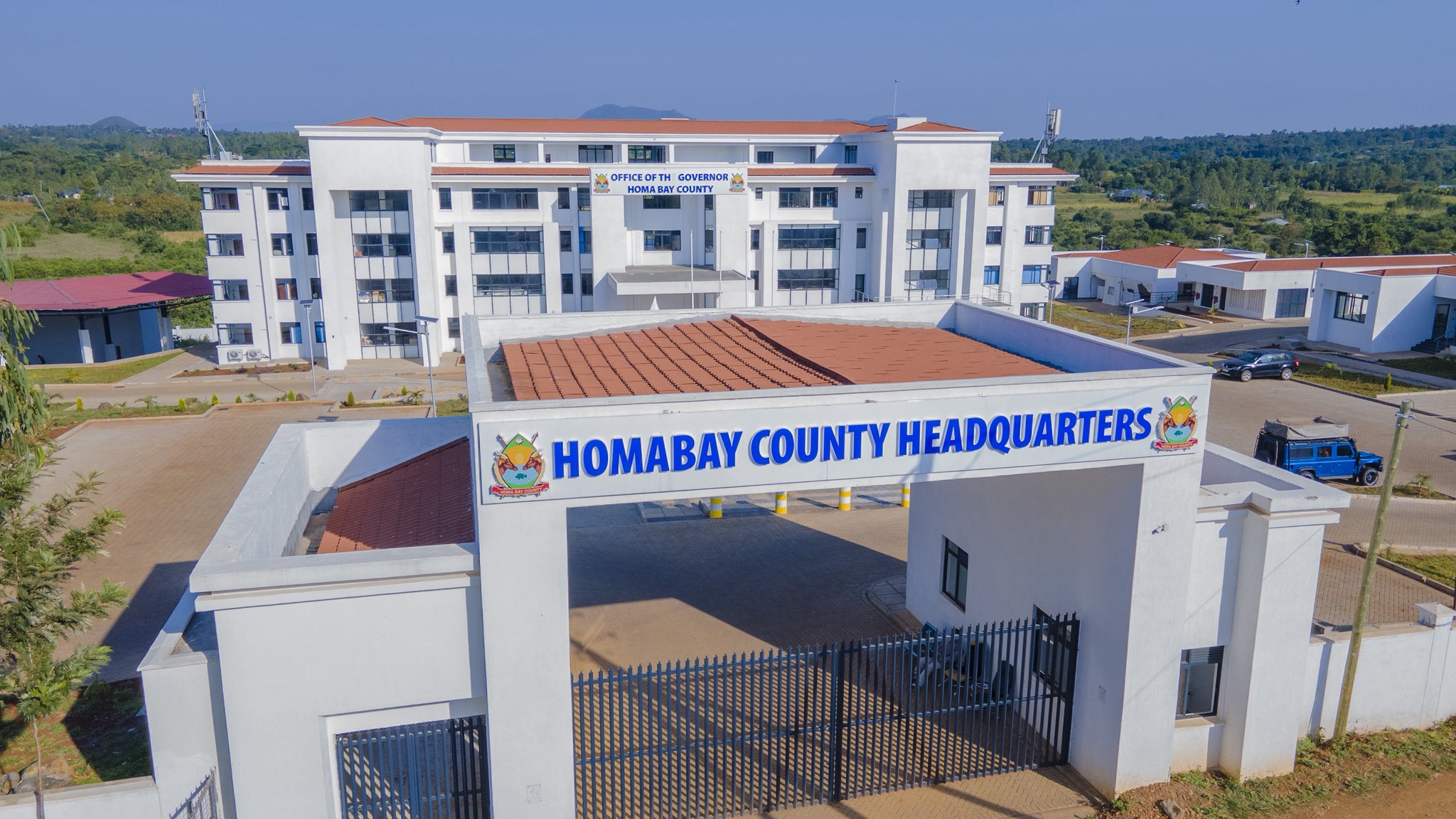
VI. THE ASSEMBLY BLOCK: A SEVEN-YEAR SCANDAL FINALLY REACHES COURT
In January 2026, the Ethics and Anti-Corruption Commission arrested four individuals and called on two more to surrender over what has become Homa Bay’s most documented procurement fraud.
The case involves Tender No. HBCA/T/W6/2018-2019 for the construction of the Homa Bay County Assembly office block, valued at Sh348.9 million and awarded to Hartland Enterprises Limited during the 2019/20 financial year under the Awiti administration.
Hartland was awarded the tender without proper open competition. No valid performance guarantee was provided. The company was linked to employees of the county government a textbook conflict of interest. Construction was eventually stopped in March 2021 when it emerged the building was being erected on national government land.
By that point, Hartland had received Sh66.774 million in two tranches despite the work not corresponding to the sums paid. EACC’s High Court application froze Sh13.5 million in the company director’s Cooperative Bank account as far back as 2022. It took until January 2026 for charges to be filed.
Those charged include former County Assembly Clerk Faith Adhiambo Apuko, former Lands CEC Roseline Anyango Odhiambo, former Ministry of Public Works quantity surveyor Patrick Tonui, and Hartland directors James Mumali Oyukah and Mary Pauline Oduor herself a principal nurse at the Homa Bay Referral Hospital.
The charges cover abuse of office, wilful failure to comply with procurement laws, conflict of interest and unlawful acquisition of public property under the Anti-Corruption and Economic Crimes Act 2003.
The relevance to the Wanga era is not that these individuals served under her. They did not they are products of the Awiti period. The relevance is threefold.
First, EACC’s Corruption Risk Assessment of Homa Bay published while Wanga was already governor found open disregard for procurement regulations and financial management laws, payments for uncertified works, un-surrendered imprests, false allowance claims and insider trading across the county’s systems.
Second, the roads department scandal that emerged in early 2025 shows that the template forged documents, proxy companies, immediate cash extraction was being replicated inside the current administration.
Third, the Hartland case shows that when files are built and institutional insulation is removed, consequences can follow even years later. The Exxel Fortune cash trail has not yet produced a file before any court. The hospital revenue variance has not produced a file. The fuel expenditure has not produced a file.
VII. THE ROADS DEPARTMENT: HISTORY REPEATING AT SPEED
In January 2025, an investigation published by local blogs detailed what it described as a Sh200 million fraud in Homa Bay’s county roads department.
According to that account, officials including the Chief Officer for Finance, the Director of Procurement, a Roads Accountant and a Procurement Officer allegedly met at the governor’s residence in Olare Kochia at the end of the 2023/24 financial year.
There, they are said to have forged documents to justify payments for non-existent road projects, using fabricated signatures of former county officers who had already left their positions. Instead of settling legitimate pending bills owed to real contractors, the funds were channelled to proxy companies and shell entities.
The Roads Accountant named in the account is alleged to have used a company called LETHI Co. Ltd, which operates M-Pesa outlets near county government locations, with employees listed as county staff, to launder the proceeds.
The investigation also named companies linked to what it described as the spouse of a county official with connections to Waponya Enterprise Ltd and Troika Enterprise Ltd, with drivers paid county salaries. This account has not been tested before a court.
Kenya Insights is not in a position to verify all elements independently. But the structural pattern it describes a meeting at the governor’s official residence, forged documents, proxy companies, immediate cash conversion is consistent with the Exxel Fortune model and consistent with what the Auditor-General’s reports have documented as the operating environment of county finance in Homa Bay.
The county website, meanwhile, records that in the 2024/25 financial year, the Roads department opened 736 kilometres of new roads, maintained 538 kilometres and rehabilitated 116 kilometres of access roads.
Whether those figures are auditable, and whether the contractors who built them have been paid, are questions the audit reports and contractors’ own public statements suggest have complicated answers.
VIII. THE DEVOLUTION CONFERENCE, THE MADARAKA DAY AND THE MATHEMATICS OF SPECTACLE
In 2025, Homa Bay hosted both Madaraka Day on June 1 and the 9th National Devolution Conference. Both events required substantial county expenditure on logistics, infrastructure upgrades visible to national visitors, and the kind of civic presentation that national television cameras require.
Governor Wanga has described these events as placing Homa Bay ‘firmly on the national stage.’ Odoyo Owidi, who has consistently been one of the loudest public critics of the administration, made a different calculation.
He condemned the resources channelled into high-profile events while county workers went without salaries and long-stalled projects remained unfinished.
A memorial event for the late Raila Odinga planned despite similar ceremonies having already been held in Kisumu and Bondo drew particular condemnation from Owidi as a use of county funds serving political symbolism rather than resident welfare.
The mathematics here matters.
When a county is spending 54 percent of revenue on wages, when Sh1.52 billion in bills is owed to suppliers and workers, when hospital revenue worth hundreds of millions of shillings cannot be accounted for, there is no fiscal space for spectacle that does not serve delivery.
The Infotrak ranking that the county website cites placing Wanga among Kenya’s best-performing governors in 2023 was produced during a period when the PwC ghost worker report had just been received but not implemented, when the Exxel Fortune contracts were being paid out, and when the pending bills that would become Sh1.52 billion were already accumulating. Perception metrics, generated in the same news cycle as the launch announcements, are not governance metrics.
When a county spends 54 percent of revenue on wages while Sh1.52 billion in verified bills goes unpaid, there is no fiscal space for spectacle that does not serve delivery.
IX. SENATE OVERSIGHT: THE TOOLS EXIST. THE WILL IS TESTED.
The Senate County Public Accounts Committee chaired by Senator Kajwang’ has exercised meaningful oversight. It has summoned the governor, pressed on the pending bills, the hospital revenue variance, the ghost workers and the fuel expenditure.
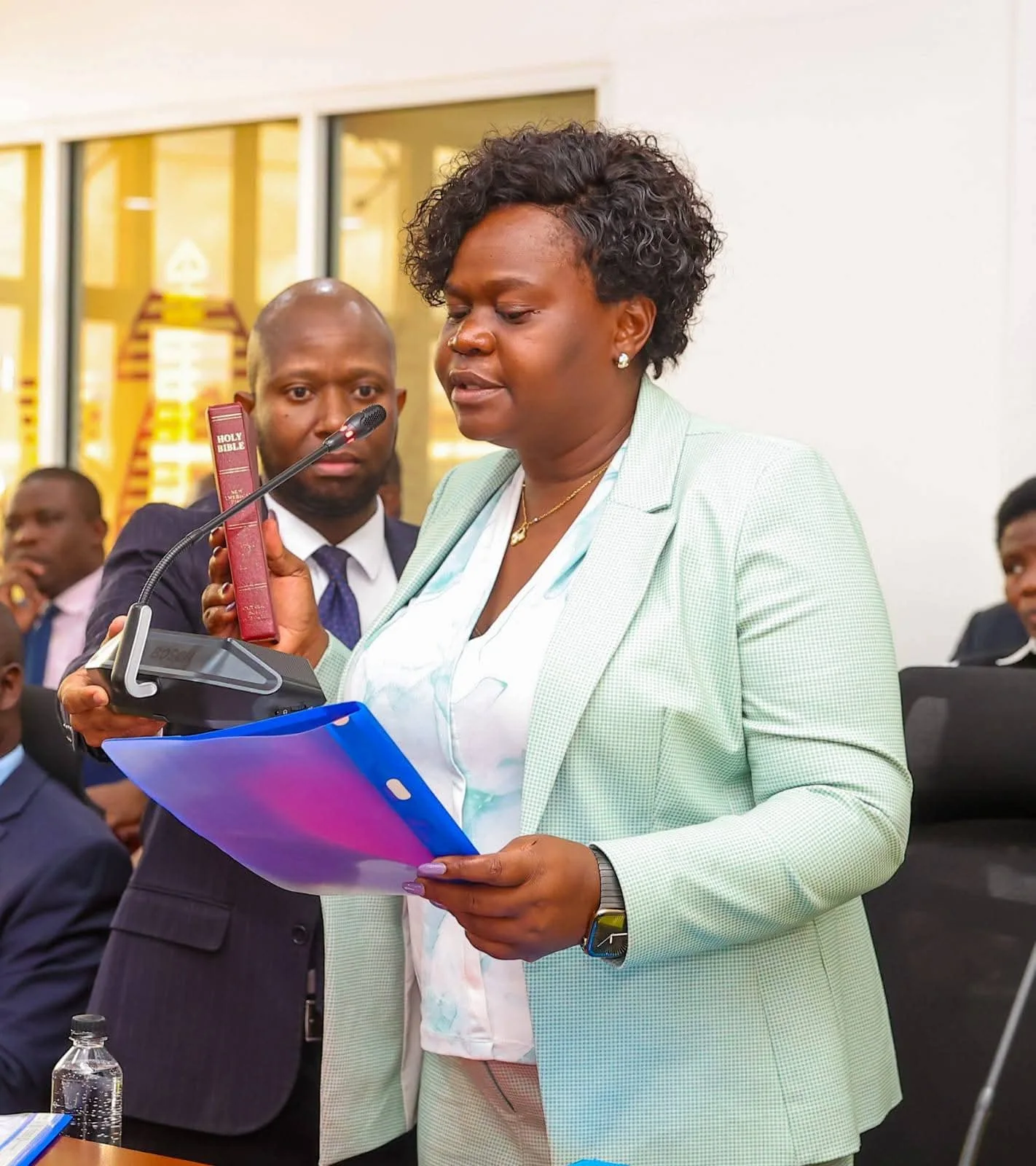
Homabay Governor Gladys Wanga, when she appeared before the County Public Accounts Committee (CPAC) in the senate, chaired by Senator Moses Kajwang at Bunge Towers, on June 16, 2026.
In January 2026, EACC finally moved on the Hartland case a case that had been documented in audit reports since 2021. These are real consequences and real accountability moments.
What the committee has not yet done at least not in public is demand the complete tender files and beneficial ownership records for Exxel Fortune Enterprises Limited. It has not publicly demanded bank records showing the post-payment cash conversions that the company’s signatories executed.
It has not publicly demanded a reconciliation of hospital revenue flows that might explain where Sh685 million went. The committee has the constitutional tools under Article 96 to make those demands, to recommend EACC referrals, to recommend surcharges.
What the Hartland case proved is that when an EACC file is built and charges are approved by the Director of Public Prosecutions, consequences can eventually materialise.
The question is whether the current patterns which are documented in official audit reports that are already public will generate the same institutional determination before they become the next generation of charges filed against officials who have long since moved on.
Governor Wanga’s record before the committee also requires examination. In March 2026, she failed to appear before the CPAC for a second consecutive scheduled session.
On the day she was due to appear, she was in Nairobi but attending a different Senate committee on climate funding, where she shared photographs of the session and noted the successes achieved. The CPAC notices the selective compliance.
Senator Kajwang’ reminded the governor that former Governor Awiti whose administration produced some of the very scandals now being prosecuted consistently attended Senate hearings even while hospitalised. The governing reflex of the current administration is to show up where the optics are good and absent itself where the accounting is hard.
X. WHAT THE OFFICIAL NARRATIVE ERASES
The county website’s ‘Governor’ page states that Wanga’s tenure has been marked by ‘measurable gains across multiple sectors’ and a ‘landmark revenue reform’ that drove own-source revenue from Sh491.5 million in FY2022/23 to Sh1.73 billion by July 2025.
Those revenue figures, if accurate, represent a genuine achievement in collection efficiency. The problem is that rising revenue collection, in the context of Homa Bay’s documented financial flows, does not automatically mean more money reaching services. It means more money entering the system and the documented question is how much of it exits the system through the same channels that the Auditor-General, PwC, EACC and the Senate committee have been tracking.
The county’s Corruption Prevention Committees, established with EACC fanfare, have not prevented the patterns documented across three consecutive audit cycles.
The cashless payment system, cited as eliminating ‘financial leakages,’ coexists with Sh685 million in hospital revenue that cannot be reconciled to its designated account, Sh43 million in fuel drawn without paper trails, and a procurement environment that the EACC’s own Corruption Risk Assessment found to be systematically compromised. The announcements describe the architecture of a clean government. The audit reports describe its operating reality.
There is a supplier in Homa Bay whose father died while waiting for payment on a county contract. There is a dispensary in Nyandiwa that received Sh19.9 million and stands bushy and neglected. There is an Accident and Emergency Centre at the county referral hospital that has been ‘under construction’ through multiple budget cycles.
There is a roads department where officials allegedly met at the governor’s official residence to forge documents for non-existent projects. There is a family-linked company that extracted nearly Sh22 million from public accounts in cash within months of the contracts landing.
There is a ghost worker payroll that PwC exposed in 2023 and the Senate found still populated with 1,327 identifiable names in 2025.
None of these facts appear on the county website. None of them feature in the governor’s press releases. None of them were present in the Infotrak rankings. They exist in audit reports, court records, EACC filings, PwC submissions and the testimonies of people whose names and losses are documented in official records.
XI. THE PATTERN, DRIVEN TO ITS CONCLUSION
Investigative journalism is not about isolated incidents. It is about patterns. The pattern in Homa Bay is consistent across every financial year of the Wanga administration and legible in the audit records going back to the previous one.
A new entity connected to the governor’s family appears within months of her taking office and receives significant county contracts before vanishing its proceeds into cash. Hospital revenue collected from the public does not reach the accounts where it is legally required to sit.
A wage bill swollen by ghost workers who were publicly identified but never removed consumes more than half of county revenue, crowding out all development.
Pending bills accumulate faster than they are paid, meaning real suppliers are effectively financing county operations through forced credit while connected entities get paid promptly. Fuel is drawn without paperwork.
Professional services contracts worth nearly a billion shillings are paid without satisfactory documentation. Legal fees worth tens of millions go to external firms for cases where no satisfactory explanation for outsourcing was provided. And throughout all of this, the communications apparatus produces a high-volume stream of content about transformation, partnership, integrity and potential.
The pattern is not hidden. It is documented, in public, by the state’s own oversight institutions.
What has been missing is synthesis the connecting of the ghost worker numbers to the fuel receipts to the hospital revenue to the family company to the roads scandal to the Senate absences into a single coherent picture of how public money is being managed in the county of Homa Bay under the leadership of Gladys Wanga.
That picture is not of transformation.
It is of capture. A county government captured first at the payroll, where fictitious employees drain Sh300 million annually while real workers go unpaid. Captured at procurement, where family-linked companies with no track record win significant contracts weeks after registration.
Captured at revenue, where hospital funds worth hundreds of millions of shillings disappear before reaching the accounts designed to ring-fence them for patient care.
Captured at the level of documentation, where verbal instructions replace paper trails and doctored records are presented to auditors.
And captured, most insidiously, at the level of narrative where every audit finding is met with a structured action plan, every scandal is answered with a press release, and every accountability moment is pre-empted by a launch.
Gladys Wanga is ODM’s national chairperson. She has national political ambitions that require the appearance of a clean governance record in Homa Bay.
The county she governs is being used, the evidence suggests, as an extraction machine for the benefit of those connected to her family members, political allies, procurement insiders while its residents pay some of the highest per-transaction bribes in Kenya, wait years for money legally owed to them, and receive healthcare from facilities whose revenues have been systematically diverted.
The PR cannot forever outrun the record. The record is in the audit reports. It is in the PwC submission. It is in the EACC filings. It is in the Senate Hansard. It is in the testimony of the supplier whose father died waiting.
It is in the court files where Hartland directors now face trial for what was done to Homa Bay’s assembly block proof that when files are eventually built, consequences come.
The file on the current administration is being built, page by page, financial year by financial year. The ‘Bay of Endless Potential’ deserves to know what has been done to it in the name of its transformation.
Kenya Insights allows guest blogging, if you want to be published on Kenya’s most authoritative and accurate blog, have an expose, news TIPS, story angles, human interest stories, drop us an email on [email protected] or via Telegram











TOO MUCH PR, NOTHING TO SEE: How Gladys Wanga Built a Perfect Story of Transformation While Homa Bay Bled

Netanyahu Says Israel Must ‘Break Free from Dependence’ After Tensions With Trump Administration

Niger pulls Out Of International Criminal Court After Calling It Neo-Colonialist

Kenya Awards Sh154 Billion JKIA Upgrade Tender To Chinese Firm CRBC

The Untouchable: How KURA’s Silas Kinoti Has Survived A Decade Of Corruption Storms While Kenya’s Roads Bled

Fake Papers, Dirty Millions And The Analo Connect: How Kitisuru MCA Alvin Palapala Built a Shadow Empire Inside Nairobi’s Planning Machine

Migori Payment Row Deepens As Branding Firm Demands Sh3.8 Million Over Unpaid Piny Luo Festival Deal

Utumishi Girls Fire Suspects To Be Charged With Murder

Putin Says Russia Ready For Peace Talks With Ukraine Based on Anchorage, Istanbul Agreements

South Sudanese Must Give Adut Salva Kiir The Benefit Of The Doubt

Businessman Philip Waithaka Kinuthia’s Minor Son Allegedly Drove Drunk, Killed Two Peponi Students in Ngong Road Horror Crash as Claims of Cover-Up Intensify

Inside NCBA’s Decline: How a Banking Giant Lost Its Strategic Edge

South Sudan: Adut Salva Kiir’s Shadow Treasury Exposed

Cement, Cash and Courts: How the Hashu Dynasty Crushed the Ramji Brothers for Fourteen Years and Why the Walls Are Now Closing In

Standard Chartered Ghosts Haunt Joshua Oigara At Stanbic As Whistleblower Spills Beans

Inside The Urban Planning Cartel That Owns Nairobi

THE VULTURE AND THE SCHEME How Nairobi West Hospital Became the Most Dangerous Institution in Kenya’s SHA Ecosystem and Why the Books Must Be Audited Now

The President’s Daughter and The Missing Witness: How Adut Salva Kiir’s Shadow Treasury Silenced Its Most Dangerous Critic

How Adil Popat Saved His Empire On The Eve Of Imperial Bank Collapse and Why Kenya’s Mainstream Media Buried The Story

Why John Ngumi Is Running From the EACC and Why the Sh415 Million Payday May Be the Least of His Worries
-
 News1 week ago
Businessman Philip Waithaka Kinuthia’s Minor Son Allegedly Drove Drunk, Killed Two Peponi Students in Ngong Road Horror Crash as Claims of Cover-Up Intensify
-
 Africa2 weeks ago
South Sudan: Adut Salva Kiir’s Shadow Treasury Exposed
-
 Business2 weeks ago
Standard Chartered Ghosts Haunt Joshua Oigara At Stanbic As Whistleblower Spills Beans
-
 Investigations5 days ago
THE VULTURE AND THE SCHEME How Nairobi West Hospital Became the Most Dangerous Institution in Kenya’s SHA Ecosystem and Why the Books Must Be Audited Now
-
 Africa2 weeks ago
The President’s Daughter and The Missing Witness: How Adut Salva Kiir’s Shadow Treasury Silenced Its Most Dangerous Critic
-
 Business2 weeks ago
How Adil Popat Saved His Empire On The Eve Of Imperial Bank Collapse and Why Kenya’s Mainstream Media Buried The Story
-
 Business2 weeks ago
Why John Ngumi Is Running From the EACC and Why the Sh415 Million Payday May Be the Least of His Worries
-
 Business5 days ago
Inside the Billion-Shilling Betrayal: How Senior Treasury Officials Plundered a UN Poverty Fund and Built a Real Estate Empire on the Backs of Kenya’s Rural Poor