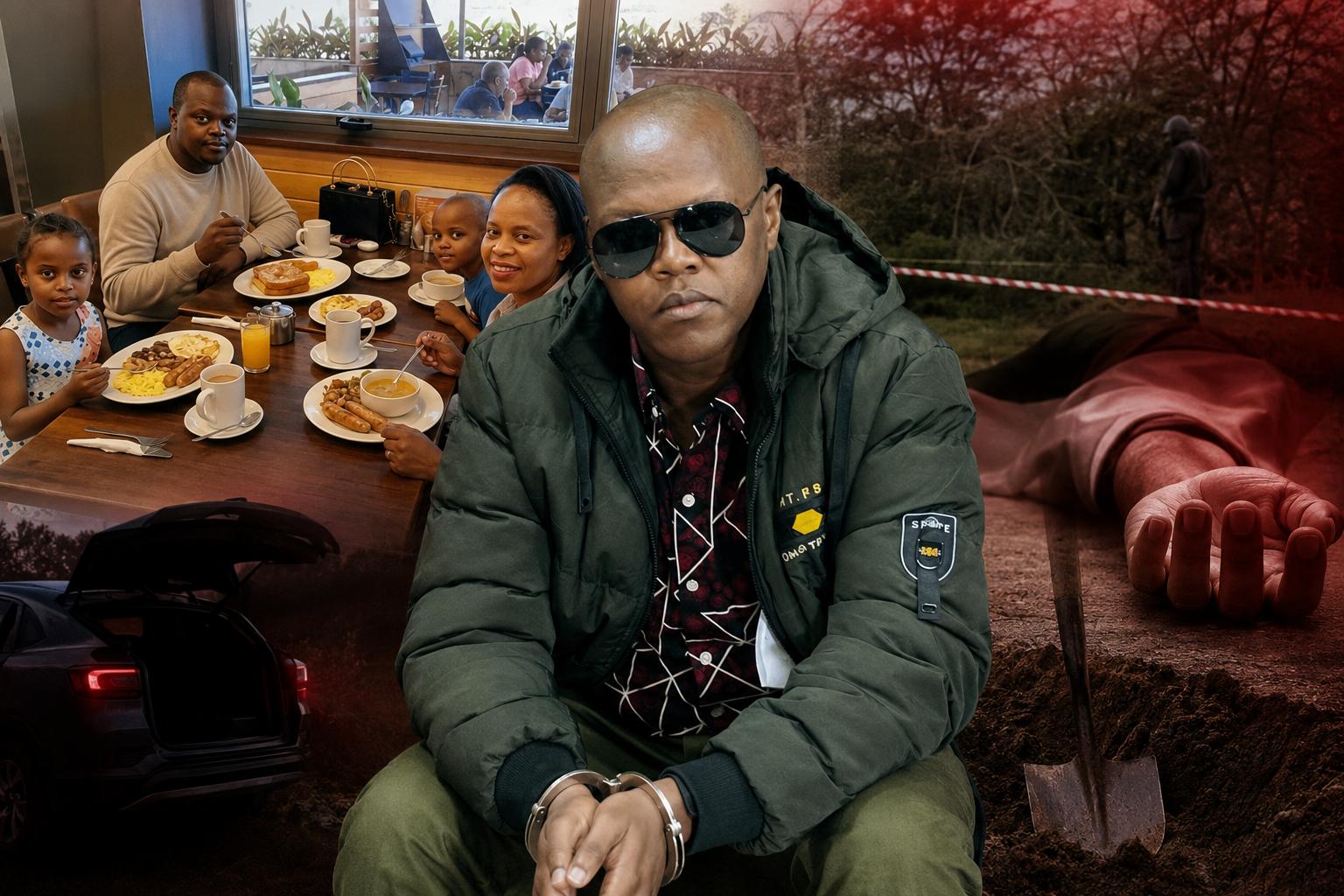
For seven years, three voices remained silent.
A young mother disappeared. So did her 10-year-old daughter. So did her five-year-old son.
Their phones went dead. Their relatives searched desperately. Police chased one lead after another. Rumours spread. Hope slowly faded.
Then, buried beneath the soil in a remote corner of Laikipia, investigators uncovered a truth so disturbing it would eventually rank among Kenya’s most horrifying family murder cases.
When the High Court finally delivered its judgment in July 2026, it concluded that former Kenya Defence Forces Major Peter Mwaura Mugure had meticulously planned the murder of his estranged wife, Joyce Syombua Maua, and their two children before secretly burying them in a shallow grave.
The conviction closed one of the country’s longest-running murder mysteries.
But to understand the horror, one must return to where the story began.
A Love Story Born in Kayole
Long before detectives, courtrooms and forensic experts became part of their story, Peter Mugure and Joyce Syombua were simply two young people trying to build a future.
Both grew up in Nairobi’s Kayole estate, raised by hardworking single mothers who sacrificed everything to educate their children.
Mugure pursued Civil Engineering at Egerton University while Joyce was still in secondary school. After graduating, their relationship blossomed into marriage.
Soon, they welcomed their first child, Shanice.
To neighbours, relatives and friends, they appeared to be another young family beginning life together.
Behind closed doors, however, cracks were already beginning to widen.
The relationship eventually collapsed.
Joyce returned to Nairobi with their daughter and began raising her alone.
Court proceedings would later reveal that she struggled financially, taking on different jobs to provide for her child while pursuing legal avenues to compel Mugure to contribute to their upkeep.
Despite the separation, the two briefly reunited at one point, resulting in the birth of their second child, Prince Michael.
But instead of rebuilding their family, the relationship deteriorated further.
The Battle Over Parenthood

According to evidence presented during the trial, Mugure disputed the paternity of both children after Joyce sought child maintenance.
Rather than engaging in prolonged conflict, Joyce turned to the courts.
DNA tests later confirmed with overwhelming scientific certainty that Mugure was the biological father of both children.
The court subsequently ordered him to pay Sh25,000 every month for child maintenance while granting him visitation rights.
Those orders would later become central to the prosecution’s case.
Investigators argued that the legal visitation arrangement provided the perfect opportunity for Mugure to lure Joyce and the children to Nanyuki.
The Invitation
In October 2019, Mugure invited Joyce to travel from Nairobi to the Kenya Air Force Base in Nanyuki together with the children.
On paper, nothing appeared unusual.
A father wanted to spend time with his children.
A mother was complying with a court order.
Before travelling, Joyce kept in close contact with a trusted friend through text messages, updating her about the journey and their arrival.
According to testimony presented during the trial, Joyce later told her friend that Mugure had suggested they rekindle intimacy.
She declined.
The following morning she reportedly messaged again, saying they had spent the night peacefully and that perhaps remaining separated parents was the healthiest path forward.
Her friend urged her to be careful.
Those messages would become some of the last traces of Joyce alive.
The Walk That Never Ended
The following day, Mugure told Joyce he wanted to take the children around the military installation.
She stayed behind.
Hours passed.
When she asked where the children were, he allegedly reassured her they were with a friend and encouraged her not to worry.
That reassurance would prove devastatingly false.
According to the court’s findings, the children never left the military base alive.
Medical evidence later showed both had been strangled.
Joyce did not know it then.
She spent hours waiting for children who would never return.
The Final Night
The prosecution reconstructed what happened next through witness testimony, forensic evidence, phone records and the testimony of a co-accused who later entered into a plea agreement.
After the children were killed, Mugure allegedly took Joyce out for dinner before returning with her to the military residence.
That night, investigators concluded, he killed her.
The post-mortem examination found that Joyce died from severe blunt force injuries to the head.
By then, according to the court, the entire family had been wiped out.
The Lie Begins
When Joyce’s family and friends could no longer reach her, concern quickly turned into panic.
Mugure reportedly claimed she had travelled back to Nairobi after an emergency at the barracks and that he had escorted her to a bus stage.
It was an explanation that failed to convince those who knew her.
Then came an unexpected breakthrough.
A public service vehicle operator found a mobile phone abandoned inside one of their vehicles.
While attempting to identify its owner, staff repeatedly noticed one number appearing in recent calls.
They dialled it.
The person who answered was Joyce’s close friend.
The recovered phone became one of the first major cracks in the narrative investigators had been given.
The Grave That Was Waiting
As detectives pieced together the evidence, an even darker picture emerged.
According to the High Court, this was not a killing born out of sudden anger.
It was carefully prepared.
Evidence showed Mugure had visited the eventual burial site three days before the murders with another military officer.
Justice Martin Muya concluded that the visit demonstrated planning.
The grave site had effectively been identified before the victims were killed.
That finding transformed the case from a domestic dispute into one of calculated execution.
The Witness Who Broke the Silence
A crucial breakthrough came from Collins Pamba, who admitted helping dispose of the bodies before entering into a plea bargain with prosecutors.
He testified that Joyce’s body had been placed inside a transparent body bag while the children’s bodies were inside a bathtub.
The bodies were tied, squeezed into the boot of Mugure’s vehicle after the spare wheel had been removed to create space, then transported out of the military installation before being buried in a shallow grave.
His testimony was supported by forensic evidence, DNA analysis, mobile phone records and other circumstantial evidence presented during the trial.
Science Confirms What Denial Could Not
Government Chemist analysis confirmed the remains recovered from the shallow grave belonged to Joyce, Shanice and Prince Michael.
DNA analysis also established with near certainty that Mugure was the biological father of both children.
The same children he had previously denied.
Chief Government Pathologist Dr Johansen Oduor concluded that Joyce died from blunt force trauma while both children died from strangulation.
Together, the forensic findings reinforced the prosecution’s reconstruction of the murders.
Seven Years Later
After years of investigations, court applications, witness testimony and legal battles, the High Court found that prosecutors had proved the case beyond reasonable doubt.
Justice Muya ruled that the murders were deliberate, carefully planned and followed by an elaborate effort to conceal the crime.
Days later, during sentencing, the court described the killings as exceptionally cruel and noted the absence of remorse before sentencing the former KDF officer to life imprisonment on all three counts of murder.
The sentence brought legal closure to a case that had haunted the country since 2019.
A Case Kenya Will Not Forget
The story of Joyce Syombua, Shanice and Prince Michael is not remembered solely because of its brutality.
It is remembered because it unfolded behind the appearance of an ordinary parental visit sanctioned by a court.
It exposed how violence can sometimes wear the mask of routine, trust and reconciliation until it is too late.
Seven years after three family members vanished without explanation, the silence was finally broken inside a courtroom.
What emerged was not merely the story of a murder.
It was the reconstruction of a plan that investigators say began long before anyone realised three lives were about to disappear forever.







Comments