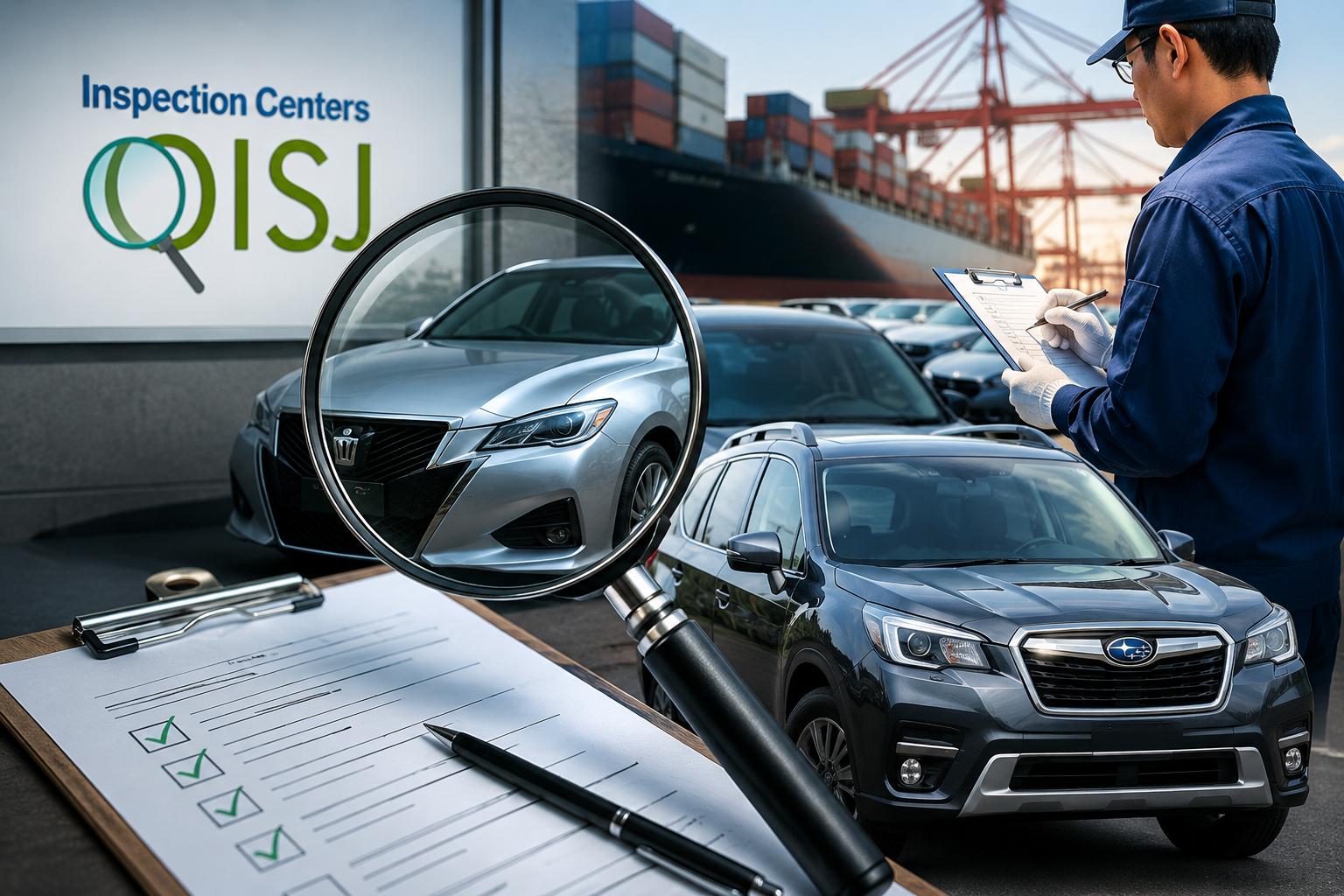
Tanzania has done what Kenyan regulators have refused to do for a decade. It looked under the hood of Quality Inspection Services Japan and said no. The Tanzania Bureau of Standards has rejected the firm for a major used vehicle pre shipment inspection contract after its own agents visited QISJ facilities in Yokohama and Nagoya and found what should have disqualified the company from Kenyan work years ago.
There were no airbag scanning tools. There were no battery testers. There were no alternator testers. And there were discrepancies in QISJ’s books of accounts for the 2022 to 2023 financial year serious enough that Tanzanian officials said they could not determine the true value of the firm’s assets and liabilities.
These are not the sites of a fringe operator. Daikoku Futo in Yokohama and the Shihonagicho centre in Nagoya are two of the flagship inspection points that have cleared vehicles bound for Kenyan roads for roughly a decade, under a contract awarded and repeatedly renewed by the Kenya Bureau of Standards.
Every Kenyan who has bought a Toyota, a Nissan, an Isuzu truck or a matatu body imported from Japan since the mid 2010s has trusted, without ever being told otherwise, that a QISJ certificate from these very facilities meant the vehicle had been properly checked. Tanzania’s rejection says that trust may never have been warranted.
An Airbag Scanner Is Not a Formality
It is worth pausing on what was actually missing, because the language of a procurement rejection can flatten how serious this is. An airbag scan tool exists to verify that a vehicle’s supplemental restraint system will deploy in a crash.
Without it, there is no way to know whether the difference between a survivable collision and a fatal one is even present in the car. Battery and alternator testers exist to catch failing electrical systems before they become fires or breakdowns on a highway.
These are the tools that separate a genuine roadworthiness inspection from a rubber stamp.
Tanzanian standards officials found them absent at the exact yards that have been certifying vehicles for Kenya since roughly 2015 or 2016, and they combined that finding with unresolved questions about QISJ’s financial statements to disqualify the firm outright, a serious step under Tanzania’s procurement rules.
KEBS has never publicly confirmed that its own officers conducted routine physical verification visits to these specific Yokohama and Nagoya sites to check for this equipment before the current contract was awarded and subsequently renewed.
When journalists have pressed the agency on due diligence questions tied to the current contract, officials have pointed to ongoing court cases as a reason to withhold comment. That silence, sustained across a decade in which hundreds of thousands of vehicles passed through QISJ’s hands, is itself part of the story.
The Jans Trading Problem That Never Went Away
QISJ’s troubles did not begin in Tanzania and they did not begin recently.
The firm has been dogged since at least 2011 by credible, well documented allegations that it operated simultaneously as inspector and as business partner to one of the biggest players in the very trade it was supposed to police.
Jans Trading Company Ltd, one of the largest exporters of used Japanese vehicles into Kenya, shared physical addresses, telephone numbers, fax lines and even company directors with QISJ.
The two men most often named in this overlap are Hatano Kiyoaki and Jans Umar, both of whom held director positions in QISJ and in Jans Trading at the same time.
The Japan Export Vehicle Inspection Centre, which held the KEBS tender before QISJ displaced it, raised the alarm in writing as early as March 2011.
In letters to the then KEBS managing director Joseph Koskey, JEVIC’s chief executive laid out multiple points of overlap between the two firms and stated that a QISJ director was operating out of Jans Trading’s own office in Yokohama.
By 2011 Jans Trading was bringing in roughly nine thousand used vehicles a year from Japan, close to a quarter of all vehicle imports into Kenya at the time, a scale that made the alleged relationship with its own inspector a direct threat to the integrity of the entire import chain.
The scandal briefly became personal and criminal.
In November 2011, Jans Umar was arrested in Kenya by the Directorate of Criminal Investigations over allegations that he had defrauded Kenyan car buyers as a director of Jans Trading, arriving in the country at the very moment KEBS was evaluating tenders for the same inspection contract his other company stood to benefit from.
Kenyan tender rules for the pre export verification of conformity assignment explicitly bar bidders with conflicts tied to vehicle exportation into Kenya. Parliament’s Public Accounts Committee took up related complaints in 2016 but reportedly reached no conclusive finding.
A private citizen petitioned the Public Procurement Regulatory Authority again in 2021 to have QISJ barred over the same undisclosed export ties, and a Nairobi law firm made similar representations during the 2022 tender round. None of it dislodged the firm.
Blacklisted at Home, Welcomed Abroad
If the conflict of interest allegations were not damning enough on their own, QISJ’s record in its home market should have settled the matter. In August 2015, the Japan Harbor Transportation Association blacklisted QISJ alongside another firm following site investigations conducted that May and August. The stated reason was that the firms’ inspectors were not properly qualified to carry out radiation surveys on used vehicles, a termination notice that explicitly found the inspectors unqualified under the union’s own standards.
The timing made the finding especially serious.
The blacklisting came against the backdrop of the March 2011 Fukushima Daiichi nuclear disaster, after which radiation screening of vehicles and scrap metal leaving Japan became a matter of urgent international concern for every importing country, Kenya included.
QISJ’s own promotional materials describe radiation inspection as a core part of its service.
The JHTA’s investigators found the opposite on the ground. Kenyan officials from the Trade ministry and the Auditor General’s office who travelled to Japan, the UAE and the UK around that period to verify inspection capacity did not impose any equivalent consequence on QISJ.
JEVIC, by contrast, had already lost its own Kenyan contract partly over radiation and overage vehicle concerns.
QISJ faced no decisive sanction and instead consolidated its position as Kenya’s sole vehicle inspector.
Sh2.5 Billion and Counting: The Overcharging Case
Beyond safety and conflict of interest questions sits a straightforward financial one, and it runs into the billions.
Between 2018 and mid 2020, QISJ inspected 229,715 vehicles bound for Kenya. Records show it was expected to charge roughly 109 dollars per vehicle but instead billed around 122 dollars, a gap that extracted an additional Sh801 million from Kenyan importers in that window alone.
Broader estimates, drawn from a parliamentary progress report on a 2019 special audit, put the vehicle count for the 2015 to 2019 period at over 409,000 units and the cumulative overcharge, including an extra roughly Sh4,000 per vehicle sustained over more than six years, at close to Sh2.5 billion.
A private importer, George Odhiambo, took the matter to the High Court in 2020, arguing that QISJ’s monopoly position allowed it to withhold excess fees that were ultimately passed on to ordinary Kenyan car buyers and businesses.
Court filings in that case argued that QISJ continued overcharging consumers by applying its own exchange rate assumptions against the currencies it was contracted in.
Then KEBS managing director Bernard Njiraini publicly acknowledged that the agency was investigating the extra charges, warning that they raised the cost of doing business and discouraged importation.
Njiraini himself was arrested in 2020 by the Ethics and Anti Corruption Commission for allegedly obstructing investigators who were seeking documents related to the same procurement scandal, and separate reporting has alleged he later received a payment to slow the inquiry, an allegation QISJ and its associates have not been shown to have answered on the record.
The Tender Wars: Forged Documents, Phantom Centres and a Rigged Audit
The fiercest fighting over the KEBS contract broke out around the 2021 retender, and it exposed how far interested parties were willing to go.
A 2019 special audit by the Auditor General questioned claims by QISJ’s rivals East Africa Automobile Services and Auto Terminal Japan that they operated seventeen inspection centres in Japan and three in the United Kingdom, when investigators could verify only eight lease agreements.
Parliament’s Public Investment Committee later recommended barring both firms from vehicle inspection tenders on the strength of that audit.
But documents seen by Kenya Insights showed the audit team’s Japan travel and accommodation had been arranged by QISJ itself, an interested party in the very tender the audit was meant to adjudicate impartially, and that the auditors had falsely claimed in their report to have travelled to South Africa before later recanting that claim.
The 2021 tender process itself became a case study in procurement sabotage. A bidder called Five Blocks Enterprises collected tender documents but never submitted a bid, then used its sole director to petition the PPRA’s Debarment Committee to have QISJ’s two main rivals barred. Reporting at the time alleged that hundreds of millions of shillings changed hands to influence investigators and Debarment Committee members, with claims that two senior officials at the DCI and KEBS each received bribes in the region of Sh100 million.
The tender, floated in January 2021 with an original closing date of February 10, was repeatedly extended through PPARB reviews and did not close until May 5, by which point only four firms remained in contention: QISJ, Auto Terminal Japan, East Africa Automobile Services and Wilnar International.
That fight has now reached the criminal courts.
In July 2026, Japanese businessmen and several Kenyan associates linked to two rival inspection firms were charged before the Milimani Law Courts with forty counts of procurement fraud tied to KEBS tenders awarded between 2014 and 2022.
Prosecutors allege forged academic certificates, the listing of inspection centres that did not exist, concealment of true corporate ownership through a shell company, and representation in the tender process by an advocate who was not licensed to practise law. Both accused firms no longer hold the KEBS contract.
QISJ, the firm that has held it throughout, has faced its own share of formal complaints, a foreign blacklisting, an unresolved conflict of interest history and now a Tanzanian rejection over missing safety equipment, and yet it has never once been the subject of criminal charges in Kenya.
What Tanzania’s Verdict Really Means for Kenya
Tanzania’s decision to hand its own contract instead to EAA Company, one of QISJ’s oldest rivals and a firm that has itself weathered Kenyan debarment attempts, is more than a lost commercial contract for QISJ.
It is independent confirmation from another East African standards body that the exact facilities used to clear vehicles for Kenya fell short on the equipment and financial transparency that any credible inspection regime requires.
The same Daikoku Futo and Shihonagicho sites appear in QISJ’s own 2022 tender submissions listing twenty nine Japanese inspection centres. The financial irregularities Tanzania flagged concern the 2022 to 2023 financial year, well within the current KEBS contract period. The equipment gaps existed the entire time vehicles kept flowing toward Mombasa and Dar es Salaam alike.
Every Kenyan who has imported a car, bought a used vehicle from a dealer, or boarded a matatu built from an imported chassis in the past decade is entitled to ask hard questions now.
Were airbags, batteries and alternators actually verified at facilities now shown to lack the tools to verify them.
How many vehicles with hidden defects reached Kenyan roads because the scanner that would have caught them was simply not there. How much of the extra Sh2.5 billion in disputed fees ended up in the price Kenyan families paid for a car.
The pattern across fifteen years is not a series of unconnected controversies.
It is warnings raised by a displaced competitor in 2011, a foreign blacklisting in 2015, procurement petitions in 2016 and 2021, a disputed audit in 2019, a Sh2.5 billion overcharging claim litigated from 2020, and now a peer regulator’s rejection in 2026, all pointing at the same company holding the same monopoly.
Parliament, the Ethics and Anti Corruption Commission, the Directorate of Criminal Investigations and KEBS itself owe Kenyans a full and independent forensic audit of QISJ’s entire tenure, not merely a review of the latest tender cycle.
Every certificate issued from the Yokohama and Nagoya sites named in Tanzania’s rejection deserves scrutiny.
Every shilling of the disputed overcharge deserves an honest accounting. Tanzania saw what Kenyan institutions have spent a decade choosing not to see. Whether Kenya finally acts on evidence that has been sitting in plain sight since 2011 will determine how many more vehicles, and how much more money, pass through this same gate unchecked.


Comments