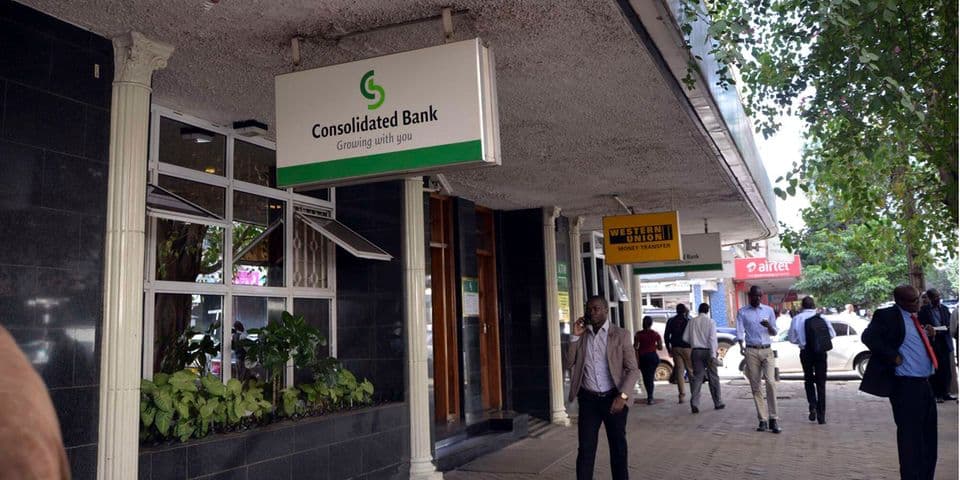
Nairobi. A bank owned by the Kenyan taxpayer to the tune of 93.4 percent was, on paper, worth less than nothing at the close of 2025. Yet inside its walls, staff loans kept growing. The Auditor-General’s verdict is unambiguous: Consolidated Bank of Kenya breached the statutory ceiling on insider lending by more than three times over, at the exact moment its balance sheet could least afford it.
THE NUMBERS THAT DON’T LIE
Auditor-General Nancy Gathungu’s review of Consolidated Bank’s financial statements for the year ended December 2025 found that loans advanced to staff had climbed to KSh435 million, up 14 percent from KSh382.3 million the year before. Ordinarily a modest, almost unremarkable figure for a mid-sized lender. Except Consolidated Bank’s core capital, the buffer that is supposed to absorb losses and protect depositors, stood at negative KSh546.1 million at the same date.
Set against that negative base, the Auditor-General calculated that staff lending alone amounted to 67 percent of core capital. The Banking Act caps aggregate insider lending, to directors, shareholders, associates and employees combined, at 20 percent of core capital. Consolidated Bank blew past that ceiling by more than three times, and it did so while operating with no real capital cushion to speak of at all.
A 20 percent cap breached by 67 percent on a negative capital base is not a technical infraction. It is a bank that let insiders keep drawing down facilities from a vault that, by every regulatory measure, was already empty.
The insider lending breach did not arrive in isolation. Gross non-performing loans stood at KSh4.09 billion, close to 40 percent of the entire loan book, with roughly a third of that classified in the highest-risk loss category, meaning the bank holds little realistic hope of recovering it. Accumulated losses had reached KSh4.27 billion.
All three of the Central Bank of Kenya’s key regulatory capital ratios sat below the prescribed minimums, and the bank had missed the new KSh3 billion minimum core capital threshold that came into force under the Business Laws (Amendment) Act, 2024.
NINE YEARS IN THE RED, TWELVE YEARS WITHOUT A RESCUE
This is not a fresh wound. Consolidated Bank has been in the red for roughly a decade, and prior Auditor-General reviews on the 2024 financial year had already catalogued a litany of dysfunction. The bank’s risk-based loan pricing model was, as of the 2024 review, still running on sectoral data collected between 2018 and 2020, meaning credit was potentially being mispriced across the book, either bleeding revenue through underpricing or driving away customers through overcharging.
Its core banking system reached end of life in 2014 and has gone without vendor security patches for over a decade, a standing invitation to cyber intrusion at an institution that holds public deposits. A roughly KSh200 million contract awarded in 2022 to upgrade that system was terminated a year later after the bank discovered the company it had actually contracted with was not the same entity that built the system being upgraded, a discovery that has since spilled into litigation.
Multiple senior managers, including heads of legal, finance, risk and human resources, served in acting capacities for well over the six-month legal limit, in some cases for more than two years, while collecting acting allowances the law does not permit beyond that window.
In November 2024 the bank pushed through a six percent general salary increase without seeking approval from the Salaries and Remuneration Commission, adding roughly KSh2.1 million to its monthly wage bill at an institution that could not meet its own capital obligations.
The National Treasury, which has controlled Consolidated Bank for more than three decades since it was cobbled together in 1989 from the wreckage of nine failed building societies and finance houses, has left the lender starved of fresh equity for over a decade even as it kept the doors open through the Central Bank’s liquidity window.
Central Bank lending to the bank reached roughly KSh4.7 billion by the end of 2024, taxpayer-backed support propping up an institution that regulatory filings show has been in breach of minimum capital requirements for nine straight years.
A BOARDROOM COUP INSIDE A CAPITAL CRISIS
As the capital numbers worsened, Consolidated Bank’s governance became a battlefield. In late 2025, with the board pushing to renew the contract of then chief executive Sam Muturi on the strength of the bank’s first half-year profit in fifteen years, Treasury Cabinet Secretary John Mbadi moved instead to block the renewal.
On October 3, Mbadi fired three sitting directors who had signed a letter backing Muturi’s extension, and President William Ruto revoked the appointment of board chairman Jared Njagagua the same day, leaving the bank without a substantive board.
Five days later, Mbadi advised the two remaining directors to install Dominic Murage Njeru, a University of Nairobi lecturer with no prior banking executive experience, as acting chief executive, doing so without the prior Central Bank of Kenya clearance the law requires for such appointments.
Muturi went to court seeking reinstatement or KSh76 million in compensation, arguing the Treasury had no authority to override the board’s decision on who runs the bank.
A state bank technically insolvent on paper still found itself at the centre of a boardroom coup over who would control it, while the underlying rot in the loan book went unaddressed.
The episode matters beyond palace intrigue. It is a live illustration of a state-owned lender whose governance is subject to ministerial direction as much as to board process or regulatory oversight, precisely the conditions in which the insider lending breach the Auditor-General has now exposed was allowed to fester unchecked for years.
THE INSIDER LENDING PLAYBOOK
The mechanics of the breach are simple, and that simplicity is what makes it so damning. The Banking Act’s 20 percent insider lending cap exists for one reason: to stop a bank’s own people from treating depositor funds as a personal credit facility, and to ensure that when a bank is under stress, its capital is not further hollowed out by preferential lending to those who control it. Consolidated Bank’s staff loan book of KSh435 million at the end of 2025 did not shrink as the capital position deteriorated. It grew.
By March 2026, the picture had not improved. Regulatory filings examined separately from the annual audit show insider loans to staff at Consolidated Bank had risen further to KSh436.7 million against a core capital position of negative KSh541.1 million, insider lending growing even as the bank remained in open breach of the cap.
The persistence of the breach across two separate reporting periods, rather than a single lapse corrected once flagged, is the detail that turns this from an accounting footnote into a governance scandal.
Directors and shareholders themselves are recorded as holding no direct insider facilities in some of the bank’s public disclosures, meaning the exposure the Auditor-General flagged sits squarely with staff lending, loans extended by the bank’s own credit function to its own employees, approved through the bank’s own internal controls, at an institution the regulator itself classifies among the most distressed Tier III lenders in the country.
OBSOLETE SYSTEMS, MISSING APPROVALS, A PATTERN OF IMPUNITY
Taken together, the Auditor-General’s findings sketch an institution where control failures compound one another. A core banking system a decade past its vendor support date sits alongside a credit pricing model built on stale sectoral data, alongside acting managers operating years beyond their legal mandate, alongside an unauthorised salary hike, alongside an insider lending breach more than three times the statutory ceiling.
None of these is, on its own, unprecedented in Kenyan banking. Together, at a single institution, over a period stretching close to a decade, they describe a culture rather than an incident.
The bank did register a modest net profit of roughly KSh184.3 million to KSh198 million for 2025, its first profitable year in over a decade after fifteen years of losses by some counts.
But the improvement leaned heavily on a shift toward lower-risk government securities rather than a rebuilt private-sector loan book, and interest income from customer loans itself declined even as non-interest income and net interest income overall improved.
A profit built substantially on a bigger government securities book, at a bank still carrying KSh4.09 billion in bad loans and a capital hole in the billions, offers little assurance that the underlying asset quality problem has been resolved.
NOT ALONE: A SECTOR UNDER STRAIN
Consolidated Bank is not the only lender caught out. Central Bank disclosures for the quarter ended March 2026 show Credit Bank, the lender associated with the family of the late politician Simeon Nyachae, also in breach of the insider lending rule, with insider loans of roughly KSh1.37 billion against core capital of about KSh1.36 billion, exposure effectively equal to its entire capital base. Development Bank of Kenya and Access Bank Kenya also remained below the Sh3 billion minimum core capital threshold as at March 2026, with Access Bank’s shortfall expected to be absorbed through its pending merger with National Bank of Kenya.
The phased increase in minimum core capital under the Business Laws (Amendment) Act, 2024, from Sh3 billion at the end of 2025 to Sh5 billion by the end of 2026, Sh6 billion in 2027, Sh8 billion in 2028 and Sh10 billion by 2029, is forcing a wave of fundraising, mergers and, for the weakest lenders, existential choices across the sector.
A Central Bank stress test has warned that under a severe scenario in which the non-performing loan ratio across the sector rises to 27.4 percent, as many as twelve banks, mostly smaller Tier III lenders, could become undercapitalised, needing a combined Sh19.8 billion by the earlier December 2025 deadline alone.
Consolidated Bank sits at the sharpest edge of that stress.
Various disclosures through 2025 and into 2026 place its negative core capital anywhere between roughly Sh541 million and Sh731 million depending on the reporting date, but every measure agrees on the direction: deeply negative, and requiring well over Sh3.5 billion in fresh capital simply to reach the current regulatory floor, before a single shilling is set aside for the Sh4.09 billion mountain of bad loans, the decade-old IT system, or the cost of fixing the governance failures the Auditor-General has now catalogued twice in successive annual reviews.
WHAT AWAITS INVESTORS, DEPOSITORS AND TAXPAYERS
The National Treasury has now allocated KSh1.125 billion toward Consolidated Bank’s recapitalisation in the 2026/27 draft budget, alongside plans to dispose of non-core assets including bank buildings, with the injection expected by the end of June 2026.
Treasury has also floated eventual privatisation, an ambition that first surfaced publicly more than a decade ago and has repeatedly stalled.
For any private investor eyeing a stake, the numbers on offer would read like a warning label rather than a prospectus: a capital deficit running into the billions, a loan book where nearly two in every five shillings lent has already gone bad, unresolved litigation over a terminated IT contract, an obsolete core system requiring hundreds of millions more to replace, and now a documented, repeated breach of insider lending limits while capital sat negative.
Any new shareholder stepping into that structure should expect demands for a large rights issue, heavy dilution of existing holders including the parastatal minority shareholders such as the National Social Security Fund and Kenya Pipeline, and years of intensified regulatory scrutiny and loan-loss provisioning before the balance sheet can be called healthy by any conventional standard.
Ordinary depositors retain protection through the Kenya Deposit Insurance Corporation up to the insured limit, but confidence in a state-owned Tier III lender carrying these metrics is inherently fragile, and a loss of confidence could trigger deposit flight that would force either heavier Central Bank liquidity support or an eventual taxpayer-funded resolution.
The wider banking system is not insulated either.
Consolidated Bank’s chronic undercapitalisation adds to a growing list of smaller lenders straining under the phased capital increases now sweeping the sector, at a moment when consolidation, through deals such as Access Bank’s acquisition of National Bank of Kenya and reported talks between Stanbic Holdings and NCBA Group, is already reshaping who survives.
THE VERDICT
The hidden story here is not simply the KSh435 million in staff loans. It is that a state bank operated for years with negative core capital, an exploding bad loan book, decade-old technology and managers serving illegally in acting roles, while its own insiders kept drawing down credit facilities and its ownership structure was consumed by a fight over who would control the institution rather than how to fix it.
Until the culture of entitlement and regulatory forbearance at Consolidated Bank is broken, the institution will remain a cautionary tale of what happens when a public bank is treated as a personal or political ATM rather than a custodian of public trust.
The Auditor-General has exposed the wound in black and white, on the record, for a second consecutive year.
Healing it will take more than another partial capital injection timed to a budget cycle.
It will demand real accountability for who authorised and benefited from insider lending on a negative capital base, root-and-branch governance reform that survives the next ministerial reshuffle of the board, and a clear-eyed decision from the National Treasury on whether Consolidated Bank deserves continued life support or a decisive resolution that protects depositors without asking taxpayers to underwrite insider excess indefinitely.




Comments