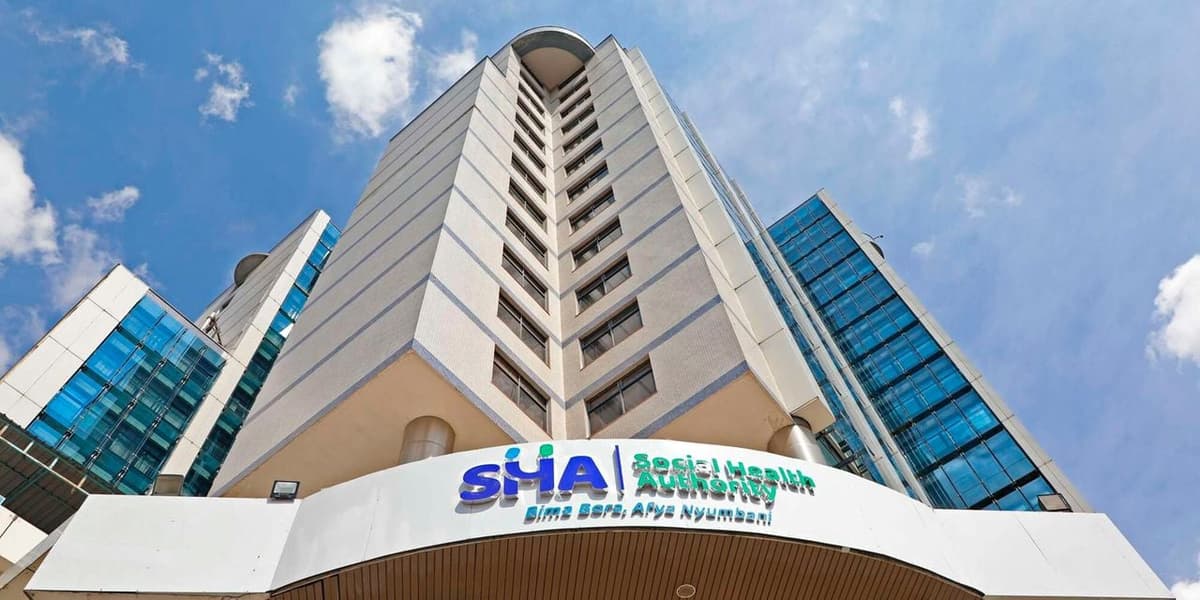
Every Kenyan who has ever tapped their SHA card at a hospital counter believes the money that follows goes straight from the fund to the facility that treated them. It does not. Buried three layers deep in a payment chain that Parliament has never fully seen, a private company operating out of an ordinary office block in Kilimani decides, keystroke by keystroke, whether that hospital gets paid at all, and helps itself to a slice before it does.
A joint review of Daily Nation’s July 6, 2026 investigation, the Office of the Auditor-General’s audits of the Social Health Authority, court filings in the still-unresolved Omtatah petition and company registry records paints a picture far uglier than a single rogue vendor. It shows a Sh104.8 billion state contract engineered so that a small circle of Kenyan and foreign shareholders, some hidden behind lawyer nominees and a company with no verifiable address, control the digital plumbing through which every shilling Kenyans pay into their national health scheme must pass.
The Kilimani Gatekeeper
Hospitals that stop receiving SHA reimbursements are routinely told by the authority that it has no control of the system and are redirected to a firm called Finsprint Limited. There, in the words of hospitals interviewed by the Nation, something as small as a misplaced space bar in a bank account field can bounce a facility’s payment indefinitely, with no formal channel to escalate the error back to SHA.
Finsprint sits at the very end of the payment chain. Approved hospital claims move from SHA’s clinical reviewers to Konvergenz Network Solutions for a further layer of sign-off, and from there to Finsprint, which Konvergenz subcontracted to actually move the money into hospital accounts. Before releasing a single shilling, Finsprint deducts two percent, a charge it describes only as covering logistics costs, one hospitals say they never negotiated or agreed to.
No hospital was ever shown a contract with Finsprint. We only found out it existed when our payment disappeared into it. — account relayed to Nation reporters by an affected facility
Since SHA’s launch, the authority has paid out roughly Sh146 billion to health facilities. At a flat two percent, Finsprint’s own slice of that pipeline works out to close to Sh2.9 billion, a figure that does not include the additional charges the wider consortium levies on claims and on the separate track-and-trace function, reported elsewhere at five percent and 1.5 percent respectively.
Finsprint’s Paper Trail Leads Straight Back to Konvergenz
Company registry records show Finsprint Limited was incorporated on July 12, 2020, with a nominal share capital of just Sh100,000, hardly the footprint expected of a firm now processing a share of Sh146 billion in public health money. Its two named directors are Issa Sheikh Mohamed of Nairobi and Abdulhakim Ibrahim Sheikh of Mombasa.
Of Finsprint’s 1,000 shares, 425 are held directly by Abdulhakim Ibrahim Sheikh. The remaining 575, the controlling stake, sit with a company called Impactsoft Technologies Group Limited, a Kenyan-registered entity for which no verifiable physical address appears in public filings, precisely the kind of opaque holding structure that beneficial-ownership rules were written to prevent.
The bridge between the approval layer and the extraction layer is not subtle. Issa Sheikh Mohamed, a Finsprint director, is also a senior figure and director at Konvergenz Network Solutions, the very company that approves claims before forwarding them to Finsprint for payment. The firm auditing the claims and the firm skimming the payout sit inside the same family and business network.
Konvergenz: From Quiet Cybersecurity Vendor to Sheikh Family Empire
Konvergenz Network Solutions was incorporated on April 2, 2014 as a modest cybersecurity outfit, with founders Asha Abdi Sheikh and Mohamed Abdi Yunis each holding an equal fifty shares. It built a client list that included KCB, Equity, Cooperative Bank, Kenya Power, KenGen, the National Social Security Fund and the old NHIF, alongside multinational partners such as Microsoft, IBM and Cisco, while staying almost entirely outside public view.
That changed abruptly after 2023, when the ownership structure was quietly rebuilt. Asha Abdi Sheikh exited. A new holding vehicle, Konvergenz Holding Company Ltd, was incorporated on May 17, 2023 and now owns ninety percent of Konvergenz Network Solutions. The remaining ten percent is split between Pitfield Auto Limited, whose sole shareholder and director is lawyer Dorothy Chepkoech Kipkenda, and Abdullahi Abdi Sheikh directly.
Konvergenz Holding itself is layered further still. Commtech Consortium Ltd, incorporated in March 2023, holds a large block of shares and is in turn owned by two lawyers at the firm Hamilton Harrison and Mathews, Deborah Linet Ontiri and Peter Okaalet Jr. Galva Investments Ltd holds another substantial block and is solely owned by lawyer Nuru Said Ahmed, who has publicly maintained she is the true beneficial owner rather than a proxy. On paper, the single largest identifiable owners of the company now running a critical slice of Kenya’s health data infrastructure are lawyers, not technologists.
Months after this restructuring, Konvergenz surfaced in two of the most consequential and contested tenders of the Ruto administration: the Sh104.8 billion SHA digitisation deal and the electronic travel authorisation system awarded by the Ministry of Interior.
Apeiro and the Abu Dhabi Money Trail
The third consortium partner, Apeiro Limited, controls e-claims processing and the hospital information systems that determine how much each facility is deemed owed, a function every bit as consequential as Finsprint’s payment gateway. Apeiro is a wholly owned subsidiary of Sirius International Holding, which is itself owned by International Holding Company, one of the largest listed investment vehicles in Abu Dhabi and a firm in which the UAE royal family holds a substantial stake.
That same royal family stake connects Apeiro’s ultimate ownership to the Adani Group, with Sirius International Holding running a joint venture, Sirius Digitech, alongside the Indian conglomerate that separately secured Kenya’s JKIA and KETRACO deals, an overlap that has drawn scrutiny from lawmakers wary of concentrated foreign influence over Kenyan infrastructure.
Locally, Apeiro’s interests were represented through two vehicles built in rapid succession in 2024, Apeiro Holdings Ltd, incorporated on February 15 with Kenyan Sanjay Lalji Devshi Patel and UK national Shilpa Valji Velji Patel listed as shareholders, and Apeiro Kenya Technologies Ltd, incorporated on July 5 and wholly owned by an entity called SIH Africa Ltd, controlled by Aswanth Bindhu Lambodaran of India and Nishant Mishra of Kenya. Both Apeiro Kenya Technologies and SIH Africa were dissolved before the end of 2024, even as Apeiro Limited continued executing the underlying contract, a pattern that complicates any effort to trace who ultimately benefits.
What the Auditor-General Actually Found
Auditor-General Nancy Gathungu’s review of the Sh104.8 billion Integrated Healthcare Information Technology System contract is unambiguous about who controls it. Her report states plainly that ownership of the system, its components and all accompanying intellectual property remains with the consortium, not the Kenyan government, and that a clause in the contract bars the state from ever building a competing system of its own.
The ownership of the system, system components and all intellectual property rights shall remain in the ownership of the consortium. — Auditor-General’s report, as read into the Senate record
The financing model the audit uncovered is just as troubling. The consortium is projected to collect more than Sh111 billion over the ten-year life of the contract, drawn from a 2.5 percent charge on member contributions, a five percent charge on facility claims and a further 1.5 percent charge tied to a track-and-trace function, all funnelled daily or weekly into an escrow account whose signatories the contract never discloses.
Gathungu’s audit also found the system was deployed before comprehensive user testing, with no IT governance structures, no standard operating procedures and no enforceable service level agreement in place, meaning the authority that disburses the money cannot independently audit or override the technology that decides how it moves.
That governance vacuum has a body count in the balance sheet. A separate Gathungu audit of the 2024/25 financial year flagged Sh49.3 billion in irregular or entirely undocumented SHIF transactions, including Sh26.8 billion paid out with no supporting documents at all and thousands of medically impossible claims, among them a single patient billed for open-heart surgery four times in one day and a woman paid out for ten deliveries in a single year. The fund collected only Sh57.7 billion in total contributions that year. The queried amount exceeded eighty-five percent of everything Kenyans paid in.
The Court Fight the Consortium Is Determined to Bury
Busia Senator Okiya Omtatah, together with activists Eliud Matindi and Dr Magare Gikenyi, filed a High Court petition in September 2024 seeking to annul the government’s contract with the consortium outright, arguing it was single-sourced without competitive bidding and structured so that Kenyans would gain no ownership of the system regardless of how many billions they poured into it. The court declined to halt the SHA rollout while the case proceeded.
More than a year later, the consortium is fighting to have the entire petition struck out, arguing that documents Omtatah obtained from a whistleblower, including the consortium’s internal agreement and Konvergenz’s audited accounts, were unlawfully leaked and that the case should collapse on that technicality rather than be heard on its merits.
Konvergenz director Abdullahi Abdi Sheikh has told the court the litigation is a gross abuse of process now that the rollout has already happened, while Apeiro has warned that halting the contract would endanger healthcare access for millions of registered Kenyans, an argument that does not address who is profiting from the arrangement or why its terms were never opened to competitive tender in the first place.
Who Really Benefits
Strip away the corporate layering and a narrow pattern emerges. A cybersecurity vendor built by two founders in 2014 was restructured in 2023 into a holding company fronted by lawyers, months before it was pulled into Kenya’s largest health technology contract.
A payment subcontractor with a hundred-thousand-shilling starting capital and a director shared with that same vendor now quietly pockets a fixed cut of every shilling paid to a sick Kenyan’s hospital.
And an Abu Dhabi royal investment vehicle with a joint venture tied to the Adani Group sits behind the system that decides how much each claim is worth in the first place.
None of this required Parliament’s blessing through open tender. None of it is fully visible to the Auditor-General, whose own report admits the government cannot access or override the system it is paying for. And none of it has been explained to the hospitals bounced between an authority that says it has no control and a private firm in Kilimani that will not say why a payment disappeared.
The Auditor-General has said the decision on whether this contract survives rests with Parliament, not her office.
Until lawmakers act, every claim processed, every contribution collected and every deduction taken continues to flow through a pipeline whose true owners spent considerable effort making sure Kenyans would never have to ask their names.


Comments