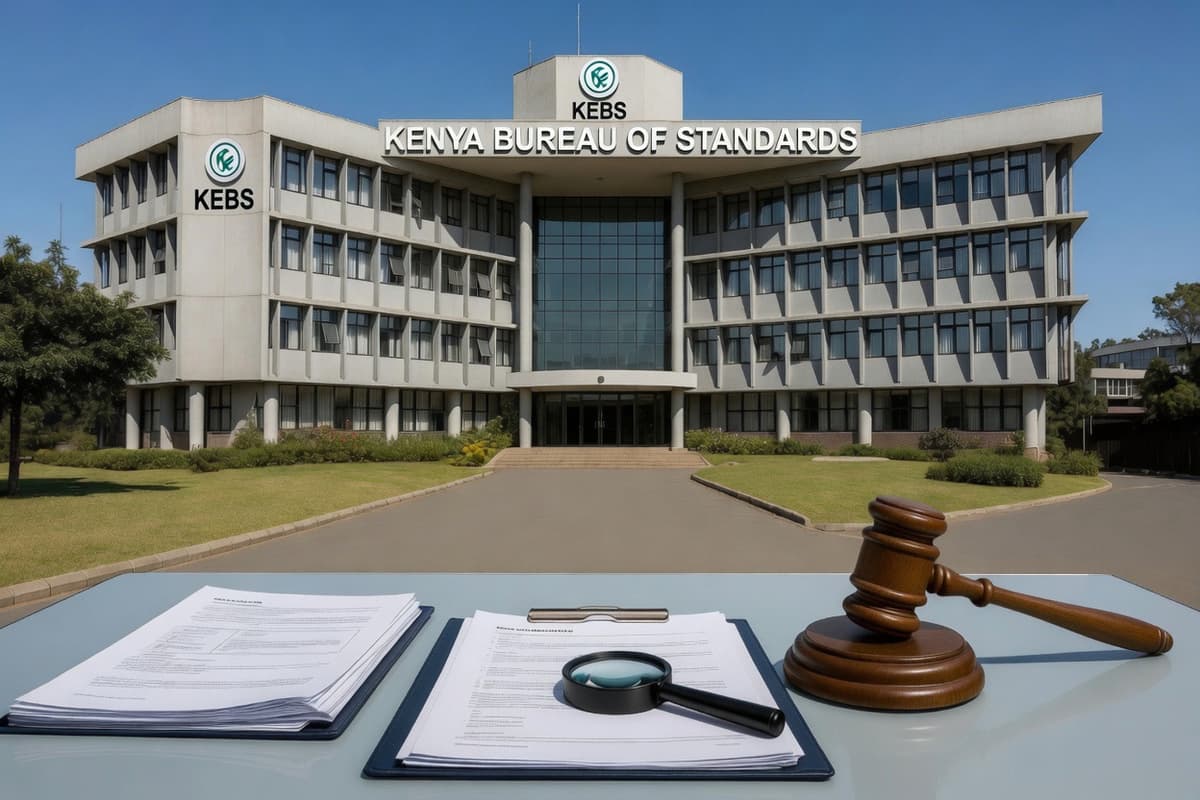
The Racket That Rode On Kenya’s Roads
For every used car, motorcycle, tractor and container of spare parts that Kenya imports from Japan, someone abroad is paid to certify that it will not kill the person who eventually drives it. That certification, the Pre-Export Verification of Conformity programme run through the Kenya Bureau of Standards, has for over a decade been the single most lucrative gatekeeping racket in East Africa’s used vehicle trade. At roughly one hundred and fifty US dollars a vehicle and thousands of units clearing Japanese ports for Kenya every month, the PVOC contract was never just a compliance exercise. It was a printing press.
This week, Nairobi’s Milimani Law Courts issued summonses in a criminal case that reads like the index of a decade of institutional failure. Japanese nationals Prosper Sugai and Toyohiko Hashino of EAA Company Ltd, Mamoru Fujie of Auto Terminal Japan Ltd, and five Kenyans, Michael Ambunli Alloys, Calvince Omondi Omino, Brian Odhiambo, Isaac Peter and Clive Mshweshwe, now face forty counts of procurement fraud alongside their two companies. The charges cover forged academic degrees, invented inspection centres, a concealed corporate identity, a phantom UK law firm and an unlicensed advocate deployed to fight the case in Kenyan courts. What is remarkable is not that this happened. What is remarkable is how long Kenyan institutions knew, and how many times these same men were allowed back to bid again.
“The documents submitted by East Africa Automobile Services Limited and Auto Terminal Japan to Kenya Bureau of Standards were forgeries and falsified during the tendering process.” — Directorate of Criminal Investigations, in a formal finding to the procurement regulator
A Degree From A University That Does Not Exist
Investigators reconstructing EAA’s 2022 bid for Kebs tender KEBS/RT/011/2021-2024 found a technical manager whose Automotive Engineering degree was attributed to Yokohama University, an institution Kenyan investigators concluded simply does not exist. The company’s quality assurance manager fared no better. Her Risk Management degree was traced to Nihon University, a real institution, but one that the Public Procurement Regulatory Board established offered no such course in 2014, the year she claimed to have graduated. A supposed Japanese government inspection certificate for the technical manager and ISO certificates for the quality manager and three other staff were all found to be fabricated.
Auto Terminal Japan’s parallel bid was, if anything, more audacious. The firm claimed ownership of sixteen inspection centres scattered across Japan. When auditors physically verified the claims, one listed centre turned out to be nothing more than leased land used for a car export business. Another was a dilapidated building with no equipment of any kind, state of the art or otherwise. At least one of the sixteen was, astonishingly, a facility actually operated by Quality Inspection Services Japan, the very rival that would go on to win the contract. Auto Terminal Japan is also alleged to have forged a letter from a UK law firm that does not exist, purporting to confirm inspection centres in Bristol, complete with fabricated invoices and sale agreements meant to prove an operational footprint in Japan, the United Kingdom and the United Arab Emirates.
None of this was a first offence. A 2019 special audit by the Auditor General, later endorsed by Parliament’s Public Investments Committee, the procurement regulator and the Directorate of Criminal Investigations, had already caught EAA claiming seventeen inspection centres in Japan and three in the United Kingdom, of which it could produce leases for only eight, several of which did not exist or belonged to somebody else entirely. Interpol detectives who travelled to verify the claims found that in the Japanese port towns of Kisarazu, Kawasaki, Kitakyushu and Moji, hubs critical to the used vehicle export trade, EAA had no staff and no operations, despite telling Kebs otherwise. One Nairobi based magazine’s earlier reporting on the file quoted Christopher Lukosi, owner of a Tokyo firm called KC Global Links, disowning a lease agreement bearing his signature that EAA had submitted to Kebs. He described it as an edited copy of paperwork from his former company, altered to serve EAA’s bid.
The Man Who Changed His Name, And The Business He Never Disclosed
Prosper Sugai, who signs himself as EAA’s president in Kenyan court filings, was not born with that name. He legally changed it from Guku Prosper Japhet. Under either identity, he also owns Rosper International Company Ltd, a firm incorporated in 2002 that exports used vehicles and heavy machinery to Kenya and other markets. The conflict is not subtle. A man who profits from shipping used vehicles into Kenya was simultaneously bidding to run the very inspection regime meant to certify those vehicles as roadworthy before they left Japan. The Auditor General flagged the arrangement as creating an inherent risk of self-dealing, the kind of structural capture that turns a safety standard into a rubber stamp.
EAA also failed to disclose an ISO accreditation ban imposed on it inside Japan between 2014 and 2016, a suspension that, had it been declared, would have disqualified the firm outright from bidding on a tender that required current, verifiable accreditation. Separately, the Public Procurement Administrative Review Board found that EAA’s accreditation number, RIB00060, had been suspended by the Japan Accreditation Board weeks before a Kenyan bid was lodged, a fact the company chose not to mention.
Tilbury, Essex: The Shell That Manufactured Legitimacy
In February 2019, as Kenyan investigators were closing in on EAA’s first debarment, Sugai quietly registered EAA UK Inspections Ltd in Tilbury, a modest Essex port town on the Thames estuary. Companies House records list the firm’s capital at a mere five thousand pounds and its declared workforce at a single employee. Its directors were Sugai himself, Toyohiko Hashino, and a New Zealander named Raymond Lee Sayer, who had already spent at least six years inside EAA’s structure as vice president or director. A British national, Christopher James Whitcombe, also sat on the periphery of the entity. Sayer resigned from the UK company in November 2024.
EAA’s own promotional material lists an even wider global scaffolding built around the Tilbury address: a UAE branch trading as East Africa Auto Technical Testing in Sharjah, an agency called STA Vehicle Inspection in Singapore, an office in Kampala serving the Ugandan market, and a South African arm styled Africa Vehicle Inspections operating out of Durban. Whatever the commercial merits of that international network, its core function inside the Kenyan case was optical. A one employee shell in a British port town, dressed up on paper as evidence of European operational depth, was the same trick as the phantom Bristol law firm and the invented Yokohama University degree: manufacture the appearance of global legitimacy for a regulator half a world away that had no easy means of checking.
The Office of the Director of Public Prosecutions has named Sayer its star witness in the criminal case now proceeding at Milimani. His account of internal dealings with Sugai and the operational reality behind EAA’s paper empire is expected to sit at the centre of the prosecution’s evidence, an insider turning on the architecture he helped build.
The Fake Lawyer Who Fought the Blacklisting
When EAA’s first three year debarment was announced, the firm did not go quietly. Court filings show it retained Andrew Ombwayo and Co. Advocates and, separately, leaned on a figure named Calvince Omondi Omino, listed in proceedings as counsel challenging the ban. Kenyan investigators later established that Omino was not a licensed advocate at all, and had been operating what the Directorate of Criminal Investigations described as an unregistered firm of advocates. A magistrate’s court in Nairobi ultimately dismissed EAA’s suit against its own blacklisting after finding the company had tried to conceal from the court that a High Court judge had already rejected an identical application, a manoeuvre the presiding magistrate treated as an attempt to mislead the bench. The remaining Kenyan defendants in the current criminal case, Alloys, Odhiambo, Peter and Mshweshwe, are tied to bid preparation, document handling and local representation, the domestic scaffolding that let two Japanese principals navigate a foreign procurement system they could not have penetrated alone.
A magistrate found the company had concealed a prior High Court defeat from his own courtroom, an act his ruling treated as a deliberate attempt to mislead the bench.
Debarred, Then Back on the Ballot
Kenya’s procurement law allows debarment to lock a company out of public tenders, typically for three years. It has proven strikingly easy to survive. EAA was first debarred in June 2021 over forged bids spanning 2011, 2014 and 2019, a ban it fought unsuccessfully all the way to the Supreme Court. No sooner had that ban lapsed than EAA was back bidding for a fresh Kebs tender, KEBS/RT/011/2021-2024, using what a subsequent High Court judgment described as substantially the same documents already impeached in the earlier debarment.
On 18 March 2025, the procurement regulator issued fresh three year bans against both EAA and Auto Terminal Japan. Auto Terminal Japan successfully challenged its second ban in the High Court in August 2025, on the narrow technical ground that the underlying forgery allegations were still under police investigation and had not been finally determined by a court.
That technicality is precisely what the Milimani criminal trial, running on forty separate counts, now exists to resolve.
Even while nominally locked out of Kenya, neither firm missed a beat elsewhere. EAA held or pursued inspection contracts in Zambia, Uganda, Tanzania, Mauritius and the Bahamas. Auto Terminal Japan did the same in Uganda, Guyana, Pakistan, Jamaica and Zambia. Reporting from Tanzania’s National Electronic Procurement System shows EAA and Auto Terminal Japan turning up together, again, on a shortlist for a Tanzanian vehicle inspection tender in 2022, while their Kenyan blacklisting was still technically active. Regulators in Kampala, Lusaka, Dar es Salaam, Georgetown, Karachi and Kingston have, as far as the public record shows, never been asked by Kenyan authorities to examine whether the same forged infrastructure claims that fooled Nairobi were recycled to fool them too.
The Winner Was Not Clean Either
It would be convenient if this were simply a story of two rogue Japanese bidders defeated by an honest Kenyan system. It is not. Quality Inspection Services Japan, the firm that has held Kenya’s PVOC contract as sole or lead inspector since 2015 and that beat EAA and Auto Terminal Japan to the 2020 award, has its own file. Testimony placed before Parliament’s Public Investments Committee by an Auto Terminal Japan director alleged that Quality Inspection Services Japan facilitated travel, five star hotel accommodation and logistics for Auditor General officials conducting what was supposed to be an independent audit of the company’s own facilities in the United Kingdom, South Africa and Japan, and that the officials accepted the hospitality.
Evidence produced to the committee included a February 2019 letter from Quality Inspection Services Japan to the British High Commission in Nairobi requesting UK visas for named Kebs and audit personnel, and a hotel booking at a London property arranged, according to the testimony, by a Quality Inspection Services Japan manager.
Kebs’ own managing director at the time, Bernard Njiraini, was separately arrested by the Ethics and Anti-Corruption Commission for allegedly obstructing a bribery investigation tied to a Sh2.5 billion overcharge in the same vehicle inspection programme.
The picture that emerges is not two forgers against a clean incumbent. It is a captured procurement line in which the loser forged its way to the table and the eventual winner allegedly greased the officials meant to audit it, while the regulatory body at the centre, Kebs, repeatedly reopened or amended contracts without disclosing to its own Attorney General that a fresh tender, rather than a mere variation, was underway.
What It Cost Kenyans
None of this is abstract. Kenya imports an average of seven thousand used vehicles a month, alongside heavy equipment and spare parts, almost all of it dependent on PVOC certification issued abroad before the goods ever reach a Kenyan port. Every forged inspection centre, invented degree and phantom lease represented a live possibility that a vehicle with compromised brakes, falsified emissions readings or structurally unsound parts rolled onto Kenyan roads carrying a certificate that meant nothing.
The Sh1.5 billion a year contract at the centre of the earliest forgery findings, the Sh2.7 billion and Sh3 billion tenders that followed, and the Sh2.5 billion overcharge scandal layered on top, were fees ultimately absorbed by Kenyan importers, dealers and the ordinary buyers of second hand cars.
Public money was then spent again and again auditing, investigating, prosecuting and litigating the same allegations across the Auditor General’s office, the Public Investments Committee, the Directorate of Criminal Investigations, Interpol, the procurement regulator and now the Milimani courts, an institutional loop that ran for the better part of a decade before a single criminal charge was filed.
The forty count criminal case now before Milimani is the first attempt to convert a decade of audits, parliamentary reports and debarment rulings into criminal accountability. Raymond Lee Sayer’s cooperation with prosecutors threatens to pull back the curtain on EAA’s internal operations in a way that Kenyan regulators, working only from paper submitted an ocean away, never could. But the case as currently framed stops at Kenya’s border. It does not touch Quality Inspection Services Japan’s own conduct, it does not reach the Auditor General officials who accepted Quality Inspection Services Japan’s hospitality, and it says nothing about whether regulators in Zambia, Uganda, Tanzania, Mauritius, the Bahamas, Guyana, Pakistan or Jamaica were sold the same forged inspection centres that fooled Nairobi. Until those questions are asked outside Kenya’s jurisdiction too, the men behind this empire on paper retain every incentive to simply pivot to whichever market has not yet caught up with them.
For the millions of Kenyans who will buy a used Japanese car this year, the only certainty is this: the piece of paper that says it was inspected has, for a decade, been worth exactly as much as the people forging it wanted it to be.


Comments