
A CAMP BUILT ON A LETTER, NOT A LAW
Nine days into July, a coalition led by the East Africa Law Society, Natural Justice, JustAct and the Africa Centre for Peace and Human Rights walked into the Environment and Land Court in Nairobi and did something Kenya’s conservation lawyers have wanted to do for two years: they stopped arguing about one camp and started arguing about the system that let it happen.
Their petition names the Ritz-Carlton Hotel Company LLC, Marriott International, the Kenyan developer Lazizi Mara Limited, Narok County Government, the National Environment Management Authority, the Attorney General, the Kenya Wildlife Service, The Safari Collection Limited and Minor Hotels Limited in a single filing, and it asks the court to do something no previous Mara litigation has attempted, order a full audit and physical inspection of every accommodation facility standing inside the reserve’s Low Use Zone and Mara River Ecological Zone.
The timing is not accidental.
The hearing is scheduled for the twentieth of July, which sits inside the annual crossing season the petitioners say the Ritz-Carlton camp has already disrupted for one full year without independent ecological oversight.
If Chief Justice Martha Koome grants the request for a five judge constitutional bench, Kenya’s judiciary will be forced to answer a question it has so far managed to dodge on procedural technicalities alone. Can a private hotel be exempted, by a letter from the President’s own chief of staff, from a conservation moratorium that Parliament’s own agencies wrote into a statutory management plan.
THE LETTER THAT UNLOCKED THE MORATORIUM
The Maasai Mara National Reserve Management Plan 2023 to 2032 is not ambiguous. It bans new visitor accommodation and any expansion of existing bed capacity across every zone of the reserve for the life of the plan, a response to visitor densities in the Central Mara that had already blown past two persons per square kilometre and were spiking above three during peak migration.
The Low Use Zone, where the Ritz-Carlton camp now stands, and the adjoining Mara River Ecological Zone exist for exactly one reason, to keep density low where it matters most, along the riverine forest, the black rhino breeding grounds and the wildebeest crossing points.
And yet, in April 2024, Felix K. Koskei, chief of staff to President William Ruto, wrote to the National Environment Management Authority requesting what internal correspondence relied upon in the new petition describes as a one time exemption from the construction freeze, framed at the time as advancing the government’s commitment to a favourable investment climate.
NEMA’s environmental impact assessment licence followed within weeks, issued in May 2024 after a review the petitioners say took twenty six days, without the GPS corridor data that would have shown where wildebeest actually cross, and without any cumulative assessment of the five other camps already strung along the same stretch of river.
A moratorium built on carrying capacity science was unwound by a letter, and the licence that followed took less than a month to arrive.
Marriott has said publicly that it could not comment on ongoing litigation, while Lazizi Mara’s managing director, Shivan Patel, has maintained since before the camp opened that the site was assessed and found not to be a wildlife crossing point, and that the company cannot release the underlying assessment for reasons of confidentiality.
Kenyan law required NEMA to gazette a public notice of that assessment. Reporters who went looking for it in the official gazette did not find one.
A SCIENCE WAR: TWENTY SIX YEARS AGAINST A SINGLE SEASON
The petitioners are not relying on activism alone. They are leaning on twenty six years of GPS collar data compiled through the University of Glasgow’s Serengeti Biodiversity Programme, alongside satellite imagery and testimony from ecologists who have tracked wildebeest movement in the Mara since the 1990s. Grant Hopcraft, who has tagged wildebeest in the ecosystem since 1996, told the Environment and Land Court in a written submission that the disputed site sits directly on one of the major corridors linking the Serengeti and the Mara.
Joseph Ogutu, who has studied the region’s migration patterns for more than three decades from the University of Hohenheim, has said plainly that data collected over decades does not lie.
The Kenya Wildlife Service disagrees, and disagrees loudly, insisting that its own long term monitoring shows the Ritz-Carlton site and the five other camps along the Sand River do not fall within, obstruct or interfere with any gazetted migration corridor, and that one full crossing season has already passed without a recorded incident.
What the agency has been considerably quieter about is the vintage of the data behind that reassurance.
Conservation groups monitoring the case say the GPS collar dataset KWS has cited publicly to defend the camp’s location tracks wildebeest movement recorded between 1999 and 2002, more than two decades before the camp was ever conceived, and a full generation before the Glasgow programme’s more recent tracking began showing the opposite pattern, a decline in high density crossings at the Sand River and increased herd activity south of the border since construction began.
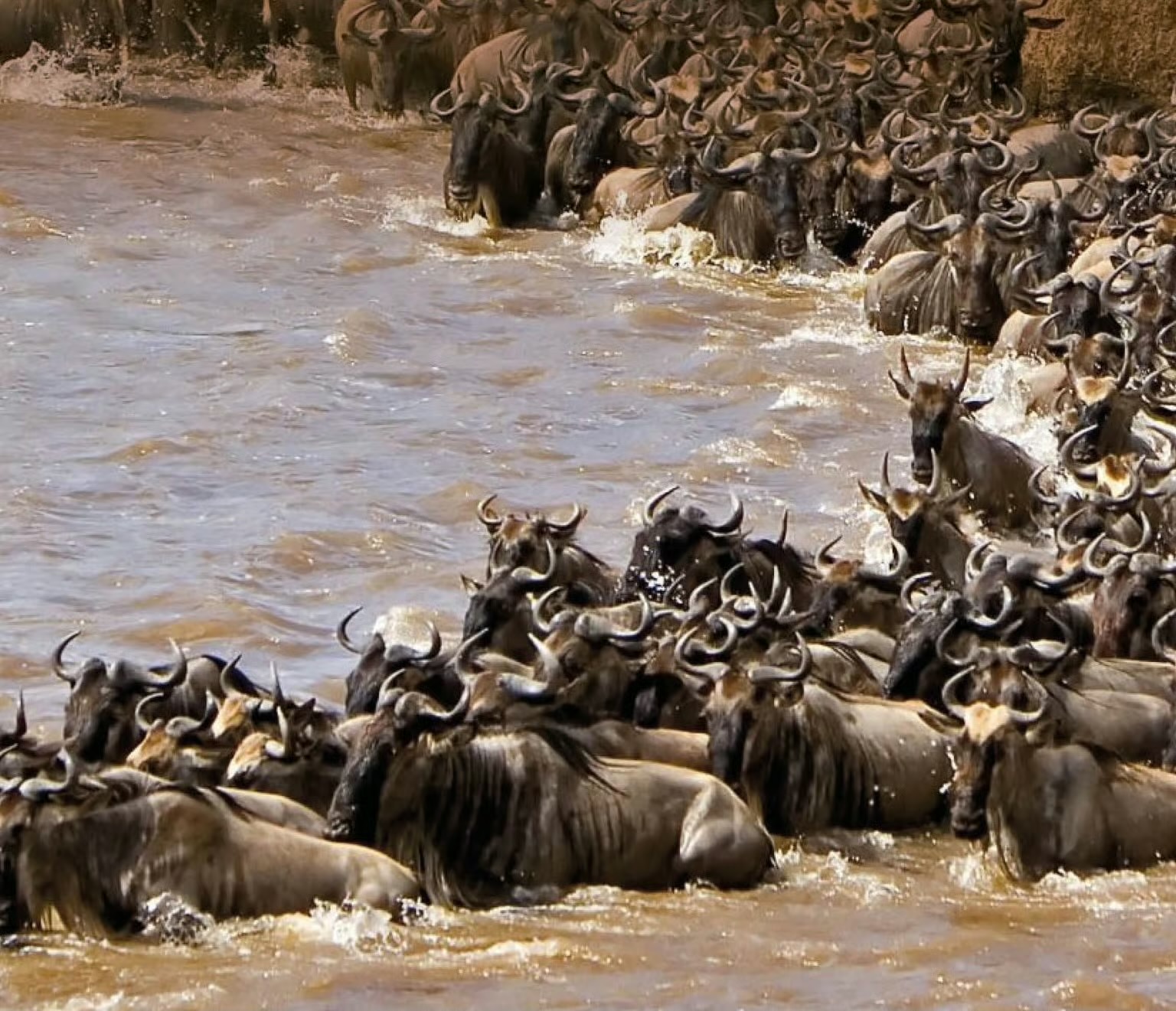
Petitioners argue that a single migration season without a recorded collision is not evidence of safety, it is simply too short a window to detect an effect that ecologists say typically shows up as gradual displacement rather than a dramatic single event.
Ecosystems, as one advocacy group following the case has put it, do not fragment politely, they erode slowly and then all at once.
THE GOVERNOR’S BROTHER AND THE LAND NOBODY WANTS TO TALK ABOUT
To understand how a presidential exemption and a month long environmental review managed to punch through what was billed as an ironclad moratorium, it helps to look at who actually controls land and tourism revenue inside the Mara ecosystem, and that record is not reassuring.
Narok Governor Patrick ole Ntutu is the same official whose administration adopted the 2023 to 2032 management plan that supposedly closed the door on new lodges. His own brother, businessman Livingstone Kunini Ntutu, has spent more than two decades locked in litigation with the very county government he is related to, over ownership of a 4,720 acre parcel known as Cis-Mara, Talek, 155, land that today hosts thirteen tourism camps, including the well known Ol Kiombo Lodge, inside the same reserve now at the centre of the Ritz-Carlton petition.
Narok County has separately acknowledged that over tourism has already degraded the Mara’s natural environment, while arguing that channelling growth toward high value, low volume properties like Ritz-Carlton is the responsible way to keep revenue up while easing pressure on the land.
Critics call this the same argument used to justify every incremental camp that has gone up inside a protected zone for a decade, an argument that only ever points toward more construction, never less.
The reserve’s bed count has told its own story regardless of the rhetoric, climbing from roughly ninety five camps in 2012 to close to one hundred and seventy five by 2024, a near doubling inside a landscape that scientists at the Greater Serengeti Mara Conservation Society’s own stakeholders forum warned in March 2025 was already carrying unsustainable tourism pressure and actively impairing the migration.
A PETITIONER SILENCED, THEN A COALITION THAT WOULD NOT LET THE CASE DIE
The Ritz-Carlton dispute has already claimed one casualty among its litigants. Dr Meitamei Olol Dapash, the Maasai elder and director of the Institute for Maasai Education, Research and Conservation who filed the original case in August 2025, sought to withdraw it in December that year, telling the court that stakeholder discussions had resolved his concerns.
Lazizi Mara opposed the withdrawal outright, with senior counsel Kiragu Kimani telling the court that abandoning the case would leave damaging allegations hanging over a company that had been, in his words, vilified nationally and internationally.
Justice Lucy Gacheru refused to allow the withdrawal, ruling that a case raising grave concerns over the obstruction of a wildebeest migratory corridor had evolved into public interest litigation that could not simply be dropped by one party’s change of heart, and ordered the matter to proceed to full hearing with the Law Society of Kenya and the East African Wildlife Society admitted as interested parties.
Greenpeace Africa has since raised a pointed question that the courts have not yet been asked to answer directly, whether Dr Dapash was placed under any agreement limiting what he could say publicly about the very project he once sued to stop.
The organisation has called for transparency around any such arrangement, arguing that silencing an indigenous voice in a case of this magnitude undermines the legitimacy of whatever settlement produced his change of position.
Dapash’s case was ultimately struck out in February 2026 anyway, not on its merits but on a technicality, Justice Gacheru finding that the petition had bypassed the National Environment Tribunal and was therefore prematurely filed, a ruling the court itself was careful to note did not amount to environmental approval of the camp.
WHAT MARRIOTT WILL NOT SAY
For a project marketed as offering guests a front row seat to one of the natural world’s last great spectacles, the companies behind it have been notably reluctant to discuss the controversy in anything but the driest corporate language.
Asked directly about the reputational fallout, the Ritz-Carlton camp’s team has said only that it does not comment on reputational assessments or speculation, that its focus remains on operating responsibly and cooperating with the legal process, and that it does not disclose occupancy or commercial performance data as a matter of company policy.
Marriott has confined itself to saying it cannot discuss ongoing litigation.
Neither company has released the underlying environmental impact assessment to the public, more than two years after it was approved.
What is not in dispute is the arithmetic of who bears the cost of getting this wrong.
A camp charging upward of three thousand five hundred dollars a night, roughly thirty percent above the average annual income of a Kenyan according to World Bank figures, sits on land whose long term value to the Maasai community lies not in nightly rates but in grazing corridors, rainfall patterns and calving grounds passed down through generations of pastoralist knowledge that no environmental impact assessment has ever been designed to measure.
THE QUESTION NOW BEFORE THE COURT
Strip away the legal citations and the new petition amounts to a referendum on what the Maasai Mara is actually for. It asks whether a statutory management plan built on carrying capacity science can be quietly unwound by an exemption letter from the corridors of State House.
It asks whether multinational hospitality brands can hide behind a franchise structure when the environmental consequences of their branding land on a Kenyan riverbank.
And it asks whether the wildebeest migration, recognised internationally under the Convention on Migratory Species, is a constitutional right belonging to the Kenyan public under Articles 42 and 69, or merely a scenic backdrop that bends whenever a big enough cheque and a well placed signature require it to.
The herds, for their part, keep to their own calendar regardless of what any five judge bench eventually decides.
They are already moving toward the Sand River as this goes to print.
The only question this petition can answer is whether, four camps and more than two decades of unresolved land disputes into this story, Kenya’s courts still have the power to decide where the law ends and where the money begins, or whether that decision was made quietly, in a letter, long before any wildebeest crossed the river at all.
Respondents named in the petition, including Marriott International, Ritz-Carlton Hotel Company, Lazizi Mara Limited, The Safari Collection and Minor Hotels, had not filed formal defences at the time of publication.
This is a developing story and will be updated as the Environment and Land Court proceedings continue.









Comments