A cross-border cryptocurrency Ponzi scheme built on promises of doubling investor money within a month collapsed in April 2025, dragging thousands of Kenyan and Nigerian victims into a scandal that eventually drew the attention of the FBI, Interpol, and domestic financial crime units.
Amid the wreckage, a single independent researcher tried to trace where the money had actually moved, and named a licensed Kenyan bank as a channel through which the scheme’s operators converted victim deposits into dollars for offshore crypto futures trading. What followed was not a public rebuttal from the bank. It was a lawsuit.
The researcher is Antony Kagirison, who publishes through Kagirison Research and describes his work as postparadigmatic activism aimed at financial market fraud and corporate accountability.
The bank is I&M Bank Limited, a Nairobi Securities Exchange heavyweight controlled by the Raja Shah family, which only weeks after the dispute began was preparing to tap Kenya’s capital markets for one of the largest corporate bond programmes of the year. The two have been locked in a Milimani courtroom fight since July 2025, one that raises hard questions about disclosure, due process, and the price of reporting on a bank that would rather litigate than explain.
THE ARTICLE THAT VANISHED
Kagirison’s dispute with I&M Bank began quietly. According to his own published record, he first wrote to the bank on February 23, 2025, with a follow-up the next day copied to the Capital Markets Authority, laying out his concern that CBEX, the platform behind the scheme, was operating a multi-currency consumer-to-business account at I&M to receive funds from Kenyan investors before converting them into dollars for futures trading.
CBEX operated under a tangle of names, including ST Technologies International Ltd and Smart Treasure or Super Technology, and marketed itself across East and West Africa as a route to guaranteed crypto returns. When it collapsed in April 2025, investor wallet balances reportedly reverted to zero, victims stormed CBEX premises in both Kenya and Nigeria, and estimates of regional losses ranged from a few million dollars into the hundreds of millions depending on the source.
Kagirison published his findings on I&M’s alleged role on April 19, 2025.
I&M responded publicly within days, stating flatly that it had no involvement in CBEX’s operations, though it did not address the specific account relationship, its due diligence process, or its anti-money-laundering controls.
That denial might have been the end of it. Instead, three months later, I&M went to court.
A FILING DELAYED BY UNPAID FEES
The bank’s own paper trail, laid out by Kagirison alongside images of the court filings, shows a legal offensive that stumbled before it started. Represented by Wamae & Allen LLP, I&M drafted its application on July 21, 2025, shortly after Kagirison had made a separate piece of research, on alleged evidence fabrication involving Safaricom and the Directorate of Criminal Investigations, freely accessible to the public.
The bank’s lawyers attempted to submit the Certificate of Urgency application to the Milimani Commercial Magistrate’s Court that same week, but according to Kagirison’s account the filing could not be formally registered for several days because the required court fees had not been paid. It was only formally lodged on Sunday, July 27, 2025, at roughly 7:44 in the evening.
Less than twenty-four hours later, at 8:59 in the evening on July 28, 2025, Senior Principal Magistrate A. Nyoike issued ex parte interim orders converting I&M’s prayers into a mandatory injunction. Kagirison was ordered to withdraw the CBEX article from publication.
There is no formal Court Orders document, no record of proceedings, recitals, attestations, or penal notice for contempt, and no undertaking as to damages on file.
— Kagirison Research, published case update
Kagirison has documented what he considers three separate procedural defects in how the order was obtained. First, he says no perfected Court Orders document exists, only a Court Directions note, meaning there is no attested record carrying the recitals or contempt penal notice that normally accompany an injunction.
Second, he argues the magistrate recorded no reasons for granting the order ex parte, which Order 40 Rule 4(1) of the Civil Procedure Rules requires.
Third, and most technical, he contends the inter partes hearing was scheduled fifteen or sixteen days out, beyond the fourteen-day maximum lifespan Order 40 Rule 4(2) sets for any ex parte order, despite I&M’s own application having invoked that same rule.
Whether these defects are ultimately fatal to the order is a legal question the Milimani court, not a researcher’s website, must resolve.
But the timeline itself is not in dispute.
It is drawn from Kagirison’s own published Notice of Withdrawal, court documents he has posted publicly, and an affidavit of service filed by I&M Bank confirming when and how he was notified.
COMPLIANCE WITHOUT ADMISSION
Kagirison withdrew the article on July 30, 2025, publishing a formal notice stating the takedown was solely to comply with the interim order, made without any admission of liability, fault, or wrongdoing, and with all rights reserved.
The CBEX article has remained offline since.
The case, registered as MCCC/E5274/2025, has moved slowly since then. Kagirison filed a Replying Affidavit on August 8, 2025, and Written Submissions on August 26, 2025. I&M sought and was granted leave in October 2025 to respond through a Further Affidavit, sworn by bank officer Andrew Muchina on January 13, 2026, and filed together with Written Submissions on February 26, 2026, nearly seven months after Kagirison’s own filing.
On March 3, 2026, the court set July 9, 2026, at 2:30 in the afternoon, as the date to deliver its ruling on the underlying Notice of Motion.
That ruling date fell one day before this story went to print. As of publication, no outcome had been made public through Kagirison’s platform, the courts, or independent reporting.
WHO IS ANDREW MUCHINA
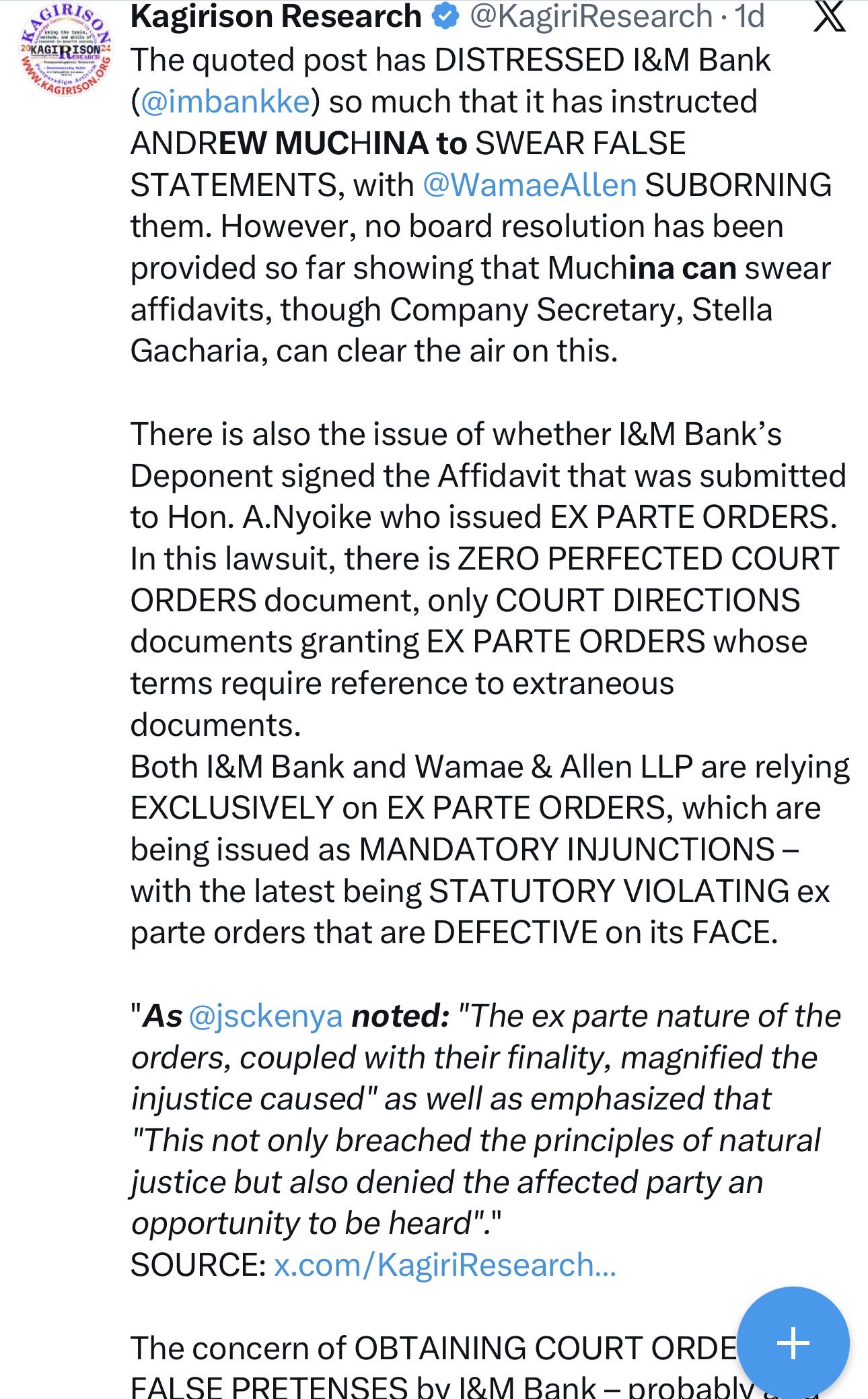
Kagirison has publicly questioned the authority under which Andrew Muchina swore I&M’s affidavits in this case, noting he has seen no disclosed board resolution authorizing the deponent to act, and flagging that the role of company secretary Stella Gacharia in the process remains unclear.
He has called for perjury and subornation of perjury investigations and urged referrals to the Law Society of Kenya’s Disciplinary Committee, the Judicial Service Commission, and the Office of the Director of Public Prosecutions.
Court records complicate at least part of that theory. In a separate and unrelated Milimani commercial suit, Unispan Limited and two others versus I&M Bank Limited, decided in July 2025, the same Andrew Muchina is recorded as I&M’s deponent, having sworn a replying affidavit for the bank in July 2024 describing a banker-customer relationship dating to 2015. That filing identifies him as someone the bank routinely deploys to depose on its behalf in contested litigation, which does not resolve the specific board-authorization question Kagirison raises in the CBEX case, but does establish that Muchina is not a fringe or invented figure. He appears to be a recurring institutional deponent for I&M in commercial disputes generally.
THE DISCLOSURE QUESTION
Kagirison’s sharpest allegation concerns timing rather than procedure.
He contends the I&M lawsuit was omitted from the Information Memorandum that accompanied the bank’s Medium Term Note debt issuance, which received Capital Markets Authority approval and opened to investors on April 30, 2026, closing on May 15 and listing on the Nairobi Securities Exchange on May 21, 2026.
The offer was a considerable success: the first tranche drew bids of roughly Sh23.2 billion against a Sh10 billion target, a subscription rate above 230 percent, pushing the bank to exercise its full green-shoe option and raise Sh13 billion.
Kenya Insights has not independently reviewed the full Information Memorandum against Kagirison’s claim, and I&M has not commented on the specific disclosure allegation.
What can be said is that the litigation was, by that point, no secret. It had been running for close to ten months, carried a named case number, and had already generated a filed Further Affidavit from the bank’s own deponent.
Whether a pending suit over a suppressed news article, rather than a quantified financial claim, met the threshold requiring disclosure under CMA and CBK rules is a governance question regulators and the bank’s own compliance function are better placed to answer than a reporter working from public filings. Kagirison has raised it as a live concern; it remains unresolved.
NOT I&M’S FIRST FIGHT OVER ACCESS TO MONEY
The CBEX case is not the only I&M Bank litigation drawing scrutiny this year. Reporting on a separate Milimani dispute involving Synergy Industrial Credit Limited describes a court finding that I&M and a senior bank executive obstructed enforcement of a debt judgment, at a cost Synergy puts at Sh5.77 billion in accrued interest since 2021, with the total claim including the underlying decree said to exceed Sh11 billion.
None of the public market commentary reviewed around I&M’s bond listing appears to flag that contingent liability, a sum equivalent to roughly a third of the bank’s most recent annual net income.
That case remains contested and untested at trial, but it establishes a pattern worth naming: a profitable, well-rated institution moving aggressively through the courts in more than one dispute where the underlying facts are still being argued.
Kagirison has framed the entire episode as a textbook Strategic Lawsuit Against Public Participation, using injunctive relief not to test the truth of his reporting through ordinary defamation proceedings but to remove it from public view while the underlying claim drags on for the better part of a year.
He has drawn a parallel to a Judicial Service Commission case from August 2025 in which misuse of ex parte mandatory injunctions contributed to a magistrate’s dismissal for gross misconduct, and has pointed to a Court of Appeal ruling holding that ex parte orders failing to comply with Order 40 Rule 4 are invalid from inception.
Those are precedents he is asking the Milimani court, and Kenya’s wider regulatory and law enforcement apparatus, to take seriously.
Whether they will is now a matter for the ruling that was due on July 9, 2026, and for whatever follows it.
I&M Bank has not issued a public statement addressing the specific procedural criticisms raised in the case or the disclosure question tied to its bond programme. The CBEX article remains offline. The lawsuit that put it there is, as of this writing, still not resolved.
This story draws on Kagirison Research’s published court filings, notices, and case updates at kagirison.org, I&M Bank’s public statements, Kenya Law records, I&M Bank’s Medium Term Note Information Memorandum and related market reporting, and independent Kenyan business coverage. Disputed factual claims are attributed to their source and have not been treated as established fact absent independent corroboration.






Comments