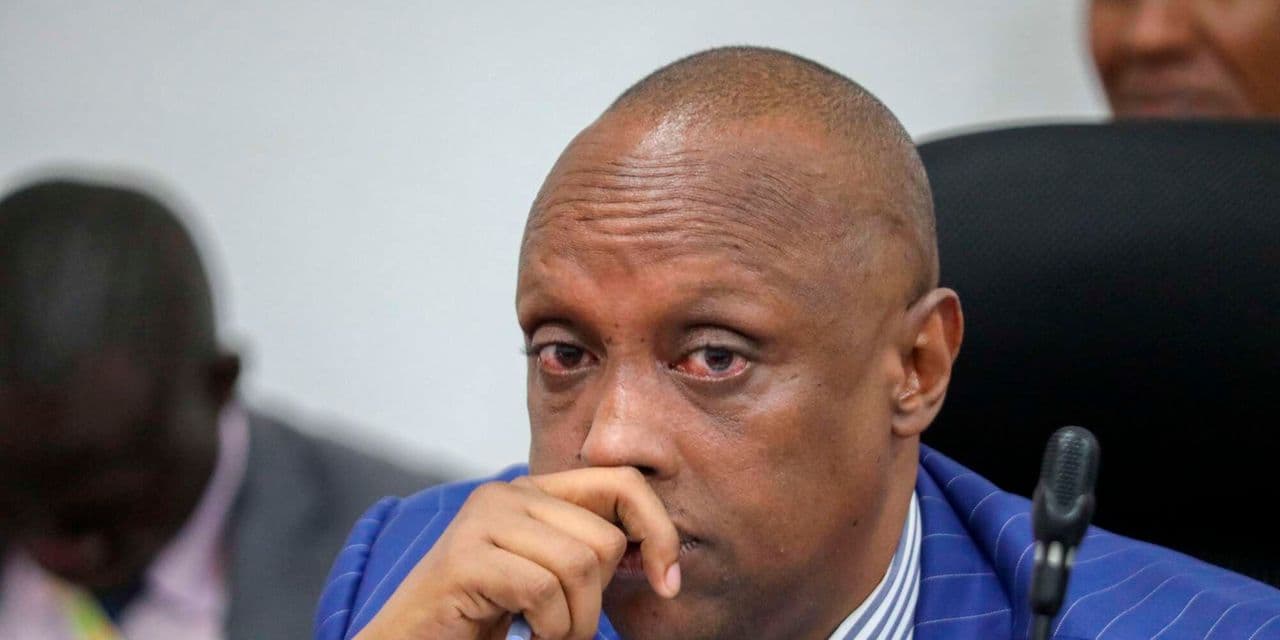
On Monday, July 20, at two in the afternoon, Isiolo Governor Abdi Ibrahim Hassan Guyo is supposed to walk into Bunge Towers escorted, if necessary, by the Inspector General of Police himself.
The Senate Public Accounts Committee has run out of patience with a governor who treats parliamentary summons the way other people treat junk mail.
Committee chairman Moses Kajwang, tired of a letter that arrived hours before a scheduled hearing pleading a clash with the County Assembly, ordered Douglas Kanja to produce the governor in person, dismissing the excuse as insufficient and reminding the country that accountability, in his words, does not go on holiday.
It is a scene Kenyans have watched on repeat since 2024. Guyo has now dodged, delayed or defied more than seven separate Senate summons across at least five committees, including County Public Accounts, Labour and Social Welfare, Health, Finance and Budget, and Public Investments and Special Funds.
He has been fined half a million shillings twice, once for recruitment irregularities and once for ignoring CPAC altogether. He has been publicly declared a governor presiding over a crime scene, after CPAC investigators visited Isiolo and found him absent, senior staff instructed to disappear, and senators themselves locked out of county headquarters. And still, more than two years into his first term, he remains firmly in the governor’s chair.
The excuses have varied in creativity but never in effect.
In one instance he blamed the Gen Z protests for skipping a hearing, only for it to emerge he had earlier cited an investment conference as his reason for the same absence.
In another, he informed a committee he was not governor when the financial year under scrutiny occurred, an argument senators found beside the point since he was the one now required to account for it.
This month’s letter, blaming a County Assembly engagement, arrived on the morning of the hearing itself, in defiance of Senate rules requiring at least a week’s notice for non-appearance.
Kajwang has publicly rejected the framing that CPAC is settling scores on behalf of Isiolo Senator Fatuma Dullo, with whom Guyo has openly sparred, telling the committee there is no vendetta and no witch hunt, only a constitutional duty to establish how billions allocated to the county have actually been spent.
Guyo, for his part, has told senators bluntly that he answers to the people who elected him and accused the Senate of allowing itself to be weaponised in local political battles.
It is the same script every time: summons arrives, governor frames it as persecution, hearing collapses or is postponed, and the underlying financial questions go unanswered for another cycle.
Strip away the theatre of missed hearings and what remains is a county executive that auditors describe as bloated almost beyond belief.
The Auditor General’s own findings, tabled before CPAC, show Guyo appointed 36 advisors in the Office of the Governor at a time when Salaries and Remuneration Commission guidelines cap the number at three or four.
When senators pressed him to simply name his advisors, he reportedly could not get past a handful, eventually conceding that most of the 32 others were technically Public Service Board staff dressed up in advisory titles.
He has also installed 31 chief officers against an approved ceiling of 18 for a county with only six departments, and appointed two deputy county secretaries where the law allows one.
The arithmetic behind this is damning on its own terms.
Auditors established that 47 percent of Isiolo’s entire county budget is consumed by wages, an extraordinary share for a marginalised county where roads remain impassable, water points run dry, and health facilities operate without basic supplies.
Each of Guyo’s county executive committee members reportedly commands five chief officers apiece, each drawing a monthly salary in the region of 255,000 shillings, a personal fiefdom structure that has less to do with efficient governance than with rewarding loyalty and managing Isiolo’s delicate clan balance through the payroll.
Beyond the wage bill, the Auditor General flagged the county for failing to remit an estimated 17.9 million shillings in statutory deductions, for retaining staff well past mandatory retirement age, and for processing salaries outside the Integrated Personnel Payroll Database, the very system designed to prevent exactly this kind of manipulation.
CPAC has separately referred a 98.5 million shilling contract for the county’s spatial plan to the Ethics and Anti-Corruption Commission for investigation, after the lowest bidder, who had quoted 62.1 million shillings, was controversially disqualified on the pretext that the price was too low to guarantee delivery.
Whether that disqualification reflects genuine due diligence or a manufactured pretext to steer the tender elsewhere is precisely the kind of question a governor who will not sit before a committee never has to answer.
If the Senate summons represent one front of Guyo’s survival strategy, the 2025 impeachment attempt showcased the other: a legal team sharp enough to make substance disappear before it is ever tested.
Sixteen of Isiolo’s eighteen MCAs voted on June 26, 2025 to remove him on grounds of gross misconduct, constitutional violation and abuse of office, citing the very advisor and chief officer numbers auditors had already flagged, along with stalled development projects and two-year contracts for chief officers that MCAs said had created a climate of fear inside the county executive.
The case never reached its merits. Guyo’s lawyers, led by former Law Society of Kenya president Eric Theuri alongside Elisha Ongoya and Elias Mutuma, told the Senate plenary that no valid sitting of the County Assembly had actually taken place on June 18 or June 26, that the Hansard presented as evidence bore no certifying stamp, and that a Meru court had already declared the underlying resolution null and void.
The Assembly’s own account wobbled under questioning, at one point claiming a sitting had occurred before conceding that the official Hansard had been destroyed amid the chaos and physical fracas that broke out during the impeachment sitting itself, a claim senators struggled to reconcile with a properly documented parliamentary process.
On the night of July 8, 2025, thirty-one senators voted to uphold the preliminary objection and terminate the proceedings outright, against twelve who wanted the substance heard.
Speaker Amason Kingi delivered the verdict with a warning attached, telling Guyo pointedly that this was not a win and amounted only to a postponement of his case, one that could return within days depending on how he conducted himself afterward.
A year on, with a fresh arrest warrant on the table and the same advisor and chief officer numbers still unresolved, Kingi’s warning reads less like caution than prophecy.
Guyo’s talent for procedural survival extends well beyond the Senate chamber.
He made history in August 2022 as the first sitting Member of County Assembly to be elected governor, edging out former governor Godana Doyo by fewer than three thousand votes on a Jubilee ticket under the Azimio la Umoja coalition.
Within a year he and his deputy James Lowasa had defected to President William Ruto’s United Democratic Alliance, a switch that triggered a court petition seeking to have both men declared unfit to hold office for abandoning the party that sponsored their election.
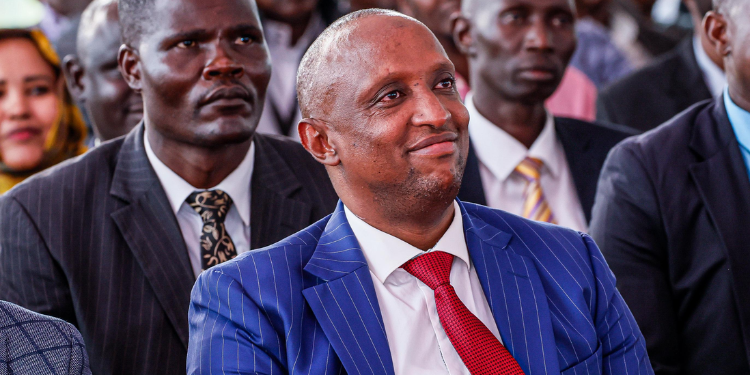
That petition was dismissed only weeks ago, in December 2025, after a three-judge bench found that petitioners could not produce a single letter or formal notice proving the defection had ever been communicated to UDA, Jubilee or the electoral commission, a technical gap that let Guyo keep both the office and the political shield his new party affiliation provides.
Guyo is no longer even the loneliest defiant governor in the country, and that may be part of what protects him now. In February this year he featured among a bloc of governors, alongside Mombasa’s Abdulswamad Nassir, Samburu’s Lati Lelelit, Kisii’s Simba Arati, Kilifi’s Gideon Mung’aro and Kakamega’s Fernandes Barasa, who jointly snubbed CPAC appearances and, at a closed-door meeting of more than thirty governors in Kilifi, resolved to boycott the committee altogether until it was reconstituted, amid allegations that some members had solicited bribes in exchange for softer audit findings.
Whatever the truth of that claim, it hands every defiant governor, Guyo included, a ready-made narrative of persecution to deploy whenever scrutiny gets close, and it dilutes the political cost of any single governor’s defiance by spreading it across a caucus of two dozen.
The mechanics of Guyo’s survival are not mysterious once laid out end to end. Senate fines are cheap enough to pay and forget.
Arrest warrants require police officers willing to spend political capital hauling in a sitting governor, and enforcement has historically arrived late or not at all.
Impeachment motions live or die on the technical competence of a county assembly’s own paperwork, and Guyo’s lawyers have shown a rare gift for finding the crack in that paperwork before the Senate ever gets to the substance.
Court petitions over party defection require a paper trail that, conveniently, is never quite complete. And Isiolo’s marginal national profile means outrage rarely travels far beyond the county’s borders, however grotesque the underlying numbers.
None of this required Guyo to actually answer for 36 advisors, 31 chief officers, an unremitted statutory bill, a spatial plan contract now sitting with the EACC, or a wage bill eating nearly half of Isiolo’s budget while the county ranks among the lowest nationally in revenue allocation.
It required only that he outlast each individual attempt at scrutiny, one postponed hearing, one disputed Hansard, one missing defection letter at a time.
What should alarm Kenyans well beyond Isiolo’s borders is not simply that one governor has proved slippery.
It is that his method now functions as a template.
Every fine paid rather than contested, every summons dodged on a technicality, every impeachment killed at the preliminary objection stage rather than heard on its merits, teaches the next errant county boss that the Senate’s oversight machinery can be outmanoeuvred with the right lawyers and the right timing.
Devolution was built on the promise that county resources would be answerable to the people who supply them.
When a governor can treat that promise as negotiable, and win the negotiation through absence and procedure rather than through a clean record, the erosion is not confined to Isiolo. It becomes the going rate for accountability in every county watching how this ends.
As July 20 approaches, Guyo’s communications team will almost certainly frame the arrest order as the latest chapter of a political vendetta.
The record says otherwise. He was summoned, repeatedly. He mostly did not appear.
When he could not avoid appearing, he could not name his own advisors. When impeachment finally caught up with him, it was killed not because the underlying allegations were false but because the paperwork behind them was flawed.
Isiolo residents who have taken to heckling him at public events with chants of one term deserve more than another procedural escape.
Whether the Senate finally makes the warrant stick, or whether Guyo produces yet another letter, another technicality, another reason to be somewhere else, will say a great deal about whether devolution still means anything at all.





Comments