
News
Kenyan Scientist Dr Arthur Obel Famed For Discovering AIDS ‘Cure’ Dies
Beyond his scientific pursuits, Prof Obel was known for his flamboyant lifestyle, owning a fleet of 21 luxury cars including Mercedes Benz and BMW models.

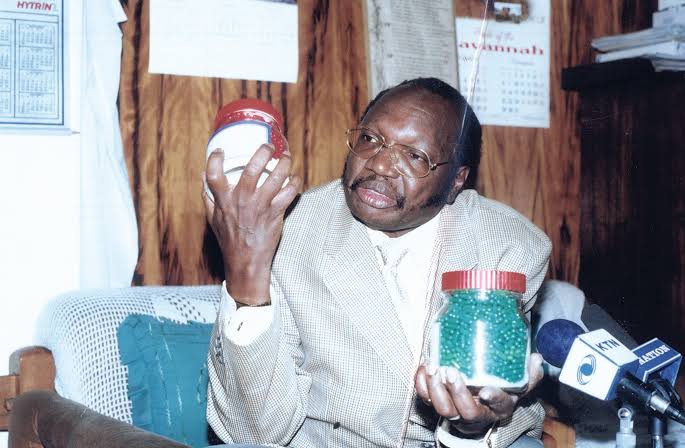
Professor Arthur Obel, the controversial Kenyan scientist who gained international attention for claiming to have discovered a cure for HIV/AIDS, has died aged 76 following a prolonged illness.
Prof Obel passed away on September 27, leaving behind a complex legacy that intertwined groundbreaking claims, scientific controversy, and an unapologetic pursuit of HIV treatment during the epidemic’s darkest years.
In 1990, Prof Obel, alongside former KEMRI director Dr Davy Koech, thrust Kenya into the global spotlight when they announced the discovery of Kemron, a drug they claimed could treat AIDS.
The announcement came at a time when HIV/AIDS was ravaging communities worldwide, with Kenya recording its first case in 1984.
According to the scientists, patients treated with Kemron showed remarkable improvement in symptoms and weight gain, with up to 10 percent reportedly showing no detectable HIV antibodies after treatment.
The drug, priced at Sh74 per tablet for a six-month course, generated unprecedented global demand from desperate patients seeking relief.
President Daniel arap Moi recognised the duo for bringing honour to Kenya, and the discovery sparked brief nationalistic euphoria.
However, the celebration was short-lived as international scientists challenged their claims, accusing them of fraud and noting the absence of controlled trials.
The World Health Organization discredited Kemron’s reliability, dismissing it as experimental.
More damaging revelations emerged when Weekly Review editor Hillary Ng’weno reported that the drug had originally been provided by American veterinary researcher Joseph Cummins for testing, with Obel and Koech later claiming credit for the discovery.
Undeterred by the controversy that forced even the Kenyan government to distance itself from Kemron, Prof Obel continued his research.
In the mid-1990s, he introduced Pearl Omega, priced at Sh30,000, followed by Iconaire in 2019, which he sold for the same amount while clarifying it was not a cure but could increase CD4 cell counts in HIV patients.
The medical establishment’s opposition to his work culminated in his deregistration by the Kenya Medical Practitioners and Dentists Council, but Prof Obel remained defiant, insisting his primary concern was improving patients’ symptoms.
Beyond his scientific pursuits, Prof Obel was known for his flamboyant lifestyle, owning a fleet of 21 luxury cars including Mercedes Benz and BMW models.
In 2004, he faced legal troubles when charged with shooting at a matatu driver on Tom Mboya Street.
Found with a pistol and 19 bullets, he was fined Sh400,000 plus Sh100,000 in damages.
A father of three acknowledged children, Prof Obel never shied away from his reputation as a womaniser.
When questioned about his legendary appetite for women, he characteristically retorted: “Which man does not love women? Tell me, which man can say he does not love women?”
Despite spending a night in VIP police cells during his 2004 arrest, Prof Obel maintained his innocence in the shooting incident, claiming he had only drawn his weapon in self-defence when surrounded by hostile touts but never fired.
Prof Obel’s career embodied the tension between hope and scientific rigour during one of medicine’s most challenging periods.
While his claims were never validated through proper clinical trials, his work represented early African attempts at local solutions to a global health crisis that had stigmatised and devastated communities across the continent.
His legacy remains deeply contested – remembered by some as a visionary who offered hope when none existed, and by others as a cautionary tale about unverified medical claims.
What remains undisputed is his unwavering belief in his work and his refusal to be silenced by controversy.
Prof Obel’s death marks the end of an era for one of Kenya’s most polarising scientific figures, whose bold claims during the AIDS epidemic continue to spark debate about medical ethics, scientific validation, and the desperate search for cures during health crises.
Kenya Insights allows guest blogging, if you want to be published on Kenya’s most authoritative and accurate blog, have an expose, news TIPS, story angles, human interest stories, drop us an email on [email protected] or via Telegram


The Oil Company That Bankrolled a Private Hospital: How Bernard Amuor Makeny Allegedly Turned Nilepet Into His Personal ATM

Death Deferred: How Kenya’s Government Is Bending Aviation Law to Shield the Rogue Developers Strangling Wilson Airport

Hit South African Show Gets The World Talking About Polygamy and Cheating

South Sudan: Fifteen Years of Independence, US$70 Billion in Oil Wealth and GDP Per Capita Cut by Two-Thirds

COFEK Escalates Bid to Oust Gambling Boss Karimi as Fresh Court Battle Puts GRA Leadership Under Siege

Desperate Family Pleads For Ruto’s Help After Safaricom Defies Court Order in Son’s Murder, Exposing Deeper Data Privacy Crisis

Nyali MP Moha Jicho Pevu Caught Up In Alleged Sh44 Million KPA Debt Scam

Somalia Deputy PM Held at JKIA, Deported Over Questionable Acquisition of Kenyan Passport

The White-Coat Heist: How MP Shah Hospital Ran a Decade-Long Double-Extraction Racket While Hiding Behind Charity Status

The Patriarch, His Children, and a Buried Sh3.9 Billion Fraud: The Story of Titus Muya That Kenya Was Never Meant to Read

Businessman Philip Waithaka Kinuthia’s Minor Son Allegedly Drove Drunk, Killed Two Peponi Students in Ngong Road Horror Crash as Claims of Cover-Up Intensify

Inside NCBA’s Decline: How a Banking Giant Lost Its Strategic Edge

South Sudan: Adut Salva Kiir’s Shadow Treasury Exposed

Cement, Cash and Courts: How the Hashu Dynasty Crushed the Ramji Brothers for Fourteen Years and Why the Walls Are Now Closing In

Standard Chartered Ghosts Haunt Joshua Oigara At Stanbic As Whistleblower Spills Beans

Inside The Urban Planning Cartel That Owns Nairobi

THE VULTURE AND THE SCHEME How Nairobi West Hospital Became the Most Dangerous Institution in Kenya’s SHA Ecosystem and Why the Books Must Be Audited Now
The Patriarch, His Children, and a Buried Sh3.9 Billion Fraud: The Story of Titus Muya That Kenya Was Never Meant to Read

The President’s Daughter and The Missing Witness: How Adut Salva Kiir’s Shadow Treasury Silenced Its Most Dangerous Critic

How Adil Popat Saved His Empire On The Eve Of Imperial Bank Collapse and Why Kenya’s Mainstream Media Buried The Story
-
 News2 weeks ago
Businessman Philip Waithaka Kinuthia’s Minor Son Allegedly Drove Drunk, Killed Two Peponi Students in Ngong Road Horror Crash as Claims of Cover-Up Intensify
-
 Investigations1 week ago
THE VULTURE AND THE SCHEME How Nairobi West Hospital Became the Most Dangerous Institution in Kenya’s SHA Ecosystem and Why the Books Must Be Audited Now
-
 Business1 day ago
The Patriarch, His Children, and a Buried Sh3.9 Billion Fraud: The Story of Titus Muya That Kenya Was Never Meant to Read
-
 Business5 days ago
BURRIED TWICE: The Victoria Bank CEO Yogesh Pattni Files
-

 Business1 week ago
Inside the Billion-Shilling Betrayal: How Senior Treasury Officials Plundered a UN Poverty Fund and Built a Real Estate Empire on the Backs of Kenya’s Rural Poor
-

 Business2 weeks ago
The Listing That Doesn’t Lie: What the Market Isn’t Saying About Family Bank’s NSE Debut
-

 Business1 week ago
The Banker Who Walked Away: How Yogesh Pattni Survived a Financial Crime Scandal That Shook Kenya
-

 News1 week ago
My Life Is In Danger: Investor Drops Bombshell Expose On Thomas Ogutu CEO VeGrid Ltd And Fugitive Nairobi CEC Charles Kerich – DCI Inaction And Corruption Network Exposed