
Investigations
THE VULTURE AND THE SCHEME How Nairobi West Hospital Became the Most Dangerous Institution in Kenya’s SHA Ecosystem and Why the Books Must Be Audited Now

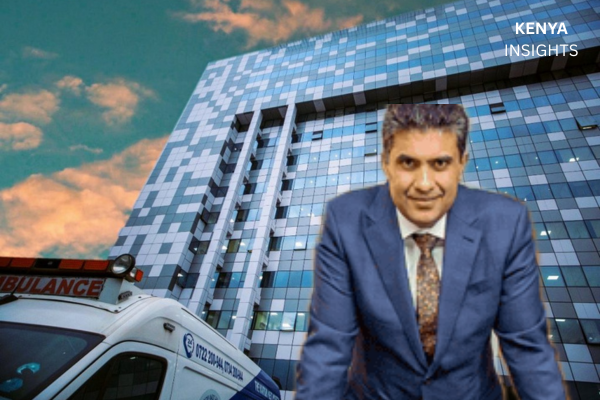
I. THE HOSPITAL ON GANDHI AVENUE
Nairobi West Hospital sits on Gandhi Avenue in the Nairobi South district, a sprawling 400-bed private tertiary facility that was, in another era, genuinely pioneering. When Dr. Umesh Saini migrated from Rajasthan to Kenya in the 1980s and established what would become the country’s first significant private hospital, it was an act of genuine entrepreneurship. His son Jayesh grew up in the corridors of that institution. He also grew up learning how to monetise it.
Today, Nairobi West Hospital is far more than a single hospital. It sits at the centre of an interlocking empire Bliss Healthcare (over 65 outpatient centres), LifeCare Hospitals (multi-specialty facilities across five counties), Medicross, Dinlas Pharma, and the now-embattled Medical Administrators Kenya Limited (MAKL) all roads leading, one way or another, back to Jayesh Saini. That empire has, for the better part of a decade, made its living from public money: the National Hospital Insurance Fund, the Teachers Service Commission medical scheme, the National Police Service health cover, and now, the Social Health Authority.
This investigation is not written to accuse Nairobi West Hospital of crimes that have not been proven. It is written because the pattern of behaviour stretching from 2012 to 2026 the NHIF Clinix scandal, the ghost clinics, the Minet capitation manipulation, the Adani-linked SHA digital contract, the LifeCare Bungoma suspension, and now the marriage-certificate IVF gatekeeping at the sole contracted facility for Kenya’s teachers constitutes a factual record that deserves scrutiny from the highest levels of government. The books at Nairobi West must be opened.
“Clinix received Ksh 91.3 million from NHIF for facilities investigators found to be non-existent or non-operational. The majority shareholder was Pharma Investment Holdings, incorporated in the British Virgin Islands.”
II. THE MAN WHO MADE NHIF HIS PERSONAL ATM
To understand what may now be happening under SHA at Nairobi West Hospital, you must first understand what happened under the defunct National Hospital Insurance Fund. In 2012, a parliamentary committee investigating the NHIF civil servants’ medical cover scheme uncovered a scandal of staggering brazenness. At the centre of it: Jayesh Saini and his company, Clinix Healthcare.
Parliamentary investigators established that Clinix Healthcare received at least Ksh 91.3 million from the NHIF’s scheme for facilities that were either non-existent or non-operational at the time of billing.
The company had registered 50 new facilities in a single year; 21 in April, 11 in March, 12 in February, 6 in January in what investigators described as a rapid-fire accreditation spree timed to coincide with public fund disbursement. Clinix and fellow accused Meridian Medical Group between them absorbed a combined Sh318 million compared to the Sh7 million allocated to Kenyatta National Hospital and Moi Teaching and Referral Hospital combined.
The majority shareholder of Clinix, parliamentary investigators noted, was a company called Pharma Investment Holdings incorporated in the British Virgin Islands, the secretive offshore jurisdiction that Kenyan investigative committees have repeatedly tracked in connection with major financial scandals.
The Registrar of Companies told the committee she did not have details of who owned Pharma Investment Holdings. Saini himself did not make this easy to untangle.
Investigators also established that the same Saini simultaneously controlled Gesto Pharmaceuticals, which had been separately accused of supplying substandard drugs to the Kenya Medical Supplies Agency.
The NHIF board was sacked by President Kibaki. Clinix accounts were frozen. Parliamentary hearings were held. Reports were published. And then nothing. No criminal conviction.
No significant legal consequence.
Clinix was quietly folded into the broader network that would eventually emerge as Bliss Healthcare. The entity changed its name, the faces remained the same, and the machinery that had just looted the NHIF was repositioned to continue feeding at the next public trough.
State prosecutors reportedly sued Clinix for defrauding NHIF of Ksh 200 million. The case did not result in a conviction that disrupted the empire. Saini’s companies continued expanding. His political connections deepened. And the lesson learned was the one that should alarm every Kenyan watching the SHA era unfold: in Kenya’s healthcare financing system, scale protects you.
“Clinix was quietly folded into Bliss Healthcare. The entity changed its name, the faces remained the same, and the machinery that had just looted the NHIF was repositioned to feed at the next public trough.”
III. THE MINET MACHINE: 161 BILLION REASONS TO ASK QUESTIONS
For nine years, the Teachers Service Commission’s medical insurance scheme which at its peak consumed Ksh 17.9 billion annually of public funds was effectively run through a consortium whose key operational players led back to Jayesh Saini.
The scheme was managed under the umbrella of Minet Kenya Insurance Brokers Limited as the lead consortium member, but two companies with documented beneficial ownership ties to Saini held the critical operational roles: Bliss Healthcare Limited, brought in as the master capitator, and Medical Administrators Kenya Limited (MAKL), serving as the medical administrator.
Over nine years, the government paid the TSC medical scheme approximately Ksh 161 billion. Bliss and MAKL, as capitator and administrator, controlled how those funds flowed through the system. They empanelled the hospitals. They set the capitation fees. They controlled pre-authorisation. And their own facilities; Nairobi West, Bliss clinics, LifeCare sat squarely within that network.
The architecture of the scheme created a perverse incentive structure that teachers and police officers experienced as daily suffering.
MAKL negotiated hospitals into the network at deliberately low capitation fees. The fewer patients the contracted hospitals treated and the more patients gave up and paid out of pocket the more profitable the arrangement became for the administrator.
Teachers across Kenya reported being kept waiting for hours before approval for emergencies. Surgery cases that required immediate intervention sat in the approval queue for three days.
Members of the National Police Service were turned away from Nairobi West Hospital itself over a demanded outstanding bill of Ksh 576,785,334 even as MAKL continued drawing its 7 percent administration fee.
Parliament noticed. The National Assembly’s Health Committee summoned Minet’s leadership. Senators asked whether MAKL had bribed committee members. A petition filed in Parliament by Amos Nyasani in March 2024 called for investigation of what it termed irregular dealings and illegal administration of the teachers’ medical scheme.
The MPs asked a straightforward question: why did companies associated with one billionaire come to dominate not just the teachers’ medical scheme but also the National Police Service and Kenya Prisons schemes simultaneously? The State had established, according to reporting by the Daily Nation, that Saini’s interests were linked to approximately nine leading healthcare service providers.
The scheme’s three-year contract with Minet ran from December 2022 to November 2025. When that contract expired, the government moved under National Treasury instruction to terminate it and transition teachers to the Social Health Authority.
That termination, insiders suggest, was not merely administrative. By late 2024, Saini’s position within the political ecosystem had changed dramatically.
IV. STATE HOUSE TO THE COLD
For years, the Saini family’s proximity to political power was well-documented in healthcare industry circles. Presidential security personnel reportedly provided security to Jayesh and his family. Members of President Ruto’s family were said to frequent Nairobi West.
The SHA Ksh 104.8 billion digitisation contract which awarded 59.5 percent of the consortium stake to Apeiro Limited, a company with documented UAE royal family ownership and directorship links to Saini’s Medicross group through shared director Rufus Marundu Maina was seen in those circles as the capstone of an arrangement that made Saini effectively the invisible partner of Kenya’s universal healthcare architecture.
Then the Adani Group’s exposure before a United States federal court changed the political landscape overnight. Adani’s Abu Dhabi-linked entity, Sirius International Holding, owned Apeiro through a chain of subsidiaries.
Apiero the largest SHA consortium member sat downstream of the same network that US prosecutors had accused of bribery. Opposition leaders including Kalonzo Musyoka called on President Ruto to cancel the SHA digitisation contract in the same breath as the JKIA and Ketraco deals.
The SHA chairperson scrambled to distance the authority from the consortium. Reports emerged that US agencies had reportedly frozen offshore accounts linked to Saini and associates as part of the wider Adani investigation trail.
More damaging than the legal exposure was the political realignment. According to reporting by local media in February 2026, Saini had been denied access to State House Nairobi a restriction that was deliberate and apparently final, communicated not through any official announcement but through the quiet closing of doors that had always been open.
The transition of teachers from the Minet scheme to SHA, which the National Treasury formally directed in December 2024, removed his companies from the Ksh 17.9 billion annual premium flow.
In a single policy letter, the financial architecture Saini had spent nearly a decade building around the TSC scheme was terminated.
A man who had been, as Kenya Today put it, deeply embedded in State programmes whose hospitals received steady patient flows and guaranteed payments from police, teachers, and civil servants was now on the outside. His influence questioned. His access gone. His name tied to three overlapping controversies: the NHIF Clinix fraud, the SHA-Adani digitisation deal, and the Minet-MAKL teachers’ scheme collapse.
This is the context in which Nairobi West Hospital became the sole accredited facility for teachers’ IVF under the SHA Mwalimu Comprehensive Cover. This is the context in which the hospital’s SHA billing patterns demand a forensic audit.
“A man once seen as a trusted ally of the regime now stands on the outside. His access gone. His influence questioned. The financial architecture he built around the TSC scheme has been terminated. But Nairobi West Hospital remains — and so do the SHA books.”
V. THE IVF MONOPOLY AND THE MARRIAGE-CERTIFICATE WALL
On April 24, 2026, the Teachers Service Commission formally activated IVF services under the SHA Mwalimu Comprehensive Cover.
The announcement was celebrated by unions and teachers alike. For the first time, public servants who had contributed monthly to a health scheme would have access to specialised fertility treatment a benefit capped at Ksh 600,000 per patient, with a maximum of two lifetime attempts. The sole contracted and accredited facility to deliver this benefit: The Nairobi West Hospital.
The exclusive accreditation of Nairobi West is not inherently suspicious. The hospital has a reproductive medicine unit, and accreditation processes have their own logic. But the combination of facts the hospital’s beneficial ownership chain, the empire’s history of public fund manipulation, and the post-tender-loss financial pressure creates a context that demands scrutiny.
When Kenya Insights reviewed the first weeks of the IVF rollout at Nairobi West, what emerged was a pattern that should disturb every SHA oversight body in the country.
A formal SHA communication to Nairobi West Hospital directed staff to require patients seeking IVF pre-authorisation to present a marriage certificate or affidavit alongside clinical documents.
Teachers like Anita a pseudonym for a teacher who has battled blocked fallopian tubes and polycystic ovary syndrome for years submitted her pre-authorisation request on June 11. Her medical diagnosis was documented. Her partner was willing. They are not married. Her request was blocked. The reason given was not medical. It was administrative: no marriage certificate.
SHA CEO Dr. Mercy Mwangangi moved quickly to describe the requirement as an ‘administrative error’ once the internal letter surfaced publicly. The clarification came only after the document was circulated.
Legal expert Michael Wanyama of Kipkorir and Wanyama Advocates observed that the Constitution does not permit denial of healthcare based on marital status for a principal member. Requiring proof beyond what is necessary for fraud prevention exceeds mandate, he said, and the policy risked pushing women into marriages of convenience.
SHA calling it an error may be technically accurate. But errors in accreditation systems do not typically emerge as formal written communications directing hospital staff.
They do not arrive at the one hospital that holds a monopoly over a high-value benefit, directing that hospital’s staff to apply a filter that would exclude a significant proportion of eligible claimants. They do not appear precisely when a historically questionable operator has every financial incentive to limit claims on a benefit that could cost the system Ksh 600,000 per patient.
Whether that instruction represented deliberate gatekeeping of an expensive benefit or genuine administrative incompetence within SHA, the effect was the same: a teacher with a documented medical need was denied access to care she contributes monthly to fund. And the question that no one in authority has publicly asked is the one this investigation places on the record: who drafted that communication, at whose direction, and what would the claim volume have been if it had remained in effect?
VI. THE LIFECARE PRECEDENT: WHEN THE NETWORK GETS CAUGHT
Nairobi West Hospital has not been publicly suspended by SHA. But the broader Saini network has. When the Ministry of Health published Kenya Gazette Notice No. 168 on August 7, 2025, listing the 40 healthcare facilities suspended for fraudulent SHA claims, item number 9 on that list was Lifecare Hospitals Bungoma Limited a facility within the same Africare network that encompasses Nairobi West, Bliss, and LifeCare under Saini’s group structure.
The suspension of LifeCare Bungoma was not an isolated incident. An investigation by Kenya Insights published in May 2026 established that LifeCare Bungoma had been billing SHA for ghost patients and inflated services while simultaneously failing to remit SHA contributions deducted from its own workers’ salaries a practice described as comprehensively parasitic.
The investigation noted that what appeared to be a branch-level failure reflected a group-wide posture. If LifeCare Bungoma could sustain both sides of the fraud claiming money from SHA for services not rendered while pocketing employee contributions to that same fund the question for investigators is not whether the Saini network has a pattern of exploiting public health financing. It is documented. The question is whether authorities have the will to apply that finding to the network’s flagship institution.
Health CS Aden Duale confirmed that SHA lost Ksh 11 billion to fraud between October 2024 and April 2025 alone with the bulk of fake claims submitted from private hospitals. Fraud types identified included upcoding, where hospitals billed for more expensive procedures than those performed; conversion of outpatient visits to inpatient billing; falsification of medical records; and in one documented case, hospitals billing for five-day admissions for patients who had merely donated blood. Twelve doctors and four clinical officers had their system access withdrawn. Names were forwarded to the Directorate of Criminal Investigations for prosecution.
The pattern is identical to what parliamentary investigators documented at Clinix in 2012. Ghost claims. Fictitious billing. Inflated procedures. The only difference is the acronym on the door: NHIF has been replaced by SHA. The beneficiary network has modernised its branding. The methodology, it appears, has not.
“SHA lost Ksh 11 billion to fraud in six months. The bulk of fake claims came from private hospitals. LifeCare Bungoma, within the Saini network, was suspended. Nairobi West, the network crown jewel, has not yet been audited. That is the gap this investigation seeks to close.”
VII. THE BILLING ENVIRONMENT: CO-CHARGES, SYSTEM FRICTION, AND THE MONEY LEFT ON THE TABLE
While SHA fraud investigators focus on ghost claims, a second and less visible form of exploitation operates in plain sight at contracted facilities: the systematic capture of out-of-pocket payments from patients who should be receiving cashless treatment.
After teachers were fully integrated into SHA in December 2025, a wave of complaints emerged nationally. The SHA CEO herself warned contracted facilities that co-charging teachers was prohibited and that strict action would be taken against violators. ‘Facilities are not allowed to co-charge teachers,’ Dr. Mwangangi said publicly. ‘We have received reports that some providers are co-charging teachers. Any provider who has co-charged a teacher will face consequences.’ The warning was not hypothetical. It was issued because the problem was real and widespread.
At Bliss Healthcare on Moi Avenue a Saini facility, teachers reported being given only painkillers due to the Ksh 1,200 outpatient ceiling, with the consultation alone absorbing Ksh 1,000 of that allocation, leaving Ksh 200 for actual treatment.
At Teleposta Towers, teachers described discovering the coverage structure at the reception desk, without prior communication. System downtimes persisted across the network, forcing teachers to queue for hours before being directed to pay cash. The Daily Nation reported teachers describing the Mwalimu Cover as ‘not producing anything’ and calling for urgent government review.
Against this backdrop of co-payment chaos, Nairobi West Hospital sits at the top of the Saini network’s value chain, processing the most complex and expensive teacher claims including, now, IVF procedures at up to Ksh 600,000 each. Every procedural inefficiency that pushes a teacher toward out-of-pocket payment at Nairobi West represents revenue that flows to the hospital from the patient rather than from SHA.
Every claim upcoded at the SHA window represents public money extracted from the fund. Both dynamics can coexist. Both have precedent in this network’s documented history. Both demand audit.
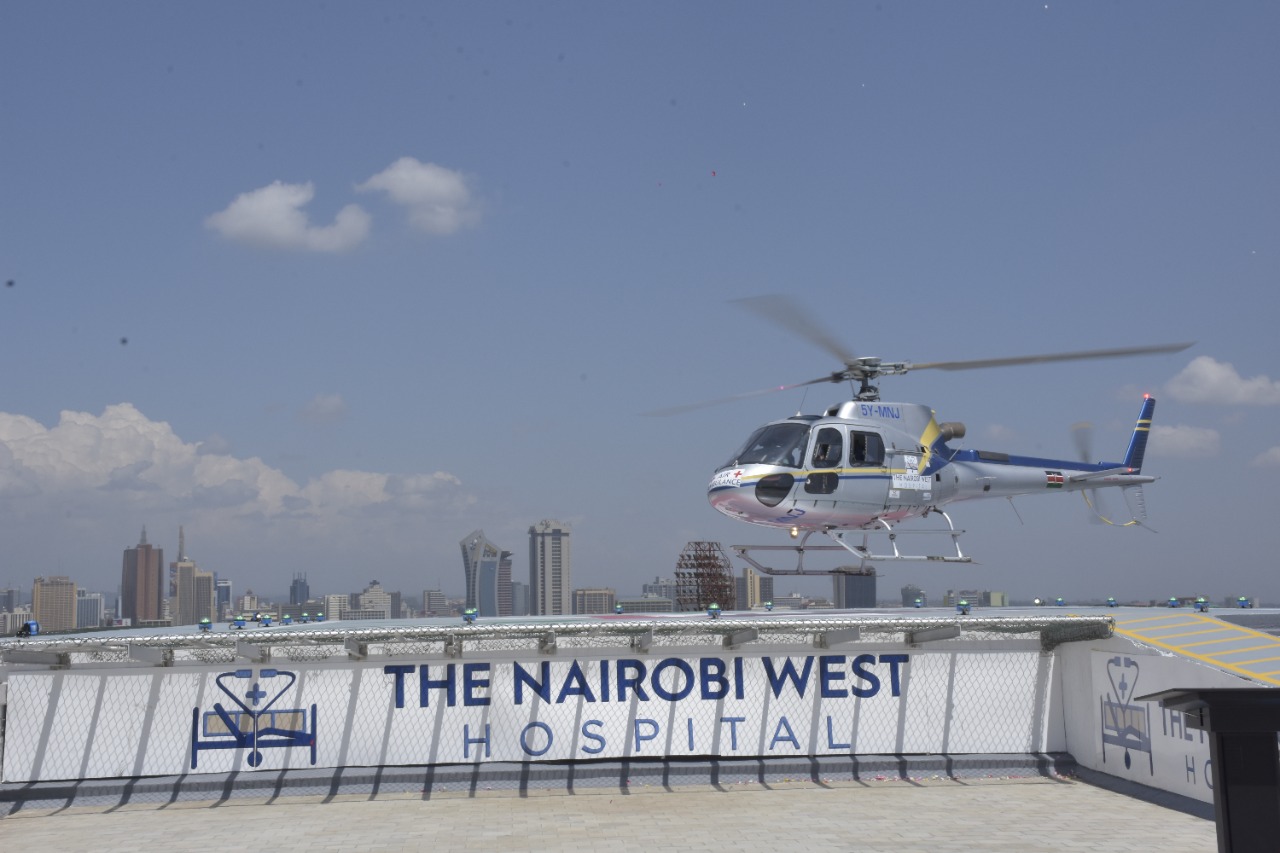
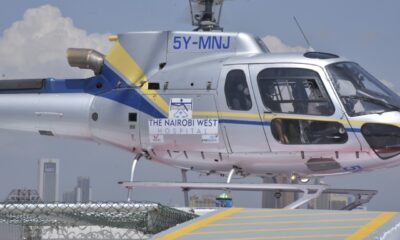
Helicopter lands on top of the hospital which is fitted with a helipad.
VIII. THE BHRIGU QUESTION: WHO CONTROLS THE NUMBERS?
There is a dimension to this story that sits beyond billing and beyond individual hospitals. It concerns the architecture of control over the SHA claims system itself.
When the Ksh 104.8 billion SHA digitisation contract was awarded to the Safaricom consortium with Apeiro holding 59.5 percent the concern raised by critics was not merely about Adani. It was about who would control the data: the claims records, the patient files, the disbursement flows that determine who gets paid and how much. SHA chairman Abdi Mohammed attempted to distance the authority from the consortium by stating that SHA itself had no contract with Apeiro or Safaricom an unusual position for the body nominally overseeing Kenya’s health insurance disbursements. COTU Secretary-General Francis Atwoli, sitting on the SHA board, revealed that the authority does not control the IT systems used to verify claims.
Director Rufus Marundu Maina who appears as a director in both Apeiro Kenya Technologies Limited and SIH Africa Limited (the entity owning all shares in Apeiro Kenya Technologies), and who simultaneously holds directorship positions in Saini-linked entities including LifeCare Hospitals represents, in corporate governance terms, a directorship overlap that any serious audit of SHA’s claims processing architecture should examine. The Daily Nation established these connections from Companies Registry filings. They are not allegations. They are documented structural realities.
The broader question whether any individual or network positioned within the SHA digitisation infrastructure is positioned to manipulate claims data in ways that are difficult to detect from outside — cannot be answered without a forensic examination of the system itself. What can be said with certainty is that the network most exposed to that question is the same network under examination in this investigation.
IX. THE CALL FOR ACCOUNTABILITY
Kenya Insights does not lightly make demands of regulatory and law enforcement authorities.
This investigation is built on public parliamentary records, documented court proceedings, official Kenya Gazette notices, Companies Registry filings, SHA media briefings, and the on-the-record accounts of teachers and legal experts. Its findings are not speculative.
They are the product of a factual chain that begins in a British Virgin Islands offshore holding company in 2012 and leads, in June 2026, to a marriage-certificate wall blocking a teacher with blocked fallopian tubes from accessing a benefit she contributes for every month.
This investigation therefore calls on the following:
The SHA Anti-Fraud Unit and the Ministry of Health must conduct an immediate forensic audit of all SHA claims submitted by Nairobi West Hospital and associated Saini-network facilities including Bliss Healthcare centres, LifeCare facilities not yet suspended, and Medicross covering the period from SHA’s October 2024 launch to the present. The audit must examine claim volumes by procedure type, cross-reference against patient OTP verifications, and reconcile inpatient conversions against clinical records.
The Directorate of Criminal Investigations must examine the IVF pre-authorisation communication that directed Nairobi West Hospital to require marriage documentation. It must establish who authored or transmitted that instruction, whether it originated within SHA, within the hospital, or within a third party, and whether the period during which the filter was applied resulted in reduced claim submissions for high-cost procedures.
Parliament’s Health Committee must summon the SHA CEO, the Nairobi West Hospital management, and MAKL’s beneficial owners to account publicly for the overlap between the terminated Minet-MAKL arrangement and the hospital’s current SHA accreditation. The committee must ask directly whether the sole-facility accreditation for IVF under the Mwalimu Cover was subject to competitive assessment or administrative discretion.
The Ethics and Anti-Corruption Commission must re-examine the 2012 Clinix parliamentary file never converted into a criminal conviction in light of the SHA-era evidence now accumulating from the same network. The EACC has the statutory mandate to pursue assets acquired through corruption. It should use it.
The Office of the Director of Public Prosecutions must be briefed on the LifeCare Bungoma suspension findings including the dual fraud of billing SHA for ghost patients while pocketing employee SHA contributions and must assess whether the documented pattern across the Africare-Saini network meets the threshold for a broader enterprise corruption prosecution.
X. WHAT THE BOOKS WILL SHOW
Jayesh Saini has never been convicted of a crime in Kenya. Every investigation into his activities has either stalled at the parliamentary report stage or settled in civil proceedings. He has built a healthcare empire that has, by any measure, expanded access to medical care for millions of Kenyans. His family’s hospital has been a fixture of Nairobi’s healthcare landscape for four decades. These things are true.
Also true: his flagship company received Ksh 91.3 million from NHIF for non-existent clinics.
Also true: the subsidiary managing teachers’ healthcare empanelled hospitals at deliberately low capitation rates and drew administrative fees while patients were turned away at emergency wards.
Also true: a branch of his hospital group was suspended by SHA for fraud within the same period that its parent network was being positioned as the sole IVF provider for the country’s largest professional group.
Also true: a directorship overlap links the network to the largest shareholder in the SHA IT consortium. Also true: an internal communication at Nairobi West the network’s crown jewel directed hospital staff to apply a marriage requirement that SHA’s own CEO described as an error.
None of these facts, individually, constitutes proof of a current SHA fraud at Nairobi West. Together, they constitute a pattern that no serious oversight body can responsibly ignore. The SHA era was supposed to be different from the NHIF era. The digitisation was supposed to make fraud impossible. The anti-fraud teams were supposed to catch what the old system missed.
Ksh 11 billion was defrauded in six months. Forty facilities were suspended. LifeCare Bungoma was on the list. Nairobi West was not.
The question is not whether Nairobi West Hospital is currently defrauding SHA. The question is: why has no one looked?
“The SHA era was supposed to be different. Ksh 11 billion was stolen in six months. Forty hospitals were suspended. LifeCare Bungoma was on the list. Nairobi West was not. The question is: why has no one looked?”
Kenya Insights allows guest blogging, if you want to be published on Kenya’s most authoritative and accurate blog, have an expose, news TIPS, story angles, human interest stories, drop us an email on [email protected] or via Telegram






The Shadow Banker of Harare

Wicknell Chivayo’s VIP Airport Access Raises Serious Questions Over Security Protocols at JKIA

UAE Bans Children Under 15 Years From Using Social Media

‘They Come At Night’: Gachagua Claims Ruto Insiders Secretly Supporting and Advising Him

Lawyer In High-Profile Ugandan Treason Case Charged With Related Offence

Sh2 Billion Time Bomb: Firm Allegedly Linked to Amason Kingi in Kilifi Revenue Deal Continues to Drain County Coffers as Senate Opens Probe

THE VULTURE AND THE SCHEME How Nairobi West Hospital Became the Most Dangerous Institution in Kenya’s SHA Ecosystem and Why the Books Must Be Audited Now

Mercy Wamoto’s Elgon Group Accused of Pocketing Piny Luo Festival Cash as Suppliers Go Unpaid

Ruto Invites Arsenal After Kenyan Fans Celebrate Title Win

The Banker Who Walked Away: How Yogesh Pattni Survived a Financial Crime Scandal That Shook Kenya

Businessman Philip Waithaka Kinuthia’s Minor Son Allegedly Drove Drunk, Killed Two Peponi Students in Ngong Road Horror Crash as Claims of Cover-Up Intensify

Inside NCBA’s Decline: How a Banking Giant Lost Its Strategic Edge

Cement, Cash and Courts: How the Hashu Dynasty Crushed the Ramji Brothers for Fourteen Years and Why the Walls Are Now Closing In

Standard Chartered Ghosts Haunt Joshua Oigara At Stanbic As Whistleblower Spills Beans

Inside The Urban Planning Cartel That Owns Nairobi

South Sudan: Adut Salva Kiir’s Shadow Treasury Exposed

Why John Ngumi Is Running From the EACC and Why the Sh415 Million Payday May Be the Least of His Worries

How Adil Popat Saved His Empire On The Eve Of Imperial Bank Collapse and Why Kenya’s Mainstream Media Buried The Story

The President’s Daughter and The Missing Witness: How Adut Salva Kiir’s Shadow Treasury Silenced Its Most Dangerous Critic

Betika Faces DCI Probe, Directors Arrest and License Revocation Over Massive 29.5 Million Safaricom Customers’ Data Breach
-
 News4 days ago
Businessman Philip Waithaka Kinuthia’s Minor Son Allegedly Drove Drunk, Killed Two Peponi Students in Ngong Road Horror Crash as Claims of Cover-Up Intensify
-
 Business1 week ago
Inside NCBA’s Decline: How a Banking Giant Lost Its Strategic Edge
-
 Business1 week ago
Standard Chartered Ghosts Haunt Joshua Oigara At Stanbic As Whistleblower Spills Beans
-
 Investigations2 weeks ago
Inside The Urban Planning Cartel That Owns Nairobi
-
 Africa1 week ago
South Sudan: Adut Salva Kiir’s Shadow Treasury Exposed
-
 Business1 week ago
Why John Ngumi Is Running From the EACC and Why the Sh415 Million Payday May Be the Least of His Worries
-
 Business7 days ago
How Adil Popat Saved His Empire On The Eve Of Imperial Bank Collapse and Why Kenya’s Mainstream Media Buried The Story
-
 Africa1 week ago
The President’s Daughter and The Missing Witness: How Adut Salva Kiir’s Shadow Treasury Silenced Its Most Dangerous Critic