
News
When Emotion Overwhelmed Protocol: Inside the JKIA Security Breach That Shocked a Nation
In a cruel irony, the condition that critics mocked actually burnished his credentials among supporters.

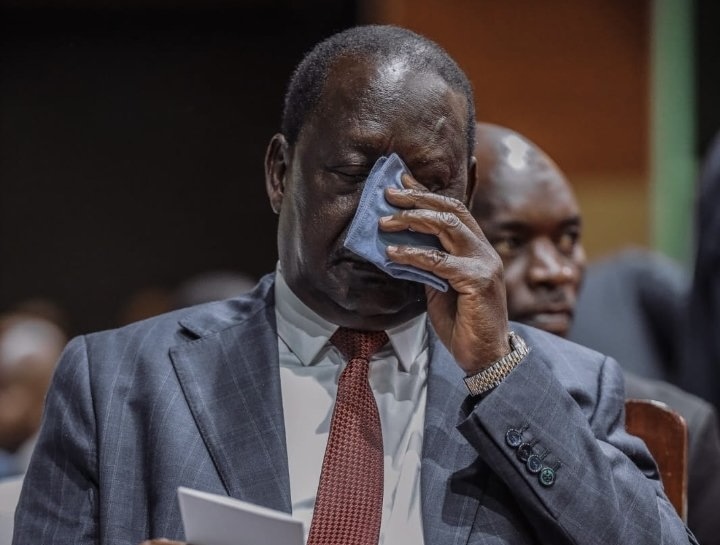
For decades, it became one of Kenya’s most recognizable political gestures. Raila Odinga, addressing thousands at rallies from Uhuru Park to Kasarani, would pause mid-sentence, reach into his pocket, and produce a crisp white handkerchief.
With practiced ease, he would dab at the corners of his eyes, then resume speaking as if nothing had happened.
The handkerchief was never far from his grasp, a constant companion that became as much a part of his public persona as his trademark Vitenge shirts.
His detractors saw opportunity in the affliction. Opposition politicians would mockingly wipe imaginary tears during their own speeches, suggesting the former Prime Minister was perpetually emotional or performing for sympathy.
On social media, memes proliferated. But those who knew the truth understood that what flowed from Raila’s eyes was not sentiment but the physical manifestation of Kenya’s darkest political chapter.
The answer lay buried in the belly of Nyayo House, in those infamous basement chambers where the Moi regime warehoused its political prisoners.
Between 1982 and 1988, Raila disappeared into that concrete hell, detained without trial after being implicated in the failed coup attempt.
What happened in those cells would mark him permanently, etching itself onto his very physiology.
Ahmed Hashi, a confidant of many years, recalled the day Raila finally explained the condition. During a routine meeting, Hashi noticed the constant dabbing and offered a fresh handkerchief.
Later, in a moment of candor, Raila revealed what seven years of detention had cost him.
The torture chambers, deliberately kept in perpetual darkness, had deprived his body of essential sunlight.
His lacrimal glands and ducts, the delicate machinery responsible for tear production and drainage, had sustained irreversible damage.
The normal communication between brain and eye had been severed. Now his tears flowed involuntarily, uncontrolled, a permanent reminder of suffering that could not be undone.
When Raila stood at Kasarani Stadium in 2021 to accept the Azimio presidential nomination, he finally told Kenyans what that handkerchief represented.
“The tears from the torture chambers are still running, as you can tell from the handkerchief that never leaves my hand,” he declared. It was not a plea for sympathy but a simple statement of fact.
Medical science explains that tears normally flow on command, when the brain detects irritation or emotion.
The lacrimal glands produce moisture, which travels through ducts to cleanse and protect the eye. But damage those glands, disrupt those ducts, and the system fails.
The tears come unbidden, streaming down without purpose or control.
For Raila, every public appearance became a dual performance.
He had to deliver his message while managing a body that would not cooperate, eyes that wept without his permission.
The handkerchief became his tool of defiance, proof that torture had marked but not broken him.
In a cruel irony, the condition that critics mocked actually burnished his credentials among supporters.
Here was physical evidence of sacrifice, a wound worn openly that testified to his commitment. Other politicians spoke of their struggles. Raila’s body bore permanent witness to his.
His supporters had long believed that decades of exposure to teargas at demonstrations had damaged his eyes.
It was a reasonable assumption for a man who had led countless protests, often standing at the front when police canisters flew.
But the truth ran deeper and darker than that.
Now, as Kenya mourns the passing of one of its most consequential political figures, that white handkerchief has taken on new meaning.
What was once a symbol of physical affliction has become a relic of national significance, a tangible connection to an era when speaking truth carried unimaginable cost.
The tears that once flowed from damaged ducts, products of deliberate cruelty in underground chambers, have been replaced by genuine tears of grief.
Across the country, Kenyans weep for a man whose own involuntary tears told a story of sacrifice that words alone could never capture.
The handkerchief that never left his hand will be remembered not as a sign of weakness, but as a badge of resilience, proof that some scars run so deep they alter the body itself, yet still the spirit endures.
Kenya Insights allows guest blogging, if you want to be published on Kenya’s most authoritative and accurate blog, have an expose, news TIPS, story angles, human interest stories, drop us an email on [email protected] or via Telegram


Shiquo wa Hii Style Counts Costly Lesson After Anti-Counterfeit Raid Wipes Out Shop Stock

“Are They Giving Kickbacks To Government Officials?” The Scandalous Record Behind Kenya’s Most Favoured Chinese Contractor

Two MPs Defrauded of Sh93.5 Million in Karen Land Scam

Gachagua Rejects Sh50 Million Court Compensation, Calls It An Insult

Ghost Firm, Ghost Justice: Two Judges Fingered In KETRACO’S Sh10 Billion Scandal

SH2 BILLION HEIST EXPOSED: How Tatu City’s Foreign Masters Used Dirty Offshore Traps, London Arbitration & Mauritius Liquidation to Strip Local Investors of Their Stake

Dimba Accused of Extorting Bank Executives in Escalating Feud

Humiliated, Handed Sh1,000 and Sent Away: Furious Residents Return Nathif Jama’s Money, Accuse Governor of Arrogance and Inhumane Treatment of Sick Woman

ICC’s Karim Khan Suspended Over Sexual Misconduct Claims

The Conquest of Tatu City, A New Zealander Story

Cement, Cash and Courts: How the Hashu Dynasty Crushed the Ramji Brothers for Fourteen Years and Why the Walls Are Now Closing In

Inside The Urban Planning Cartel That Owns Nairobi

Why Ruto’s Favourite Candidate Adan Mohammed Could Be Locked Out of the KRA Top Job

LifeCare on the Brink: SHA Fraud, Stolen Wages, and the Rotten Empire Jayesh Saini Built

Este Medical Kenya Fights American’s Explosive Complaints

Betika Faces DCI Probe, Directors Arrest and License Revocation Over Massive 29.5 Million Safaricom Customers’ Data Breach

The Rot Inside Absa: How Bank Insiders Are Looting Nairobi’s Customers

Inside FAFSA Fraud: How Kenyan Cybercriminals Siphoned Millions from America’s Sh12 Billion Student Loan System

Fresh Move Launched to Remove Kenya Railways MD Mainga From Office After Awarding Sh817 Million Consultancy Contract

Court Confirms Safaricom Customers Data Was Sold To Betting Companies In Seven-Year Cover-Up
-
 Investigations5 days ago
Cement, Cash and Courts: How the Hashu Dynasty Crushed the Ramji Brothers for Fourteen Years and Why the Walls Are Now Closing In
-
 Investigations4 days ago
Inside The Urban Planning Cartel That Owns Nairobi
-
 Investigations1 week ago
Betika Faces DCI Probe, Directors Arrest and License Revocation Over Massive 29.5 Million Safaricom Customers’ Data Breach
-
 Investigations5 days ago
Fresh Move Launched to Remove Kenya Railways MD Mainga From Office After Awarding Sh817 Million Consultancy Contract
-
 News2 weeks ago
Eight Students Arrested In Kenya After Suspected Deadly School Arson Attack
-
 News1 week ago
How Uhuru’s Deal With Obama In 2015 Paved Way For America’s Ebola Plan In Kenya
-
 Business6 days ago
TRUST BETRAYED: How Senior DTB Bank Insiders Allegedly Looted Sh149 Million From a Customer’s Account Over Five Years
-

 Investigations4 days ago
Why Drivers Cheered Bolt’s Reported Exit: Inside the Slow Financial Strangulation of Thousands of Kenyan Drivers and Riders in Kenya