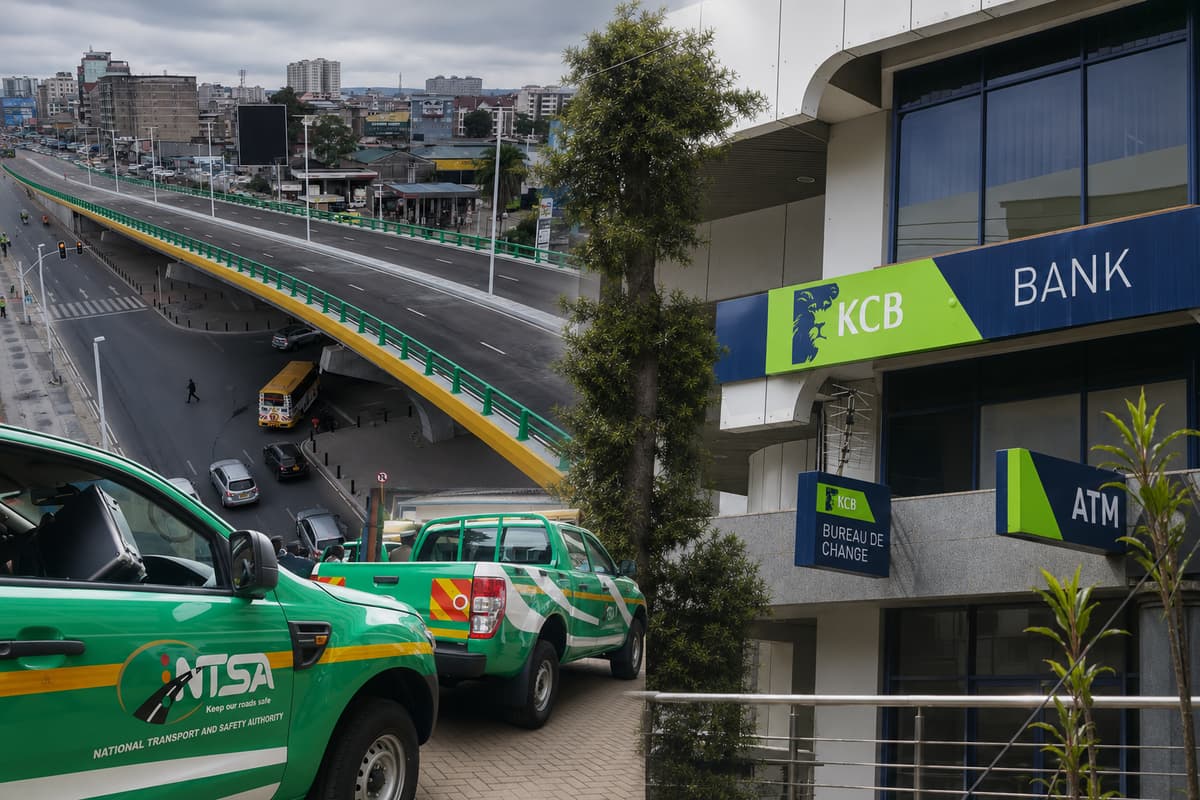
A traffic fine that should have ended with a receipt has instead opened a fresh line of questioning into how the National Transport and Safety Authority (NTSA) collects public money under its camera-based instant fines system and whether that money is, in some cases, landing in private hands before it ever reaches a government account.
The case at the centre of the dispute is straightforward enough on its face. Prominent Nairobi lawyer Donald B. Kipkorir says his younger brother received a text message purporting to be from NTSA, alleging a speeding offence on the Nairobi–Nyeri highway near Kibirigwi Girls Secondary School on 17 June 2026. The message cited ticket number 34467, listed the relevant Traffic Act provision, and directed him to settle the fine.
Wary of fraud, the family first called the number provided. The person who answered instructed payment at any KCB branch. Kipkorir’s brother went to a KCB branch on Langata Road, where a teller verified the ticket details as legitimate and accepted KSh 10,000 in payment, issuing a standard bank receipt. The transaction, by every visible signal, looked like an ordinary, sanctioned government payment.
The M-Pesa confirmation that followed told a different story. The receiving account, number 7576419, was registered not to NTSA, the National Treasury, or any identifiable government entity, but to a private individual: Catherine Jerono Tomno, described in reporting as a KCB bank agent.
Kipkorir posted the screenshots to X on 29 June, asking pointedly why a government institution would route a statutory fine into an account in a private citizen’s name. “The law doesn’t allow Government institutions to open bank accounts in the names of individuals,” he wrote. “Is NTSA exempt?” The post quickly drew thousands of reactions, with many Kenyans saying they had received similar fine notices and questioning whether they, too, had paid into accounts they could not verify.
What Is Actually Confirmed
Independent reporting on the Kipkorir case, corroborates the core sequence of events: the SMS notification, the phone call, the branch visit, the teller’s verification, and the M-Pesa confirmation naming an individual account holder. As of this writing, NTSA has not publicly responded to the claims, and KCB has not issued a statement clarifying the ownership or purpose of the account in question.
That silence matters, but it should not be mistaken for an admission. Kenya Today’s reporting on the same case noted, fairly, that the screenshots alone do not establish wrongdoing the account could plausibly belong to an authorised cashier or a legally structured collection arrangement that simply has not been explained to the public. The absence of an explanation is itself the story; it is not yet proof of a “heist” or organised theft, and this publication will not get ahead of the facts by asserting criminal intent that has not been established.
What can be said with confidence is this: NTSA’s instant fines system directs payment exclusively through the KCB Group network a fact NTSA itself has stated publicly and repeatedly since the system’s rollout and at least one verified payment under that system was received into an account carrying an individual’s name rather than an institutional one. Whether that is an isolated administrative anomaly, a structural feature of how KCB processes fines on NTSA’s behalf, or something more troubling is precisely what NTSA and KCB now owe the public an answer on.
A System Already Under Legal Strain
This is not the first time the payment architecture behind NTSA’s instant fines has been challenged. When the Instant Fines Management System went live in March 2026 built on a network of roughly 1,000 speed and traffic-violation cameras feeding automated SMS notices to vehicle owners it was almost immediately contested in court.
The advocacy group Sheria Mtaani, through lawyers Danstan Omari and Shadrack Wambui, petitioned the High Court arguing the system violated constitutional protections under Articles 47 and 50 by imposing penalties without notice, hearing, or any avenue to contest guilt before payment was demanded. Justice Bahati Mwamuye issued conservatory orders halting the system and took the unusual step of enjoining KCB Bank Kenya directly as an interested party in the case a recognition by the court that the bank’s role in the payment chain was itself part of what needed scrutiny.
Court filings in that matter went further than the constitutional due-process argument: Sheria Mtaani specifically challenged the collection of fines through a commercial KCB account rather than statutory government revenue accounts, telling the court the arrangement raised accountability concerns over how public money was being handled. NTSA briefly withdrew its original go-live notice in late March, citing a need for clearer public communication around minor traffic offences under Section 117 of the Traffic Act, though it did not cite the court order as its reason. The system has since continued operating, including under a relaunched framework that took effect on 1 June 2026.
In other words, the question Kipkorir’s family’s experience has now made vivid for ordinary Kenyans where, exactly, does this money go? is the same question that was already sitting before a High Court judge months before this single transaction came to light.
The KCB Relationship Runs Deeper Than One Payment Channel
KCB’s role in NTSA’s enforcement architecture is not limited to receiving fine payments. The bank inherited project responsibilities for NTSA’s Smart Driving Licence programme a public-private partnership originally structured around the National Bank of Kenya after Nigeria’s Access Bank acquired NBK outright. Under a Deed of Novation executed in February 2026, KCB assumed NBK’s role alongside the Pesa Print Consortium in a PPP that NTSA has described as spanning driver licensing production as well as instant fines infrastructure, with National Treasury named as overseer of the PPP’s fiscal structuring.
That broader commercial relationship is relevant context, not proof of anything improper in itself. But it does mean KCB sits inside the instant fines system not as a neutral payment processor but as a structured commercial partner with financial interest in the programme’s continuation which is precisely why transparency about how individual fine payments are received, held, and reconciled against government revenue accounts is not a minor technical detail. It goes to the core of whether the public can trust the system at all.
The Open Questions
Kenyan public finance law requires that revenue collected by or on behalf of government institutions be paid into designated, auditable accounts not accounts in the names of private individuals, however legitimate their employment or contracting relationship with the institution might be. Against that backdrop, NTSA and KCB owe the public specific, verifiable answers, not vague reassurances:
Is the KCB account named in the Kipkorir case an authorised collection point under the NTSA-KCB arrangement, and if so, why does it carry an individual’s name rather than a designation identifying NTSA, KCB Group, or the Pesa Print Consortium? What internal control reconciles funds received into such accounts with NTSA’s official revenue records? How many other fine payments, across how many similarly structured accounts, have been processed the same way since the system’s relaunch on 1 June? And why, given that KCB Bank Kenya is already an interested party in active High Court litigation over this exact payment structure, has neither institution moved to clarify the matter publicly even as it became a trending national concern?
Until NTSA and KCB answer those questions on the record, Kenyans who receive instant fine notices are left to weigh a genuine dilemma: ignoring a notice risks escalating penalties and being locked out of NTSA’s digital services, while paying means trusting a payment chain that has, in at least one documented and corroborated instance, deposited public money into a private citizen’s bank account with no public explanation of why.
This publication has sought comment from NTSA and KCB Bank Kenya and will update this report with their responses. Readers who have received instant fine notices and wish to share documentation of where their payments were directed are encouraged to come forward; verified additional cases would materially strengthen the public’s basis for demanding a full audit of the instant fines payment architecture.









Comments