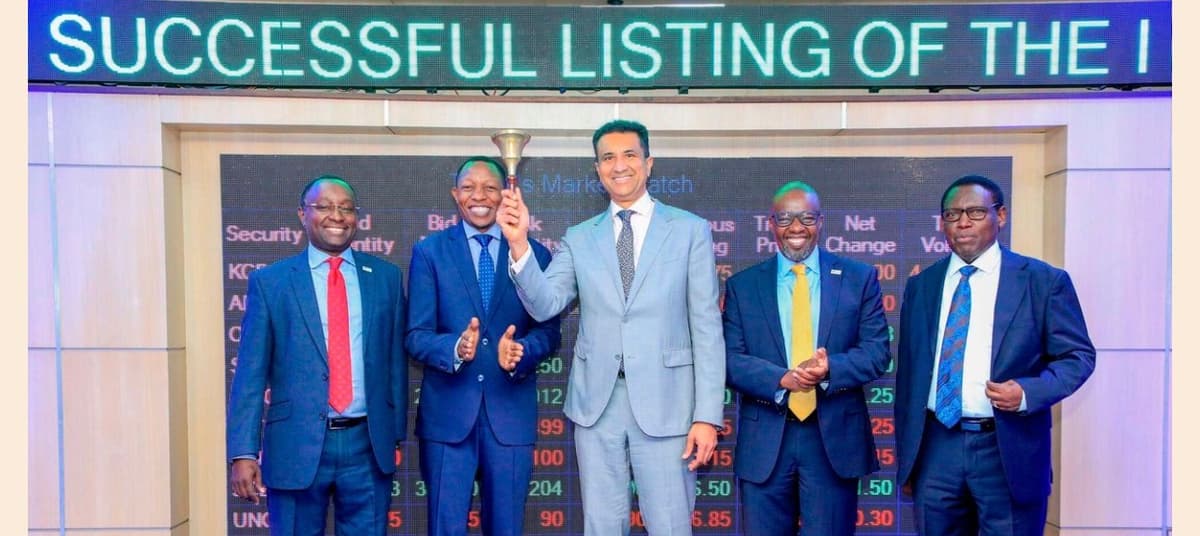
The photograph in Wednesday’s Business Daily told its own story. There stood Capital Markets Authority Director Daniel Warutere and Nairobi Securities Exchange CEO Frank Mwiti, flanking I&M Group Executive Director Sarit Shah as they rang the bell for the listing of the bank’s Medium Term Note. Regulators and the family executive, smiling for the camera on a day the market was told a comfortable story about generational wealth doubling.
The headline above it was carefully framed. It spoke of Suresh Raja Shah and his two sons watching their direct holdings rise on a 94 percent stock surge to Sh69.50 a share. Raja Shah’s named 10.06 percent stake, 174.9 million shares, now worth Sh12.16 billion. Sarit’s 2.16 percent at Sh2.61 billion. Sachit’s 2.14 percent at Sh2.58 billion. Add nearly Sh936.3 million in dividends paid out in May and the arithmetic sat neatly inside a single number: Sh17.35 billion.
That is the story the paper wanted readers to take away. It is not the full story the same article quietly disclosed further down the page.
One family, through three investment vehicles, effectively controls the direction of a bank with a Sh120.94 billion market capitalisation.
THE VEHICLES BEHIND THE NAMES
The Shahs do not just own the personal stakes attributed to them by name. They control the bank’s three largest shareholders, Minard Holdings Limited, Tecoma Limited and Ziyungi Limited, the vehicles through which the family holds the bulk of its I&M Bank shares. By the end of May 2026, those three entities alone commanded a combined 54.93 percent stake valued at Sh66.43 billion. The family’s Bhagwanji Raja Charitable Foundation holds a further 2.43 percent, worth Sh2.94 billion at the time of reporting. Add the named personal holdings and the foundation’s position, and the dynasty’s economic interest in one of Kenya’s most significant listed banks exceeds 70 percent in practical terms.
This is not a loose collection of minority positions accumulated opportunistically. These three companies have sat at the top of I&M’s share register for years. Their directors include the founder, Suresh Raja Shah. The structure is legal and has been disclosed in filings. It has also remained stable through listing, capital raises and multiple market cycles. What changes is not the structure but the public framing of it, and this week that framing chose to lead with three individuals and a comfortable number rather than with the holding companies and the much larger one.
A DILUTION THAT COST THE FAMILY ALMOST NOTHING
The article notes, almost in passing, that when I&M issued new shares to East Africa Growth Holding, the AfricInvest vehicle, in late 2024, it did so in a manner that diluted existing investors, the Shah family included. The new shares were priced at Sh48.42, a 93 percent premium to the then prevailing market price of Sh25.05. EAGH ended up with a 15.14 percent stake. The family’s percentage dipped slightly on paper.
Their absolute wealth did not dip. It expanded, because the stock went on to rally a further 44 percent from the issuance price to its all time high. Minority shareholders outside the family’s orbit saw their proportional slices of the bank shrink with no comparable offsetting gain in control. The family, already holding an overwhelming majority through the three vehicles, absorbed a cosmetic reduction in percentage terms and still walked away with personal values doubled and close to a billion shillings in a single dividend payout.
Raja Shah personally took Sh656 million of that dividend distribution. His sons took roughly Sh140 million each. The foundation collected Sh158.5 million. That single payout placed the family among the Nairobi Securities Exchange’s banking sector dividend royalty, in the company of figures such as Equity Group’s James Mwangi and Co-operative Bank’s Gideon Muriuki. The distinction worth sitting with is that those two men are chief executives with large but not controlling stakes in the institutions they run. In I&M’s case, control itself sits with the family’s vehicles, not merely a large executive shareholding.
THE GOVERNANCE QUESTION NOBODY ASKED
Sarit Shah sits on I&M’s board as an executive director. His brother Sachit sits as a non-executive director. Both are also, through the family structure, beneficial owners of the vehicles that would have had a seat at the table, formally or informally, when the AfricInvest issuance was approved. A capital raise that the coverage describes as diluting existing investors including the Shah family is accurate in the narrowest technical sense. It is close to irrelevant in practice for a family holding a supermajority through three vehicles plus a foundation.
The governance question that deserves scrutiny is not whether the family was diluted. It is whether independent minority shareholders had any meaningful influence over a transaction priced at a 93 percent premium to market, or whether the family’s aggregate voting bloc made shareholder approval a formality dressed up as a competitive capital raise. Kenyan company law and Capital Markets Authority rules on related party transactions exist precisely to police this kind of conflict. Whether those protections were tested in substance, rather than satisfied on paper, is a question the market has not yet been asked to answer.
A FOUNDATION THE SIZE OF AN INSTITUTIONAL INVESTOR
The Bhagwanji Raja Charitable Foundation holds 2.43 percent of I&M Bank, a stake worth Sh2.94 billion, and collected Sh158.5 million in the May dividend round. Raja Shah is among its directors. A charitable foundation holding a stake of that size, and drawing dividend income at that scale, is functioning less like a philanthropic vehicle and more like a family holding company that happens to carry favourable tax treatment.
Charitable trusts in Kenya receive that treatment on the understanding that their assets serve a demonstrable public benefit. What has not been established, and what this newsroom is now seeking through Public Benefit Organizations Authority filings, is whether the foundation’s disbursement history bears any reasonable relationship to an asset base of this size. Until those filings are examined, the honest position is that the foundation’s role raises a legitimate question rather than proves a conclusion. That question is nonetheless one the coverage did not think to ask.
WHAT THE NUMBERS ACTUALLY SAY
Sh66.43 billion sits inside three companies whose names appeared once, in a single paragraph, without emphasis. Sh2.94 billion sits inside a foundation whose disbursement record is not public. Add the Sh17.35 billion in named personal holdings that carried the headline, and the family’s practical economic interest in I&M Group is worth closer to Sh86 billion than the Sh17.35 billion that ran above the fold. Add close to a billion shillings banked in a single dividend cycle, and the gap between the marketed story and the disclosed architecture becomes difficult to describe as accidental.
The market was told the family’s wealth doubled. It was not told that the family’s control of the institution was never meaningfully at risk.
None of this requires alleging that the structure is unlawful. It is disclosed, it has existed for years, and it has survived listing, audits and multiple capital raises without regulatory challenge. What it does require is that the structure be reported as what it is: a controlling family interest exercised through holding companies the market has been trained to treat as ordinary institutional shareholders, sitting alongside a foundation whose scale invites questions its charitable status has so far shielded it from having to answer.
Ordinary Kenyans whose pensions or unit trusts hold I&M shares through this rally received some genuine uplift. They also absorbed a permanent dilution of influence in a bank whose strategic direction remains anchored by the family that has held the commanding stake since before most current shareholders bought in.
The story sold to the market this week was one of long-term ownership being rewarded. Read past the headline, and the more accurate account is the quiet consolidation of decisive economic power over a major financial institution, executed through vehicles and a foundation that the coverage mentioned but declined to interrogate.







Comments