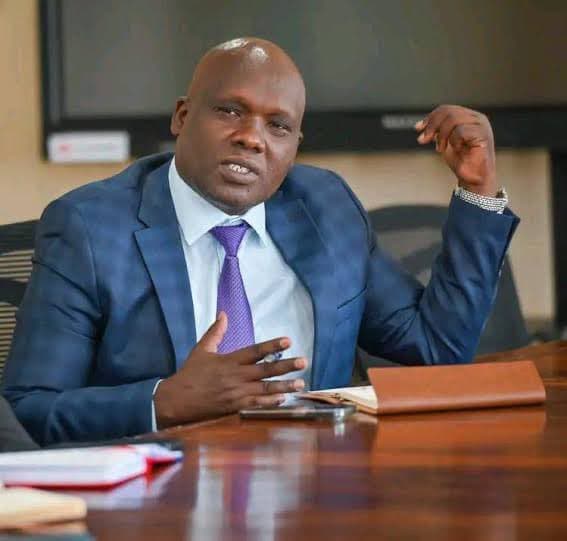
On 12 January 2026, a letter went out from the Office of the Director General at the Kenya National Highways Authority, signed by Eng. Luka Kimeli, then still warming an acting seat he would not formally inherit for another five weeks.
The letter notified Lafey Construction Company Limited that it had won Tender No. KeNHA/2915/2025, the upgrade to bitumen standard of the Masara–Muhuru Bay (B1) Road, at a price of Sh3,013,648,316.91.
On paper, a routine procurement notice.
In substance, the opening act of one of the more brazen documentary frauds to pass through a Kenyan state corporation’s evaluation committee in recent memory, and a case study in what happens when the people meant to catch fraud appear to have had every reason not to look too hard.
Kenya Insights’ investigations Desk has spent weeks cross-referencing the court record in the ensuing High Court petition with KeNHA’s own procurement history, judicial rulings against the agency, parliamentary inquiry records and corporate filings.
What emerges is not a one-off lapse.
It is a portrait of an agency whose technical evaluation processes have repeatedly failed to perform the one function they exist for, and whose current Director General arrived in his substantive post carrying a contempt of court conviction for defying a judge over an entirely separate multi-billion-shilling contractor dispute.
THE FORGERY, IN THE FORGER’S OWN WORDS
The fraud at the centre of the Masara–Muhuru Bay award was not alleged by a disgruntled rival or inferred from circumstantial gaps. It was confirmed, under oath, by the very company whose name and reputation were stolen to win the bid.
China Railway No. 5 Engineering Group Co. Ltd, a Chinese state-owned contractor with a real and verifiable Kenyan track record on the Loichangamatak–Lodwar (A1) and Kalobeyei River–Nadapal/Nakodok (A1) road projects, filed a witness statement in the High Court through its Kenya Office Director, Liao You Fu.
The statement is unambiguous in a way court filings rarely are.
The company says it has no knowledge of Lafey Construction Company Limited and has never had any dealings with it. It says it has never subcontracted, partnered with, or otherwise engaged the firm on any project in Kenya or anywhere else. It says the documents Lafey presented as proof of joint experience were not genuine, did not originate from China Railway, and were never authorised by the company.
“The documents presumed to have been issued by us and presented by M/S Lafey Construction Limited are not genuine, did not originate from our organisation, and were never authorised by us… The stamp used on our documents is not genuine.” — Liao You Fu, Office Director, China Railway No. 5 Engineering Group Co. Ltd, sworn witness statement, 29 March 2026
The forgery did not stop at a fake seal. Lafey’s bid documents invoked a named project manager, Eng. Zhang Wei, whom China Railway says it has never employed in any capacity in Kenya. The bid also misattributed the supervising consultant on the Kalobeyei River project, a detail China Railway corrected on the record: the consultant was Intercontinental Consultants & Technocrats Pvt Ltd in joint venture with CAS Consultants Ltd, not the firm Lafey’s paperwork claimed.
Three separate, independently checkable facts in the bid file were fabricated. Any one of them, verified against the public record, should have ended the bid at evaluation stage.
It did not end there because, on KeNHA’s own account, due diligence took the form of a single letter, dated 19 December 2025, addressed to China Railway and signed by Eng. Joseph Kaburia on the Director General’s behalf. China Railway says that letter was never received.
The reason becomes clear in Liao’s statement: the due diligence email KeNHA used was kenya_wjhw@163.com, an address the company explicitly disowns as not theirs.
Its real address, on the public record, is ztwjhw_kenya@163.com — a one-character substitution apart from the address KeNHA says it used. Whether that is catastrophic carelessness inside a Sh3 billion procurement, or a verification step performed for the file rather than for the truth, KeNHA has not explained.
THE CHEAPER, COMPLIANT BIDDER WHO VANISHED FROM THE RACE
The financial dimension is where the scandal stops being only a forgery story and starts being a taxpayer story. Ricons General Services Co. Ltd submitted a financial bid of Sh2,777,395,507.39 for the same scope of works, roughly Sh236 million below Lafey’s winning price, and according to the court record met the mandatory requirements.
Ricons was disqualified.
The petition filed by public interest litigant Anthony Ngatia does not record a transparent, documented justification on file for that elimination.
Strip away the procurement jargon and the arithmetic is blunt: Kenyan taxpayers were on track to pay roughly a quarter of a billion shillings more, for the identical road, to a firm whose qualifying credentials turn out to have been invented, while a bidder offering the lower, apparently compliant price was pushed out of contention through a process KeNHA has yet to publicly justify.
TOLD IN MARCH. ACTED ONLY AFTER COURT PAPERS LANDED.
Ngatia did not stumble onto this story through speculation. He went directly to China Railway No. 5 and obtained its written confirmation, dated 10 March 2026, that the documents attributed to it were forged, unauthorised, and that no contractual, business or project relationship existed with Lafey Construction.
Two days later, on 12 March 2026, he formally notified both KeNHA and the Public Procurement Regulatory Authority, in writing, demanding suspension of the procurement and an investigation into the apparent fraud.
Neither institution suspended the tender.
Neither disclosed any meaningful investigation. The contract stood, fully awarded, while the entity whose name had been forged to win it sat on record as having said so in writing to the two bodies with statutory power to stop it.
It took the filing of a High Court petition to move the needle. On 7 May 2026, nearly four months after the original notification of award and almost two months after Ngatia’s written alert, Eng. Kimeli revoked the Lafey award. KeNHA floated a new tender, No. KeNHA/2953/2026, for the same road.
The sequence is difficult to read as anything other than reactive damage control timed to the threat of judicial scrutiny rather than a good-faith response to credible fraud evidence delivered weeks earlier through entirely proper channels.
WHO IS LAFEY CONSTRUCTION, AND HOW DID IT LAND A NATIONAL TRUNK ROAD?
Lafey Construction Company Limited’s public footprint before this tender does not obviously match the technical and financial weight required to execute a Category 1 national bitumen-standard trunk road contract north of Sh3 billion.
Its documented prior work centres on CDF-funded projects in Lafey constituency, Mandera County, and smaller road works in northern Kenya.
Corporate litigation on the public record shows the firm’s footprint extends into Nairobi residential development as well: in a 2016 High Court ruling, Lafey Construction Co. Limited was the plaintiff in a dispute with Prism Investments Limited over retention payments on the Shaba Village Housing Project, a matter that named a South Sudanese national, Kennedy Losuk, as the defendant’s principal director and required him to deposit his passport in court pending the suit’s outcome.
None of this is, on its own, disqualifying. It is, however, difficult to reconcile with a bid file claiming joint highway experience with one of China’s largest state engineering contractors.
Lafey’s manager, Abdirashid Haret, known locally as Uncle Bulle, surfaced in regional news in late 2025 in connection with a reported abduction in Isiolo whose circumstances have never been fully clarified.
How a firm with that profile produced fabricated documentary cover sophisticated enough to carry a named (fictional) project manager and a forged but visually convincing corporate stamp, and how that cover sailed through KeNHA’s technical evaluation committee unchallenged, is the central unanswered question of this scandal.
It points either to an evaluation process too thin to catch elementary fraud, or to actors inside that process who had reason not to catch it.
A DIRECTOR GENERAL WHO ARRIVED WITH A CONTEMPT CONVICTION
The man whose office issued the notification of award is not a peripheral figure in this story; his own legal record is part of it. On 25 November 2025, the High Court found Eng. Luka Kipchumba Kimeli, in his capacity as KeNHA’s accounting officer, guilty of contempt of court for defying a binding mandamus order compelling the agency to settle a Sh536,464,436 debt owed to Israeli construction firm SBI International Holdings (Kenya) Limited.
The court’s language was pointed: it found that Kimeli had adopted a posture of waiting to see what consequences may follow, in the hope that none will, and called that conduct wholly unacceptable. He was ordered to appear personally for mitigation and sentencing on 19 December 2025, a hearing that took place while his substantive appointment as Director General was being processed in parallel.
On 17 February 2026, barely two months after that conviction, the KeNHA Board, chaired by Winfrida Ngumi, confirmed Kimeli in the substantive Director General role, describing the recruitment process as competitive and transparent.
The Lafey award, issued five weeks before that confirmation, and the agency’s subsequent four-month inertia in the face of documented fraud evidence, both fall squarely within his tenure as the accounting officer ultimately responsible for KeNHA’s procurement conduct.
The SBI matter is itself instructive about how expensive KeNHA’s institutional habits have become for the public purse.
SBI International Holdings has separately been paid out roughly Sh6.19 billion in settlements arising from breaches across nine KeNHA contracts, a figure that sits alongside, not instead of, the Sh536 million mandamus debt at the centre of Kimeli’s contempt conviction.
SBI itself has its own murky history in Kenya: the company is named among entities under investigation in a decade-long, Israel-linked bribery probe implicating former Transport Cabinet Secretaries Michael Kamau and Franklin Bett, former Transport Principal Secretary John Mosonik, and officials across KeNHA, KURA, KERRA and NEMA, with a 2018 raid on SBI’s Nairobi offices by Kenyan and Israeli detectives reportedly recovering false invoices and a notebook detailing bribe payments. KeNHA’s history with large contractors, in other words, has form well beyond Lafey.
A PATTERN, NOT AN INCIDENT: THE CHINA-ONLY TENDER KENHA COULD NOT EXPLAIN
Six months before the Lafey award, KeNHA had already drawn parliamentary fire for a separate procurement irregularity that speaks to the same underlying weakness: a willingness to bend or obscure procurement rules under financing or political pressure, with minimal public explanation when caught.
In July 2025, KeNHA advertised an international tender for the Pangani–Muthaiga–Kiambu–Ndumberi (B32) road, restricting eligibility exclusively to Chinese contractors or Chinese-led consortia with a minimum five-year annual construction turnover of Sh32 billion, citing financing arrangements with the China Export-Import Bank.
The restriction drew immediate criticism for apparently conflicting with the Public Procurement and Asset Disposal Act’s preference for local participation.
A week later, before the tender even closed, KeNHA cancelled it without explanation.
The Senate Roads, Transport and Housing Committee, chaired by Migori Senator Eddy Oketch, was tasked with investigating the rationale, with senators including Mohamed Chute and Moses Kajwang’ raising broader concerns that Kenyan procurement law was being routinely bent to accommodate foreign financiers and contractors at the expense of local industry and transparency.
Read alongside the Lafey scandal, the pattern is unmistakable: an agency prepared to write procurement rules that exclude Kenyan competition when a foreign financier asks for it, and an agency whose evaluation committee failed to apply elementary verification when a Kenyan-registered firm forged its way past the rules in the opposite direction. Different mechanism, same institutional permissiveness.
THE ROAD THAT IS STILL WAITING
The Masara–Muhuru Bay (B1) Road sits within the Lake Victoria Ring Road network, a corridor meant to unlock trade, fisheries and cross-border movement for communities in western Kenya who have waited years for bitumen. Every month consumed by a forged-document scandal, and every shilling inflated by the elimination of a cheaper compliant bidder, is a cost those communities absorb directly.
The officials who signed the notification of award and the firm that supplied the fabricated paperwork do not bear that cost. The people of Migori and Homa Bay counties waiting for the road do.
WHAT KENHA AND PPRA STILL OWE THE PUBLIC
The fresh tender, No. KeNHA/2953/2026, is now live, floated by the same accounting officer who presided over the original failure and who, by his own court record, has shown a documented pattern of treating binding obligations as negotiable until a judge forces the issue.
Anthony Ngatia’s High Court petition has at least succeeded in dragging the notification letter, the China Railway witness statement, and the timeline of an ignored whistleblower complaint into the public record as exhibits, the only reason the public can see any of this at all.
What remains outstanding is not a procedural footnote. It is a forgery that should trigger criminal referral under Kenya’s laws on forgery and procurement offences, a fraudulent stamp that points to either an external forger with detailed knowledge of China Railway’s documentation or an inside actor who supplied it, a disqualified lower bidder owed a transparent explanation, and an evaluation committee whose individual members have not been named, let alone held to account, for waving through documents that collapsed the instant the named company was asked a single direct question.
KeNHA and PPRA were each given the evidence in March.
They each had the option to suspend, investigate and disclose. They did neither until litigation made silence untenable. Until that changes, structurally, and not merely in response to the next lawsuit, the Masara–Muhuru Bay scandal will not be the last Sh3 billion question mark to hang over Kenya’s national roads agency.







Comments