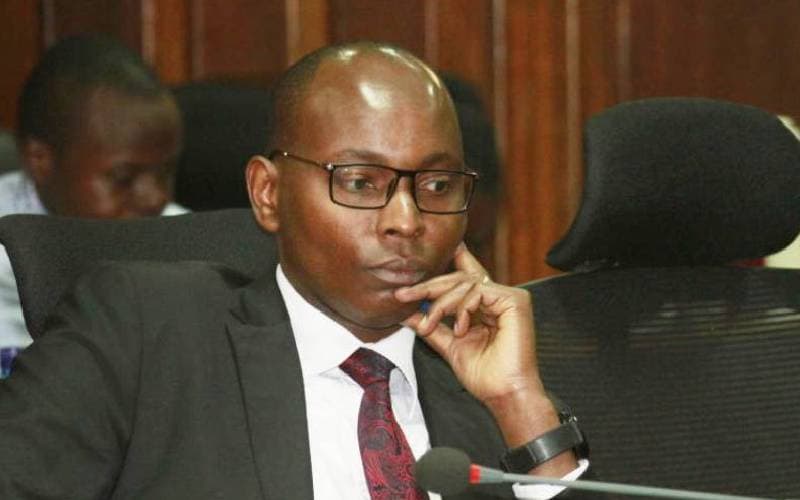
THE UNTOUCHABLE FALLS
For nearly a decade, Charles Korgoren Kerich was the man who survived everything. He survived three governors. He survived the dramatic implosion of Mike Sonko, the interregnum of Anne Kananu, and the election of Johnson Sakaja. He survived impeachments, budget crises, bursary fund misallocations, and a scandal over eleven dead babies found in a room at Pumwani Maternity Hospital. His colleagues called him ‘Mr Fix It’ and ‘Mr Money.’ At City Hall, his name was synonymous with power, precision, and impunity. When money moved in Nairobi County, Charles Kerich either moved it or knew where it went.
That man, the most enduring executive official in Nairobi County’s history, is now a fugitive.
On May 19, 2026, Justice Francis Gikonyo of the Milimani High Court sentenced Kerich to three months in civil jail for contempt of court after Nairobi County persistently refused to honour a court decree for Sh106,736,841.83 owed to Kwengu and Company Advocates, a law firm retained in a matter involving a debt ultimately traceable to Foton East Africa Limited under a decree dated June 29, 2023. Justice Gikonyo directed police at Central Police Station to arrest and commit Kerich to prison immediately. The court issued no option of a fine. The message from the bench was unambiguous: this man must go to jail.
He did not go to jail. He went to Dubai instead.
‘His connections to the system mean no officer will touch him.’ Kerich allegedly boasted openly after sentencing. He was right. No officer touched him.
FROM MICROPHONE TO CITY HALL: THE RISE OF ‘MR MONEY’
Before he was a county official, Charles Kerich was a journalist. He rose to become Group Editor-in-Chief at Radio Africa Group, giving him media fluency and a rolodex of political contacts that would prove invaluable when he pivoted to power. In October 2017, then-Governor Mike Sonko plucked him out of radio and installed him as CEC for ICT and e-Government in his inaugural cabinet.
Kerich’s ascent within City Hall was rapid and telling. He accumulated dockets with a collector’s appetite. Lands and Housing. Acting Finance from 2018, stepping in when Danvas Makori exited. Acting Health, during the explosive Pumwani Maternity Hospital scandal in which eleven dead infants were discovered in a storage room at the facility, triggering national outrage. He gazetted health management boards, steered the county’s budget through a hostile County Assembly when others had failed, and appeared before the Senate’s Public Accounts Committee to answer on Governor Sonko’s behalf, although senators turned him away, insisting on seeing the governor himself.
In September 2019 he was among sixteen officials Sonko suspended following the Precious Talent Academy tragedy in which eight pupils perished. Four months later, he was reinstated. He resigned in early 2022 to contest the Bomet Central parliamentary seat under the UDA ticket, lost in the primaries, pivoted to Sakaja’s campaign machinery, and was back at City Hall when Sakaja won. By 2022, Charles Kerich was once again Finance CEC, the single most consequential financial office in a county whose annual budget exceeded fifty billion shillings. He had served under Sonko, under Kananu, and now under Sakaja. He was, as the Daily Nation put it, ‘the most enduring county executive in Nairobi’s history.’
Those who worked with him described a meticulous technocrat with encyclopaedic knowledge of county revenue streams. He understood not just where money came from, but where it could be made to go, which budgets were flexible, which creditors could be ignored, and which obligations could be deferred indefinitely. That mastery was precisely what made him untouchable for so long. And it is precisely what now makes his flight from accountability so brazen.
THE DEBT, THE DEFIANCE, AND THE CONTEMPT CONVICTION
The case that brought Kerich down began not with a grand corruption scandal but with something embarrassingly mundane: a bill that the county simply refused to pay. Kwengu and Company Advocates obtained a court decree for legal fees owed after the county failed to settle obligations. The decree was lawful. The amount was specific. The order to pay was clear. Nairobi County, under Kerich’s financial stewardship, ignored it.
Repeated court orders followed. Repeated non-compliance followed those. The matter dragged from 2018 through 2023 and into 2024, when a November 2024 order to pay Sh106,736,841.83 was also disregarded. The lawyers at Kwengu and Company finally returned to court, now seeking contempt proceedings. Justice Gikonyo delivered his verdict on May 19, 2026: three months in prison, no fine option, immediate arrest.
What happened next is a masterclass in elite impunity. According to lawyers for the decree holders, Kerich did not express contrition or seek to negotiate a settlement. He allegedly boasted to those around him that his connections within the system ensured no police officer would dare lay a hand on him. The lawyers themselves warned, in a formal submission, that any officer who failed to execute the arrest warrant risked criminal liability for obstruction of justice.
Kerich proved himself correct. No officer arrested him. Instead, reports emerged within days that he had left the country for Dubai, allegedly under cover of official county business, and allegedly with the facilitation of Governor Johnson Sakaja himself. Kwengu and Company returned to court on May 30, 2026, filing a fresh lawsuit citing Sakaja as the principal author of a calculated conspiracy to defeat the authority of the court, and seeking to have the governor himself committed to civil jail for contempt.
Sakaja facilitated a fugitive’s escape to Dubai while courts issued arrest warrants. The Governor now faces civil jail himself for allegedly obstructing justice.
The case brought into the dock not just Kerich but the Inspector General of Police, alleging a three-way conspiracy involving the governor, his finance boss, and the police hierarchy. Governor Sakaja, confronted with the political and legal fallout, suspended Kerich around June 5, 2026, and named an acting replacement. The suspension came weeks after the contempt conviction, and only after it became undeniable that Kerich was gone.
DUBAI, THEN AMERICA: THE MEDICAL PRETEXT THAT FOOLED NOBODY
After the Dubai chapter emerged, the story mutated again in late June 2026. Reports surfaced that Kerich was now in the United States of America. His legal team, appearing before the High Court, had previously argued on June 15, 2026, that Kerich was not a fugitive but was merely on ‘official duty’ abroad and on ‘working leave.’ That explanation satisfied nobody, least of all a county assembly whose budget preparations had been crippled by his absence. The County Assembly’s Committee on Implementation summoned Kerich to appear. He did not appear.
The latest legal manoeuvre, filed as of June 29, 2026, is Kerich’s fourth attempt to suspend his imprisonment. This time, the argument is medical: he claims to be undergoing specialist treatment in the United States and is too ill to return to Kenya. The High Court has declined to suspend the sentence on that basis. The illness narrative is the final card in a hand played with remarkable shamelessness. The sequence speaks for itself: first the arrest warrant is ignored; then the country is left for Dubai under the cover of official business; then the story pivots to ‘working leave’; and now, caught in America, the man is suddenly too sick to face justice.
For a man who steered Nairobi’s fifty-billion-shilling budget across three administrations, managed crises ranging from dead infants in maternity wards to a collapsed multi-storey building, and kept a county machine running through multiple political upheavals, the suggestion that he is too fragile to board a flight home strains credibility beyond its limits.
Judge Roselyne Aburili has already recused herself from a related constitutional petition, filed by city businessman Bryan Yongo, that challenges Kerich’s eligibility to hold public office following the contempt conviction. A fresh judge must now handle that matter. The contempt sentence itself stands. The warrant stands. And Kerich remains in America.
THE VEGRID SCANDAL: A SOLAR COMPANY, A FUGITIVE SHAREHOLDER, AND A GERMAN INVESTOR’S NIGHTMARE
The contempt conviction and the Dubai-to-America flight would be damaging enough on their own. But in June 2026, a parallel scandal detonated that drags Kerich’s name into territory that should concern not just Kenyan authorities but American ones.
VeGrid Ltd styles itself as Africa’s digital operating system for distributed solar power-as-a-service, a clean-energy venture promising to revolutionise off-grid power delivery across the continent. Its Chief Executive Officer is Thomas Mboya Ogutu, who lists stints at Kenya Power and the Postal Corporation of Kenya on his resume. In late 2025, Hannes Bend, a German entrepreneur and artificial intelligence patent holder associated with breathing.ai and VitalSignAI, was brought into the VeGrid orbit to add technical and strategic muscle to the venture.
Bend contributed substantially. He worked on the company website, the pitch deck, the business plan, and growth strategy. He helped incorporate a US-linked entity, VeGriddy Inc. A signed agreement, he says, promised him an equity stake in the business. What he received instead, according to his detailed, documented public account, was approximately fifty-two thousand dollars in unauthorised charges run up on his personal credit cards by Ogutu, ostensibly for technology trials and infrastructure setup costs. When Bend sought repayment and the formalisation of his shareholding, the relationship collapsed with explosive force.
In March 2026, recorded telephone calls captured Ogutu in a rage. The recordings, portions of which Bend posted publicly on TikTok and X, contain what Bend describes as threats of deportation and explicit physical harm, laced with xenophobic undertones directed at him as a foreigner. One exchange captured around ten in the morning on March 13, 2026, contains Ogutu saying: ‘Otherwise you’ll get deported. Uh huh. Take it from me. Okay.’ Other recorded calls, Bend says, contained threats of serious personal harm. He reported to Nairobi police. Officers visited his apartment, reviewed evidence, and confronted Ogutu, who denied wrongdoing. No arrest followed.
Bend went to the Directorate of Criminal Investigations. Three months later, he publicly declared that the DCI had collected no forensic evidence, had suppressed requests from the Office of the Director of Public Prosecutions for victim protection, and had taken no meaningful action whatsoever. ‘You haven’t even taken any actions to protect me after three months of reported death threats,’ he posted. ‘How are you making Nairobi safe? It is a joke at this point.’ Bend eventually fled Kenya, calling the system ‘utterly corrupt.’
‘I fear for my life. Hopefully I’ll be alive next week.’ Hannes Bend, German investor, after reporting death threats to Nairobi police. Three months later, the DCI had collected no forensic evidence.
Then came the bombshell that connects VeGrid directly to Charles Kerich. In June 2026, Bend’s legal team uncovered what they allege are company ownership records indicating that Kerich holds approximately twenty percent of VeGrid Ltd. Bend posted screenshots, WhatsApp exchanges with Ogutu, and a newspaper front page documenting Kerich’s contempt conviction alongside claims that Ogutu had repeatedly boasted to Bend about Kerich’s position as Finance CEC providing the political cover needed to shield VeGrid from regulatory scrutiny and tax obligations. Ogutu allegedly described Kerich’s role in facilitating what he termed ‘corrupt things,’ specifically the capacity to help the company and its allies avoid tax trouble and wield influence over county economic processes.
Ogutu has not issued any substantive rebuttal addressing the audio recordings, the alleged credit card fraud, the claimed share ownership, the police confrontation, or the DCI inaction. VeGrid’s public posture of being a clean-energy innovator stands in sharp contrast to the picture painted by Bend’s documented timeline.
The implications for Kerich are severe. As Finance and Economic Planning CEC, he sat at the precise intersection of county tenders, revenue collection, permits, economic planning approvals, and tax enforcement. Any solar or energy-related county contracts, tax relief measures, regulatory facilitation, or development approvals would have passed through or adjacent to his office. A twenty-percent stake in an energy company aggressively pursuing county and government-linked contracts, held secretly by the very official overseeing those processes, is not a business arrangement. It is a conflict of interest at the highest level of public office.
THE CITY HALL CORRUPTION ECOSYSTEM: KERICH WAS NOT ALONE
Kerich’s flight did not happen in isolation. It was the capstone of a broader reckoning at Nairobi City Hall that had been building for months. On June 4, 2026, the same week Sakaja suspended Kerich, EACC detectives raided the Syokimau residence of Patrick Analo, the county’s Chief Officer for Urban Development and Planning, and found Sh65.3 million in cash, including fifty-one million three hundred thousand shillings in Kenyan currency and one hundred and thirteen thousand US dollars, stashed in two travel suitcases and in the boot of his vehicle. EACC also seized title deeds, vehicle logbooks, laptops, land sale agreements, dozens of Nairobi County building approval plans, mobile phones, and iPads.
Preliminary EACC investigations revealed that between 2020 and 2026, Analo had received more than one hundred and seventy million shillings through cash and mobile money deposits deemed suspicious by investigators. He stands accused of corruption, conflict of interest, abuse of office, bribery, and accumulation of unexplained wealth. He has previously been linked to the approvals process that allowed additional floors to be added to a sixteen-storey building on Muhoho Avenue in South C, which collapsed on January 1, 2026, killing at least four people.
Analo and Kerich worked in the same administration. Urban planning approvals and finance are interlocking functions. No building gets approved without budgetary and process oversight. No revenue is collected or waived without the knowledge of the finance office. The simultaneous exposure of the county’s chief planner sitting on Sh65 million in cash and its finance CEC running from a contempt warrant while allegedly holding shares in a company seeking county-level protection is not a coincidence. It is a systemic picture of a county government whose highest levels had been compromised.
WHAT AMERICA SHOULD KNOW ABOUT ITS GUEST
Charles Kerich is now on American soil. His stated reason is medical treatment. The Kenyan High Court has already rejected this argument as a basis to suspend his sentence. What should concern American authorities, and what should concern any institution or individual interacting with him, is the full profile of the man in their midst.
He is a convicted contemnor under active court order for imprisonment. A Kenyan arrest warrant has been outstanding since May 19, 2026. He has appeared before courts four times seeking to evade that sentence, and has failed on each occasion. His own lawyers argued on June 15 that he was on ‘official county duty,’ contradicting the medical claim now being advanced. These are not the shifting positions of an innocent man caught in a bureaucratic confusion. They are the sequential strategies of someone systematically exhausting every legal and geographic avenue to avoid three months in prison for ignoring a lawful debt.
Beyond the contempt conviction, Kerich is credibly accused, through documented evidence including recorded conversations, of holding a secret stake in a private company that allegedly exploited his public office for commercial advantage. The investor who exposed this connection reported death threats to Kenyan police and the DCI and received no protection. He fled the country. The institutions of law enforcement in Kenya failed, demonstrably and completely, to protect a foreigner who reported credible threats to his life. Kerich’s alleged commercial stake in VeGrid sits at the centre of that failure.
Kenya and the United States have a longstanding framework of legal and law enforcement cooperation. Kenya is a partner in counterterrorism, trade, and security. But partnership cannot extend to providing sanctuary to public officials evading legitimate court processes at home. The medical pretext has already been tested and rejected by Kenyan courts. There is no reason for American institutions to treat it more charitably.
Fugitives from accountability do not always arrive with criminal records stamped on their passports. Sometimes they arrive claiming they are too sick to face justice back home.
THE BROADER DAMAGE: WHAT KERICH’S FLIGHT COSTS KENYA
While Charles Kerich was in Dubai and then in America, Nairobi County was attempting to finalise its 2026 to 2027 budget, a constitutionally mandated process with hard deadlines. The Finance CEC, the man who understood the revenue streams and budget levers better than anyone else in the administration, was unavailable. MCAs openly asked on the floor of the County Assembly: ‘Where is he?’ The Majority Leader, Peter Imwatok of Makongeni Ward, put the crisis starkly: ‘We are in the process of making the budget in the county government and the CEC for finance is nowhere to be seen. We are reading from the newspapers that he has been imprisoned but he is not yet in prison so the question is, where is he?’
The answer, it turned out, was: first Dubai, then America. The budget process was crippled at its most critical juncture. An acting CEC, Ibrahim Auma, was named, but Kerich had not formally handed over. Documents sat unsigned. Decisions sat unmade. Services that depend on budget certainty, roads, health facilities, water, sanitation, went into uncertainty. The Sh106.7 million that Nairobi County refused to pay to Kwengu and Company for years was not some abstract sum. It was public money that a government refused to honour, triggering years of litigation, administrative paralysis, and ultimately, the contempt sentencing of the man who sat atop the county’s finances throughout. Every shilling spent on that legal fight was a shilling not spent on Nairobi’s roads or clinics.
The human cost of City Hall corruption is rarely calculated in these terms, but it must be. When the Finance CEC allegedly holds a secret stake in a solar energy company and allegedly uses his office to shield it from regulatory scrutiny, every legitimate solar energy competitor is disadvantaged. Every county revenue that should have been collected from VeGrid and was not is a public loss. Every foreign investor who comes to Nairobi hoping to build something of value and instead gets defrauded of fifty-two thousand dollars and threatened with deportation is a catastrophe for Kenya’s investment climate.
Hannes Bend came to build. He contributed intellectual capital, technical expertise, equity in a business idea, and money. He got allegedly stolen credit card charges, recorded death threats, and three months of institutional abandonment by the DCI. He left. Whatever he would have built in Nairobi, whatever jobs or innovation or capital flows that might have represented, left with him. His public warning is now on the internet for every foreign entrepreneur considering a Nairobi investment to find. The cost is incalculable.
WHAT MUST HAPPEN NOW
Kenya’s courts have done their part. The conviction stands. The warrant stands. The multiple attempts to suspend the sentence have been rejected. What has failed is enforcement, and what has failed with it is Kenya’s credibility as a country that holds its powerful accountable.
Governor Sakaja himself faces contempt proceedings for allegedly facilitating Kerich’s Dubai escape. The Inspector General of Police is cited in the same proceedings. If those allegations are substantiated, they represent a three-way conspiracy between a county governor, his finance chief, and the national police command to obstruct a court order. That is not a bureaucratic failure. That is an institutional one, and it demands consequences at the highest levels.
On VeGrid and the alleged twenty-percent stake, the Kenya Revenue Authority and the Ethics and Anti-Corruption Commission must urgently examine all transactions between Nairobi County and VeGrid Ltd, all tax filings or exemptions sought by the company, and all company ownership records, including any beneficial ownership arrangements. The DCI must explain, publicly and accountably, why three months of reported death threats against a foreign investor produced no forensic investigation, no protection order, and no arrests.
On the American dimension, Kenya’s Director of Public Prosecutions and the Attorney General must determine whether Kerich’s conduct and the nature of the VeGrid allegations meet the threshold for an extradition request, or whether asset recovery proceedings can be initiated. The United States receives visitors on the implicit assurance that they are not using American territory to evade lawful legal obligations at home. Kerich’s medical claim has already been rejected by his own courts. His American hosts deserve to know what they are hosting.
CONCLUSION: THE END OF INDISPENSABILITY
There is a particular kind of Kenyan public official who makes himself indispensable, who accumulates influence across administrations, who knows where every body is buried and every shilling has gone, and who treats that knowledge as personal insurance. Charles Kerich was that official. For nearly a decade he was genuinely irreplaceable at City Hall. Governors needed him. Budgets needed him. Revenue strategies needed him.
What such officials always misunderstand is that indispensability has a shelf life. The moment the warrant lands, the moment the contempt is proven, the moment a German investor posts audio recordings and credit card statements and VeGrid ownership documents on the internet, the indispensability evaporates. What remains is the record: a man who spent a decade at the apex of Nairobi’s finances, who allegedly used that position to shield a private company from tax and regulatory oversight, who bragged openly that his connections would protect him from arrest, who fled first to Dubai and then to America, and who is now arguing in court that he is too ill to face three months in civil jail for ignoring a lawful debt.
The record is public. The warrant is outstanding. The VeGrid allegation is documented and unrebutted. The investor’s suffering is on camera. The DCI’s inaction is on the record. The governor’s alleged facilitation of flight is before the courts. The Sh65.3 million found in his colleague’s suitcases speaks to the systemic character of what flourished around Kerich’s office.
Charles Kerich wanted to be untouchable. He may have succeeded longer than most. But courts, investors, and history have a longer memory than political connections. The question now is whether Kenya’s institutions, prodded by public exposure and international scrutiny, will finally prove him wrong.








Comments