
Business
After Ndegwa’s Controversial Reign, Vodacom Will Likely Name a Mzungu CEO Next To Clear The Mess Left
Six years of internet shutdowns, surveillance scandals, media intimidation, racial contempt in company stores, and board opacity have so badly shredded Safaricom’s institutional trust that its new majority owner now holds the key to the CEO’s office — and has every reason to turn it.

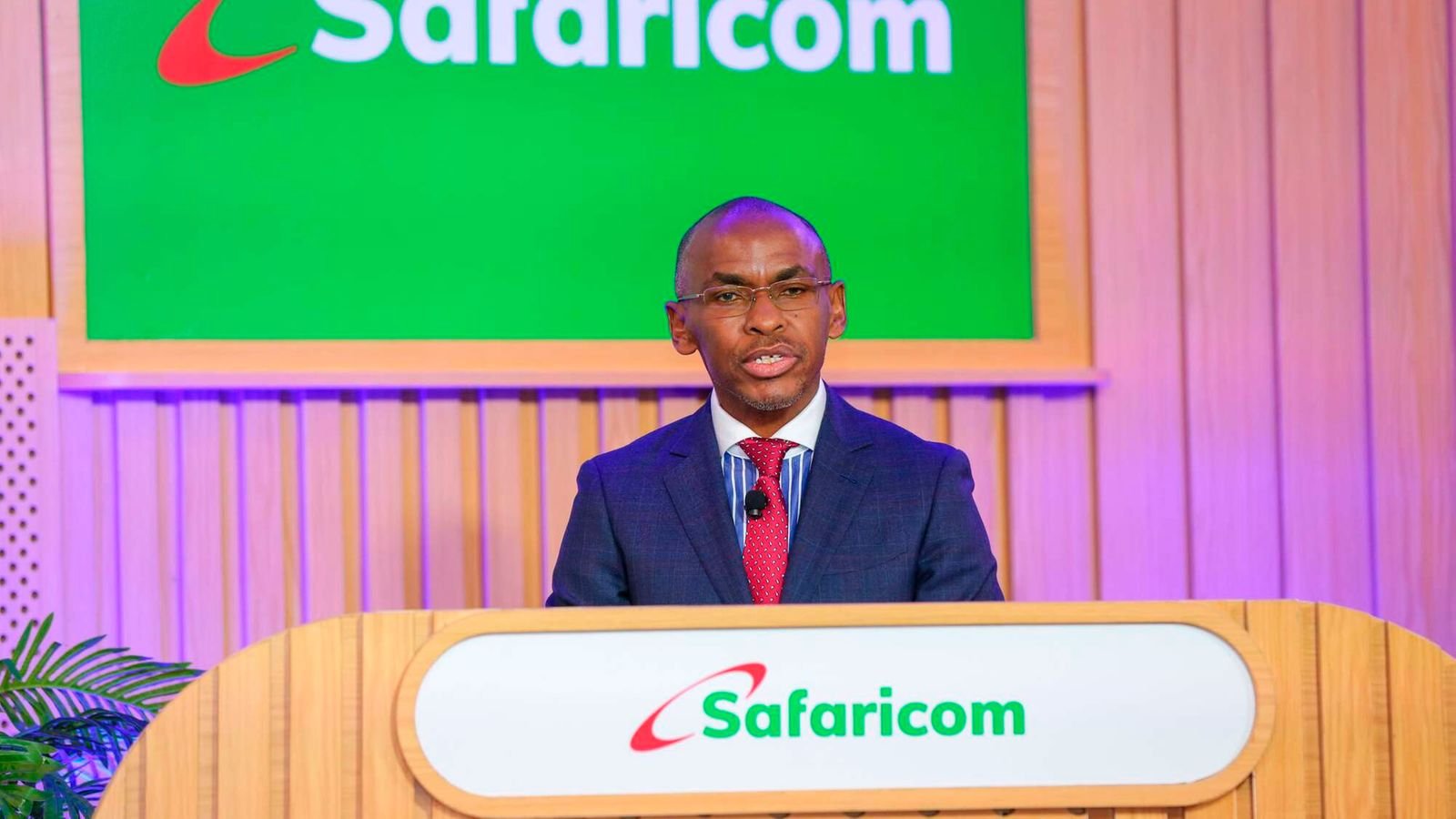
The deal that will determine the future leadership of East Africa’s most powerful company was filed not at the Communications Authority of Kenya, not at the Nairobi Securities Exchange, but at the United States Securities and Exchange Commission.
Buried in Vodafone Group’s SEC disclosures dated May 22, 2026, is language that, once decoded, ends a six-year experiment in Kenyan corporate nationalism and restores to foreign hands the power to install and remove the chief executive of Safaricom PLC.
It is a detail that should enrage shareholders, regulators and every Kenyan who celebrated the April 2020 appointment of Peter Ndegwa as the first indigenous son to lead the telecom giant. It does not enrage them nearly enough. Because the honest, uncomfortable accounting of what Peter Ndegwa’s tenure has produced makes it very difficult to argue that the foreigner’s return is not deserved.
This investigation does not dispute that Safaricom under Ndegwa crossed the one-billion-dollar EBIT threshold or that Safaricom Ethiopia now covers nearly half that country’s population.
Those are real achievements, dutifully noted. But achievements do not exist in a vacuum, and the architecture of failure that surrounds them the deliberate suppression of democratic communication, the construction of a surveillance apparatus that international human rights organisations say enabled enforced disappearances, the weaponisation of advertising budgets against a free press, the governance opacity that has reduced CEO succession at Kenya’s most consequential listed company to what the Consumers Federation of Kenya charitably describes as ‘educated guesswork’ represents a record so comprehensively damaging that it has handed the corporate reins of Safaricom to Johannesburg, not because Vodacom is particularly visionary, but because Ndegwa’s board, and Ndegwa himself, left nothing else on the table.
The honest, uncomfortable accounting of what Peter Ndegwa’s tenure has produced makes it very difficult to argue that the foreigner’s return is not deserved.
THE ARCHITECTURE OF THE TRANSFER
Under the terms of a shareholder agreement signed on December 3, 2025, and filed with the SEC in May 2026, Vodacom Group of South Africa agreed to acquire a combined 20 percent stake in Safaricom from the Kenyan government and from Vodafone Group directly.
The purchase price Sh204.3 billion for the government’s 15 percent and approximately Sh68.1 billion for Vodafone’s residual holding would lift Vodacom’s total stake from roughly 35 percent to 55 percent. The deal also includes a Sh40.2 billion upfront dividend payment to the National Treasury, to be recouped from the state’s future earnings on its remaining 20 percent.
That structural shift triggers a provision in the new shareholder agreement that is deceptively plain in its language: Safaricom’s directors may appoint a chief executive from a list of nominees provided by Vodafone Kenya Limited, as long as VKL holds more than 50 percent of the company’s issued share capital.
The wording is careful. Nominees. A list.
The board chooses but from options pre-selected in Johannesburg, by a South African company ultimately controlled by Vodafone Group in London. On the nationality question, VKL has agreed to ‘endeavour to ensure’ that the chairman is Kenyan. The CEO position carries no such commitment. The deal was inked in December 2025. Parliamentary approval followed in March 2026. The COMESA Competition Commission cleared it.
A three-judge High Court bench then issued conservatory orders on March 23, 2026, freezing the transaction pending constitutional petitions filed by activist Tony Gachoka and others who argued the sale price undervalued a public asset and bypassed due process.
The government has now gone to the Court of Appeal seeking to lift those orders, warning that every month of delay costs the Treasury billions.
Vodacom CEO Shameel Joosub has told investors the deal can close quickly once the courts stand aside. It will close. The question is not whether Vodacom will assume majority control of Safaricom. The question is who they will put in charge once they do and why the Kenyan era ended the way it did.
WHAT CAME BEFORE: THE BENCHMARK OF JOSEPH AND COLLYMORE
To measure how far Safaricom’s governance has fallen under Ndegwa, one must first understand what existed before him. The company’s first two chief executives were foreigners who, over time, became Kenyans in every meaningful sense and who, crucially, conducted their tenures with a transparency and institutional respect that their successor has conspicuously failed to replicate.
Michael Joseph, a South African-born American electrical engineer, joined as founding CEO in July 2000 when Safaricom was a joint venture between Vodafone UK and Telkom Kenya with fewer than 20,000 subscribers. By the time he stepped down in November 2010, Safaricom had 16.71 million subscribers, had staged one of East Africa’s most successful public listings, and had launched M-Pesa — a mobile money platform that the Harvard Business Review would later cite as among the most consequential financial innovations in emerging market history.
Joseph’s contract was known. His departure was announced. His return as interim leader after Bob Collymore’s death was executed cleanly and with full public knowledge. When Joseph eventually departed the substantive role and assumed a board position, there were no mysteries, no governance questions, no shareholders left guessing.
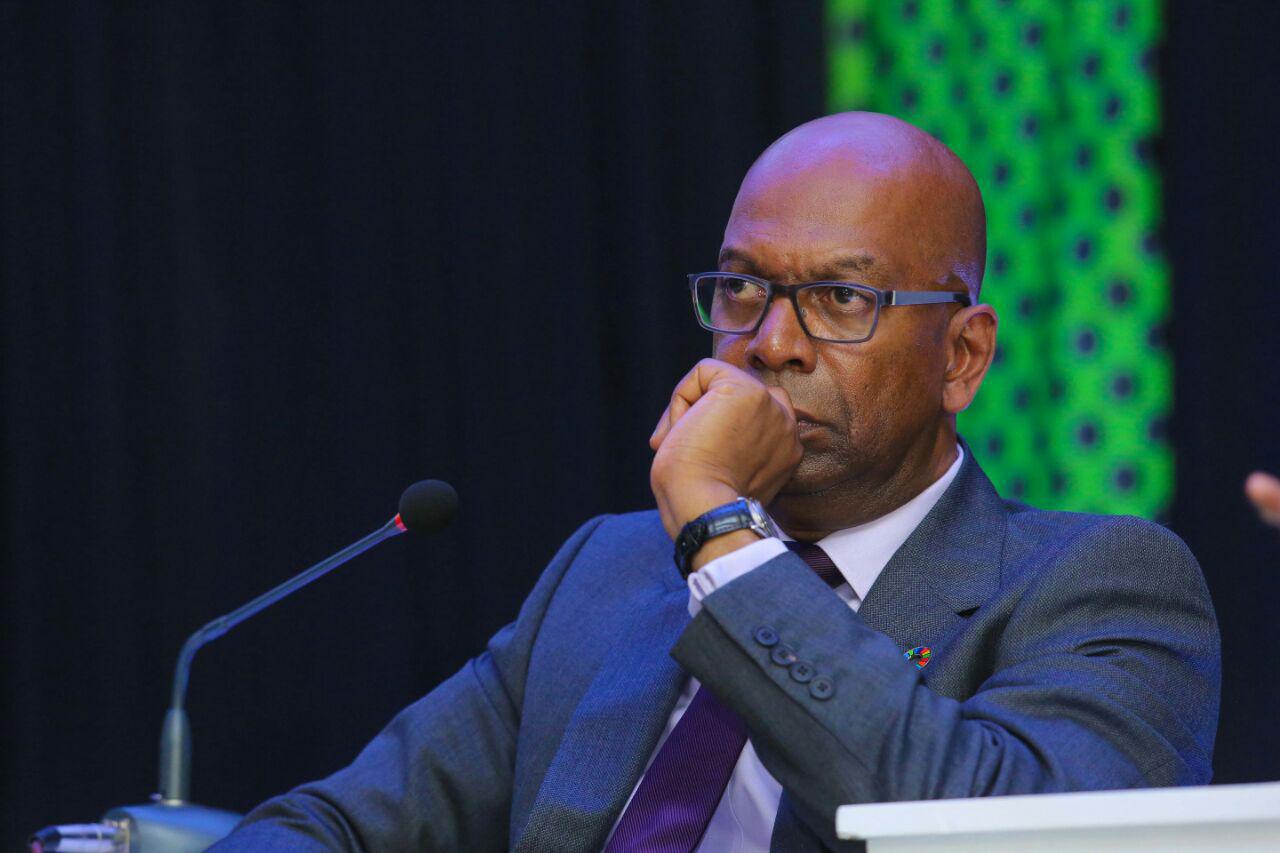
The late Bob Collymore.
Bob Collymore, the Guyanese-born British executive who succeeded Joseph in November 2010 and who later acquired Kenyan citizenship, operated to the same standard. His initial fixed-term contract was extended publicly in 2013, then again in 2017, with clear board announcements on each occasion. Under Collymore, Safaricom’s share price rose more than 400 percent, the subscriber base more than doubled from 17 million to over 30 million, and net profit expanded by 380 percent.
He introduced M-Shwari, Fuliza and a national 4G rollout that transformed Kenya’s digital economy.
When he died from acute myeloid leukaemia on July 1, 2019, the reaction was genuine national mourning complicated, unusual grief for a corporate executive, made uncomplicated by the fact that the public had always been told the truth about what they had. His tenure had no governance shadows. His leadership had no data scandals. He did not threaten journalists. He did not preside over an internet outage during a democracy movement. His store staff did not racially profile customers.
His tenure had no governance shadows. His leadership had no data scandals. He did not threaten journalists. He did not preside over an internet outage during a democracy movement.
THE CONTRACT THAT NOBODY CAN EXPLAIN
Peter Ndegwa’s appointment in October 2019, effective April 1, 2020, was framed as a historic corrective the first Kenyan to lead East Africa’s most profitable listed company. That framing was legitimate. The expectation it generated was reasonable. What followed was not.
Unlike Joseph and Collymore, who came in as expatriates on conventional fixed-term contracts, Ndegwa negotiated what he has described publicly as a deliverables-based arrangement rather than a calendar-driven one. ‘Unlike my two predecessors who came in as expatriates, I am a Kenyan and so the issue of contract didn’t have to apply,’ Ndegwa told journalists.
‘So, when I was joining, we sat with the Board of Directors and agreed on a number of deliverables against which they would track my performance.’ In principle this sounds progressive.
In practice it has produced something worse than an expired contract: a tenure without a publicly known end date, governed by criteria the board has never disclosed, running in the shadow of a charter provision that sets a seven-year maximum.
Safaricom’s own board governance charter is unambiguous: the CEO shall serve on a fixed-term contract of not less than three years and not more than seven, with extensions requiring explicit board action.
Ndegwa passed the six-year mark on April 1, 2026. His contract, notionally, would have lapsed on March 31, 2026. The board issued no statement. No renewal was announced. No succession plan was communicated. No end date was given.
As of the time of this publication, Ndegwa is listed on Safaricom’s official website as Group CEO, was actively testifying before parliamentary committees in late March 2026, and is apparently running the company on a tenure that the Consumers Federation of Kenya has called with characteristic understatement ‘unusual.’
It is not unusual
For a company listed on the Nairobi Securities Exchange, with the Government of Kenya and millions of retail investors holding shares, and with the company’s every decision touching the daily economic lives of ordinary Kenyans, the CEO’s contractual status is not a private matter between a board and an executive. It is a material fact. The board’s failure to disclose it is a failure of fiduciary duty, full stop.
JUNE 25, 2024: THE DAY THE INTERNET WENT DARK
If a single moment defines the Ndegwa era’s relationship with Kenyan civil society, it is the afternoon of June 25, 2024.
As a generation of Kenyan youth converged on Parliament in Nairobi in the largest civil uprising the country had seen in decades protesting the Finance Bill 2024 and the accumulated failures of a ruling class that had long since forfeited their trust Safaricom’s network suffered a nationwide internet outage that lasted more than two hours.
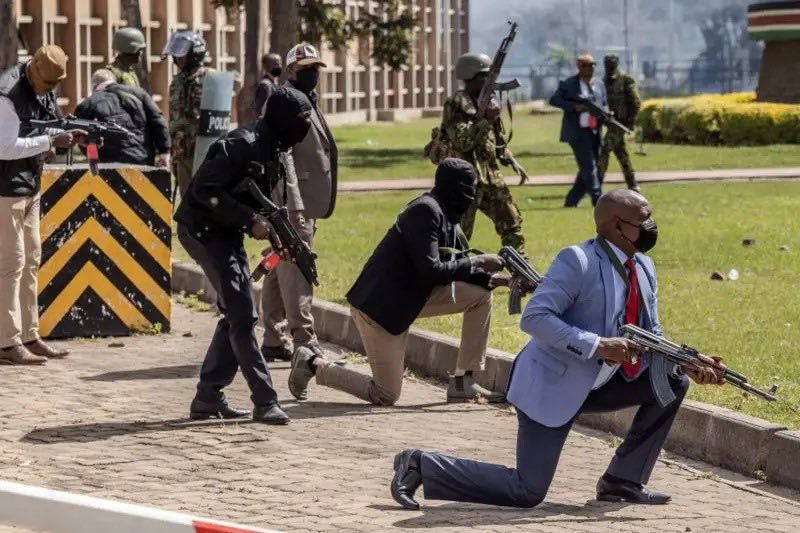
Police officers taking positions as youths storm parliament buildings during June 25, 2024 protests.
The timing was not ambiguous.
The outage began at approximately 4:30 pm EAT, precisely as protesters breached the parliamentary compound. It knocked out mobile money services, card transactions, and e-commerce platforms across Kenya.
Ndegwa’s initial explanation was that undersea cables had experienced ‘reduced bandwidth.’ The internet observatory platform NetBlocks immediately contradicted him, reporting that no evidence of physical cable damage had been identified and that the disruption’s impact on Kenya was more severe than any previous documented cable cut.
The major undersea cable operators serving East Africa TEAMs, SEACOM and EASSy reported no service disruptions on their respective systems. Airtel Kenya, which operates on the same physical infrastructure as Safaricom, described its services as intermittent rather than totally unavailable. Safaricom alone experienced a complete outage. The distinction matters enormously.
The company subsequently issued conflicting accounts first blaming underground cables, then undersea cables, then the entire industry. Ndegwa eventually appeared on Citizen TV‘s JK Live programme to apologise.
‘It is unfortunate that we lost the internet and let our customers down,’ he said. ‘Safaricom is the largest provider of internet in Kenya and we let our customers down.’
The apology was noted. It settled nothing.
The Kenya Human Rights Commission later warned that the High Court had in May 2025 issued orders expressly prohibiting any form of internet shutdown by telecommunications operators orders that traced their origins directly to the June 2024 episode.
Article 19 Eastern Africa and ARTICLE 19 had already been on record calling the outage a gross contravention of Article 31 of the Constitution and the Data Protection Act, citing the timing’s coincidence with protesters entering Parliament.
The question that was never conclusively answered whether the most powerful telecommunications company in the country had, willingly or under pressure from a government that holds 35 percent of its shares, suppressed communication at the precise moment that the Kenyan public needed it most remains open.
That it remains open, with no independent investigation commissioned and no forensic account provided, is itself a governance failure for which Ndegwa and his board must be held responsible.
Whether the most powerful telecom company in Kenya had suppressed communication at the precise moment that Kenyans needed it most remains unanswered. That it remains unanswered is itself a governance failure.
THE SURVEILLANCE STATE INSIDE SAFARICOM
The internet outage was damaging enough.
What followed in October 2024 was categorically worse, and its implications reach far beyond Safaricom’s balance sheet into the question of what kind of company Kenya’s most trusted institution had become under Peter Ndegwa’s leadership.
On October 29, 2024, Nation Media Group published one of the most consequential corporate exposés in Kenyan journalism history.
The investigation, drawing on months of research and insider testimony, revealed that Kenya’s security agencies had gained routine access to Safaricom’s customer call data records, frequently without court orders, and had used that access to track, abduct, and in some cases facilitate the killing of Kenyan citizens.
The investigation alleged that Safaricom, in collaboration with a British company, Neural Technologies Limited, had developed or deployed software granting security agency officers what was effectively real-time, browser-based access to subscriber data a visualisation function that law enforcement officers had nicknamed ‘Find My Friends.’ Officers attached to Safaricom’s own Law Enforcement Liaison Office, the investigation alleged, were in some cases the same individuals implicated in enforced disappearances a conflict of interest so fundamental it rendered the internal oversight mechanism meaningless.
The Kenya Human Rights Commission and Muslims for Human Rights wrote a formal open letter to Safaricom documenting specific cases, including that of Trevor Ndwiga, whose CDRs placed him simultaneously en route to the Somali border and in Nairobi a physical impossibility pointing either to deliberate data manipulation or catastrophic record-keeping failures.
The commission alleged that Safaricom had retained customer data it had publicly claimed to delete, and had produced inconsistent, redacted or false CDR records before Kenyan courts.
Safaricom’s response was to deny everything and then, in a move that should have prompted immediate condemnation from every journalist and press freedom organisation in East Africa, threaten Nation Media Group with a strategic lawsuit against public participation if the article was not withdrawn and a correction published.
When NMG declined to comply, Safaricom pulled its advertising from all NMG-owned publications. Safaricom spends close to five hundred million shillings monthly on advertising across Kenya’s media landscape.
Pulling that spend from the Nation, the East African, the Business Daily and associated platforms was not a commercial decision. It was a financial weapon wielded against independent journalism, and it should be called precisely that.
Reporters Without Borders condemned the pressure. Senior editors at NMG confirmed that Safaricom officials visited major Kenyan newsrooms in October 2024 to request that critical coverage be toned down. Safaricom further sued journalist Robert Wanjala Kituyi in Civil Appeal No. HCCA E207 of 2025 after he sought basic information about police data requests under the Access to Information Act arguing, through counsel, that as a private company it was not obliged to disclose how many court orders it had received from police during the period when enforced disappearances were at their peak. Katiba Institute is defending Kituyi. Access Now and dozens of global civil society organisations wrote an open letter to Vodacom Safaricom’s second-largest shareholder at the time demanding a full investigation into whether Safaricom had facilitated human rights abuses. That letter remains publicly unanswered.
The Al Jazeera network subsequently revisited the allegations in 2026, reporting on the broader surveillance infrastructure context.
The Law Society of Kenya filed a constitutional petition seeking a court-supervised audit of all subscriber data requests made by the Directorate of Criminal Investigations between June 2024 and December 2025.
The Office of the Data Protection Commissioner has yet to conclude any public investigation. The constitutional petition filed by this publication’s author under HCCHRPET No. E095 of 2026, challenging the legality of the data sharing arrangements, is pending before the High Court.
THE MONOPOLY THAT CROWDS OUT COMPETITION
Beyond the scandals, there is a structural dimension to Ndegwa’s record that defines the era in a quieter but equally consequential way. Safaricom commands 65 percent of Kenya’s mobile subscriptions, approximately 92 percent of SMS volumes, and 89 percent of the mobile money market through M-Pesa, according to Communications Authority data published in late 2025.
These are not the numbers of a company competing in a healthy market. They are the numbers of a company that has used first-mover advantage to build barriers so high that meaningful competition is structurally impossible without regulatory intervention.
Rather than engaging calls from consumer advocates and smaller rivals for Safaricom to be formally declared a dominant operator with the interconnection pricing reforms, restrictions on bundled pricing, and enhanced data portability obligations that such designation typically requires Ndegwa has adopted a posture of open contempt.
He has publicly advised rival operators to ‘invest more’ if they wish to compete, as though the question of market dominance were purely a matter of effort rather than market architecture, regulatory forbearance and historical spectrum allocation.
The Communications Authority reduced mobile termination rates from Sh0.41 to Sh0.37 per minute in March 2026 a marginal adjustment that Safaricom’s scale absorbs without consequence and that smaller operators have welcomed as a small step toward a level playing field that Ndegwa has consistently resisted.
In 2024, Safaricom wrote to the Communications Authority urging caution in granting independent licences to satellite internet providers, this after Starlink had become Kenya’s eighth-largest internet service provider in record time, demonstrating that Kenyan consumers will rapidly adopt alternatives when they are available and competitively priced. The spectacle of East Africa’s largest and most profitable telecommunications company lobbying regulators to slow a competitor’s entry apparently did not trouble Ndegwa or his board.
THE VILLAGE MARKET SCANDAL: RACISM UNDER THE PRIDE OF KENYA BRAND
There is a dimension to the Ndegwa record that resists being filed as a governance failure or a financial controversy. It is more personal, and in some ways more corrosive, than either. Under his leadership, Safaricom became the subject of documented allegations of racial discrimination at its flagship Village Market outlet in Nairobi, with Kenyan customers publishing detailed firsthand accounts of differential treatment: white patrons served promptly, Black Kenyan customers made to wait, ignored, and in some accounts subjected to outright hostility by staff.
The Consumers Federation of Kenya published a searing account under the headline ‘Safaricom for Whites? Pain of a Kenyan as raw hate and racism persists at Village Market, Nairobi.’ It was not an abstract critique or a statistical complaint. It was a paying Safaricom customer’s firsthand account of degradation inside a shop operated under a brand that markets itself — loudly, expensively, relentlessly — as the pride of Kenya, a homegrown institution of national identity.
Michael Joseph was American. Bob Collymore was Guyanese-British. Neither of them presided over allegations that their shops subjected Kenyan customers to racial contempt.
Peter Ndegwa the first Kenyan CEO, the man whose appointment was celebrated precisely because it was supposed to bring local authenticity and accountability to the leadership of a company built on Kenyan money, Kenyan innovation, and Kenyan loyalty has. That this persisted without a credible public response from the chief executive is not a footnote. It is a character of leadership.
THE PAY PACKET THAT KEPT RISING
Throughout all of this the outage, the data scandal, the media intimidation, the racial discrimination allegations, the governance opacity Ndegwa collected compensation packages that rank among the highest in Kenya’s entire corporate sector.
According to Safaricom’s published financial disclosures, his total remuneration for the 2024 fiscal year exceeded KSh283 million, approximately USD 2.2 million, placing him at the summit of the Nairobi Securities Exchange’s executive pay rankings by a significant margin.
The figure includes base salary, performance bonuses, non-monetary benefits and incentive payments.
The juxtaposition requires no embellishment. The boda boda rider who sends money home via M-Pesa, the mama mboga who deposits float at a Safaricom agent, the student who relies on Safaricom’s network for academic access they fund this compensation through tariffs levied by a monopolist that faces no real competitive alternative.
They also fund it while absorbing the relentless tide of unsolicited promotional texts, gambling alerts and mysterious short-code messages that COFEK and consumer advocates have documented for years, a spam crisis that persists despite repeated management promises to address it.
THE EXPATRIATE RETURNS: READING THE VODACOM SEC FILING
Against this backdrop, the Business Daily’s June 9, 2026, disclosure of the Vodacom-Vodafone shareholder agreement filed with the SEC is not merely a corporate governance story.
It is the natural consequence of a six-year tenure that has depleted the institutional credibility of Kenyan management at Safaricom to a point where a foreign majority shareholder has decided it cannot be trusted to select its own chief executive.
The agreement is explicit. Safaricom’s board may appoint the CEO from a list of nominees provided by Vodafone Kenya Limited, for as long as VKL holds more than 50 percent of the company.
VKL undertakes to notify and consult with the Government of Kenya before appointing or replacing a chairman or CEO, and further undertakes to ensure the chairman is Kenyan.
On the CEO, there is no such nationality undertaking.
The shareholder agreement represents a return to the pre-2020 structure in which Vodafone and Vodacom, as the dominant shareholders, exercised decisive influence over who occupied Safaricom’s corner office. Michael Joseph was installed from that structure. So, in a different fashion, was Bob Collymore. The difference is that Joseph and Collymore came to the role with the institutional culture of multinational telecoms governance, maintained transparent contractual arrangements, and did not preside over data surveillance scandals or suppress media coverage.
A foreign majority shareholder has decided it cannot be trusted to select its own chief executive. Peter Ndegwa’s record makes it difficult to argue they are wrong.
There is, it must be noted, a countervailing position. The Kenyan government, in the initial December 2025 announcement of the Vodacom deal, included a clause mandating that both the chairman and CEO of Safaricom must at all times be Kenyan citizens.
That clause, sourced from the National Treasury’s own statement, flatly contradicts the provision in the Vodafone Group’s SEC filing that grants VKL the CEO nomination list without a Kenyan nationality requirement.
One of these documents does not accurately reflect the final terms, or the documents serve different functions and their apparent conflict will be resolved in Vodacom’s favour once majority control is formalised. Given that the SEC filing is a binding disclosure to the world’s largest capital markets regulator and that VKL will hold majority control of the company’s shares, the smart money is on the SEC document.
The deal remains suspended by the High Court’s conservatory orders, with a ruling on the substantive application pending and the state having appealed to the Court of Appeal.
Vodacom CEO Shameel Joosub has told investors the deal can close ‘very quickly’ once the orders are lifted. It is a question of when, not whether. And when it closes, the CEO question returns to the agenda.
THE PATTERN, AND WHAT IT MEANS
Safaricom’s leadership history follows a pattern that is worth stating plainly. The company was built by an expatriate who grew into a Kenyan. It was developed to greatness by another expatriate who became Kenyan by choice and conviction, who understood the country he served, who maintained transparent governance, and whose death was mourned as a national loss.
It was then handed to the first indigenous Kenyan, whose tenure whatever its financial metrics produced a surveillance apparatus deployed against citizens, an unexplained internet shutdown during a democracy movement, the financial punishment of a newspaper that reported the truth, a legal attack on a journalist who asked a straightforward public interest question, governance opacity that leaves shareholders guessing about whether their CEO’s contract is current, and unresolved allegations of racial contempt inside the company’s own premises.
The outcome of that Kenyan chapter is that the company now passes back toward foreign-directed leadership.
The business community, the capital markets, the consumers and the political establishment that celebrated Ndegwa’s appointment should sit with that uncomfortable arithmetic.
The argument for Kenyan leadership of Safaricom was never merely symbolic.
It was substantive a Kenyan CEO would understand Kenya, would be accountable to Kenya, would build an institution that belonged to Kenya.
What the Ndegwa years have demonstrated is that nationality is a necessary but not sufficient condition for that outcome.
Character, governance instinct, the courage to tell a government shareholder that it cannot use Safaricom’s network infrastructure as a political instrument these things do not come with a passport.
WHAT VODACOM MUST CONFRONT
If and when Vodacom closes its acquisition and moves to name a new chief executive, it will inherit not just a profitable telecom company but a deeply damaged institutional brand.
The surveillance allegations have been documented by RSF, Access Now, Amnesty International, the Kenya Human Rights Commission and multiple international civil society organisations. The litigation is active. The constitutional petitions are pending. The global civil society letter to Vodacom demanding an investigation into Safaricom’s data practices remains publicly unanswered.
Whatever nominee VKL places on its list, that person will be required to make a definitive break from the practices of the Ndegwa years not performatively, but structurally. Independent oversight of data sharing arrangements. A public, credible audit of CDR access protocols. Full cooperation with the Office of the Data Protection Commissioner. Settlement of outstanding litigation rather than SLAPP suits that prolong the company’s reputational exposure.
An expatriate CEO — a mzungu, in the blunt vernacular of the headline above will not in themselves resolve these problems.
Safaricom’s failures under Ndegwa are not failures of Kenyan management in the abstract. They are failures of this management, in these circumstances, with this set of governance choices.
A foreign CEO who imports the same instincts would produce the same outcomes.
What is required is a clean break: from the secrecy, from the surveillance complicity, from the financial intimidation of journalism, and from the six-year pattern of treating Safaricom’s dominance as a right rather than a privilege earned from and accountable to the Kenyan public.
Whether Vodacom’s nominee is Kenyan or foreign is, at this point, almost beside the point. The bar is not nationality.
The bar is whether the next person to occupy Safaricom’s corner office understands that running Kenya’s most powerful company is a public trust, not a commercial extraction opportunity wrapped in national symbolism.
Peter Ndegwa’s tenure suggests that six years of occupying the chair is not the same as understanding that distinction.
The silence of Safaricom’s board on the contract, on the succession, on the surveillance, on the press freedom violations is not caution. It is contempt. The question is whether Vodacom’s incoming management team will be capable of something better.
This article draws on SEC filings, court records, communications from the Consumers Federation of Kenya, Reporters Without Borders, Access Now, the Kenya Human Rights Commission, Katiba Institute, and published reporting by local media and international correspondents. The author is a petitioner in HCCHRPET No. E095 of 2026 relating to Safaricom data practices.
Kenya Insights allows guest blogging, if you want to be published on Kenya’s most authoritative and accurate blog, have an expose, news TIPS, story angles, human interest stories, drop us an email on [email protected] or via Telegram










Politician Charged in Court for Defrauding Couple Sh1 Million in Botched Deputy President’s Office Tender Deal

After Ndegwa’s Controversial Reign, Vodacom Will Likely Name a Mzungu CEO Next To Clear The Mess Left

The Chairman’s Conflicts: How Adil Khawaja’s Boardroom Empire Compromised Safaricom’s Governance

Businessman Philip Waithaka Kinuthia’s Minor Son Allegedly Drove Drunk, Killed Two Peponi Students in Ngong Road Horror Crash as Claims of Cover-Up Intensify

Painted Into a Corner: Inside Crown Paints’ Sh791 Million Tanzania Gamble, the Shutdown of a Kenyan Factory, and a Sh244 Million Payday for the Boardroom

Shiquo wa Hii Styles Alleges Powerful Somali Cartel Used State Officials to Cripple Her Multi-Million Shoe Empire

Absa Bank Kenya Faces Mounting Internal Fraud Storm as Parliament Demands Answers Over Sh3 Million Vanishing From Customer Accounts

Secret Footage Reveals 500kg Zimbabwean Gold Smuggling Pipeline Into Kenya Linked to ‘Spiritual Son’ Networks

mTicket CEO Brian Okinyi Exposed In Court For Attempted Sh500K Fraud

How Mary Wambui’s Bid To Delete Her Past Collided With A Fresh Sh400 Million Conflict-Of-Interest Finding

Inside NCBA’s Decline: How a Banking Giant Lost Its Strategic Edge

Cement, Cash and Courts: How the Hashu Dynasty Crushed the Ramji Brothers for Fourteen Years and Why the Walls Are Now Closing In

Standard Chartered Ghosts Haunt Joshua Oigara At Stanbic As Whistleblower Spills Beans

Inside The Urban Planning Cartel That Owns Nairobi

South Sudan: Adut Salva Kiir’s Shadow Treasury Exposed

Why Ruto’s Favourite Candidate Adan Mohammed Could Be Locked Out of the KRA Top Job

Betika Faces DCI Probe, Directors Arrest and License Revocation Over Massive 29.5 Million Safaricom Customers’ Data Breach

Why John Ngumi Is Running From the EACC and Why the Sh415 Million Payday May Be the Least of His Worries

LifeCare on the Brink: SHA Fraud, Stolen Wages, and the Rotten Empire Jayesh Saini Built

The President’s Daughter and The Missing Witness: How Adut Salva Kiir’s Shadow Treasury Silenced Its Most Dangerous Critic
-
 Business5 days ago
Inside NCBA’s Decline: How a Banking Giant Lost Its Strategic Edge
-
 Investigations1 week ago
Cement, Cash and Courts: How the Hashu Dynasty Crushed the Ramji Brothers for Fourteen Years and Why the Walls Are Now Closing In
-
 Business4 days ago
Standard Chartered Ghosts Haunt Joshua Oigara At Stanbic As Whistleblower Spills Beans
-
 Investigations1 week ago
Inside The Urban Planning Cartel That Owns Nairobi
-
 Africa3 days ago
South Sudan: Adut Salva Kiir’s Shadow Treasury Exposed
-
 Business3 days ago
Why John Ngumi Is Running From the EACC and Why the Sh415 Million Payday May Be the Least of His Worries
-
 Africa4 days ago
The President’s Daughter and The Missing Witness: How Adut Salva Kiir’s Shadow Treasury Silenced Its Most Dangerous Critic
-
 Business3 days ago
How Adil Popat Saved His Empire On The Eve Of Imperial Bank Collapse and Why Kenya’s Mainstream Media Buried The Story