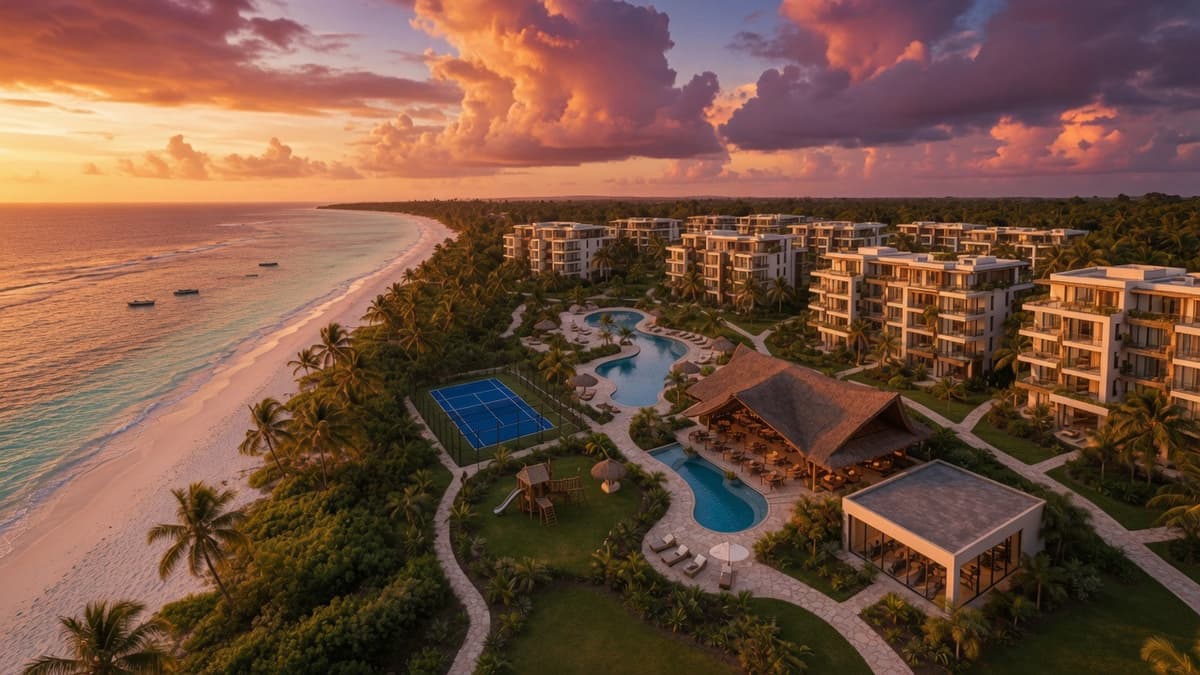
Beneath the polished marketing renders and five-star branding language now circulating for “Diani Beach Residences by CityBlue,” a far less glamorous paper trail tells the real story: a beachfront mega-project that appears to have entered Kenya’s regulatory system carrying one set of numbers while being sold to the international investment market under another, on a stretch of coastline that the law never intended for this kind of concrete sprawl.
Kenya Insights has reviewed the official Environmental and Social Impact Assessment (ESIA) notification letter issued by Bj’s Environmental Consulting Services & Supplies Ltd, dated June 22, 2026, alongside a formal memorandum of objection filed by the South Coast Residents Association (SCRA), and cross-checked both against the project’s own international promotional rollout. What emerges is a textbook case of a developer telling regulators one thing and telling investors another on land that sits, by the project proponent’s own admission, on the first row from one of Africa’s most awarded beaches.
The numbers don’t add up and the developer’s own marketing proves it.
The ESIA notification letter, addressed to the Assistant County Commissioner of Diani and signed by Bj’s Environmental Consulting Services, is unambiguous: the proposed development on Land Reference No. 16289 “shall include 300 apartments featuring a combination of 1, 2 & 3 bedroom units distributed in 12 blocks of double storey.”
That figure 300 units is what was filed with the people legally empowered to assess the project’s environmental and social footprint.
But that is not the project Kenya’s investors and the international hospitality press were told about. At the Future Hospitality Summit Africa in Nairobi, held barely three months earlier, CityBlue Hotels formally unveiled “Diani Residences by CityBlue” developed through a partnership between The Diar Group and Staroot Real Estate as a mixed-use destination on roughly five acres comprising between 400 and 500 units.
Trade publications covering the launch reported the same figure independently, describing a flagship offering of 400-500 units tailored to meet the evolving needs of both investors looking for high-quality rental properties and end-users desiring a permanent or vacation home.
That is not a rounding error. It is a gap of up to 200 units roughly two-thirds again the size of what regulators were told to assess. SCRA’s memorandum calls this out directly, describing it as a “Misrepresentation of Project Scope” and warning that presenting a downscaled version of the project to local stakeholders while marketing a significantly larger project internationally constitutes a severe flaw in the transparency of the ESIA process.
When the regulatory filing and the investor brochure disagree this starkly, only one explanation survives scrutiny: someone is not being told the truth and it is almost certainly the Kenyan public and the local administration officers who are supposed to weigh this project’s real impact.
Beach Zone 1: built for hotels, not concrete blocks
Diani is not an unregulated frontier where developers can simply build whatever the market will bear. The Diani Municipality Land Use and Zoning Plan gazetted, with a South Coast Residents Association representative now sitting on the Municipality’s board designates Beach Zone 1, the prime first-row tourism frontage, specifically for hotels, resorts and hospitality uses.
The logic is straightforward and well understood across the world’s premier beach destinations: hospitality assets generate sustained, high-multiplier local economic activity direct employment, food and beverage procurement, support for tour operators and artisans, and significant county tourism revenue. Residential apartment blocks, particularly ones aimed at international buyers seeking second homes or short-let investment units, do not replicate that value.
They generate sporadic occupancy, a fraction of the jobs, and direct competition with the very hotels that built Diani’s global reputation.
That distinction sits at the heart of a broader public conversation that is already underway about Diani’s Beach Zone 1.
Local hospitality commentator Mohammed Hersi, writing on social media in response to a separate development proposal currently undergoing NEMA’s public participation process and which was also the subject of SCRA’s submissions warned that Beach Zone 1 “was never intended to become a corridor of residential apartment blocks.
It was envisioned as the tourism frontage of Diani a place reserved for hotels, resorts and hospitality developments that generate employment, attract international visitors and contribute significantly to the local economy.” Hersi’s post did not reference the CityBlue project and should not be read as an opposition to it; his concern, as he stated it, was with the protection of the county’s approved planning framework as a general principle.
That principle, however, applies with full force to any first-row proposal, and his core point stands independently of any single development: “Once prime beachfront land is converted into residential apartments, reversing that decision becomes almost impossible.”
Satellite mapping of the site reinforces just how literally “first row” this proposal is. The five-hectare parcel sits directly between Bahari Dhow Beach Villas and The Oasis Beach Bar & Restaurant, a short walk from Papaya Beach Bar currently green, vegetated, undeveloped land separating the beach road from open sand and turquoise water.
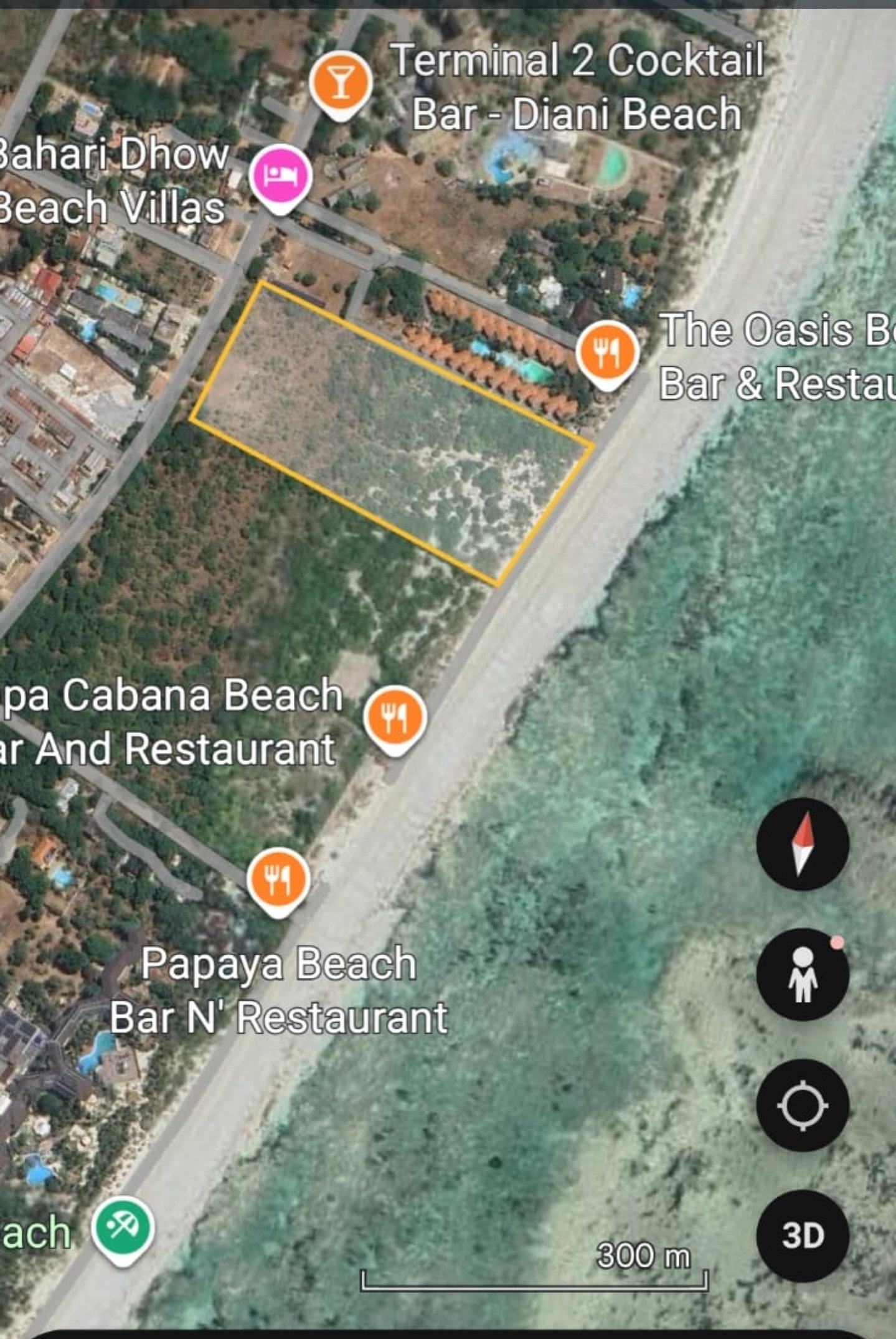
It is precisely the kind of low-density, vegetated buffer that gives Diani its postcard identity, and precisely what would disappear under 12 double-storey concrete blocks.
An ecosystem that cannot absorb this load
SCRA’s memorandum does not rely on emotion; it lays out a systemic case. Covering a 5.14-hectare beachfront site in concrete leaves virtually no space for indigenous coastal vegetation, destroying natural habitats and wildlife corridors while removing the buffer that moderates microclimate and resists erosion.
The infrastructure case is, if anything, more alarming. Diani currently lacks a centralised municipal sewerage network.
A development of up to 500 units using the figure the developer itself advertised internationally would push an estimated 1,500 to 2,000 additional residents and guests onto a single five-hectare plot, generating hundreds of thousands of litres of effluent daily. The “waste water treatment plant” mentioned in the developer’s own ESIA letter, the memorandum warns, poses an extreme risk of subterranean seepage into the area’s porous coral rag a direct contamination threat to the same ocean the project is selling as its core amenity.
Add to that an already strained freshwater table, with heavy borehole reliance threatening saltwater intrusion that could permanently damage groundwater for neighbouring properties; a local power grid prone to fluctuations that would likely be pushed into reliance on diesel generators; and beach-road corridors never engineered for the daily traffic surge of hundreds of additional vehicles, delivery trucks and service vehicles.
This is not a project being scaled to its environment. It is an environment being asked to scale to the project.
Who is actually doing the assessing?
Perhaps the most pointed allegation in the residents’ memorandum concerns the consultant tasked with judging all of this. SCRA notes that Bj’s Environmental Consulting Services & Supplies Ltd maintains no functional website and no verifiable public track record of managing developments of this scale and sensitivity.
An ESIA for a beachfront ecosystem of this magnitude, the memorandum argues, requires a consultant with proven experience in coastal dynamics and high-density infrastructure impact mitigation a bar the residents say has not been demonstrated.
If the firm responsible for certifying this project’s safety cannot show it has done anything comparable before, the public participation process scheduled to be chaired by the Assistant County Commissioner risks becoming exactly what SCRA fears: a box-ticking exercise rather than a genuine check on a project that could permanently alter Diani’s coastline.
The legal exposure is real
SCRA’s memorandum does not stop at environmental objection it frames the matter in explicitly legal terms, citing Article 42 of the Constitution of Kenya, which guarantees every citizen the right to a clean and healthy environment; the Physical and Land Use Planning Act, 2019, which requires developments to conform strictly to local zoning guidelines; and the public participation requirements under the Environmental Management and Coordination Act (EMCA, Cap 387).
The Association has put Bj’s, Kayali Development Limited, NEMA’s Kwale County office, the Kwale County Executive Committee Member for Environment, and the Diani Municipality board on formal notice: pause the ESIA until the true project scope is disclosed, produce verifiable evidence of the consultant’s licensing and capacity, and recommend a severe downscaling of the development to match the zoning plan’s low-density character. SCRA has stated it is prepared to seek injunctions through the National Environment Tribunal and the Environment and Land Court if its objections are ignored.
Why this matters beyond one beachfront plot
This is not simply a local planning dispute. It is a precedent test for every undeveloped first-row parcel left on Kenya’s south coast, now that the Dongo Kundu Southern Bypass has slashed travel time from Mombasa’s international airport and made Diani newly attractive to a wave of regional and international capital.
If a project that was filed with regulators at 300 units but marketed internationally at up to 500 can proceed on Beach Zone 1 without serious consequence, every other beachfront landowner in Diani now has a templated playbook for doing the same.
Destinations that made this mistake before, from parts of the Mediterranean to overdeveloped stretches of the Indian Ocean coastline elsewhere in Africa, did not get their low-density character back once the concrete was poured. SCRA’s memorandum makes the same point bluntly: similar high-density mega-structures in other coastal precincts have historically led to rapid environmental decay, collapsing property values and the flight of premium international tourists.
The public stakeholder meeting on this project was scheduled to be chaired by the Assistant County Commissioner in Diani. What happens in that room and whether NEMA, Kwale County’s environment leadership and the Diani Municipality board choose to enforce the zoning protections already gazetted into law will determine whether Diani Beach remains the low-density, high-value destination that built its global reputation, or becomes the next cautionary tale in coastal overdevelopment.
The land in question is still green in the satellite imagery reviewed for this report.
Whether it stays that way is now a test of institutional will, not of available evidence.
Kenya Insights will continue to track the ESIA process, NEMA’s response, and any further disclosures from Kayali Development Limited, The Diar Group, Staroot Real Estate and CityBlue Hotels as this story develops.









Comments