
News
Parliament is Too Small For Baba: Public Viewing of Raila’s Body Moved to Kasarani Amid Surging Crowds
Some mourners scaled the Parliament perimeter wall in their determination to view the body, creating what observers described as unprecedented scenes in Kenya’s history of state funerals.

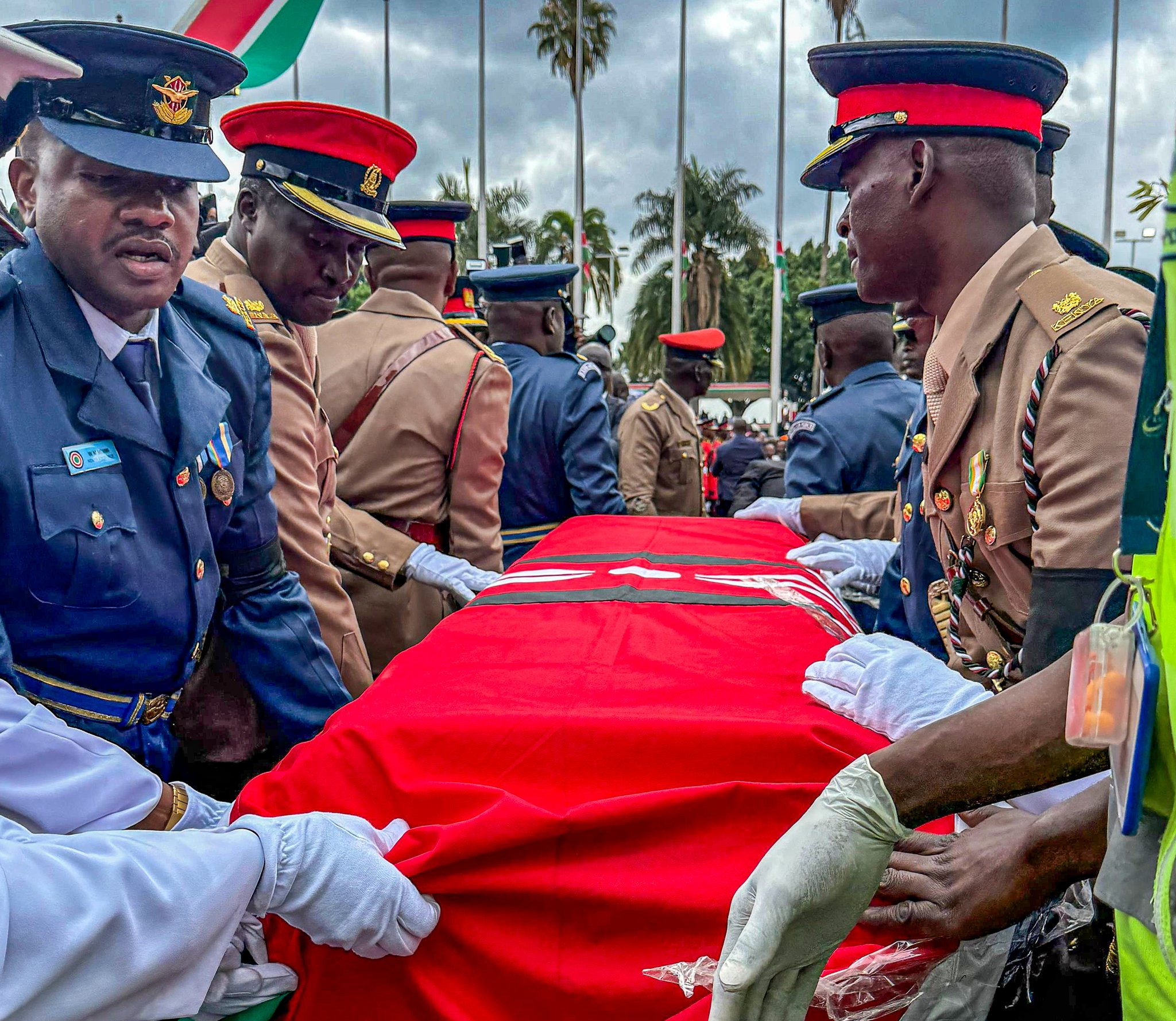
NAIROBI, Kenya— The overwhelming outpouring of grief following the death of former Prime Minister Raila Odinga has forced authorities to relocate public viewing arrangements from Parliament Buildings to the larger Kasarani Stadium, as thousands of mourners continue to throng the city in unprecedented numbers.
The decision came after chaotic scenes unfolded both at Jomo Kenyatta International Airport and Parliament on Thursday morning, with security personnel unable to contain the massive crowds determined to pay their last respects to the man affectionately known as “Baba.”
At JKIA, where Raila’s body arrived aboard a special Kenya Airways flight at 9:30 am from Mumbai, India, security was breached in dramatic fashion.
Thousands of mourners who had gathered outside the airport overwhelmed officers and stormed through the main entrance as the aircraft carrying the former premier’s remains approached.
The security detail deployed to maintain order could only watch in disbelief as the crowd surged forward, their collective grief overriding all protocols.
The scenes were replicated at Parliament Buildings later in the morning, where police had erected razor wire barriers along Parliament Road extending to City Hall Road in an attempt to manage the expected turnout.
But the preparations proved woefully inadequate. Within minutes of the gates opening, the crowds had overpowered officers, removing the barriers as they pushed forward, chanting the Luo phrase “Onge ng’at ma baba osenego”—“there is no one that Baba has killed”—while singing praises of the fallen leader.
Some mourners scaled the Parliament perimeter wall in their determination to view the body, creating what observers described as unprecedented scenes in Kenya’s history of state funerals.
The emotional intensity of the crowds reflected the profound impact Raila had on ordinary citizens across the country’s diverse communities.
Despite the chaos, the atmosphere remained largely peaceful, with the crowds united in grief rather than disorder.
Security officers worked to guide people where possible, conscious that any heavy-handed response could trigger a volatile situation.
The sheer numbers, however, made crowd control nearly impossible within the confines of Parliament Buildings.
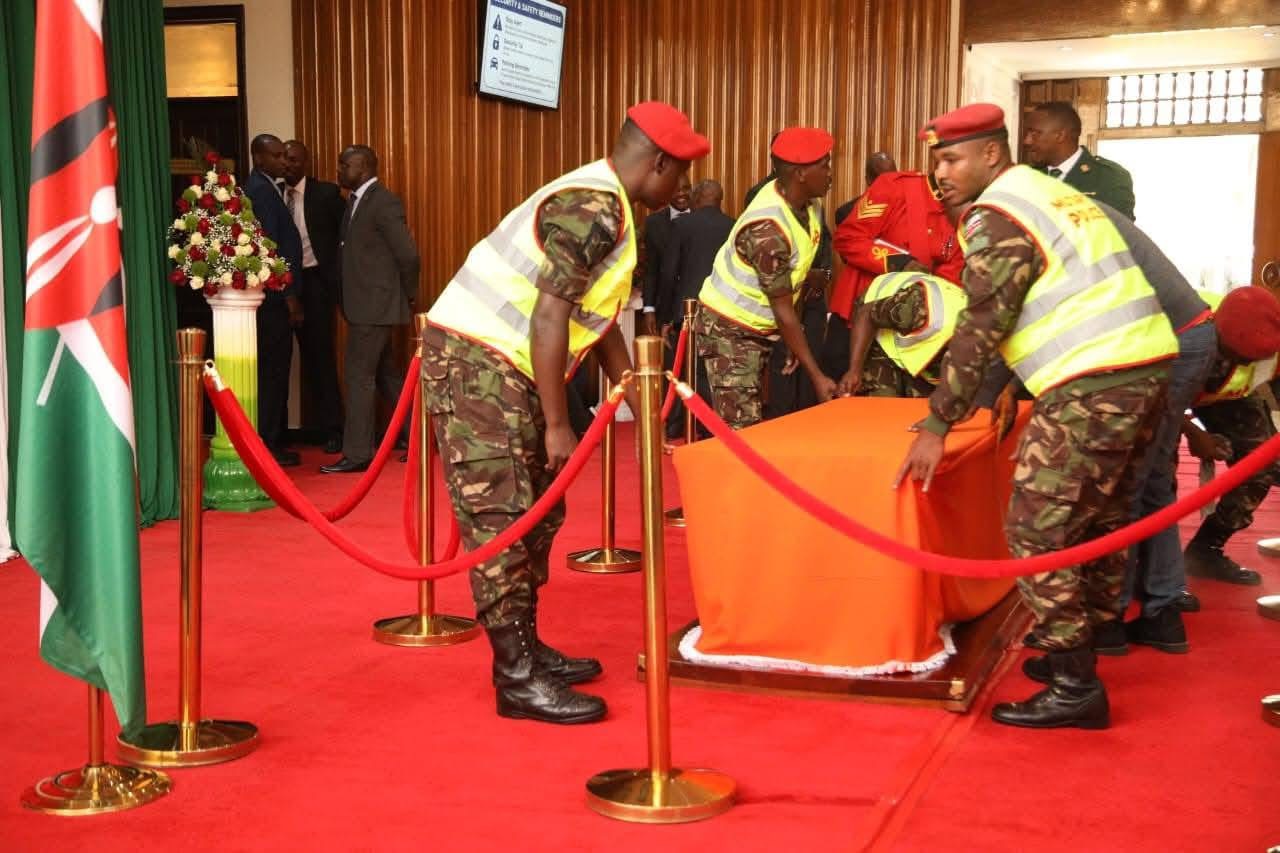
The government has moved the public viewing of Raila Amolo Odinga’s body from parliament to Kasarani Stadium due to the massive crowds that have overwhelmed the convoy and security teams.
It was this reality that prompted the swift decision to move the public viewing to Kasarani Stadium, a venue with a capacity of 60,000 that can accommodate the masses seeking to bid farewell to the political giant.
Authorities are now coordinating with event organizers to ensure smooth flow management at the larger facility while maintaining the dignity befitting a state funeral.
Raila died on Wednesday morning in India, where he had been receiving treatment in recent weeks.
According to his family, he succumbed to cardiac arrest during a morning walk at the Ayurvedic Eye Hospital campus in Mumbai.
His body was flown back to Kenya on a flight designated RAO001, which received a historic water salute upon landing.
The unprecedented turnout for the public viewing underscores the national significance of Raila’s passing.
For decades, he shaped Kenya’s political landscape, fighting for democracy, social justice, and devolution.
His death has united Kenyans across political divides in mourning, with President William Ruto and former President Uhuru Kenyatta both present at JKIA to receive the body—a rare show of unity in the country’s often fractious political environment.
As preparations continue for the funeral, scheduled for Sunday in Bondo, Siaya County, authorities are bracing for what could be one of the largest gatherings in Kenya’s history.
The move to Kasarani Stadium acknowledges what many mourners have been saying since Thursday morning: that no ordinary venue could contain the love and respect Kenyans held for the man who, in life and death, remained larger than any institution.
Kenya Insights allows guest blogging, if you want to be published on Kenya’s most authoritative and accurate blog, have an expose, news TIPS, story angles, human interest stories, drop us an email on [email protected] or via Telegram


Shiquo Hii Style Store Was Not Raided, Anti-Counterfeit Authority Confirms; Says Influencer Used Empty Shelves for Content as She Relocates

Treasury CS Mbadi Unveils Sh4.8 Trillion Budget Estimates

Fraud, Misrepresentation and A Decade Of Evasion: How Indo Africa Finance Pocketed Sh150 Million Youth Funds and Fought To Keep Every Cent

Kenya Picks Chinese Firm For Sh375 Billion JKIA Upgrade Project After Adani Fallout

The President’s Daughter and The Missing Witness: How Adut Salva Kiir’s Shadow Treasury Silenced Its Most Dangerous Critic

Kisii Under Siege: Governor Arati’s Wife Accused of Hijacking IFMIS and Running a Parallel Government

Al-Shabaab Issues Statement Defending Omar Artan, Accuses U.S. of Discrimination After Referee’s Deportation

Netanyahu To Run For Re-Election, His Party Says, After Trump Raises Doubts

US Cracks Down on Birth Tourism Schemes

Microsoft Limits Employee Use Of Anthropic’s Claude Fable 5 Over Data Retention Concerns, The Verge Reports

Cement, Cash and Courts: How the Hashu Dynasty Crushed the Ramji Brothers for Fourteen Years and Why the Walls Are Now Closing In

Inside The Urban Planning Cartel That Owns Nairobi

Why Ruto’s Favourite Candidate Adan Mohammed Could Be Locked Out of the KRA Top Job

LifeCare on the Brink: SHA Fraud, Stolen Wages, and the Rotten Empire Jayesh Saini Built

Betika Faces DCI Probe, Directors Arrest and License Revocation Over Massive 29.5 Million Safaricom Customers’ Data Breach

Standard Chartered Ghosts Haunt Joshua Oigara At Stanbic As Whistleblower Spills Beans

Este Medical Kenya Fights American’s Explosive Complaints

Fresh Move Launched to Remove Kenya Railways MD Mainga From Office After Awarding Sh817 Million Consultancy Contract

The Rot Inside Absa: How Bank Insiders Are Looting Nairobi’s Customers

Inside FAFSA Fraud: How Kenyan Cybercriminals Siphoned Millions from America’s Sh12 Billion Student Loan System
-
 Investigations7 days ago
Cement, Cash and Courts: How the Hashu Dynasty Crushed the Ramji Brothers for Fourteen Years and Why the Walls Are Now Closing In
-
 Investigations6 days ago
Inside The Urban Planning Cartel That Owns Nairobi
-
 Investigations1 week ago
Betika Faces DCI Probe, Directors Arrest and License Revocation Over Massive 29.5 Million Safaricom Customers’ Data Breach
-
 Business14 hours ago
Standard Chartered Ghosts Haunt Joshua Oigara At Stanbic As Whistleblower Spills Beans
-
 Investigations7 days ago
Fresh Move Launched to Remove Kenya Railways MD Mainga From Office After Awarding Sh817 Million Consultancy Contract
-
 Business1 day ago
Inside NCBA’s Decline: How a Banking Giant Lost Its Strategic Edge
-

 News2 weeks ago
Eight Students Arrested In Kenya After Suspected Deadly School Arson Attack
-
 News2 weeks ago
How Uhuru’s Deal With Obama In 2015 Paved Way For America’s Ebola Plan In Kenya