
News
Government Caps SHA Overseas Treatment at Sh500,000 Under New Framework
Overseas healthcare providers must meet stringent accreditation requirements in their home countries and obtain official recognition from relevant Kenyan regulatory bodies.

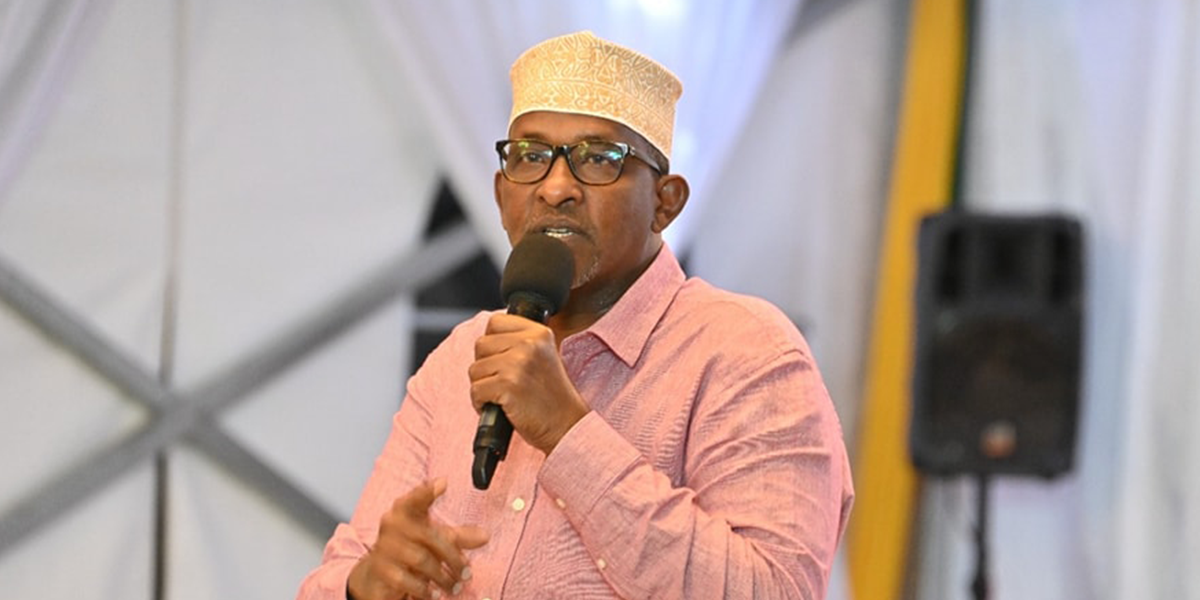
The Kenyan government has unveiled a comprehensive overseas medical treatment scheme under the Social Health Authority that will provide specialized healthcare access abroad while maintaining strict financial controls and quality standards.
Health Cabinet Secretary Aden Duale announced on Saturday that the new framework caps overseas treatment coverage at Sh500,000 per patient, marking a significant shift from previous arrangements under the defunct National Health Insurance Fund.
The announcement represents what officials describe as a milestone in ensuring no Kenyan is denied access to life-saving medical procedures unavailable locally.
The scheme operates under stringent eligibility criteria that require beneficiaries to maintain up-to-date Social Health Insurance contributions.
Access is strictly limited to medical procedures that are not available in Kenyan hospitals, ensuring the program serves as a genuine safety net rather than a preference-based alternative to local healthcare.
Duale emphasized that the framework establishes “a transparent, evidence-based, and accountable system for Kenyans seeking treatment abroad.”
The new process represents a departure from previous arrangements, incorporating robust legal frameworks including the Social Health Insurance Act of 2023, attendant regulations, and the Public Procurement and Asset Disposal Act.
Central to the program’s operation is a rigorous approval mechanism managed by the Claims Management Office, which conducts peer reviews to ensure medical necessity and compliance with financial limits.
The system explicitly excludes unproven, experimental, or unconventional therapies, maintaining focus on established medical treatments with demonstrated efficacy.
The Benefits Package and Tariffs Advisory Panel has already gazetted an initial list of 36 specialized procedures eligible for overseas treatment.
This preliminary catalog will expand based on ongoing Health Technology Assessments, ensuring the program evolves with medical advances and identified gaps in local healthcare capacity.
Overseas healthcare providers must meet stringent accreditation requirements in their home countries and obtain official recognition from relevant Kenyan regulatory bodies.
A critical requirement mandates that overseas providers maintain partnerships with contracted health facilities in Kenya to ensure continuous follow-up care upon patients’ return, addressing concerns about treatment continuity and long-term patient management.
The Ministry of Health has positioned the scheme as both a safety net and quality assurance measure, stating that “no Kenyan should be denied life-saving care due to local limitations or personal cost.”
The framework aims to complement rather than compete with local healthcare services by integrating overseas care with domestic follow-up protocols.
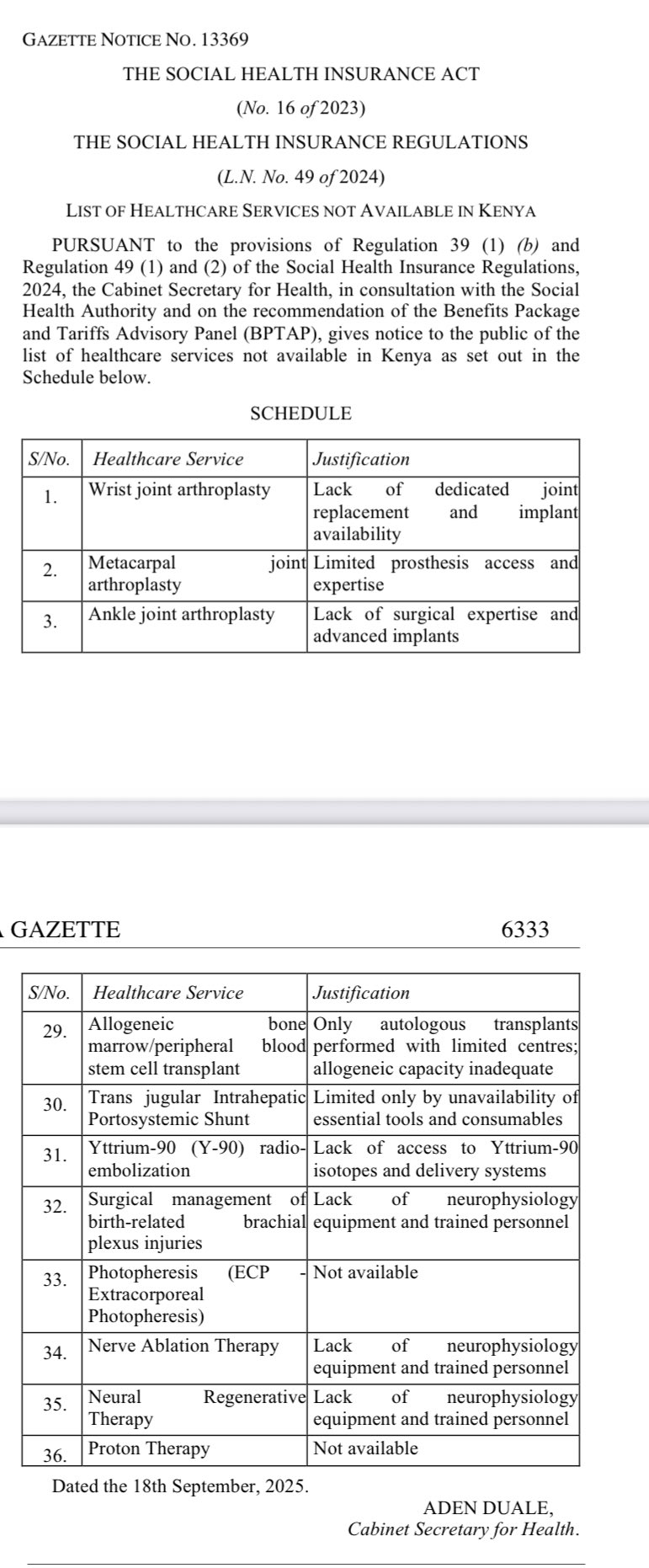
Officials acknowledge that the Sh500,000 coverage limit may be adjusted as contracts with overseas providers are finalized and rate negotiations conclude.
The ministry has directed the SHA Board of Directors to proceed with empaneling and contracting overseas facilities while preparing public notification of contracted facilities to streamline approval processes.
The new framework addresses previous concerns about unregulated overseas medical tourism and ensures that patients receive treatment from accredited facilities with established quality standards.
By requiring partnerships with Kenyan hospitals, the system maintains continuity of care and supports the national health system’s development through knowledge transfer and capacity building.
This initiative emerges as Kenya continues implementing broader health sector reforms under the Social Health Authority, which replaced the National Health Insurance Fund as part of efforts to achieve universal health coverage.
The overseas treatment component represents a specialized aspect of these reforms, designed to address gaps in local healthcare capacity while maintaining fiscal responsibility and quality assurance.
The scheme’s success will depend largely on effective implementation of the peer review process, timely contracting of quality overseas providers, and seamless coordination between foreign treatment centers and local follow-up facilities.
As the program launches, healthcare stakeholders will monitor its impact on both patient outcomes and the broader goal of strengthening Kenya’s healthcare system.
Kenya Insights allows guest blogging, if you want to be published on Kenya’s most authoritative and accurate blog, have an expose, news TIPS, story angles, human interest stories, drop us an email on [email protected] or via Telegram












Karua Detained at Entebbe as Uganda Blocks Besigye Lawyer From Entering Country

How KCB and Airtel Turned Kenya’s Unbanked Into a Data Goldmine Behind a ‘Financial Inclusion’ Deal

The Chivayo Network: How a Convicted Fraudster Won Access to Presidents, Passports and Billion-Dollar Deals Across Africa

BURRIED TWICE: The Victoria Bank CEO Yogesh Pattni Files

Court Stops Transfer Of EABL Shares To Asahi By Diageo In A Fresh Snag

Death Before Justice: Stephen Ngei, Victim of Sh180 Million Laptop Tender Scam Linked to Allan Chesang, Killed in Highway Crash

Court Brands Sh1.1 Billion Fee Demand by Lawyer Victor Swanya “Excessive and Exorbitant,” Exposes How City Hall Lets Public Money Bleed Through Legal Bills

Trump Unveils New Air Force One

MR. NO SHOW: Finance Bill 2026 Exposes Ndindi Nyoro’s Political Conmanship

Billionaire Eric Muli Rebukes Musalia Mudavadi Over Nairobi Capital Relocation Debate

Businessman Philip Waithaka Kinuthia’s Minor Son Allegedly Drove Drunk, Killed Two Peponi Students in Ngong Road Horror Crash as Claims of Cover-Up Intensify

Inside NCBA’s Decline: How a Banking Giant Lost Its Strategic Edge

Cement, Cash and Courts: How the Hashu Dynasty Crushed the Ramji Brothers for Fourteen Years and Why the Walls Are Now Closing In

Standard Chartered Ghosts Haunt Joshua Oigara At Stanbic As Whistleblower Spills Beans

South Sudan: Adut Salva Kiir’s Shadow Treasury Exposed

Inside The Urban Planning Cartel That Owns Nairobi

THE VULTURE AND THE SCHEME How Nairobi West Hospital Became the Most Dangerous Institution in Kenya’s SHA Ecosystem and Why the Books Must Be Audited Now

How Adil Popat Saved His Empire On The Eve Of Imperial Bank Collapse and Why Kenya’s Mainstream Media Buried The Story

The President’s Daughter and The Missing Witness: How Adut Salva Kiir’s Shadow Treasury Silenced Its Most Dangerous Critic

Why John Ngumi Is Running From the EACC and Why the Sh415 Million Payday May Be the Least of His Worries
-
 News1 week ago
Businessman Philip Waithaka Kinuthia’s Minor Son Allegedly Drove Drunk, Killed Two Peponi Students in Ngong Road Horror Crash as Claims of Cover-Up Intensify
-
 Business2 weeks ago
Inside NCBA’s Decline: How a Banking Giant Lost Its Strategic Edge
-
 Business2 weeks ago
Standard Chartered Ghosts Haunt Joshua Oigara At Stanbic As Whistleblower Spills Beans
-
 Africa2 weeks ago
South Sudan: Adut Salva Kiir’s Shadow Treasury Exposed
-
 Investigations4 days ago
THE VULTURE AND THE SCHEME How Nairobi West Hospital Became the Most Dangerous Institution in Kenya’s SHA Ecosystem and Why the Books Must Be Audited Now
-
 Business2 weeks ago
How Adil Popat Saved His Empire On The Eve Of Imperial Bank Collapse and Why Kenya’s Mainstream Media Buried The Story
-
 Africa2 weeks ago
The President’s Daughter and The Missing Witness: How Adut Salva Kiir’s Shadow Treasury Silenced Its Most Dangerous Critic
-
 Business2 weeks ago
Why John Ngumi Is Running From the EACC and Why the Sh415 Million Payday May Be the Least of His Worries