
Grapevine
Alex Chesang Busted Lying: Sleeping In The Streets And Making Sh2 Million Per Weekend In Campus?
The Trans Nzoia Senator has told two radically different stories about his early life. Netizens are demanding to know which version is true. Kenya Insights digs deeper.

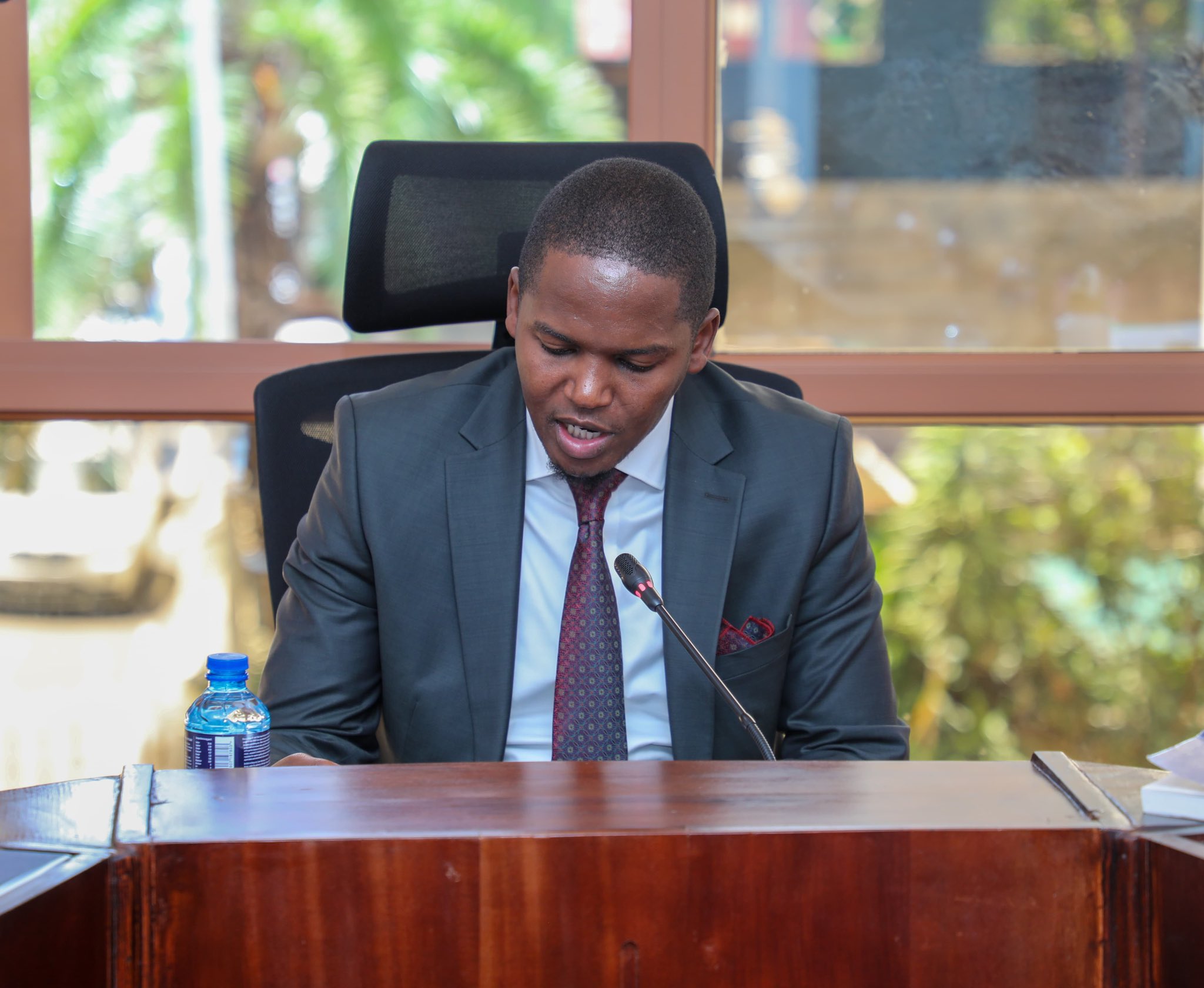
For a man who has made a political career on the strength of a compelling personal narrative, Trans Nzoia Senator Allan Kiprotich Chesang has developed a troubling habit of telling two completely different stories about who he is and where he came from.
The latest contradiction to surface is not a minor embellishment or the routine rounding-up of figures that characterises political autobiography in Kenya. It is a head-on collision between two versions of reality that cannot both be true.
In a recent interview with Chris Da Bass that circulated widely on social media, Senator Chesang painted a vivid and emotionally charged picture of struggle. He claimed he arrived in Nairobi completely alone, with no family connections or friends to lean on, and was reduced to sleeping rough along River Road.
In Chesang’s telling, he would bed down in the streets until a stranger, a Kamba man, took pity on him and gave him a place to rest. The senator even claimed that once he found success, he tracked down this Good Samaritan and bought him land as a gesture of gratitude.
It was the kind of origin story that politicians reach for when they want to demonstrate that they understand poverty from the inside. Gritty. Relatable. Memorable. The problem is that it directly contradicts what Chesang himself said in a widely-viewed earlier interview on Jalang’o’s Bonga na Jalas programme, in which he described a young life that bore no resemblance whatsoever to the streets of River Road.
“Politicians randomly come up with something that fits an occasion and embellish it so well, then make a presentation to a delusional audience. And the stories keep changing.” – X user Ja Loka
THE JALANGO VERSION: MILLIONS AT FOURTEEN
In the Bonga na Jalas interview, which has been archived and circulated anew by online investigators, Chesang gave a markedly different account of his teenage years.
He told Jalang’o that while still in Form One at St. Anthony Boys High School in Kitale, he was already representing Kenya at junior international table tennis championships and earning close to Sh1 million in allowances for a single weekend of play.
He said his first major international outing was in Congo Brazzaville in 2003, where he collected the equivalent of Sh1 million in tournament allowances alone.
That was not the ceiling. Chesang went on to claim that he was eventually poached by a professional table tennis club in France and was earning up to Sh2 million per weekend representing the club.
He further stated that during his university years, he invested his sports earnings in his father’s insurance company, Crackerbell Insurance Link, and was operating as a teenage sharebroker with access to capital that most Kenyans could not dream of.
These are two mutually exclusive life stories.
A teenager earning Sh2 million per weekend in France and investing in insurance companies is not the same person who was sleeping homeless on River Road.
A young man with a father who ran an insurance brokerage does not arrive in Nairobi knowing nobody. The contradiction is not subtle. It is total.
Online users were quick to notice.
X user Mkenya Halisi wrote that he knew Chesang from Moi University and recalled him as someone who had been signed by a sports club in Spain, adding that the street-sleeping story “inakaa jaba.”
Ja Loka observed, with some resignation, that politicians tailor their narratives to whichever audience happens to be listening on any given day. The internet does not forget, and in Senator Chesang’s case, it has stored both transcripts.
THE TABLE TENNIS CHAPTER: REAL, BUT HOW LUCRATIVE?
What makes this particular lie-detection exercise complicated is that the table tennis element of Chesang’s biography is broadly corroborated by independent sources.
His profile on the parliament website acknowledges his sports background. Multiple biographical accounts confirm he was part of the Kenyan national team and represented the country at the 2010 Commonwealth Games in New Delhi.
The international table tennis player database lists a Chesang Allan from Kenya.
But the financial figures he has thrown around over the years do not withstand scrutiny.
According to data published by Investopedia, typical table tennis tournament purses range from the equivalent of Ksh280,000 to Ksh3.3 million, reserved for the top tier of the global game.
For a junior Kenyan player competing in regional championships in the early 2000s, allowances of Sh1 million per weekend were not remotely standard.
Chesang himself has given slightly varying figures across different interviews, sometimes citing $10,000 in allowances and elsewhere inflating the sums, depending on which interviewer he is speaking to and what impression he wishes to create.
More fundamentally, the France club contract, which Chesang references as the source of Sh2 million weekly earnings, has never been independently verified.
Kenya Insights could find no contemporaneous record, no club name, no contract details, and no corroborating accounts from other players or officials who might have been part of Kenya’s table tennis circuit at the time.
What is confirmed is that Chesang attended Moi University in Eldoret from approximately 2008, studied Business Management with a specialisation in Purchasing and Supply, and graduated in 2012.
A France contract that paid Sh2 million per weekend and a man sleeping on River Road with no one to call are two biographical impossibilities that cannot be reconciled by selective memory.
“The laptop scam suspect. The DoD jute bags fraud. The Sh221 million case. And now Harambee House ambulances. A pattern is a pattern.”
FRAUD CASES: A FILE THAT KEEPS GETTING THICKER
The biographical inconsistencies would be merely embarrassing if Chesang’s personal history outside the interview circuit were clean. It is not. The senator is a man whose name has appeared in criminal proceedings with a consistency that defies coincidence.
The oldest and most documented case dates to 2018, long before anyone had heard the name Senator Chesang.
A businessman named Charles Musinga of Makindu Motors was lured into what appeared to be a legitimate government tender to supply 2,800 HP laptops to the Ministry of Devolution.
Musinga lost Sh181 million.
Court testimony described how victims were entertained at Ole Sereni Hotel and in Karen before being escorted into Harambee House Annex through the VIP lift, with the clear suggestion that they had access to the highest levels of government.
Chesang, courts heard, was the person who drove to collect the laptops in a Range Rover bearing stickers from Parliament and the Office of the Deputy President, then under William Ruto.
Chesang and six co-accused were charged with seven counts including conspiracy to defraud, making a document without authority, obtaining goods by false pretences, handling stolen goods and abuse of office.
The case has wound through Milimani Law Courts for years, plagued by the kind of procedural delays that tend to cluster around cases with politically prominent defendants.
As recently as March 2024, Chesang attended the morning session of the hearing virtually from Switzerland, claiming parliamentary business, and then could not be reached for the afternoon session, forcing Nairobi Chief Magistrate Lucas Onyina to adjourn the matter. The case remains unresolved.
A separate prosecution arose from a Department of Defence fake tender case in which Chesang and six others stand accused of conspiring to steal Sh25.95 million from a company called Wil Developers and Construction Limited.
The pretext was a contract, bearing the forged number MODP/SUPPLS/0451-270/2017-18/SP, for the supply of 175,000 jute gunny bags.
The offences are alleged to have occurred in late 2017 and early 2018. Chesang attempted to have the charges withdrawn by offering to repay Sh17 million, the sum deposited into his account that implicated him in the scheme.
The court declined to dismiss the charges on three separate occasions, most recently in May 2025, after the complainant disputed whether the full repayment had actually been received.
A May 2025 acquittal in a separate but related DoD case does not affect the jute bags prosecution, which continues.
Investigators and lawyers who have followed his career find the repetition of the pattern difficult to attribute to misfortune.
THE FIANCEE IN THE CABINET: A CONFLICT HE WILL NOT DISCUSS
The senator has also been confronted with a more intimate hypocrisy. Chesang has positioned himself as one of the most vocal critics of Trans Nzoia Governor George Natembeya, publicly accusing the governor of tribalism in county appointments and demanding accountability over healthcare and development spending.
In April 2025, Natembeya fired back with a disclosure that briefly silenced the senator’s critics on social media.
The governor stated publicly that Chesang’s fiancee, alternately referred to as his wife in various accounts, was serving as a minister in his county cabinet.
Natembeya challenged Chesang directly, asking why he was generating noise about tribal appointments while his own partner occupied a position in the very executive he was attacking. Chesang has not provided a satisfactory public response to the conflict of interest this represents.
The identity of the woman in question has not been confirmed publicly, but Natembeya’s allegation stands unrebutted.
A senator who profits politically from criticising a governor’s administration while his partner draws a salary from that same administration is not a credible accountability champion. He is an actor performing a role.
THE MAN FROM MATANO: WHICH STORY SERVES HIM TODAY?
Allan Kiprotich Chesang was born in Matano village in Trans Nzoia County, a detail that all versions of his biography agree on.
He attended Kitale Academy for primary school, proceeded to St. Anthony Boys High School and then Musingu High School in Kakamega, before enrolling at Moi University.
His father, the late Reverend Nathan Chesang Moson, was an insurance broker, a family background that already complicates the destitute-arrival-in-Nairobi narrative considerably.
Before entering politics he built a business portfolio that included the Club Blend entertainment franchise, The Craft Lounge in Westlands and The Garage Club in Thika, the logistics company Uplift Express, and Aquarage Purified Water.
He attempted the Kwanza parliamentary seat in 2017 and lost before winning the Trans Nzoia senatorial seat in 2022 under the UDA ticket.
He chairs the Senate Standing Committee on ICT and has sponsored the Real Estate Regulation Bill in an attempt to construct a legislative identity.
By his own account and that of various profiling sites, his net worth runs into the hundreds of millions of shillings, with some estimates reaching over a billion.
A man of this financial biography does not sleep on the streets of River Road. At most, he may have passed through difficult years after, by his own earlier admission, his early business ventures collapsed and he was auctioned.
But an auctioned businessman with a father in insurance, a sports career, a university degree and nightclub investments is a different creature entirely from the destitute youth of the Chris Da Bass interview.
The street-sleeping story, told with the emotional specificity of a man who remembers exactly where he put down his head and exactly which stranger showed him kindness, appears constructed for a particular audience at a particular political moment. It is the kind of story a politician tells when he wants to be seen as a man of the people rather than a man of the courts.
WHAT KENYANS ARE SAYING
The viral collision of the two interviews has generated sustained commentary on social media platforms, with users largely unimpressed by the senator’s credibility as a narrator of his own life.
The sentiment expressed by Ja Loka on X captured the prevailing mood precisely: politicians craft whatever story fits the occasion, deliver it to an audience they calculate will believe it, and move on, trusting that the previous version has been forgotten. In Senator Chesang’s case, it has not been forgotten. It has been bookmarked, screenshotted and retweeted.
What the online commentary has not fully addressed is the larger pattern: a man accused of constructing fake government documents to defraud businessmen has also apparently constructed a fake biographical document to defraud voters.
The methodology is consistent.
The target audience changes.
The essential character of the enterprise does not.
Kenya Insights allows guest blogging, if you want to be published on Kenya’s most authoritative and accurate blog, have an expose, news TIPS, story angles, human interest stories, drop us an email on [email protected] or via Telegram






Kenya Stops Work At The US-Linked Ebola Facility

‘The Polygamist’ Pirated Book Go On Sale in Nairobi Following Show Popularity

Justice Mong’are, the Machakos Injunction and the EABL-Asahi Questions Kenya Cannot Ignore

The EABL–Asahi Deal and the Growing Demand for Judicial Transparency

Samburu Governor Lati Lelelit Exposed For Paying Sh60 Million To Ghost Workers

THE GHOST AT ELYSEE PLAZA: How Ghanaian Businessman Erick Agbeko Built a Two-Decade Empire of Land Fraud in Kenya

Njuca Consolidated, Three Firms Faces Auction of 65 Properties Over Crippled Cash Flow

Why Absa Bank Is On The Spot For Enabling Sh150 Million Alleged Insider Fraud In Vetlab Club

Somalia’s Disputed President Allegedly Siphons Up to $6 Million Monthly from Kenyan Miraa Trade, Sharing the Spoils with Nairobi’s Shadow Cartels

Ahmed Adan Hefow: Governor Otuoma’s Trusted Right-Hand Man at the Centre of Busia’s Deepening Finance Scandal

Businessman Philip Waithaka Kinuthia’s Minor Son Allegedly Drove Drunk, Killed Two Peponi Students in Ngong Road Horror Crash as Claims of Cover-Up Intensify

Inside NCBA’s Decline: How a Banking Giant Lost Its Strategic Edge

South Sudan: Adut Salva Kiir’s Shadow Treasury Exposed

Cement, Cash and Courts: How the Hashu Dynasty Crushed the Ramji Brothers for Fourteen Years and Why the Walls Are Now Closing In

Standard Chartered Ghosts Haunt Joshua Oigara At Stanbic As Whistleblower Spills Beans

Inside The Urban Planning Cartel That Owns Nairobi

THE VULTURE AND THE SCHEME How Nairobi West Hospital Became the Most Dangerous Institution in Kenya’s SHA Ecosystem and Why the Books Must Be Audited Now

The President’s Daughter and The Missing Witness: How Adut Salva Kiir’s Shadow Treasury Silenced Its Most Dangerous Critic

How Adil Popat Saved His Empire On The Eve Of Imperial Bank Collapse and Why Kenya’s Mainstream Media Buried The Story

Why John Ngumi Is Running From the EACC and Why the Sh415 Million Payday May Be the Least of His Worries
-
 News1 week ago
Businessman Philip Waithaka Kinuthia’s Minor Son Allegedly Drove Drunk, Killed Two Peponi Students in Ngong Road Horror Crash as Claims of Cover-Up Intensify
-
 Business2 weeks ago
Inside NCBA’s Decline: How a Banking Giant Lost Its Strategic Edge
-
 Africa2 weeks ago
South Sudan: Adut Salva Kiir’s Shadow Treasury Exposed
-
 Business2 weeks ago
Standard Chartered Ghosts Haunt Joshua Oigara At Stanbic As Whistleblower Spills Beans
-
 Investigations5 days ago
THE VULTURE AND THE SCHEME How Nairobi West Hospital Became the Most Dangerous Institution in Kenya’s SHA Ecosystem and Why the Books Must Be Audited Now
-
 Africa2 weeks ago
The President’s Daughter and The Missing Witness: How Adut Salva Kiir’s Shadow Treasury Silenced Its Most Dangerous Critic
-
 Business2 weeks ago
How Adil Popat Saved His Empire On The Eve Of Imperial Bank Collapse and Why Kenya’s Mainstream Media Buried The Story
-
 Business2 weeks ago
Why John Ngumi Is Running From the EACC and Why the Sh415 Million Payday May Be the Least of His Worries