
Investigations
Newly Confirmed KeNHA Boss Luka Kimeli Dragged In Alleged Multimillion Tender Scam
Weeks after securing his substantive appointment, the Director-General of Kenya’s most powerful roads agency faces mounting questions over a foreign contractor tender, a High Court contempt conviction, and a systemic record of procurement scandal that has shadowed KeNHA for years.

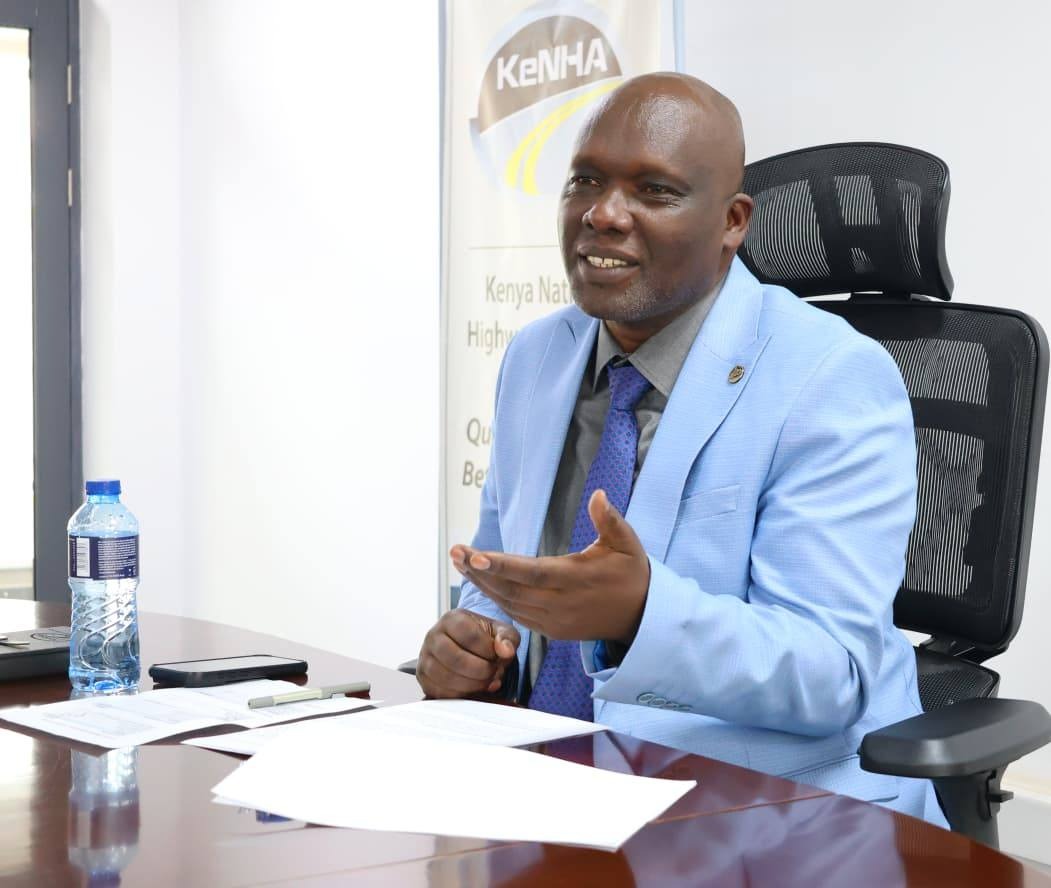
The ink on his official appointment letter had barely dried when the questions began to follow Eng. Luka Kipchumba Kimeli through the corridors of KeNHA’s upper hill offices. On 17 February 2026, the Kenya National Highways Authority Board, acting in consultation with the Cabinet Secretary for Roads and Transport, formalised his elevation to Director-General, ending a seven-month acting tenure that had itself been turbulent.
The Board, through its Chairperson Winfrida Ngumi, assured the public of a recruitment process it called “competitive and transparent” conducted in line with the Kenya Roads Act, 2007. What the statement did not address was the cloud of allegations, court findings and institutional controversy that had accumulated around Kimeli and the agency he now helms during the very months he was auditioning for the role permanently.
A wave of claims circulating across public platforms since the announcement allege that Kimeli’s office may have played a facilitative role in the award of a multi-million-shilling contract to a foreign entity under circumstances that have raised serious questions about competitive bidding, preferential treatment and due process.
The allegations, which have yet to be tested before any formal body, describe a procurement environment in which internal processes may have been tailored to accommodate an outcome already decided elsewhere. As of the time of this investigation, neither KeNHA nor the Ministry of Roads and Transport had issued any public response to the claims, and no oversight authority had publicly pronounced itself on the matter.
What makes the allegations particularly combustible is the context in which they land. KeNHA is not an agency with a pristine reputation. It has spent the better part of two decades at the centre of Kenya’s most consequential and most contested infrastructure governance controversies.
Its procurement architecture has drawn sustained fire from the Auditor-General, parliamentary committees, and anti-corruption investigators. Its project files are laden with cost overruns, vanished documentation, unexplained contract variations, and billions in pending bills to contractors who in turn have dragged the agency into protracted, expensive court battles. Kimeli now presides over all of it, and the allegations against him are arriving at a moment when the institution he leads can least afford further reputational damage.
The Contempt Conviction That Preceded the Appointment
Long before the current tender allegations surfaced, Kimeli’s tenure as acting Director-General had already attracted the attention of the High Court in a manner that would ordinarily give any appointing authority cause for reflection. On 25 November 2025, the High Court found Kimeli guilty of contempt of court for defying a binding judicial order directing KeNHA to settle a debt of Sh536,464,436 owed to SBI International Holdings (Kenya) Limited, an Israeli construction firm.
The court was unambiguous in its language. It characterised Kimeli’s conduct as adopting a posture of waiting to see what consequences may follow, in the hope that none will, and declared such conduct wholly unacceptable.
Kimeli was summoned to appear before the Nairobi court on 19 December 2025 for mitigation and sentencing, a proceeding that unfolded while his permanent appointment was already being processed.
He had argued before the court that KeNHA’s failure to pay was not wilful disobedience but a consequence of budgetary constraints and administrative processes.
He told the court that KeNHA had proposed a structured repayment plan in December 2023 involving six equal instalments beginning January 2024, that partial payments had been made, and that the agency had written to the Principal Secretary for Roads in May 2025 to notify the balance outstanding. The court rejected this framing entirely. It ruled that the continued default, in the face of a binding consent order and available statutory funding mechanisms, constituted wilful contempt. A statutory body that elects to disobey orders, it held, undermines public confidence in lawful administration.
The SBI International dispute is itself a decades-long saga that illuminates the chronic dysfunction at the heart of KeNHA’s contract management. SBI, the Kenya subsidiary of the Israeli construction giant Shikun and Binui, had been awarded a series of major highway contracts including the dualling of the Kisumu Boys Roundabout to Mamboleo Junction and stretches of the Mau Summit to Kericho to Kisumu corridor.
In December 2018, the company abandoned works on the Kisumu dual carriage, citing unpaid arrears and delayed completion. A Disputes Adjudication Board subsequently awarded it Sh1.3 billion in April 2019 for the illegal termination of contracts, a figure that KeNHA contested in court and lost. The cascade of litigation that followed has cost the Kenyan taxpayer over Sh6 billion in payments to SBI across nine contract disputes, accounting at its peak for more than 80 percent of all payments made by road agencies for contract breaches in a single financial year.
The SBI saga carries an additional layer of toxicity that predates Kimeli’s tenure but that continues to shadow the institution he has inherited.
Israeli investigators established that SBI’s parent company, Shikun and Binui, had paid bribes to Kenyan public officials to secure road tenders.
The Israeli probe, which culminated in a court fine exceeding Sh9 billion, named 18 Kenyan nationals as implicated, including two former Transport Ministers and a former Principal Secretary, as well as officers drawn from KeNHA, KURA, and KeRRA. Coordinated raids by Kenyan and Israeli detectives on SBI offices in February 2018 yielded seized documents, false invoices and a twenty-page notebook detailing transactions. The stain of that episode has never fully lifted from the institutional memory of Kenya’s roads agencies.
The Kiambu Road Debacle and the Question of Foreign Contractor Preference
One of the most legally contentious procurement episodes of Kimeli’s acting tenure unfolded in July 2025, when KeNHA published Tender Number KeNHA/2889/2025 for the capacity enhancement of the Pangani-Muthaiga-Kiambu-Ndumberi road, the busy B32 corridor linking Nairobi’s northern suburbs to Kiambu County.
The notice attracted immediate controversy for a single, striking reason: it restricted eligible bidders exclusively to Chinese firms or consortia led by Chinese enterprises, citing financing arrangements with the China Export-Import Bank.
Prospective applicants were required to demonstrate a minimum annual construction turnover of Sh32 billion over the preceding five years, a threshold that, combined with the nationality restriction, effectively closed the procurement to virtually the entire Kenyan construction industry.
Stakeholders and legal observers reacted with alarm, arguing that limiting bidders to Chinese companies on a government procurement was a direct violation of the Public Procurement and Asset Disposal Act, which reserves preferential treatment for Kenyan firms.
One week after publishing the notice, KeNHA silently revoked it through a second advertisement in the government’s official MyGov publication, without explanation. The agency did not respond to press inquiries.
The abrupt reversal left the project in limbo and raised questions about who had approved the original notice, what instructions had been received from the Ministry, and whether the restriction was demanded by the Chinese financier or volunteered by KeNHA officials. Kimeli was acting Director-General at the time and was therefore the accounting officer on whose watch the controversial tender was issued and then withdrawn without public explanation.
The affair drew parliamentary attention.
The Senate mounted an inquiry into the agency’s use of exclusionary foreign tender restrictions on a project of national significance. Separately, a Kiambu County Assembly official who sought formal clarification from KeNHA was assured, through a letter, that the project would eventually be re-tendered under the Kenya Urban Roads Authority, an explanation that raised further questions about why KeNHA had originated the procurement for a project that fell within KURA’s jurisdiction.
No formal accountability mechanism has since been triggered. Kimeli was confirmed as substantive Director-General without being required to publicly address the circumstances of the controversial tender or its unexplained withdrawal.
An Auditor-General’s Graveyard: KeNHA’s Long Procurement Record
To understand the gravity of the current allegations against Kimeli and the fragility of KeNHA’s institutional standing, one must reckon with the depth of the agency’s documented governance failures.
The Office of the Auditor-General has for years produced reports that read less like routine financial reviews and more like indictments of a procurement system that operates with remarkable indifference to the law.
Auditor-General Nancy Gathungu has, across successive reports, flagged KeNHA for missing board minutes, contracts awarded without supporting documentation, consultancy fees paid without underlying contracts, unexplained cost variances running into the billions, and payments made for services that cannot be independently verified.
A forensic audit of the Mombasa-Mariakani highway project, presented to Parliament in 2024, exposed some of the most egregious examples.
The audit found that KeNHA had implemented a project alternative that exceeded the cheapest feasible option by more than Sh5 billion without documenting any justification for the change.
A difference of Sh9.7 billion between the project’s cost and its approved budget went unexplained. The National Land Commission was found to have irregularly paid public funds to acquire parcels of land that belonged to other state entities, including Kenya Power, KenGen, Kenya Revenue Authority and Kenya Railways. Board minutes for the project were absent.
Multiple consultancy contracts, including those awarded to AECOM, SAI Consult and other firms, could not be supported by documentation. Missing exchequer and receipt vouchers worth Sh127 million were flagged in donor-funded accounts for the same project.
Cost overruns across KeNHA’s project portfolio have been equally disturbing. An analysis of official Transport Ministry data tracking infrastructure spending between 2007 and 2017 identified at least 26 KeNHA projects that had exceeded their initial cost estimates, collectively overshooting their budgets by more than Sh20 billion.
A single project, the rehabilitation of the Kakamega-Webuye Road, ran Sh1.3 billion over estimate.
The Mwatate-Taveta Road, commissioned with fanfare during the Kenyatta era, cost Sh10.5 billion against an initial estimate of Sh9.55 billion.
The Kisumu-Kakamega road was varied by 78.8 percent beyond its contract sum in violation of procurement law.
Such variations, the auditor noted, effectively doubled the cost to the taxpayer while providing no corresponding accountability.
The cumulative pending bills owed to road sector contractors at the time stood at Sh145 billion, representing a quarter of the government’s entire pending bill backlog.
A March 2026 report by the Organisation for Economic Co-operation and Development on competition law and public procurement in Kenya lent international credibility to what domestic auditors had been documenting for years.
The OECD found that while Kenya possessed sound legal frameworks against collusion and bid-rigging, enforcement was weak, penalties were rarely applied, and the oversight agencies responsible for monitoring procurement, most notably the Public Procurement Regulatory Authority and the Competition Authority of Kenya, operated in institutional silos with little coordination.
Digital procurement systems that could flag suspicious bidding patterns in real time covered only a small fraction of public agencies.
The consequences of this enforcement vacuum were described by the OECD as systemic and economically costly, with road infrastructure repeatedly identified as among the sectors most vulnerable to cartel activity.
The Succession That Raised Its Own Questions
Kimeli inherited the acting role under circumstances that were themselves unexplained. On 11 July 2025, his predecessor Eng. Kung’u Ndung’u resigned with immediate effect, on the very same day that the Director-General of the Kenya Rural Roads Authority, Eng. Philemon Kandie, also stepped down.
The simultaneous resignation of the heads of two of Kenya’s three principal road agencies on a single day, without public explanation from either agency, was treated by observers as either a coordinated political manoeuvre or the consequence of pressure emanating from the political transitions of mid-2025.
KeNHA’s Board accepted Ndung’u’s departure and appointed Kimeli in his place within hours, a speed of transition that suggested the succession had been anticipated.
Ndung’u’s own tenure had not been without controversy.
A petition was filed at the High Court in connection with allegations that his KeRRA counterpart Kandie had used state machinery to facilitate anti-government protests, and the broader wave of leadership exits was widely read as a political cleansing within the transport infrastructure bureaucracy.
Into this environment Kimeli stepped, armed with credentials that were individually impressive, a First Class Honours degree in Civil Engineering from the University of Nairobi, an MBA from the same institution, 27 years across multiple roles in the road sector, and a 2025 award for contributions to the digitalisation of weighbridge operations.
Whether credentials alone are sufficient armour against the institutional forces that have made KeNHA a byword for procurement opacity is the question that the current allegations are forcing into the open.
Silence as a Policy: The Accountability Deficit
The most troubling aspect of the controversy surrounding the current tender allegations is not the allegations themselves, which remain unverified and whose full details have not been placed before any formal investigative body, but rather the institutional posture they have provoked. KeNHA has not issued any statement.
The Ministry of Roads and Transport has been silent. No parliamentary committee has publicly called for an explanation.
The Ethics and Anti-Corruption Commission, whose mandate expressly covers procurement irregularities in state agencies, has made no public pronouncements. This silence is itself a governance failure.
KeNHA does maintain a public portal through which quarterly tender awards are published, a transparency mechanism that governance advocates have cautiously welcomed.
But publication of tender awards is only meaningful if the process that produces those awards is itself subject to scrutiny. The Auditor-General’s repeated findings suggest that documentation, the evidentiary paper trail that procurement law requires, has been systematically absent or manipulated.
An agency that can award contracts without supporting documentation, vary project costs by billions without board approval, and miss exchequer vouchers worth hundreds of millions in donor-funded accounts is not made more transparent by a public portal. The portal becomes, in that environment, a fig leaf.
The Kenya Railways Corporation offers a cautionary parallel. In March 2026, reporting revealed that the corporation had awarded a Sh29.5 billion Nairobi Railway City Central Station contract to China Road and Bridge Corporation despite a lower competing bid, only for the Public Procurement Administrative Review Board to nullify the award after finding that CRBC had improperly submitted its technical and financial proposals in a single envelope.
Kenya Railways then re-awarded the same tender to the same disqualified bidder, triggering a second appeal and prompting reports that representatives of the competing firm had been detained and deported.
The episode illustrated precisely the culture that the OECD report had warned against: oversight institutions acting, but accounting officers treating their decisions as negotiable inconveniences.
Billions at Stake and a Test of Institutional Character
The stakes at KeNHA are not abstract. The agency has secured Sh77 billion in funding to revive stalled projects, including the Sh85 billion Isiolo-Mandera highway, a strategic corridor whose completion has been deferred across multiple administrations. In late 2025, KeNHA also accessed a Sh389.1 billion World Bank grant for rural roads across nine counties.
The government has separately allocated Sh175.6 billion for road construction and rehabilitation in the 2025-26 financial year and has committed to investing Sh394 billion over the next five years in highway construction and rehabilitation. Kimeli is the accounting officer for all of it.
The decisions made at KeNHA over his tenure will shape Kenya’s road network for a generation and will also determine how much of that public money survives the procurement process intact.
For an agency trusted with funds of this magnitude, the allegations now in circulation cannot be allowed to fester in an accountability vacuum. The Public Procurement Regulatory Authority possesses the mandate to investigate complaints about procurement irregularities in public bodies.
The Ethics and Anti-Corruption Commission has jurisdiction over conduct that constitutes corrupt practice in state institutions.
Parliament’s relevant committees have the power to summon accounting officers and demand documentation. What has been conspicuously absent in the weeks since the allegations surfaced is any indication that any of these mechanisms is being engaged. Accountability in Kenya’s roads sector has historically moved only when institutional pressure made inaction politically costly. That pressure has not yet been applied.
Kimeli personally has taken no public position on the tender allegations and has not addressed the circumstances of his contempt conviction in the context of his permanent appointment.
He was, at the time of going to press, instead conducting site visits alongside KeNHA Board Chair Winfrida Ngumi as part of what the agency described as efforts to accelerate road development. The optics of senior leadership on site tours while procurement allegations circulate unaddressed will not escape observers who have watched this agency manage its public relations through activity rather than accountability.
The broader Kenya governance context in which Kimeli’s appointment sits is one defined by the Auditor-General’s own words, repeated in her latest public briefing in early 2026: year after year, we continue to flag the same issues, weak procurement systems, unsupported expenditures, and lack of accountability.
The roads sector has been a reliable entry in that catalogue of recurring failure. Whether Kimeli’s tenure at KeNHA will represent a departure from that record or an extension of it is the question that the current moment is asking.
The answer will not emerge from a press release or a site visit. It will emerge from whether the men and women with oversight authority over this agency choose, this time, to exercise it.
Kenya Insights allows guest blogging, if you want to be published on Kenya’s most authoritative and accurate blog, have an expose, news TIPS, story angles, human interest stories, drop us an email on [email protected] or via Telegram


Google Must Let UK Publishers Opt Out Of AI Search Under New Rules

Maraga’s 2027 Bid Hit by Explosive Sexual Harassment Claims as Former Insider Alleges Cover-Up and Victim Intimidation

Tanzanian President Visits Russia

Why PayPal Is Freezing Kenyan Accounts in Massive Crackdown

Inside Bharat Thakrar’s Plot for a Hostile Scangroup Takeover

The Man Who Keeps Coming Back: How a Corrupt History and a Missing Masters Degree Could Finally Lock Wamukota Out of the KETRACO Corner Office

Yet Another Blow for Bia Tosha as Court Rejects Bid to Halt Diageo–Asahi Transaction

US to Slash Number of African Embassies Processing Visas from 50 to 20, Kenya Remains a Key Hub

Trump Picks Veteran Crisis Diplomat Henry Wooster as New U.S. Ambassador to Kenya

Former Catholic Priest Arrested Over Alleged Treasonous Social Media Posts

Why Ruto’s Favourite Candidate Adan Mohammed Could Be Locked Out of the KRA Top Job

Este Medical Kenya Fights American’s Explosive Complaints

Safaricom’s Sh1.4 Billion Reckoning: How Kenya’s Most Profitable Company Stole a Man’s Idea and Got Caught

LifeCare on the Brink: SHA Fraud, Stolen Wages, and the Rotten Empire Jayesh Saini Built

The Rot Inside Absa: How Bank Insiders Are Looting Nairobi’s Customers

The $24 Million Heist at the End of the World

Denial Under Duress: The Untold Collapse Threatening David Lagat’s DL Group’s Empire

THE INSURER THAT TOOK YOUR PREMIUM AND FORGOT YOUR NAME: How ICEA Lion Left a Client Begging for Sh7.8 Million Across Four Months

Court Confirms Safaricom Customers Data Was Sold To Betting Companies In Seven-Year Cover-Up

Inside FAFSA Fraud: How Kenyan Cybercriminals Siphoned Millions from America’s Sh12 Billion Student Loan System
-
 News1 week ago
Este Medical Kenya Fights American’s Explosive Complaints
-
 Investigations1 week ago
LifeCare on the Brink: SHA Fraud, Stolen Wages, and the Rotten Empire Jayesh Saini Built
-
 Americas1 week ago
Inside FAFSA Fraud: How Kenyan Cybercriminals Siphoned Millions from America’s Sh12 Billion Student Loan System
-

 News5 days ago
Eight Students Arrested In Kenya After Suspected Deadly School Arson Attack
-
 Business1 day ago
THE GREAT HOLLOWING: How James Mworia Extracted KES 750 Million While 33,000 Centum Shareholders Lost Everything
-

 Investigations1 week ago
LSK On The Spot For Renewing Rogue Lawyer Dennis Onyango’s Licence Despite Mounting Evidence He Held Foreign Investors’ Millions Hostage
-

 Investigations2 days ago
Betika Faces DCI Probe, Directors Arrest and License Revocation Over Massive 29.5 Million Safaricom Customers’ Data Breach
-
 News3 days ago
How Uhuru’s Deal With Obama In 2015 Paved Way For America’s Ebola Plan In Kenya