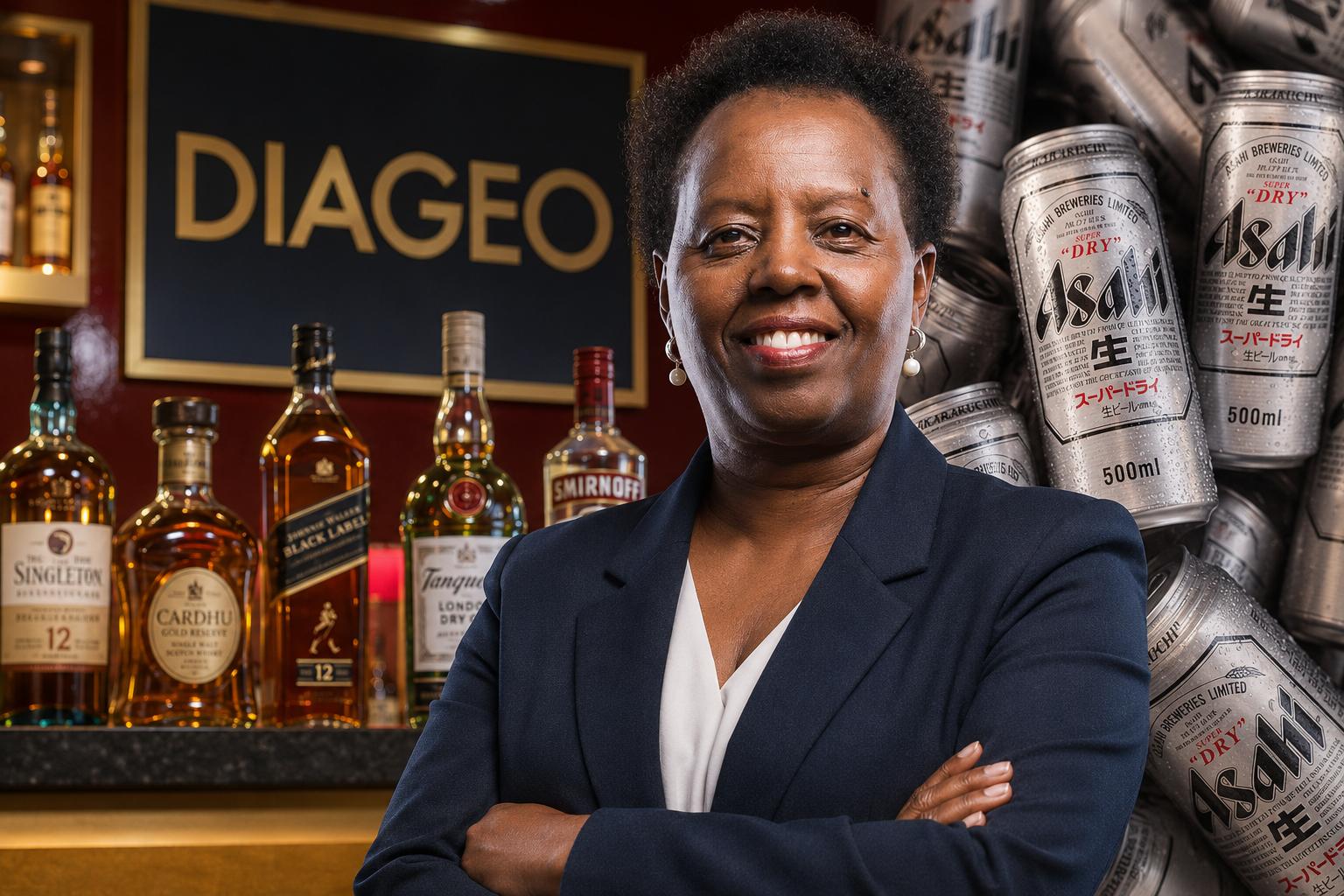
The Diageo-Asahi deal to transfer control of East African Breweries Limited one of Kenya’s oldest listed companies and the maker of Tusker has hit yet another wall. This time, the torpedo came from a direction nobody saw coming: a private citizen named Christine Irungu, armed with a constitutional petition that cuts straight to the heart of how Kenya’s capital markets have been gamed, in plain sight, by one of the world’s largest drinks multinationals.
On Thursday, Machakos High Court Judge Josephine Mongare issued an order preserving the ownership, control, and shareholding status quo of EABL until July 2, 2026, when the application will be formally heard.
No transfer of Diageo’s 65 percent stake to Japan’s Asahi Group Holdings is to move an inch until that court reconvenes.
It is the third separate legal effort to arrest the transaction, following suits filed by beer distributor Bia Tosha and local construction outfit JILK both of which were eventually dismissed. This one, however, is categorically different in character and in law.
Irungu does not claim a commercial interest. She claims a constitutional one. And that distinction may be what finally makes this challenge stick where the others have not.
Diageo told shareholders it was deepening its commitment to EABL. Months later, it was in Tokyo, negotiating the exit.
THE TIMELINE THAT TELLS THE WHOLE STORY
To understand why Irungu’s petition carries legal weight that the others lacked, you have to go back to October 2022. That is when Diageo Kenya Limited the British multinational’s local vehicle served notice of its intention to launch a partial tender offer for additional EABL shares, lifting its stake from 50.03 percent to a maximum of 65 percent.
The formal offer launched in February 2023 at KSh 192 per share and closed oversubscribed in March of that year. Diageo Kenya had to apply a scale-down mechanism because more shareholders wanted to sell to it than it had budgeted for.
What was Diageo telling the market at that point? The official communications spoke of strengthening long-term commitment to EABL and deepening investment in East Africa. Regulators at the Capital Markets Authority approved the tender offer. The Nairobi Securities Exchange listed the additional shares accordingly. Minority shareholders who chose not to tender because they believed the majority shareholder was in for the long haul kept their stock on the basis of that representation.
Then, in December 2025 less than three years later Diageo announced it had agreed to sell the entire 65 percent to Asahi Group Holdings of Japan at an implied enterprise value of $4.8 billion for 100 percent of EABL.
Net proceeds to Diageo: approximately $2.3 billion. Multiple of adjusted EBITDA: 17x. Diageo’s publicly stated justification was that EABL had become a ‘non-core asset’ and the sale would help reduce debt and offset pressure from US tariffs and softer global demand.
The timeline raises a question that Irungu’s petition puts in unsparing terms: at the time Diageo was conducting the 2022-23 tender offer, was it already in talks to sell the enlarged stake to a third party? Her petition alleges there is ‘clear and incontrovertible evidence’ that Diageo and EABL were already in discussions to sell the very shares they were in the process of acquiring.
If that allegation is substantiated, it describes a transaction in which minority shareholders were induced to sell at KSh 192 per share under false pretenses, while the controlling shareholder then flipped the same stake enlarged by those very shares at a premium unavailable to anyone else.
THE REGULATORY ABDICATION
Irungu did not stop at Diageo. She named four respondents: Diageo, EABL, the Capital Markets Authority, and the Competition Authority of Kenya. The Law Society of Kenya was added as an interested party. The inclusion of the CMA and CAK as respondents is the signal that this petition is aimed at institutional failure, not merely corporate misconduct.
On the mandatory takeover question, the precedent elsewhere in Africa is unambiguous. When Diageo sold its 80.4 percent stake in Guinness Ghana Breweries in July 2025, the transaction triggered a mandatory buyout offer to minority shareholders.
The October 2024 sale of Guinness Nigeria to Singapore’s Tolaram included a mandatory tender offer at a 63 percent premium over market price.
In Seychelles, the same pattern applied. Only in Kenya did Asahi apply for and receive regulatory exemptions from all three East African securities authorities, meaning the 35 percent of EABL held by ordinary Kenyan investors on the Nairobi Securities Exchange, the Uganda Securities Exchange, and the Dar es Salaam Stock Exchange will get nothing beyond the routine trading price. No premium. No offer. No exit.
That the CMA granted this exemption while simultaneously being the regulator that approved the 2022-23 tender offer the very offer now alleged to have been conducted under false pretenses is an irony thick enough to choke on.
Irungu’s petition accuses the CMA of violating its constitutional mandate to protect investors and ensure fair, orderly, and transparent capital markets. She accuses the CAK of failing to consider the competition implications of handing control of East Africa’s dominant beer and spirits business to a foreign entity whose anti-competitive track record inside EABL is already the subject of ongoing litigation.
In Nigeria, Ghana, and Seychelles, Diageo’s exits triggered premium buyout offers. Only in Kenya are minority shareholders being abandoned without so much as a shilling of premium.
THE CORPORATE CONTEMPT THAT NEVER GOT RESOLVED
Before this newest chapter, the most damaging legal threat to the transaction was not Irungu. It was Bia Tosha Distributors Limited and their decade-long war with EABL’s Kenya Breweries Limited subsidiary tells you everything you need to know about how this company has treated Kenyan stakeholders.
Bia Tosha filed its case in 2016, alleging that KBL wrongfully terminated its distribution agreements and handed its routes to competitors in what amounts to a classic market-foreclosure play. The High Court issued conservatory orders protecting Bia Tosha’s routes in June of that year. EABL and KBL, according to sworn affidavits, simply defied those orders continuing to supply the replacement distributors in Bia Tosha’s territories as though the court had said nothing.
When the matter reached the Supreme Court in February 2023, a five-judge bench reinstated the June 2016 conservatory orders, found EABL in contempt, and sent the matter to the High Court to assess punishment.
The bench was categorical: before receiving any further audience in any court, the respondents had to appear and purge the contempt.
EABL’s response was to file a review application arguing that the executives named in the contempt proceedings had been condemned without a hearing. The Supreme Court dismissed that attempt in May 2023. The punishment still had not been addressed when Diageo announced the Asahi deal in December 2025.
What happened to the three executives found in contempt? Jane Karuku was promoted to EABL Group CEO. Andrew Kilonzo was sent to run Uganda Breweries before rotating back to Kenya as KBL MD. Andrew Cowan became Managing Director of Diageo’s Africa Travel Retail division.
The message to the company’s leadership that defying court orders accelerates rather than ends a career at EABL was unmistakable.
Yet when Bia Tosha moved to freeze the Asahi transaction in January 2026, citing the risk that Diageo’s exit would make enforcement of any eventual judgment impossible, Justice Bahati Mwamuye dismissed the application in April, holding that Asahi as incoming majority shareholder would remain subject to Kenyan law. The contempt issue never fully resolved was effectively sidestepped.
JILK, THE DPP, AND THE CRIMINAL DIMENSION
Bia Tosha was not the only party that tried to stop the deal. JILK Construction Limited argued that completion of the transaction would undermine enforcement of a pending arbitral award connected to construction contracts it had with KBL specifically, three agreements entered between October 2017 and March 2018 for refurbishment works at the Kisumu brewery under a project called ‘Project Nafasi.’ JILK alleged the works were completed and handed over but payment disputes followed, with Diageo allegedly exercising direct financial and supervisory control over the project.
Justice Gregory Mutai dismissed JILK’s application on June 17, 2026 just days before the Irungu order landed. The court found JILK had not demonstrated a sufficient connection between the historical construction dispute and the proposed share transaction, noting that EABL and KBL would continue to exist post-sale regardless of who owned Diageo Kenya’s shares.
But the JILK matter has a dimension the court did not address head-on: the criminal one. Diageo filed its own constitutional petition against JILK, the Director of Criminal Investigations, and the Director of Public Prosecutions, seeking to restrain criminal proceedings it alleges are being used to weaponize the same underlying facts already in arbitration and civil litigation.
The DPP has resisted, arguing that Diageo is seeking to frustrate constitutionally mandated investigative processes before any prosecution decision has even been made. That fight is still very much alive.
A HEINEKEN SUBSIDIARY JOINS THE QUEUE
If the cascade of litigation was not enough, Semafor reported in April 2026 that Kenya Wine Agencies Limited a subsidiary of Dutch brewing giant Heineken had filed a regulatory complaint with the Competition Authority of Kenya alleging that EABL abuses its dominant market position, and that the Asahi acquisition risks entrenching those practices.
KWAL told CAK that the deal should be conditioned on competition remedies to protect smaller players. Keroche Breweries and African Originals had raised similar concerns in earlier years. The Competition Authority’s approval of the transaction, despite this mounting evidence of structural market dominance, is precisely the regulatory failure Irungu’s petition calls out.
THE CONSTITUTIONAL ARGUMENT NOBODY HAS MADE — UNTIL NOW
What distinguishes the Irungu petition from its predecessors is not merely its standing argument that any Kenyan investor or member of the public has a constitutional interest in how listed companies and their regulators conduct themselves but the specific constitutional provisions it invokes.
The petition targets Articles 10, 35, and 46 of the Constitution: the rule of law and public participation; the right of access to information; and consumer and investor protection rights.
The core legal proposition is this: a controlling shareholder in a public listed company cannot use superior information, dominant position, and control of corporate processes to obtain a private premium that is structurally unavailable to the minority shareholders whose decisions were shaped by that same controlling shareholder’s public representations.
That is not a commercial proposition. It is a constitutional one. It asks whether Kenya’s capital markets are instruments of equitable economic participation as the Constitution contemplates or whether they are vehicles through which dominant players can extract value while regulators avert their gaze.
The second proposition is about regulatory accountability. The CMA, which approved the 2022-23 tender offer on the basis of Diageo’s stated long-term commitment to EABL, has now approved Asahi’s exemption from a mandatory takeover offer meaning the same regulator blessed both the acquisition that allegedly carried a misrepresentation and the exit that confirmed it.
Irungu wants a full regulatory review of the transaction and compelled disclosure of all agreements, term sheets, board approvals, valuation reports, and correspondence relating to the sale — including any documentation that could reveal when Diageo first began exploring the disposal.
The CMA approved the 2022 tender offer on Diageo’s stated long-term commitment, then approved Asahi’s exit from offering minorities a premium. The same regulator blessed both the entry and the abandonment.
WHAT HAPPENS NEXT
As of Thursday, the shares are frozen. Diageo had been expecting completion of the transaction in the second half of 2026, which would have handed the Kenya Revenue Authority an estimated KSh 42 billion in capital gains tax one of the largest single-transaction tax windfalls in Kenyan fiscal history. Whether that timeline holds now depends on what happens on July 2 before Justice Mongare.
The irony of the position Diageo and Asahi now find themselves in is not lost on those who have watched this saga unfold.
Every court that has been asked to stop the deal on commercial grounds has ultimately allowed it to proceed, citing public interest in letting the transaction close and anchoring a large capital gains tax receipt for the Treasury.
But the constitutional dimension of the Irungu petition is qualitatively different.
A commercial court can weigh a distributor’s contract dispute against a KSh 297 billion transaction and conclude the balance of convenience favours completion.
A constitutional court must weigh whether the very process by which that transaction was constructed the tender offer, the regulatory approvals, the information asymmetry violated the rights of investors and the public.
That is a harder question. And for the first time since this deal was announced in December 2025, it is the question actually before a Kenyan court.
Diageo declined to comment on the Irungu petition at the time of publication. EABL did not respond to a request for comment. The Capital Markets Authority and Competition Authority of Kenya also did not respond. Asahi Group Holdings directed media inquiries to its December 2025 stock exchange announcement.





Comments