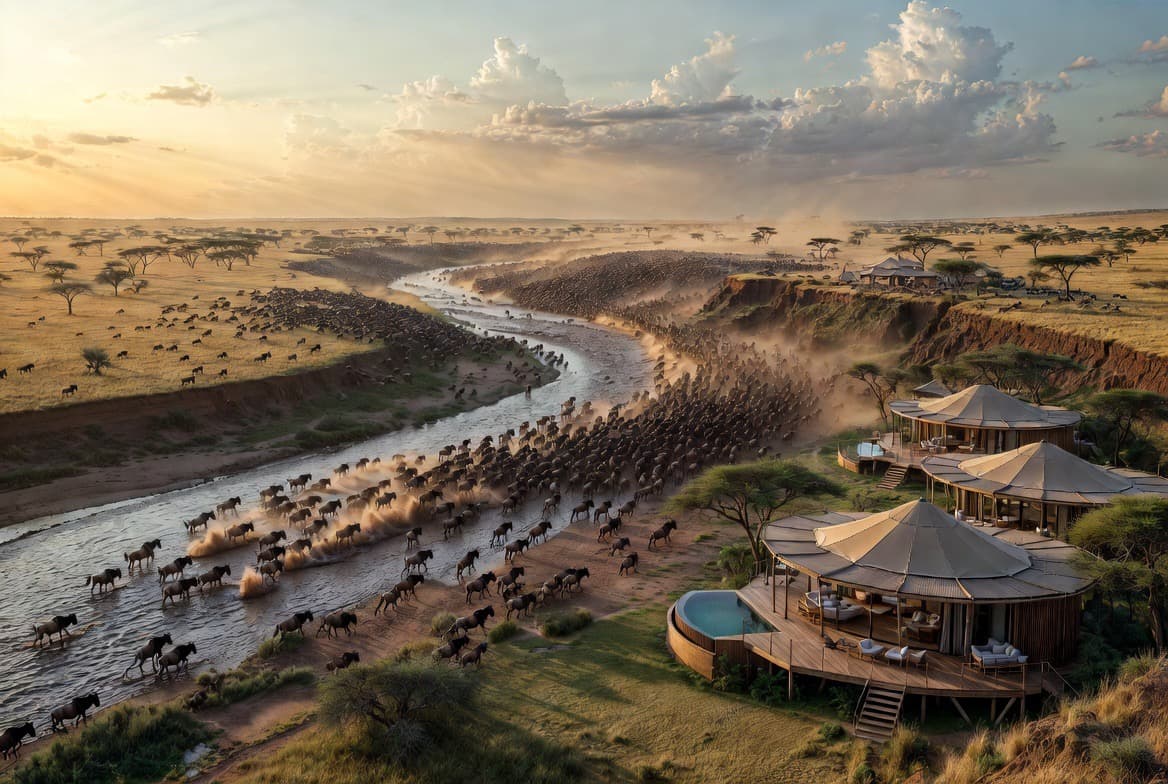
Nairobi’s Environment and Land Court has, this week, become the last line of defence for a corridor that a wildebeest cannot petition for itself. A coalition of regional lawyers and conservation defenders, the East Africa Law Society, Natural Justice, JustAct and the Africa Centre for Peace and Human Rights, has filed a fresh constitutional petition seeking to halt the construction and expansion of luxury tourist accommodation inside the Maasai Mara National Reserve, naming three of its most expensive addresses as the accused.
The Ritz-Carlton Maasai Mara Safari Camp, Sala’s Camp and Elewana Sand River Masai Mara stand charged, in substance, with sitting where the law says nothing should be built at all.
The petition, filed through advocate Gichohi Waweru, does not merely ask the court to look again at one troublesome camp. It asks for something far more sweeping: a full audit and physical inspection of every accommodation facility currently operating inside the reserve’s Low Use Zone and the Mara River Ecological Zone, a conservatory order freezing new approvals while the case is heard, and, should the audit find what the petitioners already believe it will, restoration orders to undo the damage.
The respondents are a roll call of global hospitality power and domestic political authority in one document: Ritz-Carlton Hotel Company LLC, Marriott International Inc, Lazizi Mara Limited, The Safari Collection Ltd, Minor Hotels Ltd, Narok County Government, the National Environment Management Authority, the Attorney General and the Kenya Wildlife Service.
The case has been fast-tracked precisely because the wildebeest do not wait for court calendars. The Sand River crossing season runs from June through October, and the petitioners argue that every week of construction activity during this window compounds ecological harm that cannot later be reversed by a judgment.
They are also asking the Chief Justice to empanel a bench of at least five judges, arguing that the matter raises constitutional questions never before settled in Kenyan law, chief among them the limits of presidential power to exempt a private development from an environmental protection regime enacted to protect a UNESCO-adjacent natural wonder.
THE CAMP THAT MIGRATION FORGOT
At the centre of the storm sits a 20-suite tented camp on a bend of the Sand River, on the Kenya-Tanzania border, where nightly rates have been reported anywhere from 3,500 to more than 5,000 US dollars, a single night costing more than the average annual income of the Kenyan citizens whose reserve it sits inside.
The Ritz-Carlton Maasai Mara Safari Camp, developed and operated by Lazizi Mara Limited under franchise from Marriott International and fronted by Kenyan businessman Shivan Patel, opened its doors on 15 August 2025, becoming the Ritz-Carlton brand’s first tented camp anywhere on earth.
It opened, petitioners say, inside a zone where it should never have been allowed to break ground.
The Maasai Mara National Reserve Management Plan 2023-2032, adopted by Narok County and national authorities, imposed a strict moratorium on new accommodation beds precisely because visitor densities had already exceeded the reserve’s ecological carrying capacity. The plan designated the site’s location a Low Use Zone in proximity to the Mara River Ecological Zone, a classification under which new lodges are not permitted at all.
The camp’s Environmental Impact Assessment licence, according to the petition, was issued in May 2024 after a review the petitioners say took only 26 days, without GPS corridor data, without any cumulative assessment of the five other camps already strung along the same river, and without the public participation the law demands.
Allowing luxury developments to be sited within primary migration corridors… would be catastrophic for every conservation area across Kenya.
— From the petitioners’ court filing
The scientific spine of the case comes from outside Kenya’s borders entirely. The petition leans on 26 years of GPS collar data compiled by the University of Glasgow’s Serengeti Biodiversity Programme, led by conservation ecologist Grant Hopcraft, who has tracked the movement of the Serengeti-Mara herds since 1996.
That dataset, petitioners argue, places the camp squarely inside a core crossing corridor used by roughly 1.36 million wildebeest as they pour across the Sand River each year, and shows a measurable diminishment of that crossing point since construction began in 2022, with herds reportedly lingering longer on the Tanzanian side of the border rather than entering Kenya at the accustomed point.
One Maasai resident living near the reserve told American journalists last November that an elephant had been seen struggling to find a path across the river since the camp went up, unable to use the crossing it once used freely.
THE LETTER THAT BROKE THE WALL
Here is the part of the story the glossy brochures do not mention. The moratorium that was supposed to protect the Mara through 2032 has a hole in it, and that hole has a name: Felix K. Koskei, chief of staff to President William Ruto.
According to reporting relied upon in the court filings, it was Koskei who, in April 2024, wrote to the National Environment Management Authority requesting a one-time exemption from the construction freeze specifically to allow the Ritz-Carlton development to proceed, framed at the time as part of the government’s push to attract high-end investment.
NEMA’s licence followed within weeks.
It is this single exemption that the new petition asks the court to strike down as unconstitutional. The argument is elegant in its simplicity: a moratorium exists to give effect to Kenya’s entire environmental protection regime governing the reserve, so an executive exemption from the moratorium is, in substance, an exemption from that entire regime, and Section 27 of the governing environmental law renders any such purported waiver void from the outset.
If the court agrees, the ruling would not only threaten the Ritz-Carlton’s legal footing, it would call into question the very mechanism by which politically connected developers have historically found their way around conservation law in Kenya’s protected areas.
Kenya Wildlife Service has, for its part, defended the location repeatedly and on the record, insisting that long-term monitoring shows no interference with migration routes and that an environmental audit places the camp more than 15 kilometres from the nearest recognised corridor.
The agency has noted that camps along the Mara, Sand and Talek rivers have coexisted with wildlife movement for decades without obstruction. Whether that institutional confidence survives scrutiny by a five-judge constitutional bench, rather than a press statement, is precisely what the coming months in court will test.
THREE CAMPS, ONE PATTERN
The new petition’s most significant escalation is its refusal to treat the Ritz-Carlton as an isolated case. Sala’s Camp, operated by The Safari Collection Ltd, and Elewana Sand River Masai Mara, operated by Minor Hotels Ltd, are named as co-respondents accused of the identical offence: operating inside protected ecological zones in defiance of the reserve’s own statutory management plan.
Between 2012 and 2024, independent tourism researchers documented the number of camps and lodges in and around the 1,510-square-kilometre reserve nearly doubling, from 95 to 175, a densification that conservation scientists studying the wider Serengeti-Mara system have described as the unmistakable onset of mass tourism engulfing a fragile ecosystem never designed to absorb it.
What we’re seeing here is the onset of mass tourism.
— Grant Hopcraft, conservation ecologist, University of Glasgow
Petitioners argue the consequences already extend beyond Kenya’s borders. The Serengeti-Mara ecosystem is transboundary by definition, and fragmentation on the Kenyan side of the Sand River reverberates directly into Tanzania’s Serengeti National Park, forcing already pressured herds into higher energy expenditure, altered grazing patterns and, over time, the kind of slow structural shift in migratory behaviour that cannot be undone by a single conservatory order.
Wastewater, light pollution and noise from a growing string of luxury enclaves along rivers the animals must physically cross only compound the pressure, according to the filing.
THE GRAVEYARD OF EARLIER WARNINGS
This is not the first time a Kenyan court has been asked to intervene, and understanding why the earlier attempt failed is essential to understanding why this one has been built so differently. In August 2025, Maasai conservationist Dr Meitamei Olol Dapash, director of the Institute for Maasai Education, Research and Conservation, filed his own petition against the same camp, the same developer and the same government agencies, seeking to stop the opening entirely.
His case was dismissed by the Environment and Land Court at Narok in February 2026, not on the merits of whether the camp harms the migration, but on the narrower and more procedural ground that he had not first exhausted the dispute resolution mechanism available under Section 117 of the Wildlife Conservation and Management Act.
The court itself acknowledged its hands were tied by jurisdiction, never reaching the ecological question at all.
The saga took a stranger turn in December 2025, when Dapash unexpectedly filed to withdraw his own suit, an application the court blocked from proceeding.
Conservationists close to the case, including Osotua Green Alliance founder Yiamat, described the entire episode as a form of intimidation designed to discourage ordinary citizens and community leaders from raising legitimate environmental concerns, noting that losing litigants in Kenya are routinely ordered to pay costs, a financial risk heavy enough to silence poorer petitioners before their case is ever heard on its facts.
It is against that backdrop that the new coalition’s strategy becomes legible.
By assembling four well-resourced regional institutions rather than a single individual activist, by widening the net to three lodges instead of one, by demanding a systemic audit rather than the closure of a single facility, and by seeking certification for a five-judge constitutional bench from the outset, the petitioners appear determined not to be struck out on the same procedural technicality that ended Dapash’s case before a single judge ever examined the GPS data on its merits.
WHOSE RESERVE IS IT, REALLY
To understand why a presidential exemption and a 26-day environmental study were able to open a gap in a supposedly ironclad moratorium, it helps to look at who actually controls land and revenue inside the Mara ecosystem, and the record there is not reassuring.
Narok Governor Patrick ole Ntutu’s own brother, businessman Livingstone Kunini Ntutu, has spent more than two decades locked in litigation with the county government he is related to over ownership of a 4,720-acre parcel, Cis-Mara/Talek/155, which hosts thirteen tourism camps including the well-known Ol Kiombo Lodge and lies inside the same reserve now at the centre of this petition.
The Environment and Land Court ruled in Kunini Ntutu’s favour in March 2025, granting him the right to collect tourism levies directly, only for the Court of Appeal to intervene in May 2026, strip him of interim control, order the land reverted to the county pending a fresh hearing, and direct him to account for and refund revenue collected in the interim, after appellate judges found the trial court had sidestepped critical constitutional questions about whether the parcel was ever lawfully excised from public trust land in the first place.
That case sits alongside a separate 2026 ruling in which the Environment and Land Court dismissed a petition by a concerned citizen, Jimmy Parnyumbe, challenging the 2019 allocation of a further 1,000 acres inside the Mara Triangle to Pinecrest Holdings Limited under former Governor Samuel Tunai, again on jurisdictional grounds rather than on the substance of whether public conservation land had been improperly handed to private hands.
Taken together, the pattern across more than two decades of Mara litigation is unmistakable: petitions challenging how land and licences move inside the reserve tend to die on procedural technicalities long before any court examines whether the underlying allocation served conservation or served connections.
FOLLOW THE MONEY, IF YOU CAN FIND IT
The county government asking the court to trust its stewardship of the reserve cannot, by its own admission, fully account for the reserve’s own gate receipts.
Appearing before the Senate County Public Accounts Committee in February 2026, Narok County Finance Executive David Muntet admitted the county does not control the backend of the private system that processes more than five billion shillings a year in park entry fees, a system run since 2014 by Kenya Airports Parking Services Limited under a contract Governor Ntutu himself conceded contains punitive clauses making early termination difficult.
Auditor-General Nancy Gathungu’s report flagged the continued use of cash payments despite automation, including 26 million shillings and 608,550 US dollars collected in cash during the period under review, a mode of payment the audit warned provides no reliable trail and leaves the county unable to independently verify what was actually collected against what was declared.
The same audit uncovered visitors identified in the system as non-resident foreigners who then produced East African identity documents at the gate, undercutting confidence in the fee categorisation that generates the bulk of Narok’s revenue.
Senators on the committee called the arrangement skewed and demanded a forensic audit.
In the financial year to June 2025, park fees alone delivered 5.6 billion shillings, 91 percent of the county’s entire internally generated revenue, all of it flowing through a system the county cannot independently verify.
This is the same county government whose officials sit as respondents in the fresh petition, and whose approvals for Sala’s Camp, Elewana Sand River and the Ritz-Carlton are now under direct constitutional challenge.
A reserve that cannot audit its own turnstiles is being asked, in effect, to certify that the lodges built along its rivers pose no threat to the animals those turnstiles were built to protect.
THE MARKET HAS ALREADY VOTED
While lawyers argue jurisdiction and moratoria, the tourists have been quietly leaving. Kenya National Bureau of Statistics data in the Economic Survey 2026 shows Maasai Mara visitor numbers collapsing from roughly 420,000 in 2023 to 343,000 in 2024 and down to 213,000 in 2025, a decline of close to half in just two years. For the first time in years, neighbouring Amboseli National Park, with 295,000 visitors in 2025, outperformed the Mara entirely.
Industry figures point to Narok’s own 2024 decision to as much as triple park entry fees, alongside overcrowding, environmental strain and stronger marketing from Tanzania’s Serengeti, as the drivers of the exodus.
Tourism operators interviewed in the trade press have been blunt that the fee increase was survivable for county revenue but corrosive to visitor volume, effectively trading footfall for margin while the reserve’s global reputation absorbs the damage of a court battle over whether its most exclusive new address belongs there at all.
Industry analysts tracking the broader ecosystem note that land subdivision and expanding conservancy development are disrupting migration corridors even as human-wildlife conflict rises, meaning the Mara’s shrinking visitor numbers and its shrinking wild space may be two symptoms of the very same disease.
WHAT COMES NEXT
Respondents, including Marriott International, the Ritz-Carlton Hotel Company, Lazizi Mara, The Safari Collection and Minor Hotels, have yet to file their defences in the fresh suit.
An initial hearing is reportedly scheduled for 20 July, squarely inside the current wildebeest crossing season the petitioners say the case exists to protect.
Should the Chief Justice grant the request for a five-judge constitutional bench, the matter would rank among the most consequential environmental rulings in Kenyan legal history, forcing a definitive answer to a question the courts have so far managed to avoid: can a president exempt a private hotel from the conservation law built to protect a reserve that belongs, on paper, to the Kenyan public.
|
Court |
Environment and Land Court, Nairobi |
|
Petitioners |
East Africa Law Society, Natural Justice, JustAct, Africa Centre for Peace and Human Rights |
|
Respondents |
Ritz-Carlton Hotel Company LLC, Marriott International Inc, Lazizi Mara Ltd, The Safari Collection Ltd, Minor Hotels Ltd, Narok County Government, NEMA, the Attorney General, Kenya Wildlife Service |
|
Relief sought |
Conservatory orders halting new construction, a full audit of facilities in the Low Use Zone and Mara River Ecological Zone, a declaration that the 2024 presidential exemption is unconstitutional, and restoration orders where violations are found |
|
Next hearing |
20 July, during the current wildebeest crossing season |
THE DEEPER WOUND
Strip away the legal citations and this case is, at bottom, a referendum on what the Maasai Mara is for.
It is about whether a statutory management plan drafted with scientific input on carrying capacity can be quietly unwound by a letter from the president’s chief of staff.
It is about whether Maasai communities whose ancestral land underwrites this entire industry see genuine benefit, or watch instead as more lodges rise on ground they can no longer graze freely, while the county charged with protecting their inheritance cannot say with certainty how much money its own gates collect.
And it is about whether Kenya’s most internationally recognised wildlife destination remains a functioning ecosystem, or finishes its transformation into a curated backdrop for the ultra-wealthy, guarded by a moratorium with a president-shaped hole in it.
The wildebeest keep their own calendar regardless of what the Environment and Land Court decides. The question this petition puts squarely to Kenya’s judiciary is whether the law can still keep pace, or whether, four camps and two decades of unresolved land disputes into this story, the answer has already been quietly decided somewhere else.



Comments